
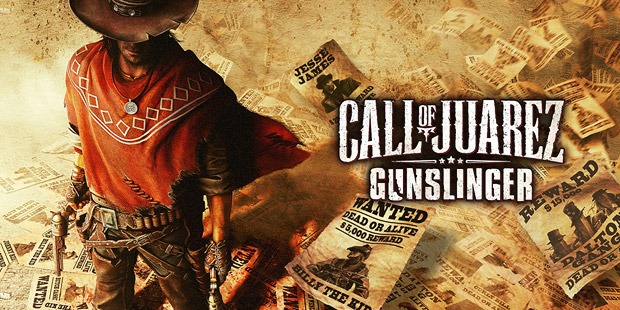
📅 Game released: 2013
Call of Juarez: Gunslinger is a fast-paced, single-player Western FPS in which bounty hunter Silas Greaves retells encounters with famous outlaws, sometimes changing the levels as his story unfolds. This PC guide compares official Steam and DRM-free GOG purchase and download options, Story, Arcade and Duel modes, system requirements, Steam Deck support, and practical installation and compatibility advice.
 By Editor Zero — independently researched, edited, and maintained.
Last updated: 14 November 2026
Last reviewed: 14 November 2026
Table of Contents
- Quick Facts
- Official PC Stores, Download & Installation
- Call of Juarez: Gunslinger Review
- Pros & Cons
- PC System Requirements
- Frequently Asked Questions
- Similar Games
Call of Juarez: Gunslinger Quick Facts
- Game: Call of Juarez: Gunslinger
- Developer: Techland
- Publisher: Techland Publishing (originally Ubisoft)
- Genre: First Person Shooter (FPS), Western
- Release: May 21, 2013 (PS3, North America); Windows PC: May 22, 2013
- Platforms: Windows PC, PS3, Xbox 360, Nintendo Switch
- Steam Deck: Verified; external controllers may require changing controller order
- Engine: Chrome Engine 5
- Modes: Story, Arcade and Duel; single-player only
- Community: Official game website, Steam Discussions
- PC modding: Unofficial Nexus Mods for FOV, visuals and quality-of-life changes; no official Steam Workshop
- Metacritic score: 79/100 (PC)
- IGN score: 7.5/10 (PS3 review)
- PC Gamer score: 84/100 (PC)
- Steam user reception: Very Positive overall
Official PC Stores, Download & Installation
👇 Compare the official Steam and GOG options below before purchasing, downloading, or installing Call of Juarez: Gunslinger on PC.
- Official Windows stores: The game is available on Steam and GOG. Both sell a native Windows edition; no emulator or unofficial download is needed.
- Publisher and rights: Techland regained the franchise’s publishing rights from Ubisoft in 2018. Current PC store listings identify Techland Publishing; a separate Ubisoft Connect purchase or account is not listed as a requirement.
- Game edition and DLC: The standard purchase includes the complete single-player game. There is no separate paid story expansion, season pass, or mandatory DLC to add.
- Series bundles: Steam offers the Call of Juarez Bundle, containing the original game, Bound in Blood and Gunslinger. Check your library before buying titles you already own; bundle pricing is storefront-specific.
- Steam features: The Steam version lists 26 achievements, Steam Cloud, leaderboards, trading cards, Family Sharing, and full controller support, and requires acceptance of a third-party EULA.
- GOG offline installer: GOG sells a DRM-free Windows edition. GOG Galaxy is optional: owners can download standalone offline backup installers from their GOG library and play without online activation.
- GOG optional services: GOG Galaxy can provide achievements and cloud saves. Steam and GOG ownership, achievements and cloud-save services remain separate; purchasing on one store does not grant the other edition.
- Single-player access: Story, Arcade and Duel modes have no co-op, PvP, matchmaking or multiplayer-server requirement. Steam’s offline play is subject to Steam’s client and Offline Mode behavior.
- Steam Deck: Valve rates the Steam edition Verified. Its default controller layout, legible text and graphics configuration pass Valve’s checks; external Bluetooth/USB controllers may need a manual change of controller order.
- Unofficial modifications: No official Steam Workshop or Techland mod toolkit is listed. Community FOV, ultrawide, border and visual adjustments are optional and can differ by installation; back up affected files first.
 Buy Call of Juarez: Gunslinger on Steam
 Buy Call of Juarez: Gunslinger on GOG
 Visit the Official Call of Juarez: Gunslinger Website

Call of Juarez: Gunslinger Review
A fast Western shooter where the man telling the story can change it mid-gunfight.
Most linear shooters decide what happened in advance. Call of Juarez: Gunslinger lets the storyteller change his mind. Silas Greaves, an aging bounty hunter, recounts supposed encounters with Billy the Kid, Jesse James, Butch Cassidy, John Wesley Hardin and other frontier legends to a skeptical saloon audience. The player fights through his memories as he tells them. A listener interrupts, Silas corrects a detail, and the level itself may change to accommodate his latest version.
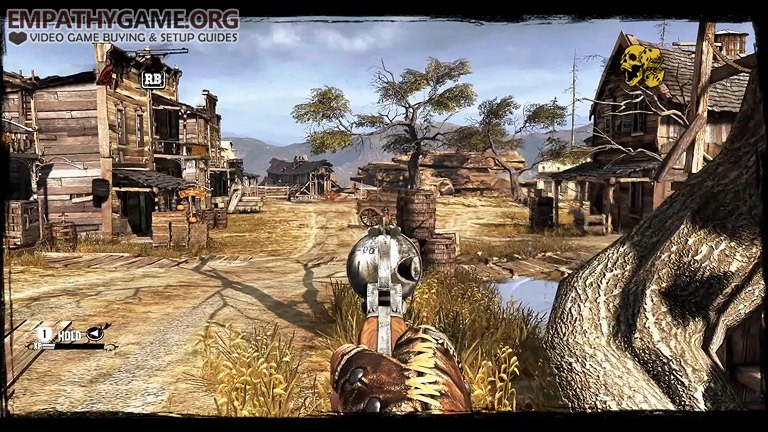
The trick would wear thin without good shooting. Compact firefights, forceful revolvers, accurate rifles, shotguns and a relentless scoring system give the action its own identity. Gunslinger asks less for elaborate tactics than for better execution: faster target changes, cleaner shots and the confidence to keep a combo alive when retreat would be safer.
There are limits to that focus. Enemies lack variety, the campaign follows a narrow route, duels take practice and there is little here for someone expecting an explorable frontier. Yet its roughly five- or six-hour story benefits from knowing when to finish. Score-focused players will find more to do after the credits.
The Gunplay Works Because It Never Forgets the Score
The weapons belong to familiar Western categories, but they change how a fight is approached. Revolvers suit quick exchanges at short and medium range, particularly when dual-wielded. Rifles reward picking off gunmen across open spaces. Shotguns make cabins, mines and narrow passages dangerous places to meet someone at close range, while dynamite can clear clustered enemies or troublesome cover. Weapon preference genuinely matters.
The scoring system is what gives those differences sharper consequences. Consecutive kills build a multiplier, while headshots, environmental kills and other stylish actions increase score and experience. Waiting for an enemy behind cover may protect Silas, but it can also end a valuable chain. Gunslinger creates an unusually direct conflict between staying safe and playing well.
That pressure changes the character of Story Mode. Reloading a revolver under fire, snapping toward the next target and finding a shot before the multiplier expires become part of the enjoyment. The frequent reloads might be irritating in a slower shooter; here they give the weapon a rhythm. A rifle rewards more measured accuracy, while a shotgun encourages moving close enough to keep the chain going without getting surrounded. The score rules create different tensions with each weapon.
Enemy behavior is comparatively basic. Gunmen take positions on rooftops, balconies, cliffs, train cars and behind cover, relying more on numbers and crossfire than particularly clever tactics. The repetition shows, but enemies are not just obstacles. Each is a possible extension of the combo, another source of XP and sometimes the difference between reaching a new upgrade now or later. It is a smart way to make otherwise ordinary encounters worth paying attention to.
Concentration Turns Momentum Into a Weapon

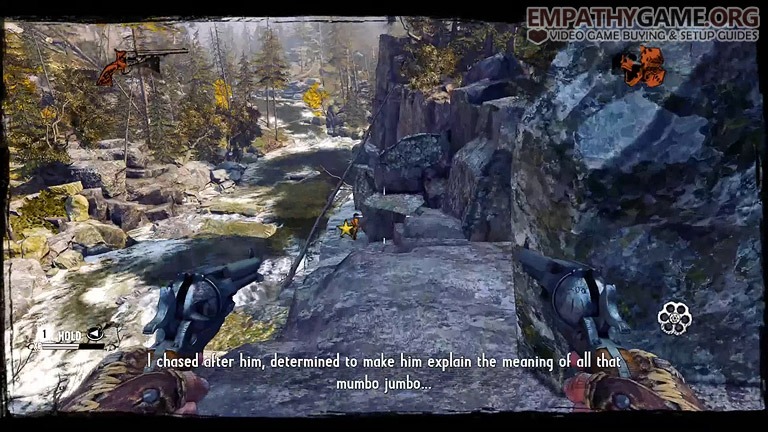
Concentration Mode slows time, making several threats easier to separate and target. Available regularly, it fits the scoring rhythm rather than becoming an emergency ability reserved for bosses. When gunmen emerge from different elevations, a well-timed activation can turn a messy ambush into a controlled sequence of shots, preserving a combo that would otherwise be lost.
Sense of Death approaches survival from the other direction. When the ability is available, a potentially fatal shot can trigger a brief slow-motion opportunity to dodge. The player still has to react correctly. Silas gains extraordinary reflexes, but no unconditional escape from careless positioning. The mechanic feels especially appropriate for a man whose own account of events is hardly restrained by probability.
Difficulty exposes the trade-off between those abilities and the score chase. On easier settings, Concentration can rescue a fight before it becomes chaotic. When enemies hit harder and Silas has less room for mistakes, pursuing the next kill can be a bad decision even if it would preserve the multiplier. Familiar, compact arenas begin to demand more judgment. Gunslinger wants aggression, but harder play makes the difference between controlled aggression and impatience much clearer.
Silas Greaves Can Rewrite a Level Mid-Sentence
The shooting makes Gunslinger enjoyable; Silas makes it memorable. He is not delivering an objective history lesson. He is entertaining people in a saloon, and they are not always willing to take him at his word. Their interruptions and his increasingly convenient corrections do more than decorate the action with dialogue. They can change the scene the player is standing in.
A route can open or disappear when Silas remembers events differently. An objection from the audience may introduce another wave of enemies. A sequence can rewind when he admits he got something wrong, and details can materialize around the player as the tale continues. These are not merely visual jokes. They reveal who controls the world: not the level designer within the fiction, but the old bounty hunter inventing or rearranging his own legend.
A smaller gag makes the idea particularly clear. When Silas steps away from telling his story, the action can effectively pause along with the narration, leaving the saloon audience waiting. Gunslinger treats the spoken tale as the force keeping its world in motion. It is a playful reversal of the usual shooter, where voice-over runs while levels continue unchanged.
That also changes how the linear campaign should be judged. There is little freedom to explore because this is not an independent frontier waiting to be discovered. It is Silas’s account of where he went, whom he met and how he survived. The routes and encounters exist according to his memory, or perhaps his ego. The exaggerations become more interesting than their truth.
Western History Becomes Material for a Dime-Novel Myth
Billy the Kid, Pat Garrett, Jesse James, Butch Cassidy and the Sundance Kid all help anchor Silas’s story in familiar Western history. They do not make this a documentary. The more interesting subject is how reputations grow when events are retold, details are selected for dramatic effect and the person holding the audience’s attention places himself near every famous moment.
The hidden Nuggets of Truth offer an effective contrast. They provide historical context about people and events raised in the campaign, giving the player something more grounded to set against Silas’s increasingly theatrical account. Here, collecting them reinforces a central idea: recorded history and a good story are not always the same thing.
The illustrated transitions, bold outlines and exaggerated character introductions complete that approach. Gunslinger looks more like a lively dime novel than an attempt to recreate the nineteenth-century West. Compared with the patient observation and physical realism of Red Dead Redemption 2, it is deliberately artificial. Neither approach makes the other less valid. One invites players to inhabit a frontier; this one wants to show how a frontier becomes a legend.
Duels Sell the Fantasy Better Than They Explain Themselves

Duels interrupt the normal shooting rhythm with a very different test. Facing another gunfighter, the player must keep the opponent in focus while moving Silas’s hand into a favorable position near his revolver. Once the other gunfighter makes a move, preparation gives way to a quick draw. It captures a Western standoff without becoming another boss firefight.
The problem is learning what the game actually expects. Maintaining focus, adjusting hand position and reacting to the draw are interdependent skills, but normal combat teaches almost none of them. The silence, waiting and temptation to fire before the opponent make excellent theater. The controls can be less convincing, particularly in the first few duels, when an encounter may end before the player fully understands which part of the preparation went wrong.
Practice makes an honorable win feel earned. Draw timing and responsiveness matter more than the usual ability to line up shots, and a small overcorrection can be costly. Duel Mode sensibly allows that specific skill to be refined without replaying whole chapters. Its distinctiveness is appealing, even if the learning curve is rough.
Some conventional bosses fare worse. Encounters that emphasize repeated explosive pressure can interrupt the freedom and momentum that make ordinary shootouts appealing. Gunslinger is at its strongest when it trusts its firearms, positioning and score system rather than trying to make every major opponent feel larger through a separate gimmick.
Three Skill Trees Encourage Different Kinds of Style
Because combat score feeds into experience, performance has an immediate effect on progression. Accurate, stylish shooting is not just something to admire on a results screen; it can bring the next upgrade closer. The Gunslinger, Ranger and Trapper trees broadly emphasize revolvers, rifles and shotguns or explosives, without locking the player into a single permanent class.
That flexibility is valuable in a game this short. Favoring Gunslinger abilities makes rapid target switching and aggressive revolver chains more appealing. Ranger upgrades suit controlled headshots and longer sightlines, while Trapper supports closing distance and using shotguns or dynamite. They are not complicated builds or a transformed campaign. They do, however, give a preferred weapon a clearer purpose and make a second run feel different enough to justify trying another approach.
There is also something coherent about rewarding good shooting with tools that help produce more good shooting. The progression loop encourages the same behavior as the multiplier: be accurate, keep moving and accept some pressure instead of waiting indefinitely behind cover. It teaches the intended style without interrupting the action.
Arcade Mode Shows How Strong the Shooting Is Without the Story
A short campaign could easily leave a game like this feeling disposable, particularly when so much of its personality comes from the narrator. Arcade Mode tests whether the combat can stand on its own by turning familiar fighting spaces into direct score challenges, with most of the storytelling stripped away.
Without Silas to carry the pace, hesitation stands out. Kill quickly, choose worthwhile targets, preserve the multiplier and recover when a shot misses. An Arcade stage can feel more demanding than its campaign counterpart because the purpose is no longer simply to survive and reach the next scene. It is to understand the encounter well enough to perform it cleanly.
That makes Gunslinger closer to a score-attack shooter than a broad Western adventure such as Red Dead Online. The latter relies on a persistent multiplayer frontier for its breadth; Gunslinger builds longevity from mastering deliberately authored encounters. Replaying a known fight is not a concession here. It is the point of the mode.
There is an equally revealing contrast with Hunt: Showdown 1896. Both make old firearms important to how combat feels, but Hunt creates tension through information, positioning and the risk of losing a Hunter. Gunslinger uses speed, combos and theatrical accuracy. They draw very different kinds of enjoyment from an overlapping weapon fantasy.
New Game Plus and True West Reward Mastery
New Game Plus carries progression into another campaign run, allowing unfinished skill branches to develop instead of making the player start from nothing. True West difficulty then challenges familiarity by leaving Silas more vulnerable and removing conveniences. Knowing where enemies appear still helps, but knowledge alone will not protect a gunfighter who exposes himself carelessly.
This structure makes sense for a story that does not demand a huge time commitment. Another run can focus on a different weapon family, higher scores, missed Nuggets of Truth or an attempt to master tougher versions of familiar battles. Replayability comes from execution, not a different world.
Arcade and Duel modes sharpen that idea further. One isolates target priority, accuracy and score management; the other isolates the uncomfortable split second before a draw. Together with New Game Plus and True West, they give Gunslinger more meaningful reasons to return than its short, strictly linear story might initially suggest.
Final Verdict
Call of Juarez: Gunslinger succeeds because its mechanics and storytelling seem to belong to the same exaggerated man. Revolvers need quick hands, rifles reward careful aim, shotguns demand confident positioning, and the scoring system makes even a routine enemy worth engaging with purpose. Concentration and Sense of Death give Silas just enough implausible reflex to fit the legend he is telling.
His unreliable narration is the more unusual achievement. Routes change, memories rewind and the world responds to arguments in a saloon. The campaign’s narrow design becomes part of the idea rather than simply a lack of exploration.
Limited enemy variety, uneven bosses and difficult-to-learn duels remain genuine weaknesses. Anyone seeking an open frontier will find little freedom. For players who prefer tightly designed shooting, playful storytelling and the satisfaction of improving a score, that restraint is an advantage. Gunslinger knows when to end the tale, and it leaves enough mechanical depth to make hearing it again worthwhile.
Call of Juarez: Gunslinger Pros & Cons
- Pro: Silas Greaves’ unreliable narration can alter dialogue, objectives and even the environment while a level is unfolding, giving a short linear shooter an unusually distinctive storytelling identity
- Pro: Revolvers, rifles, shotguns, concentration slow motion, headshots and combo scoring create fast, responsive gunplay that fits the exaggerated Western presentation
- Pro: Story, Arcade and Duel modes use the same shooting mechanics for different goals, giving score-chasing and gunslinger challenges meaningful replay value after the campaign
- Pro: Comic-book visuals and stylized transitions have aged more gracefully than a purely realistic 2013 presentation might have, while modest hardware requirements make the game easy to run
- Pro: Steam Deck Verified support and a DRM-free GOG option make the current PC release unusually convenient for an older single-player shooter
- Con: The main campaign is relatively short and highly linear, with little exploration compared with open-world Western games
- Con: Enemy encounters rely heavily on repeated waves of gunmen, so the satisfying shooting has to carry much of the experience
- Con: Duel mechanics can feel less intuitive than normal gunplay because success depends on balancing focus, hand position and draw timing
- Con: Ultrawide resolutions, FOV changes and some modern presentation preferences can require configuration edits or unofficial quality-of-life tweaks
Call of Juarez: Gunslinger PC System Requirements
Official Windows PC requirements (original game specification; see OS notes below):
MINIMUM:
OS: Windows XP SP3 / Windows Vista SP2 / Windows 7 SP1 / Windows 8 in the original Steam specification; the current Steam client requires Windows 10 or later
CPU: 2 GHz Intel Core 2 Duo / 2 GHz AMD Athlon 64 X2
RAM: 2 GB
GPU: 512 MB DirectX 9.0c-compliant graphics card
DirectX: Version 9.0c
Storage: 5 GB available space
Sound Card: DirectX 9.0c-compliant
Additional Notes: Windows-compatible keyboard and mouse supported; controller optional, with Xbox 360 Controller for Windows originally recommended
RECOMMENDED:
OS: Windows 7 SP1 in the original Steam specification; the current Steam client requires Windows 10 or later
CPU: 3 GHz Intel Core 2 Duo / 3 GHz AMD Athlon 64 X2 or better
RAM: 4 GB
GPU: 1024 MB DirectX 10-compliant graphics card or better
DirectX: Version 10
Storage: 5 GB available space
Sound Card: 5.1 surround sound
Additional Notes: Windows-compatible keyboard and mouse supported; controller optional, with Xbox 360 Controller for Windows originally recommended
Additional PC Performance and Setup Notes
- Original versus current OS: The 2013 requirements list Windows XP SP3, Vista SP2, Windows 7 SP1 and Windows 8. Steam’s current client requires Windows 10 or later; the GOG product page lists Windows 7, 8 and 10. These store listings do not constitute a guarantee for every Windows 11 configuration.
- Installation space: Both official PC listings specify 5 GB available space. Leave some additional free capacity for downloads and temporary installation files.
- Steam Deck controls: Steam Deck is Verified. If a Bluetooth or USB gamepad does not respond, open Steam’s Quick Access Menu and select the external device as the active controller by changing controller order.
- Widescreen and ultrawide: Standard widescreen resolutions are supported. On some 21:9 or multi-monitor setups, HUD elements can be misplaced or missing, including boss health bars; see the Call of Juarez: Gunslinger PCGamingWiki entry for documented presentation limitations.
- FOV and borders: The community-documented
Video.scrconfiguration file can be used to adjust field of view or disable the painted border and letterboxing. These tweaks are unofficial and are not required for normal 16:9 play; back up the file and follow the exact PCGamingWiki video configuration notes before editing it. - Startup troubleshooting: If the game fails to launch or shows unexpected visuals, first remove unofficial overlays, ReShade files or modifications and verify files through Steam, or reinstall the original GOG package. Avoid changing several settings at once.
Official Trailer
Note: Techland’s official Call of Juarez: Gunslinger launch trailer highlights Silas Greaves, famous Wild West outlaws, stylized shootouts, revolvers, rifles, duels and the game’s comic-inspired presentation, while this written guide adds current Steam and GOG access, Steam Deck status, requirements, mods, and PC setup guidance.
Frequently Asked Questions
Do I need to play the earlier Call of Juarez games before Gunslinger?
No. Silas Greaves tells a standalone story that does not require knowledge of Call of Juarez, Bound in Blood, or the McCall brothers.
Is Call of Juarez: Gunslinger an open-world game?
No. It is a chapter-based, linear first-person shooter. Western towns, canyons, mines and railways are settings for directed firefights rather than a freely explorable frontier.
How long does the campaign take to finish?
The main story usually lasts about five to seven hours. Arcade scores, Duel Mode, skill unlocks and collectibles offer additional playtime beyond the first ending.
Why do some levels change while Silas Greaves is narrating?
Silas is an unreliable storyteller. When he corrects himself or responds to someone in the saloon, the action may rewind or a route, enemy encounter or environment may change to match his revised account.
Is the story historically accurate?
Not as a factual retelling. It deliberately mixes frontier legend and real people, including Billy the Kid, Jesse James, Butch Cassidy and the Sundance Kid. Hidden Nuggets of Truth provide historical background separate from Silas’ claims.
Does Gunslinger have multiple endings?
Yes. Minor ending spoiler: a choice near the finale leads to two different conclusions. You can replay the final chapter to see the alternative without beginning the entire campaign again.
What difficulty should I choose, and what is True West?
Normal is a sensible starting point for a first playthrough. True West is a tougher difficulty unlocked through progression that reduces on-screen assistance and makes familiar firefights less forgiving.
How do New Game Plus and skill points work?
Completing the story unlocks New Game Plus, allowing another run with progression carried forward. Experience from combat and Nuggets of Truth goes into skill upgrades across Gunslinger, Ranger and Trapper trees; a replay provides more opportunities to develop them.
Which skill tree should beginners choose?
Gunslinger is a natural first choice for players who use revolvers and dual wielding most often. Ranger favors rifle accuracy and useful collectible assistance, while Trapper specializes in close-range shotgun play. No tree is mandatory for finishing the story.
What is the difference between Concentration and Sense of Death?
Concentration slows combat to help Silas identify and shoot multiple threats. Sense of Death can trigger a brief chance to dodge an otherwise fatal bullet when available; it still requires the player to react.
How do score combos work?
Quick consecutive kills maintain a multiplier, while accurate headshots and stylish environmental kills improve the score and experience earned. Slowing down too much may break the chain, especially in Arcade Mode.
How do quick-draw duels work, and why are they difficult?
Duels ask players to balance focus on the opponent with hand position, then draw and fire at the right moment. Drawing only after an opponent begins is honorable; drawing first may win a fight but is penalized. The timing feels different from ordinary FPS gunplay.
How are Arcade Mode and Duel Mode different?
Arcade Mode reuses combat encounters as score-attack challenges with Gunslinger, Ranger and Trapper styles. Duel Mode concentrates on consecutive one-on-one quick-draw confrontations, without full story levels.
What are Nuggets of Truth, and how many are there?
There are 54 Nuggets of Truth to collect. They reveal background about Old West history and award experience. The Ranger tree’s Truth Seeking upgrade helps with finding them.
Does Gunslinger support multiplayer, local co-op or LAN?
No. Story, Arcade and Duel are all single-player. There is no online PvP, co-op, split-screen or LAN mode to set up.
Can I play offline without a separate launcher?
Yes, particularly with the DRM-free GOG edition, which has an offline installer and does not require GOG Galaxy to run the game. The Steam edition uses the Steam client and its normal Offline Mode rules; neither listing requires Ubisoft Connect.
Can I use a controller or mouse and keyboard on PC?
Yes. Both storefronts list controller support, and mouse and keyboard are supported. Standard gunplay follows familiar FPS controls; duel hand-positioning and focus controls may take more practice on either input method.
Does Gunslinger work on Windows 11?
The original PC specifications predate Windows 11, and the official storefront pages do not give a blanket Windows 11 guarantee. Many systems can run the game, but if it will not start, first try clean game files, current graphics drivers and removing third-party tweaks before investigating specific compatibility workarounds.
What should I know about ultrawide monitors and FOV adjustments?
Standard widescreen works, but some 21:9 and multi-monitor setups may display HUD elements incorrectly. The PCGamingWiki technical guide documents configuration-based FOV, border and letterboxing changes; back up the file before editing it.
Still have questions? Check the Call of Juarez community on Reddit, Call of Juarez: Gunslinger Steam Discussions, and official Techland Support.
Sources & References
Key release, storefront, platform, PC setup and reception information in this guide was checked against:
- Steam — Call of Juarez: Gunslinger — official Windows availability, features, system requirements, review reception and Steam Deck rating.
- GOG — Call of Juarez: Gunslinger — DRM-free ownership, optional Galaxy integration, offline installation and PC specifications.
- Techland — Call of Juarez Returns to Techland — official confirmation of publishing-rights transfer.
- Techland — Nintendo Switch Release — platforms and Story, Arcade and Duel modes.
- MobyGames — Version and Regional Release Records — early PS3 release and separate Windows release chronology.
- PCGamingWiki — Call of Juarez: Gunslinger — ultrawide display behavior and documented FOV, border and resolution configuration.
Similar Games Like Call of Juarez: Gunslinger
- Call of Juarez: Bound in Blood
- Call of Juarez
- Gun (2005)
- Red Dead Redemption
- Red Dead Redemption 2
- Hunt: Showdown 1896



Found something worth playing through DecideGame?
DecideGame.com is an independent gaming project run by Editor Zero. If this guide helped you discover a game, solve a problem, or find useful information, you can support DecideGame.com and help keep new and updated game guides coming.
DecideGame — PC Game Guides, Reviews & Setup Help