
📅 Game released: 2010
Call of Duty: Black Ops is Treyarch’s Cold War first-person shooter, combining Alex Mason’s conspiracy-driven campaign with competitive multiplayer and round-based Zombies survival. This PC guide compares official Steam and Microsoft Store download and installation options, explains its four Zombies DLC packs, and covers multiplayer security, Steam Deck support, system requirements, and Windows setup.
 By Editor Zero — independently researched, edited, and maintained.
Last updated: 9 November 2026
Last reviewed: 9 November 2026
Table of Contents
- Quick Facts
- Official PC Stores, Download & Installation
- Call of Duty Black Ops Review
- Pros & Cons
- PC System Requirements
- Frequently Asked Questions
- Similar Games
Call of Duty Black Ops Quick Facts
- Game: Call of Duty: Black Ops (original 2010 game)
- Developer: Treyarch; separate Nintendo DS adaptation by n-Space
- Publisher: Activision
- Genre: First Person Shooter (FPS), Multiplayer, Co-op Shooter, Zombie Games
- Release: November 9, 2010 (Windows PC and original consoles); macOS: September 27, 2012
- Platforms: Windows PC, macOS, PS3, Xbox 360, Wii, Nintendo DS, PS4, PS5
- Windows DLC: First Strike, Escalation, Annihilation, and Rezurrection, sold separately on Steam
- Steam Deck: Playable; SteamOS compatible, with manual resolution and keyboard/controller-interface caveats
- Engine: Treyarch-modified IW 3.0 engine (original Windows release)
- Campaign: Single-player Cold War narrative following Alex Mason
- Multiplayer: Competitive modes, dedicated-server browser, Combat Training, Wager Matches, Theater Mode, and customizable classes
- Zombies: Solo or up to four players online; no native split-screen in the original Windows PC release
- Steam anti-cheat: Valve Anti-Cheat listed for multiplayer; legacy online security warrants caution
- PC modding: Legacy official Call of Duty Black Ops – Mod Tools (BETA) on Steam; no Steam Workshop integration
- Community: Steam Discussions, Black Ops 1 Reddit, Activision Support
- Metacritic score: 81/100 for Windows PC
- IGN score: 8.5/10 for the original multiplatform release
- Steam user reception: Very Positive overall
Official PC Stores, Download & Installation
👇 Compare the official Steam and Microsoft Store Windows versions before purchasing, downloading, or installing Call of Duty Black Ops on PC; DLC and online compatibility differ by store.
- Steam PC edition: Steam sells the original Windows game, with the campaign and competitive multiplayer represented by associated applications in the same purchase. You do not need to buy a second multiplayer game.
- Microsoft Store PC edition: An official Call of Duty: Black Ops (2010) Windows release is also sold through Microsoft’s PC storefront. It uses Xbox app/Microsoft account services rather than granting a Steam licence. Do not confuse it with the separate Xbox 360 console listing.
- Store separation: The Microsoft Windows listing explicitly states that cross-platform multiplayer is not supported. Do not expect the Microsoft Store and Steam editions to share multiplayer lobbies, cloud saves, achievements, or purchases; pick the storefront your friends use.
- Base-game content: The campaign, original competitive multiplayer modes, Combat Training and the base Zombies experience are part of the game. Additional paid Zombies and multiplayer maps are not necessary to finish the campaign.
- Four Steam DLC packs: First Strike adds Ascension and four multiplayer maps; Escalation adds Call of the Dead and four multiplayer maps; Annihilation adds Shangri-La and four multiplayer maps; Rezurrection adds Moon and four remastered World at War Zombies maps.
- Microsoft DLC caution: Do not assume Steam’s four separate DLC products, or Xbox console DLC purchases, are available or transferable to the Microsoft Windows edition. If buying mainly for Zombies maps, verify the exact PC edition’s add-on catalogue before purchasing.
- Legacy multiplayer: The original Steam Windows version uses a dedicated-server browser. Public server and DLC-map availability vary; buying a multiplayer map does not guarantee a populated compatible server.
- Online security: Established technical references warn about serious security vulnerabilities in older Call of Duty PC online modes. VAC listing is not a guarantee against exploits; consider limiting use of legacy public online play, particularly on untrusted servers, and avoid unknown executables or unofficial game downloads.
- Steam setup and offline use: Purchase and install through the Steam client, complete the required online activation and updates, then use Steam’s supported offline functionality for the single-player campaign where appropriate. Online multiplayer and cooperative online Zombies require network services.
- Steam Deck: Valve rates the original Steam game Playable. It can run on SteamOS, but first-time setup requires internet and some keyboard/controller and native-resolution adjustments may be necessary.
- Official mod tools: Steam retains the legacy Call of Duty Black Ops – Mod Tools (BETA) under the Tools library. Steam Workshop integration is not provided; preserve clean files for normal online use.
 Buy Call of Duty Black Ops on Steam
View Call of Duty Black Ops DLC on Steam
 Buy Call of Duty: Black Ops (2010) for Windows on Microsoft Store

Call of Duty: Black Ops Review
A paranoid Cold War campaign, playful competitive multiplayer and endlessly escalating Zombies make this one of Treyarch’s most complete classic-era Call of Duty packages.
Call of Duty: Black Ops begins with Alex Mason strapped to a chair, surrounded by darkness and interrogated about a sequence of numbers he cannot explain. That image changes the tone of everything that follows. Missions through Cuba, Soviet facilities, Vietnam and covert Cold War operations are not simply presented as another soldier’s career; they are memories being extracted from someone whose understanding of those memories is increasingly questionable.
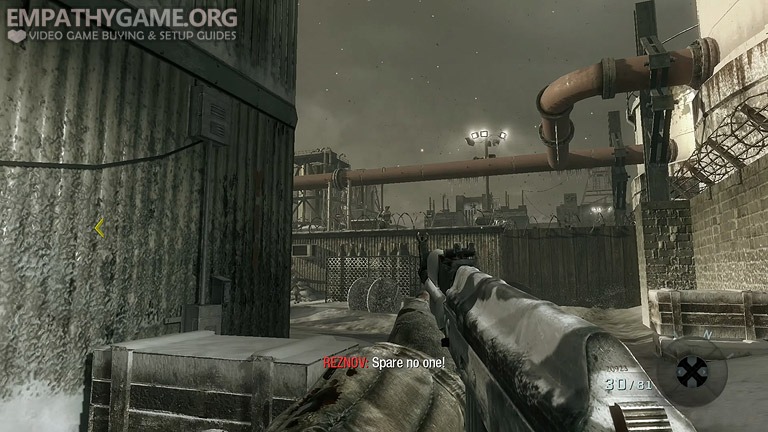
Underneath that psychological framing is unmistakably classic Call of Duty. The campaign is fast, linear and heavily scripted, enemies arrive in large groups, allies constantly push toward the next objective and spectacular set pieces rarely stay quiet for long. Black Ops succeeds because Treyarch gives that familiar structure a stronger personality. The gunplay remains immediate, missions constantly change context, and Mason’s interrogation makes even conventional military action feel like evidence inside a larger mystery.
The package also extends far beyond the campaign. Competitive multiplayer takes the established Create-a-Class formula and adds an earned currency, strange Wager Matches, Combat Training and Theater Mode, while Zombies turns simple survival rules into a completely different cooperative obsession. Few Call of Duty releases from this period make their three major modes feel this individually recognizable.
The Campaign Rarely Lets One Idea Sit Still
Black Ops understands the value of changing circumstances before ordinary shooting becomes routine. The campaign jumps from an assassination attempt in Cuba to imprisonment, covert infiltration, jungle warfare, urban battles, vehicle sequences and underground facilities without trying to make those locations part of one continuous battlefield.
“Victor Charlie” is a good example of how much variety can exist inside a single mission. Fighting through Vietnamese positions gives way to movement through water before the route narrows into claustrophobic tunnels. The basic controls never fundamentally change, yet the emotional rhythm does. An assault rifle fight across an outdoor village asks for quick target acquisition; the tunnels turn the same first-person perspective into something much more uncomfortable because visibility and movement collapse around Mason.
Other missions use explosive crossbows, mounted weapons, vehicles or unusual vantage points to produce similar breaks. Some are little more than short-lived gimmicks, but the rapid turnover works in the campaign’s favor. Black Ops is not trying to simulate one continuous operation. Mason is reconstructing fragments, and the constant jumps suit a story built from unstable recollection.
This also makes the campaign easy to continue playing. Chapters rarely spend enough time on one mechanical idea to become exhausting before another location, weapon or narrative interruption arrives.
The Weapons Feel Better Than Their Simplicity Suggests
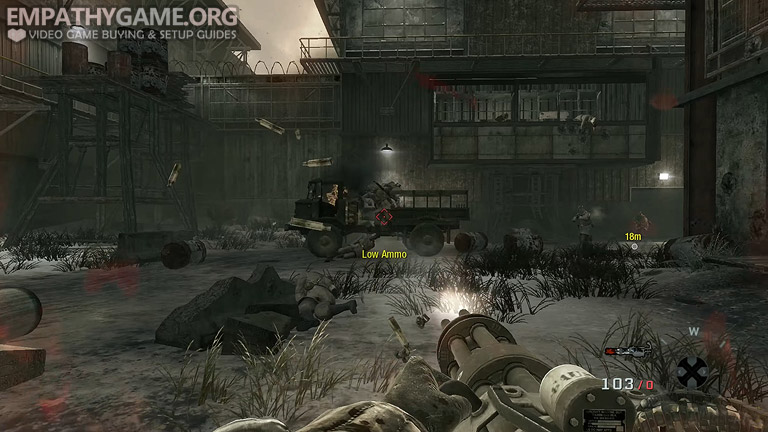
Black Ops comes from an era before shooters surrounded every firearm with elaborate attachment economies and animation-heavy customization screens, so its campaign arsenal can initially look straightforward. What matters more is how quickly the weapons communicate their purpose.
Assault rifles provide the dependable middle ground, submachine guns suit aggressive interior fighting and rifles make distant targets satisfying to remove. Shotguns are particularly enjoyable because they do not always behave like absurdly short-range videogame weapons. Their spread still makes close combat ideal, but useful damage extends far enough that carrying one does not mean waiting until an enemy is practically touching the muzzle.
Hit reactions help enormously. Enemies visibly respond to gunfire, giving automatic weapons a sense of physical interruption rather than making soldiers behave like health bars hiding behind scenery. Fast reload animations preserve momentum as well. Emptying a magazine, ducking behind cover and returning to the fight happens quickly enough that the campaign rarely loses its pace to weapon maintenance.
None of this makes Black Ops mechanically complicated. Its gunplay succeeds through clarity. Pull the trigger, the weapon reports sharply, the target reacts and the player can immediately read whether the exchange worked.
Great Spectacle Comes With Very Visible Rails
The same control that allows Treyarch to orchestrate memorable scenes also creates the campaign’s biggest frustration. Black Ops frequently knows exactly where it expects Mason to stand, which ally he should follow and when he should cross an invisible line that advances the encounter.
When the player naturally follows that rhythm, the illusion is excellent. Squads push through streets, explosions redirect movement and friendly dialogue makes a narrow combat arena appear to be one section of a much larger conflict. Move differently from what the scripting anticipates and the machinery becomes easier to see.
Some encounters effectively continue feeding enemy soldiers into an area until the player advances far enough to trigger the next stage. On Normal difficulty this can disappear underneath the pace. On Veteran it becomes much more obvious because briefly exposing Mason can be fatal, encouraging the exact cautious play that prevents the script from progressing. “Executive Order” is a good example of how an encounter can become less about eliminating a finite enemy force and more about discovering when the game expects the player to push forward.
That makes Veteran uneven. Some sequences genuinely reward sharper aim and better cover use; others amplify grenade pressure, enemy accuracy and scripted respawns until success feels based on learning the trigger rather than fighting more intelligently.
Players familiar with Battlefield 3 will recognize a similar trade-off in its campaign: cinematic military spectacle can be extremely effective when the player cooperates with the intended route, but the battlefield becomes less convincing once the underlying scripting is exposed.
Mason’s Interrogation Makes the Story Feel Dangerous

The campaign’s locations are memorable, but the interrogation room is what gives them meaning. Mason is not calmly narrating past assignments. He is restrained, disoriented and repeatedly forced to explain connections he does not fully understand. The mysterious numbers intrude visually and aurally, while abrupt editing makes memories feel less like clean flashbacks than fragments being dragged into view.
Frank Woods, Joseph Bowman, Jason Hudson and Viktor Reznov become anchors inside that confusion. Some accompany Mason directly; others enter the story through different perspectives or memories. Names such as Dragovich, Kravchenko and Steiner recur across missions until apparently separate operations begin looking like pieces of the same problem.
Black Ops freely mixes real Cold War figures and recognizable historical situations with fictional chemical weapons, covert programs and conspiracy-thriller excess. It works much better when treated as paranoid pulp than as an attempt to reconstruct history faithfully. The point is not whether every mission could have happened exactly as shown. The point is that Mason himself is increasingly uncertain about what happened.
The major revelation works because the campaign spends hours establishing that uncertainty before explaining it. Even knowing Black Ops contains a psychological twist does not require spoiling what Mason eventually understands.
The Main Menu Is Secretly Part of the Story
One of Black Ops’ cleverer details is easy to miss because the player can complete the campaign without ever discovering it. The interrogation chair is not merely animated menu scenery. Mason can break free and move around the room, revealing a computer terminal hidden behind his normal seated viewpoint.
The terminal contains emails and other material that expand the surrounding characters and conspiracy without interrupting the main missions. It is optional enough that many players may never see it, which makes discovering it feel more like finding something forbidden than opening another collectible screen.
There are also playful secrets tied to the computer, reinforcing a useful contrast in Treyarch’s design. The campaign can be grim and psychologically aggressive, yet the game is still willing to hide arcade experiments and jokes inside its own interrogation chamber.
That optional layer gives the presentation unusual cohesion. Even the menu can participate in the fiction rather than acting purely as a list of modes.
Multiplayer Gives the Gunplay Room to Breathe
The campaign constantly directs the player; multiplayer does the opposite. The same responsive weapons are placed into compact maps where positioning, reactions and understanding the opposing team matter more than reaching the next scripted trigger.
Create-a-Class returns with weapons, attachments, perks, equipment and killstreak rewards, but Black Ops changes the progression economy with its original COD Points. These are earned through play rather than functioning like the premium Call of Duty Points associated with later games. Ranking still determines what becomes available, while the currency lets the player choose which eligible weapons, attachments and customization options are worth purchasing first.
That adds a useful layer of ownership. Reaching a new rank does not automatically flood the inventory with everything connected to it. A rifle specialist can spend toward that preference instead of treating each unlock as equally important.
Prestige remains the long-term reset structure, but it is not purely an emblem chase. Progressing through Prestige can also expand the number of custom-class slots available, providing practical room for more specialized setups. A player invested in Search and Destroy, for example, can maintain situational classes without constantly rebuilding the same few slots.
Search and Destroy also highlights Black Ops’ comparatively deliberate multiplayer side. The broader game is still fast Call of Duty, but a single-life objective mode naturally slows that pace and makes footsteps, routes and the decision to expose a position much more consequential.
Wager Matches Let Treyarch Stop Taking Multiplayer Seriously
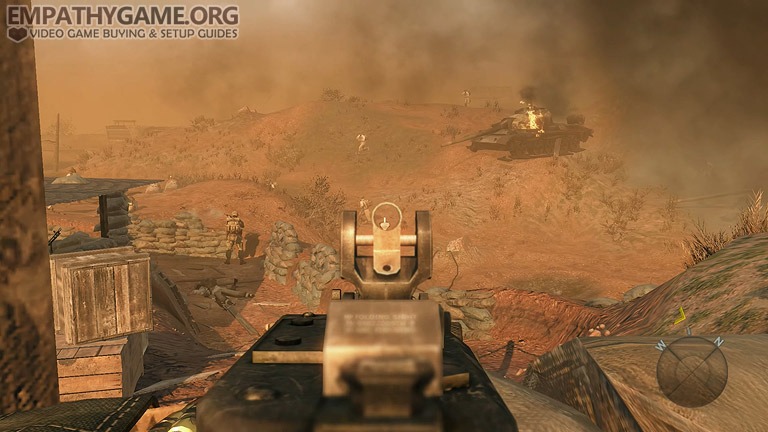
Wager Matches are one of the reasons the original Black Ops multiplayer has such a distinctive personality. Instead of merely modifying Team Deathmatch rules, they take the earned COD Points economy and make players risk part of it inside unusual free-for-all formats.
Gun Game constantly changes the weapon after successful kills, forcing competence across the arsenal rather than rewarding one perfected class. One in the Chamber gives players a pistol, one bullet and a high-stakes relationship with accuracy. Sticks and Stones replaces ordinary gunfights with crossbows, ballistic knives and tomahawks, while Sharpshooter periodically forces everyone onto the same changing weapon.
These modes work because failure is often funny rather than purely frustrating. The competitive game briefly stops protecting the normal loadout hierarchy and asks players to adapt to deliberately strange rules.
Combat Training serves almost the opposite purpose. Bots let players learn multiplayer maps and basic engagement patterns without immediately entering a server full of veterans. For a series normally built around throwing new players straight into competitive matchmaking, that lower-pressure practice space remains a valuable idea.
Theater Mode then gives completed matches another life by allowing them to be revisited from different viewpoints. It was a substantial feature for players interested in clips, tactics or simply understanding how a confusing death happened.
Black Ops Multiplayer Is Smaller and Faster Than Battlefield
Black Ops and Battlefield 4 can both satisfy players who enjoy military multiplayer, but their philosophies are almost opposites. Battlefield gains much of its identity from large maps, vehicles, destructible spaces and squads operating inside battles that exceed any one player’s immediate surroundings.
Black Ops compresses the fight. Maps are designed around rapidly readable routes, repeated engagements and killstreak momentum. A few seconds can be enough to respawn, return to a contested area and begin another duel. The scale is smaller, but individual encounters occur more frequently.
That distinction helps explain why Black Ops multiplayer can remain appealing even after playing much larger shooters. It is less about inhabiting a battlefield and more about mastering a collection of tightly designed competitive spaces.
Kino der Toten Shows Why Simple Zombies Works
Zombies strips away both campaign scripting and competitive loadouts. Everyone begins weak. Zombies enter. Kills produce points. Points open doors and buy weapons. The map expands, the horde becomes more dangerous and every mistake becomes increasingly expensive.
Kino der Toten is especially effective because the theater is easy to understand without being immediately solved. Early rooms are restrictive enough to create pressure, opening doors gradually creates more movement options, and eventually the map provides routes capable of supporting longer survival strategies.
The Mystery Box introduces uncertainty into weapon progression, perks encourage investment in survival, and Pack-a-Punch creates an expensive longer-term goal for equipment. None of those systems is particularly complicated alone. Their interaction becomes compelling because every purchase competes with another need.
Spend heavily chasing a desirable weapon and there may not be enough left to open the next route. Buy perks too aggressively and one bad down can erase much of that investment. Save everything and the current weapon may become dangerously weak as rounds climb.
Kino can become repetitive once a strong run is fully established. Experienced players may settle into a reliable route and repeat the same broad pattern for many rounds. Yet that simplicity is also why returning after years away can feel immediately natural. There is very little administrative friction between starting the map and discovering whether this run will collapse in ten minutes or continue for hours.
Zombies Replaces Character Progression With Knowledge
A new Zombies match removes almost everything earned during the previous one. The weapon disappears, doors close again and the player returns to the starting state. Long-term mastery therefore happens mostly outside the character sheet.
Players remember which route opens efficiently, where wall weapons are located, which purchases are worth delaying and how to create space when the horde becomes too dense. Map knowledge gradually turns early rounds from survival problems into preparation.
Co-op changes those calculations further. One player going down can pull everyone else away from an established route, and reviving someone may require risking a setup that had been working perfectly moments earlier. Surviving one additional round becomes a shared objective without needing scripted mission design.
This is why Zombies feels less like a bonus survival mode and more like another game built from the same shooting mechanics.
Three Modes Create Three Different Reasons to Return
The campaign itself offers relatively little persistent progression. Intel collectibles and higher difficulty provide replay targets, while revisiting a favorite mission is mostly about experiencing its set pieces again. Veteran can be genuinely demanding, although its harsher interpretation of scripted encounters will not appeal to everyone.
Multiplayer uses the opposite structure. Ranks, COD Points, weapon purchases, custom classes and Prestige give continued play a visible progression track, while Wager Matches and standard objective modes allow that progression to be used in very different competitive environments.
Zombies resets the visible equipment every match but rewards accumulated knowledge instead. A veteran Kino player begins with the same weak starting position as a newcomer and immediately has a much clearer idea of what the next twenty minutes should look like.
That separation is a major strength. Black Ops does not ask one progression system to support everything. Campaign, multiplayer and Zombies each provide a different reason to press “play” again.
Players who enjoy how Black Ops gives its campaign, competitive multiplayer and Zombies distinct reasons to return may also appreciate Call of Duty: Black Ops III. The later game pushes much further into futuristic movement, specialist abilities, weapon progression and elaborate Zombies systems, making it mechanically denser than the comparatively straightforward original. Even so, both entries feel distinctly Treyarch because they treat Zombies and multiplayer as major parts of the package rather than minor additions attached to a cinematic campaign.
Final Verdict
Call of Duty: Black Ops remains memorable because Treyarch gave familiar Call of Duty shooting three very different identities. The campaign uses it for a paranoid Cold War thriller where locations change constantly and Mason’s own memory becomes part of the mystery. Multiplayer removes the scripting and surrounds the same quick gunplay with COD Points, practical Prestige rewards, Wager Matches, Combat Training and tightly constructed competitive maps. Zombies reduces everything to points, doors, weapons and the question of whether the group can survive one more round.
The campaign’s age is most visible whenever the rails become impossible to ignore. Invisible progression triggers, replenishing enemies on certain Veteran encounters and rigid set pieces can punish players for behaving sensibly instead of behaving as the script expects. Multiplayer is tied to an older competitive design with less of the modern series’ onboarding and convenience, and Zombies can become repetitive once a reliable high-round routine is established.
Those weaknesses do little to erase what Black Ops does particularly well. Its weapons remain satisfying because hit reactions and quick handling make firefights readable. Missions such as Victor Charlie change rhythm several times without losing momentum. The interrogation-room presentation gives a short military campaign an identity that extends all the way into hidden menu secrets, while Kino der Toten demonstrates how little structure a cooperative mode needs when its risk-and-reward loop is strong enough.
For players seeking open battlefields or flexible campaign objectives, Black Ops remains unapologetically restrictive. For anyone interested in the classic Call of Duty formula at one of its most confident points, however, this is more than a memorable campaign attached to old multiplayer. It is a compact collection of three distinct shooters sharing the same controls—and each one understands how to make pulling the trigger mean something different.
Call of Duty Black Ops Pros & Cons
- Pro: The Cold War campaign uses Alex Mason’s unreliable memories, interrogation scenes, coded numbers and shifting locations to give a familiar military FPS structure a much stronger psychological-mystery identity
- Pro: Missions move through Cuba, Vietnam, Soviet facilities and covert operations with enough weapon, vehicle and set-piece variety to keep the relatively short campaign moving quickly
- Pro: Original Zombies remains highly replayable because simple survival rules gradually develop into weapon management, map knowledge, barricade control, mystery-box decisions, Easter eggs and increasingly dangerous rounds
- Pro: Competitive multiplayer introduced memorable additions including COD Points, Wager Matches, Combat Training, Theater Mode and extensive loadout customization while retaining the fast pacing associated with classic Call of Duty
- Pro: Four DLC packs considerably expand the Zombies side of the game, while official PC mod tools provide possibilities that were not available to most console players
- Con: Completing the Windows Steam map collection requires buying four separately sold DLC packs
- Con: The original competitive multiplayer depends on legacy online infrastructure and a server browser, with limited control over which public modes or DLC maps are populated
- Con: The PC version’s partial controller support, old menus, legacy graphics options and separate multiplayer executable feel less seamless than current Call of Duty PC releases
- Con: DLC multiplayer maps require compatible owners and servers, whereas the Zombies maps offer more predictable value for solo play
- Con: Valve rates the game Steam Deck Playable rather than Verified because several interface and setup details still need manual intervention
Call of Duty Black Ops PC System Requirements
Important: Activision publishes a minimum specification for the original Windows PC release, but not a separate official recommended tier. The Windows versions below are historical requirements, not a recommendation to install modern Steam on an unsupported operating system. These specifications do not describe the separately released PlayStation versions.
OFFICIAL MINIMUM:
OS: Windows Vista / Windows XP / Windows 7 (original requirements)
CPU: Intel Core 2 Duo E6600 or AMD Phenom X3 8750 or better
RAM: 2 GB
GPU: Shader Model 3.0 or better; 256 MB NVIDIA GeForce 8600 GT or ATI Radeon X1950 Pro or better
Storage: 12 GB free space in the original Activision specification
Internet: Internet connection required for initial Steam registration/activation
RECOMMENDED:
Activision does not publish a separate official recommended CPU, graphics card, RAM, or storage tier for this release. Avoid treating invented modern targets as official requirements; compatibility and setup on a supported Windows system matter more than the old specification alone.
Additional PC Performance and Setup Notes
- Modern Windows: The legacy specification predates Windows 10 and 11. Start with an up-to-date Windows and graphics-driver installation and Steam’s normal defaults; do not attempt to run a modern Steam client on XP or Vista.
- Steam Deck: Valve rates the main Steam Black Ops application Playable with SteamOS compatibility. Its compatibility warnings do not automatically mean the game fails to launch.
- Display and inputs: Steam Deck can require manual native-resolution selection, the on-screen keyboard, or a community input configuration. Windows controller support is partial; mouse and keyboard provide the most predictable menu and aiming experience.
- Separate executables: Steam associates Black Ops campaign-related content and multiplayer with separate applications. When diagnosing a startup problem, verify the files for the failing Steam component first.
- Legacy PC fixes: Back up saves and configuration files before editing FOV, aspect ratio, or ultrawide settings. The PCGamingWiki Black Ops page documents game-specific technical limitations and community fixes; unofficial tools are not guarantees of compatibility.
- Mods and online play: Keep an unmodified installation for Steam online multiplayer and avoid unfamiliar downloadable tools. Technical references report security vulnerabilities in legacy PC multiplayer, so decide whether the risk is acceptable before joining public sessions.
- DLC troubleshooting: If an owned Zombies map fails to load, check its installed DLC files and verify the relevant Steam applications before reinstalling or modifying anything.
Official Trailer
Note: Activision’s official Call of Duty: Black Ops launch trailer introduces Alex Mason’s Cold War missions, covert operations, Vietnam-era combat, explosions, vehicles and Treyarch’s darker conspiracy-driven presentation, while the rest of this guide explains official PC store choices, Zombies DLC, multiplayer considerations, Steam Deck support, system requirements, and PC setup.
Frequently Asked Questions
Do I need to play World at War before Black Ops, and which game comes next?
No. Black Ops explains its main story without requiring World at War, although that earlier game adds context for Viktor Reznov. Call of Duty: Black Ops II is the main story follow-up.
How long is the Black Ops campaign, and does it have multiple endings?
A typical first playthrough takes roughly six to eight hours, depending on difficulty. Mason’s story follows a single scripted ending rather than branching into alternative conclusions.
Can I play the Black Ops story campaign with a friend?
No. The campaign is strictly single-player. Cooperative play is available in Zombies and certain multiplayer-related modes, not in Mason’s story missions.
What can I do with the secret computer in the interrogation room?
Break free from Mason’s chair in the main menu, approach the terminal behind him, and explore its hidden files. Entering DOA unlocks Dead Ops Arcade, a separate top-down Zombies mode; ZORK launches a bonus text adventure.
Which Zombies maps come with the base game?
The original game includes Kino der Toten, Five, and Dead Ops Arcade. Kino is available immediately, Five is normally unlocked by completing the campaign, and Dead Ops Arcade is unlocked through the interrogation-room terminal. Other first-person survival maps require DLC.
Can I play Black Ops Zombies alone or online with friends?
Yes. Zombies supports solo play and online cooperative sessions with up to four players. Everyone in an online DLC-map session needs access to that map in the same compatible PC edition.
Does the Windows version support split-screen or offline LAN?
The original Windows release does not provide the console-style native split-screen mode or a conventional offline LAN feature. Adding a second controller does not enable local split-screen on PC.
Which Zombies map is best for beginners?
Kino der Toten is the easiest place to learn the core loop: earn points, open doors, control the flow of zombies, buy perks, and eventually upgrade a weapon through Pack-a-Punch.
What do Quick Revive and Pack-a-Punch do?
Quick Revive speeds up reviving teammates and provides a limited solo self-revive function. Pack-a-Punch upgrades weapons using earned points, making it valuable for longer rounds but competing with the cost of doors and perks.
Which Black Ops DLC pack offers the most Zombies maps?
Rezurrection includes Moon plus four remastered World at War survival maps, making it the pack with the most Zombies maps. First Strike, Escalation, and Annihilation each introduce one additional Zombies map and four multiplayer maps. Check add-on availability for the specific PC store version you own.
How do Wager Matches and the original COD Points work?
Wager Matches include Gun Game, One in the Chamber, Sticks and Stones, and Sharpshooter, with earned COD Points at stake. These points are an original multiplayer unlock currency, not the premium COD Points system used in newer games.
Is the original Black Ops safe to play online on PC?
Older Call of Duty PC multiplayer has documented security vulnerabilities, including potentially serious risks when connecting to legacy online games. Steam’s Valve Anti-Cheat designation is not a guarantee against networking exploits. Avoid untrusted servers and unknown downloads; do not assume public legacy sessions are risk-free.
Can Steam and Microsoft Store Black Ops players join the same multiplayer games?
No supported cross-store multiplayer is advertised for these separate Windows editions. Microsoft’s PC listing explicitly says cross-platform multiplayer is unsupported, so choose the same storefront as the people you intend to play with.
Does Black Ops have cross-progression between PC and consoles?
No modern cross-progression system is provided for the original Black Ops releases. Do not expect multiplayer ranks, purchases, or save files to move between Steam, the Microsoft Windows version, PlayStation, or Xbox.
Does the original Windows game support controllers and console-style aim assist?
Steam lists partial controller support. Menus and input behavior differ from console versions, and console-equivalent aim assistance should not be assumed. Mouse and keyboard are the safest starting point for the original PC release.
What should I try if Black Ops fails to run on Windows 10 or 11?
The original official requirements predate these systems. Verify the relevant Steam game files, test without conflicting overlays or unofficial modifications, and check whether the failure affects the campaign or the separate multiplayer application.
Why won’t a purchased Zombies DLC map load?
Confirm that the DLC belongs to the same PC storefront edition as your game and is installed. For Steam, check the DLC selection and verify the relevant game files; Steam add-ons cannot be assumed to work with the Microsoft Store version.
Can I adjust FOV or use an ultrawide display?
The original PC release has limited native field-of-view controls, and ultrawide support may require a community workaround. Configuration-based FOV changes are possible, but back up the original files and use established technical documentation before modifying anything.
Is there a remastered Black Ops edition for Windows?
No new PC remaster is identified by the official Steam or Microsoft Windows releases; both concern the classic game. Separate PS4 and PS5 ports launched in 2026, but those console versions do not provide a PC licence.
Still have questions? Check the Black Ops 1 Reddit community, Steam Discussions, and official Activision Support.
Sources & References
Key product, compatibility, and technical details in this guide were checked against these sources:
- Activision — Call of Duty: Black Ops — original release, developer, core modes, and multiplayer systems.
- Steam — Call of Duty: Black Ops and official DLC catalogue — PC purchase, original Steam package, four content packs, reviews, and Steam Deck status.
- Microsoft Store — Call of Duty: Black Ops (2010) — separately sold Windows edition and its cross-platform multiplayer limitation.
- Activision Support — Black Ops minimum PC requirements — original Windows hardware and Steam activation specification.
- PlayStation — Call of Duty: Black Ops — separate PS4 and PS5 releases and their platform-specific multiplayer support.
- PCGamingWiki — Call of Duty: Black Ops — original PC engine, storefront differences, modern PC limitations, fixes, and legacy online security warnings.
Similar Games Like Call of Duty Black Ops
- Call of Duty: Black Ops II
- Call of Duty: World at War
- Call of Duty: Modern Warfare 2
- 007: Quantum of Solace
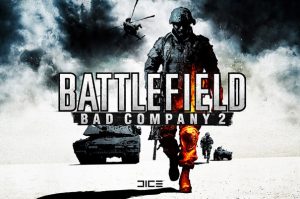
- Battlefield: Bad Company 2
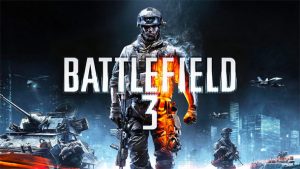
- Battlefield 3
Found something worth playing through DecideGame?
DecideGame.com is an independent gaming project run by Editor Zero. If this guide helped you discover a game, solve a problem, or find useful information, you can support DecideGame.com and help keep new and updated game guides coming.
DecideGame — PC Game Guides, Reviews & Setup Help