
📅 Game released: 2008
Call of Duty: World at War follows U.S. Marines in the Pacific and Soviet troops advancing toward Berlin in a brutal World War II campaign, with four-player co-op and the original Call of Duty Zombies. This PC guide compares official Steam and Microsoft Store download options, explains the free PC map packs, online-profile limitations, system requirements, mods, and practical setup.
 By Editor Zero — independently researched, edited, and maintained.
Last updated: 14 November 2026
Last reviewed: 14 November 2026
Table of Contents
- Quick Facts
- Official PC Stores, Download & Installation
- Call of Duty: World at War Review
- Pros & Cons
- PC System Requirements
- Frequently Asked Questions
- Similar Games
Call of Duty: World at War Quick Facts
- Game: Call of Duty: World at War
- Developer: Treyarch
- Publisher: Activision
- Genre: First Person Shooter (FPS), Multiplayer, Co-op Shooter, Zombie Games
- Release: November 11, 2008 (North American retail release); Steam: November 18, 2008
- Platforms: Windows PC, PS3, Xbox 360, Wii; Nintendo DS and PS2 (Final Fronts) are separate adaptations
- Modes: Single-player campaign, up to four-player online campaign co-op, Competitive Co-Op, Zombies, and online competitive multiplayer; no PC split-screen
- Official PC Zombies Maps: Nacht der Untoten, Verrückt, Shi No Numa, and Der Riese with the complete PC content
- PC DLC: Map Packs 1–3 became free through PC updates; the paid Xbox console Map Pack Bundle is not PC DLC
- Steam Deck: Unsupported (Valve compatibility rating for the Steam version)
- Engine: IW 3.0, Treyarch’s modified version of the Call of Duty 4 engine
- Community: Official Call of Duty Website, Steam Community Hub, Call of Duty Zombies Reddit Community
- PC modding: Official PC Mod Tools and manually installed custom Zombies maps; no Steam Workshop, and Microsoft Store mod compatibility is not officially documented
- Metacritic score: 83/100 (original Windows PC release)
- IGN score: 9.2/10 (original PC/PS3/Xbox 360 review)
- Steam user reception: Very Positive overall (Steam customer reviews)
Official PC Stores, Download & Installation
👇 Choose an official PC storefront below, then use these version-specific notes before downloading Call of Duty: World at War or planning an online co-op session.
- Steam version: The classic Windows release includes the campaign, co-op, Zombies, multiplayer, and the PC map packs after Steam finishes updating it. Steam and the game are separate services, so a Steam purchase does not create a Microsoft Store or Xbox console license.
- Microsoft Store PC version: The separate Windows PC package advertises the classic experience and four-player cooperative campaign. Its product page warns that some Xbox Network features may be unavailable, including cross-platform multiplayer and achievements; check the listing for the current feature set before purchasing.
- Xbox console version: The similarly named Xbox Store product is the backward-compatible Xbox 360 release for Xbox One and Xbox Series X|S. It is not the Microsoft Store PC package, and its paid Map Pack Bundle is console content rather than required PC DLC.
- Installation: Install through the storefront account that owns the game, let every update complete, launch once with a standard Windows account, and allow the game through the firewall only when prompted by Windows or trusted security software.
- Complete PC map set: Updated PC installations include Map Packs 1–3 at no additional charge. This supplies nine added competitive maps plus Verrückt, Shi No Numa, and Der Riese; Nacht der Untoten is the original unlockable Zombies map.
- Campaign co-op: Most campaign missions support up to four online players, but the Windows release has no local split-screen. Every participant needs a compatible PC copy, and online-profile or networking problems can prevent a session even when the campaign works offline.
- Online-profile warning: Steam customers have reported a loop that prevents creation of the in-game online profile required for multiplayer and online co-op. Activision has not posted a universal fix or a complete PC-service shutdown notice, so online access should be treated as unreliable rather than guaranteed.
- Storefront separation: Cross-buy, cross-save, shared achievements, and cross-store multiplayer are not advertised between Steam, Microsoft Store PC, and Xbox console versions. Buy on the same PC storefront as the people with whom you intend to test co-op.
- Mods and custom Zombies: The official Mod Tools and large manual-map archive are hosted on ModDB, but there is no Steam Workshop. Back up the player profile, read each mod’s required game version, prefer established projects, scan downloads, and never replace the game executable with an unknown file.
- Download safety: Avoid cracks, repacks, key generators, mod menus, pirated map bundles, unofficial executables, and websites promising to bypass online-profile or ownership checks. Community multiplayer clients are third-party services, not official Activision storefront support, and are outside this guide’s recommended installation path.
 Buy Call of Duty: World at War on Steam
 Buy Call of Duty: World at War for PC on Microsoft Store

Call of Duty: World at War Review
Brutal atmosphere, unpredictable infantry combat and remarkably direct Zombies give this war its own identity.
Call of Duty: World at War takes the quick aiming, regenerating health and multiplayer progression of Call of Duty 4: Modern Warfare back to World War II, but the mood is very different. Treyarch’s war is full of mud, fire, executions and attacks that arrive before anyone can settle into cover. The campaign alternates between U.S. Marines in the Pacific and Soviet troops fighting from Stalingrad toward Berlin. Survival gradually becomes difficult to separate from revenge.

That contrast defines much of the 15-mission campaign. Concealed defenders and banzai charges make the Pacific feel dangerously close, while the Soviet advance uses ruined cities, tanks and Reznov’s anger to build an increasingly relentless offensive. Not all of it works as well as it looks. Invisible progression triggers and Veteran’s notorious grenade barrages can turn dramatic battles into exercises in repetition. Yet campaign co-op, competitive multiplayer and the original Zombies make the whole package surprisingly varied.
Familiar Gunplay in a More Hostile War
Anyone comfortable with Call of Duty 4 will understand the basic handling quickly. Aim-down-sights is responsive, health returns when the player escapes incoming fire, and the two-weapon limit encourages swapping guns rather than carrying an answer for every situation. Bolt-action rifles reward patient shots across open ground; the M1 Garand and Gewehr 43 allow quicker follow-ups; the PPSh-41 can tear through a crowded room if its appetite for ammunition can be managed. The shooting is accessible, but exposure is costly.
More importantly, seemingly safe positions rarely remain safe. Japanese soldiers emerge from foliage, feign death or rush Miller with fixed bayonets. A close banzai attack demands an immediate counter, but surviving that struggle does not mean the surrounding enemies have stopped firing. The flamethrower clears bunkers and vegetation, yet its effect is intentionally disturbing: enemies burn rather than simply falling behind a neat hit marker. A rifle-mounted bayonet offers a different close-range response. These simple mechanics disrupt the usual rhythm of trading shots from cover.
Some of this aggression, unfortunately, is stage management. Enemies may keep arriving until a particular line is crossed, no matter how efficiently the player clears their positions. Friendly soldiers shout warnings and make a battlefield feel occupied, but they can ignore threats, crowd an entrance or wait for a trigger before advancing. The player ends up reading mission triggers as much as enemy behavior.
The Pacific Missions Keep Changing the Threat
The American chapters excel at complicating familiar infantry assaults. Makin Atoll opens with an execution and escape, establishing how quickly apparent safety can collapse. Later missions move through beaches, caves, airfields and fortified hills. Mortars punish anyone who stays still, snipers in the trees force attention above the normal firing line, and satchel charges make getting close to a defensive position part of the challenge. Flak guns and a PBY Catalina gunner sequence interrupt the infantry combat.
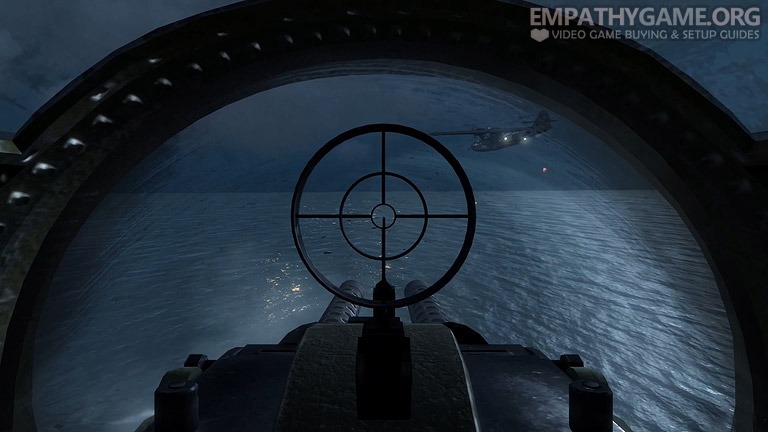
The Pacific develops its threats more than it develops Miller. Burn ’em Out turns the flamethrower into the answer to fortified bunkers, while Blowtorch & Corkscrew combines fire with explosives and entrenched resistance. Foliage makes recognizing a target an actual task rather than a formality. The objective remains to push forward, but each advance feels different.
Those islands also produce some of the campaign’s most uncomfortable images. Bright water and thick tropical greenery sit beside burned defenses and soldiers waiting silently to ambush the squad. That contrast makes the violence harder to dismiss as spectacle. Roebuck helps hold the American storyline together. Kiefer Sutherland gives his orders a practical urgency, and his exchanges with Polonsky create a human relationship that the otherwise mission-driven plot needs. A late choice involving them is rather direct, but it has weight because the two have accompanied so much of the advance.
The Soviet Offensive Has a Clearer Emotional Direction
The Eastern Front sacrifices some variety for continuity. Dimitri Petrenko first appears beneath the bodies of fallen Soviet soldiers in Stalingrad during Vendetta. Viktor Reznov discovers he is alive and leads him toward a German sniper and General Amsel. Gary Oldman’s performance makes Reznov compelling because encouragement and fury seem to come from the same place. He believes he is leading Dimitri toward justice, yet his idea of justice grows increasingly difficult to distinguish from retaliation.
Vendetta also reveals the distance between cinematic tension and player freedom. The Amsel assassination is tightly staged, and a shot that appears to have found its mark can be treated as a wound rather than the intended kill. The tension is carefully paced, but accuracy remains subordinate to the script. Later battles have a similar problem when a defended position refuses to empty until Dimitri advances far enough.
Street fighting, an escape through the Berlin U-Bahn and a T-34 tank assault broaden the Soviet chapters without breaking their sense of one continuing push toward the Reichstag. Red Army chants, burning buildings and Reznov’s increasingly severe orders give the advance a momentum that individual mechanics alone could not supply. Victory is not uncomplicated. Surrendered German soldiers can be executed, and Reznov treats mercy with growing contempt. The writing is hardly subtle, but the conflict between liberation and revenge gives the Soviet missions a sharper identity than a straightforward march toward a final objective.
Veteran Difficulty Often Punishes the Wrong Things
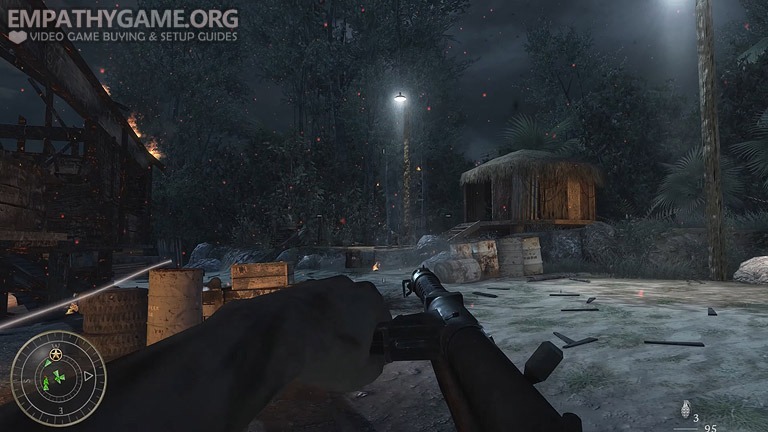
Higher difficulty initially sharpens the combat. Enemies are quicker to punish exposure, charging into an occupied position is risky, and keeping track of firing angles matters. Short movements between cover, disciplined target selection and learning a checkpoint’s timing can turn a chaotic engagement into a manageable one. At its best, difficulty rewards appropriate caution.
Veteran eventually stretches that idea beyond usefulness. Grenades arrive so frequently around occupied cover that moving becomes compulsory even when the next position is no safer. Several indicators can appear at once, and an escape from one blast may lead directly into the sights of enemies who acquire targets almost immediately. Forced movement is not always intelligent movement. Sometimes the player is simply guessing which route the grenade barrage will briefly permit.
Heart of the Reich exposes the issue particularly clearly. Destroying the 88mm guns outside the Reichstag requires crossing a packed battlefield where grenades repeatedly drive Dimitri out of shelter. Enemy waves, checkpoints and the last approach can make success feel dependent on finding a narrow opening rather than steadily improving. Pacific tree snipers and flamethrower positions can cause a similar cycle of retries. Finishing Veteran demands persistence, certainly, but its worst moments confuse surviving the script with mastering the combat.
Campaign Co-Op Changes the Mood More Than the Missions
Up to four online players can tackle most of the campaign together. The game increases enemy numbers, teammates can revive one another, and an assault that feels oppressive alone becomes a loud shared effort. One player can suppress a bunker while another approaches with explosives, or intercept a banzai attacker threatening a teammate. Those moments create cooperation naturally, even though the levels were not designed around complicated team roles.
There is a trade-off. Additional guns and revives make some staged dangers easier to overcome, but they can also turn World at War’s grim atmosphere into competitive chaos. There are no distinct classes, linked puzzles or objectives requiring four carefully assigned positions. Competitive Co-Op makes the rivalry explicit by awarding points for kills, headshots and revives. The shift in tone is striking.
Death Cards offer a more substantial reason to replay missions. Hidden throughout the campaign, they unlock optional co-op rules, including restrictions on how enemies can be killed or unusual explosive effects. The cards do not redesign a level, but they change what a familiar encounter asks of the group. Co-op is therefore best understood as a lively alternative way of experiencing the campaign, not a separate set of missions built around deep coordination.
Multiplayer Gives Modern Warfare a Different Battlefield
The competitive mode retains much of Call of Duty 4‘s structure. Match experience advances a persistent rank, Create-a-Class combines weapons, grenades and three perks, and challenges unlock attachments. Prestige allows the climb to begin again. Even a short session contributes toward a new weapon, attachment or class experiment.
The setting changes more than weapon appearances. Recon planes, artillery and attack dogs take the place of UAVs, airstrikes and helicopters at three-, five- and seven-kill streaks. Dogs are a particularly good fit because they enter the fight as physical threats. They can drive a defender out of position, but can also be shot before reaching their target. An MP40, scoped bolt-action rifle and M1 Garand each demand different engagement distances and play styles.
Tanks on selected maps introduce both spectacle and imbalance when a team cannot deal with enemy armor. War mode is a more consistently successful addition. Instead of scattering attention across several unrelated objectives, it moves both teams along a sequence of capture points. Losing ground does not end the contest; a counterattack can reverse the front, and securing an area matters more than collecting kills at its edges. Its compact tug-of-war structure suits the game’s aggressive pacing.
Zombies Makes Simple Decisions Feel Important
Nacht der Untoten barely needs an explanation. Up to four survivors defend a ruined bunker, repair barricades, earn points by killing zombies, purchase weapons from walls and take their chances with the Mystery Box. Doors open more space, but they also expose additional entry points. There is no final enemy whose defeat means victory. Each round is another attempt to hold out as the number and durability of the undead increase.
What makes that modest setup work is the cost attached to every choice. Opening a door may provide the route needed to escape a crowd, but it postpones buying a better gun. Staying together improves the chance of reviving someone, yet it can leave the team trapped if too many zombies converge on one entrance. Barricades buy time without solving the problem permanently. The rules are easy to understand, while the decisions become more uncomfortable the longer the group survives.
The later maps expand that foundation without abandoning it. Verrückt separates the team at the start and adds power, traps and perks, making coordination and route planning more important. Shi No Numa spreads the fight through a swamp and connected huts, introduces Hellhounds and gives the playable cast more personality. Der Riese adds teleporters and Pack-a-Punch weapon upgrades, allowing a more deliberate path toward surviving higher rounds. Each map gives the group something new to learn while keeping the core objective clear.
Mystery rewards curiosity. Radios, environmental clues and hidden songs suggest a larger story, but nobody has to solve it before enjoying the survival game. That restraint is appealing beside the elaborate quests of later Zombies modes. Limited spaces and uneven weapon balance remain. Still, the original formula understands something valuable: a few understandable rules can create lasting tension when every decision gradually becomes harder to reverse.
Final Verdict
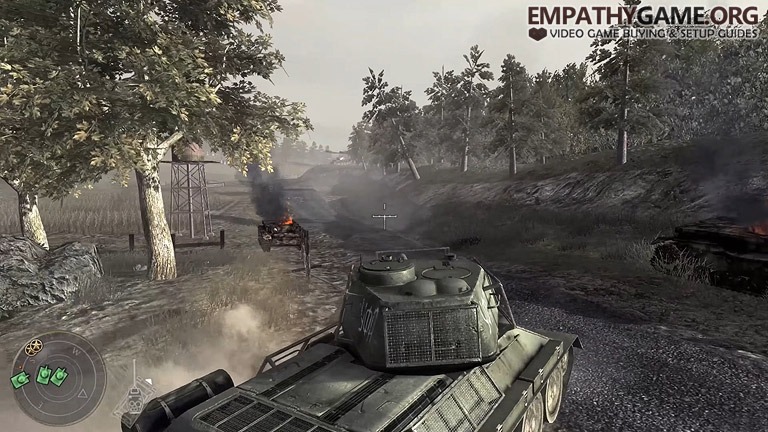
Call of Duty: World at War works best when its combat and atmosphere reinforce one another. Pacific ambushes make a beautiful landscape threatening, banzai attacks break up ordinary cover shooting, and the Soviet campaign gives each advance a more troubling purpose. Roebuck and Reznov hold the two stories together, while gunfire, shouting and harsh imagery make this war feel unusually hostile.
It also shows the limitations of its own cinematic ambitions. Infinite-feeling enemy waves expose the level triggers, scripted moments sometimes overrule convincing shots, and Veteran can replace tactical challenge with grenade-driven trial and error. Co-op offers shared energy rather than elaborate teamwork, while competitive multiplayer is an effective World War II adaptation of a familiar framework.
Zombies shows how much the game achieves with little. From Nacht der Untoten to Der Riese, its steadily expanding survival rules invite cooperation, improvisation and repeated attempts without demanding a complicated explanation. Players who want open-ended battles or a reliably fair highest difficulty will notice the campaign’s restrictions. Those who value a fierce World War II atmosphere, lively co-op, focused multiplayer and direct survival tension will find a rough-edged shooter whose strengths are still distinctly its own.
Call of Duty: World at War Pros & Cons
- Pro: The Pacific and Eastern Front campaigns deliver a harsher, less sanitized World War II atmosphere than the earlier Call of Duty games
- Pro: Four-player online campaign co-op and Competitive Co-Op remain rare features within the series
- Pro: Nacht der Untoten established Call of Duty Zombies, while later maps introduced perks, traps, teleporters, Pack-a-Punch, and a deeper hidden story
- Pro: Strong weapon audio, flamethrowers, brutal close combat, large assaults, and Reznov’s Soviet missions give the campaign a distinctive identity
- Pro: Dedicated-server roots, official Mod Tools, custom maps, and community Zombies projects give the classic PC version unusual longevity
- Con: Some Steam buyers report online-profile creation failures that can block multiplayer and online campaign co-op
- Con: Public-server population, player behavior, anti-cheat coverage, and lobby availability are inconsistent in an aging online game
- Con: No PC split-screen, no Steam Workshop, and no advertised cross-progression between current storefront versions
- Con: Scripted enemy waves, grenade pressure, checkpoint placement, and friendly AI can feel dated or frustrating on higher difficulties
Call of Duty: World at War PC System Requirements
Important: These are the legacy official requirements shown for the original PC version. Steam’s desktop client now requires Windows 10 or later, and the separate Microsoft Store package has its own current operating-system requirements. Meeting the hardware minimum does not guarantee multiplayer-profile creation or Steam Deck compatibility.
MINIMUM:
OS: Windows XP or Windows Vista; the legacy listing also identifies Windows 7 support
Processor: Intel Pentium 4 3.0 GHz or AMD Athlon 64 3200+
Memory: 512 MB RAM for Windows XP or 1 GB RAM for Windows Vista
Graphics: 256 MB Nvidia GeForce 6600 / 6600 GT or ATI Radeon X1600 with Shader Model 3.0 support
DirectX: DirectX 9.0c
Storage: 8 GB available space
Sound: On-board or better DirectX-compatible sound card
Network: Broadband internet connection for online multiplayer and co-op
Modern Windows, Saves and Troubleshooting Notes
- Let Steam or Microsoft Store finish every update before starting Zombies or installing a custom map. On Steam, use Properties → Installed Files → Verify integrity of game files if the game crashes after a failed modification or interrupted update.
- The original requirements mention Windows XP and Vista because they date from 2008. Use a currently supported 64-bit Windows installation, updated graphics drivers, and the current storefront client rather than attempting to recreate an unsupported operating system.
- If the game opens with a black screen or an unsuitable resolution, reset the local configuration, start in a conservative resolution, and then select the correct display mode in-game. Back up the player profile folder before removing or replacing any configuration file.
- If sound is missing, choose the intended Windows playback device before launch, close exclusive audio software, and test a standard sample rate. Avoid downloading replacement DLL files from driver or “fix” websites.
- If the online-profile prompt loops, first confirm that the connection, firewall permission, storefront account, and in-game name are valid. Reinstalling repeatedly or buying a code from a reseller is not a verified universal fix; request a storefront refund within its policy window if online play was the deciding purchase reason.
- For private co-op, use matching storefront versions and game updates, then test online-profile creation before scheduling a full group. The Microsoft listing explicitly warns that cross-platform multiplayer may be unavailable.
- Steam Deck is currently marked Unsupported by Valve. Community compatibility reports and control layouts can change, but they do not replace the official category; desktop Windows remains the supported target for this guide.
- For traditional custom Zombies, the Steam version has the best-documented file layout and community history. Verify that a map matches the installed patch level, extract only to the documented user-data location, and remove the mod cleanly if stability changes.
Official Trailer
Note: The official Call of Duty launch trailer highlights World at War’s Pacific and Eastern Front combat, flamethrowers, tanks, squad assaults, and grim World War II tone; the guide above adds the current PC-store, co-op, Zombies, map-pack, multiplayer, mod, and compatibility details.
Frequently Asked Questions
How long is the Call of Duty: World at War campaign?
A first campaign run usually takes around six to eight hours, depending on difficulty, deaths, and how quickly you move through its scripted battles. Co-op, mission replays, multiplayer, and Zombies add substantially more replay value.
Is Call of Duty: World at War connected to Call of Duty: Black Ops?
Yes. World at War tells a self-contained World War II story, but its Soviet campaign introduces Viktor Reznov and Dimitri Petrenko, whose history matters to Black Ops. Playing World at War first provides useful context but is not required.
Does World at War have campaign co-op or split-screen on PC?
Most campaign missions support up to four people over a network, and Competitive Co-Op adds a scoring element. The Windows version does not offer local split-screen campaign co-op. Each player needs a compatible PC copy, and an online-profile issue may prevent network sessions on some installations.
Does Call of Duty: World at War support LAN play on PC?
Yes. The original Windows game supports LAN hosting for cooperative and competitive play. Each player needs a legitimate, matching installation and game version; LAN availability does not mean a single PC can provide split-screen play.
Are Call of Duty: World at War PC multiplayer services still available?
The publisher has not announced a comprehensive shutdown of World at War PC multiplayer, but working online access is not guaranteed. Some Steam purchasers report being unable to create the in-game online profile needed for multiplayer and online co-op. Public-server availability and third-party community arrangements are separate considerations.
Can Steam and Microsoft Store PC players play World at War together?
Cross-store multiplayer is not advertised for these separate PC packages, and shared achievements, saves, and progression should not be assumed. For a co-op group, using the same storefront and testing connectivity before committing to a purchase is the safer approach.
Can World at War be played offline on PC?
The original campaign and solo Zombies content can be played without public matchmaking after the game is installed and launched, subject to the storefront’s setup and sign-in rules. Online co-op, public multiplayer, and community network sessions require their respective connections and services.
Which Zombies maps are included in the full PC version?
The complete updated Windows game contains Nacht der Untoten, Verrückt, Shi No Numa, and Der Riese. The later three came through the PC map packs, which became free through official PC updates; the separately sold Xbox console map bundle is not needed for the Windows release.
Can you play World at War Zombies solo or with friends?
Yes. Zombies supports solo survival and up to four-player cooperative play. Solo runs emphasize personal positioning and ammunition management, while a coordinated group can revive teammates, divide defensive areas, and plan how to spend points. Network play can still be affected by the game’s online-profile limitations.
Which World at War Zombies map is best for beginners?
Nacht der Untoten is the simplest starting point because its small bunker makes the basic survival loop easy to understand. Der Riese is a useful next step, introducing power, teleporters, perks, traps, and Pack-a-Punch in a map with more long-term strategy.
How does Pack-a-Punch work in World at War Zombies?
Pack-a-Punch is available in Der Riese. Turn on the power and link the teleporters to unlock access to the machine, then spend points to upgrade a weapon. New players may benefit more from learning safe routes and obtaining dependable weapons and perks before committing points to upgrades.
Does World at War Zombies have modern main-quest Easter eggs?
Not in the elaborate, cinematic style of later Black Ops entries. These maps emphasize surviving rounds, finding equipment, opening the environment, and discovering hidden audio or visual story clues rather than completing a lengthy required quest.
Does Call of Duty: World at War multiplayer have bots?
The standard PC release does not provide an official offline bot mode for competitive multiplayer. Some community modifications offer alternatives, but those are separate from the game’s original multiplayer functionality.
Can Call of Duty: World at War use custom Zombies maps?
Yes. World at War has official PC Mod Tools and a long-running custom Zombies community, with maps generally installed manually rather than through Steam Workshop. Follow established map creators’ instructions, back up your profile, and avoid mods that require unknown executables or bypasses.
Does Call of Duty: World at War work on Windows 10 and Windows 11?
The original PC release can run on modern Windows, but older display, audio, controller, and networking behavior can vary by hardware and storefront. Start with the official installation, keep files intact, and use conservative in-game settings before experimenting with community workarounds.
Does Call of Duty: World at War have good controller support on PC?
The original Windows version is much less controller-friendly than modern Call of Duty games. Mouse and keyboard are the straightforward option, while gamepad setups can require manual mapping and do not necessarily reproduce console-style aim assist or button prompts.
Does Call of Duty: World at War work on Steam Deck?
Valve labels the Steam version Unsupported for Steam Deck. Community configurations may be possible, but they are not an official compatibility guarantee, and a regular Windows PC remains the safer platform for this guide.
Still have questions? Check the Call of Duty Zombies Reddit community, Steam Discussions, or Activision support for additional help and community discussion.
Sources & References
Key release, storefront, PC compatibility, reception, and online-access facts were checked against the following sources:
- Activision — original launch announcement — confirms the November 2008 release, developer, and four-player co-op.
- Steam — Call of Duty: World at War — verifies the PC purchase, Steam release date, original requirements, review reception, and Steam Deck rating.
- Microsoft Store — World at War (2008) for PC — confirms separate Windows availability and Microsoft’s warning about certain Xbox Network features.
- PCGamingWiki — Call of Duty: World at War — documents legacy PC versions, map-pack update history, and technical compatibility details.
- Steam Discussions — online-profile reports — documents first-person reports of profile-creation failures; these reports are not an official service-shutdown notice.
- IGN — Call of Duty: World at War review — documents the original 9.2/10 critical score across the major PC and console editions.
Similar Games Like Call of Duty: World at War


Found something worth playing through DecideGame?
DecideGame.com is an independent gaming project run by Editor Zero. If this guide helped you discover a game, solve a problem, or find useful information, you can support DecideGame.com and help keep new and updated game guides coming.
DecideGame — PC Game Guides, Reviews & Setup Help