

📅 Game released: 2004
Use this updated 2026 James Bond 007: Everything or Nothing PC guide to check official download availability, compare Dolphin and PCSX2 for playing an owned GameCube or PS2 copy, configure controllers and graphics, review emulator system requirements, and revisit Pierce Brosnan’s cinematic Bond adventure.
 By Editor Zero — independently researched, edited, and maintained.
Last updated: 21 October 2026
Last reviewed: 21 October 2026
Table of Contents
- Quick Summary
- Quick Facts
- Official PC Stores, Download & Installation
- James Bond 007: Everything or Nothing Review
- Pros & Cons
- PC System Requirements
- Frequently Asked Questions
- Similar Games
James Bond 007: Everything or Nothing Quick Summary
✔ Cinematic third-person action-adventure starring Pierce Brosnan as James Bond, who investigates a dangerous nanotechnology conspiracy involving former KGB operative Nikolai Diavolo, voiced by Willem Dafoe
✔ Combines third-person gunfights, hand-to-hand combat, stealth takedowns, Q Branch gadgets, rappelling, motorcycle chases, armed vehicles, and large scripted action sequences across international locations
✔ Similar to 007: Blood Stone through its third-person Bond action, cinematic espionage, cover-based shooting, gadgets, vehicle chases, and original movie-style storyline
✔ No native Windows PC edition exists, and the game is not officially available to purchase or download through Steam, GOG, Epic Games Store, or EA’s PC storefront
✔ The recommended PC route is the original GameCube version through Dolphin, whose compatibility database rates the game Perfect; the PlayStation 2 version through PCSX2 is a practical alternative for owners of that edition
✔ The original home-console releases include a single-player campaign, two-player cooperative missions, and competitive local multiplayer; the PS2 edition additionally featured an online mode whose original EA service is no longer available
James Bond 007: Everything or Nothing Quick Facts
Official PC Store Status, Download & Installation
👇 James Bond 007: Everything or Nothing has no native Windows PC release or official PC game download. Use the guide below to compare its original console versions and configure Dolphin or PCSX2 with a lawful backup of a game you own.
- Official Windows status: Electronic Arts released Everything or Nothing for GameCube, PlayStation 2, and the original Xbox, but never published a native Windows edition. There is no official Steam, GOG, Epic Games Store, Microsoft PC Store, or EA App version available for Windows installation.
- Best emulator for PC: Dolphin Emulator is the recommended starting point. It emulates Nintendo GameCube and Wii software on Windows, and the official Dolphin compatibility database rates Everything or Nothing as Perfect. Dolphin supports modern gamepads, graphics scaling, multiple rendering backends, and memory-card save management.
- Best console version to emulate: For most Windows players, choose the original GameCube release through Dolphin. It offers an excellent documented compatibility rating, avoids proprietary console BIOS requirements, and includes the complete home-console campaign and local multiplayer features. This recommendation concerns practical emulation, not an assertion that the original GameCube release has the highest visual quality.
- PS2 alternative: The PlayStation 2 edition works through PCSX2. Its compatibility documentation identifies the game as Playable and provides fixes for certain lighting and loading-screen issues. Choose this route if you own the PS2 edition, prefer its original presentation, or want to reproduce the PlayStation controller experience.
- Original Xbox comparison: The Xbox release was especially well regarded for its original hardware visuals, lighting, and sound. However, it is not automatically the best version to emulate on a Windows PC. Its original-console advantages should be weighed separately against emulator maturity, ease of configuration, and game-specific compatibility. Dolphin is the better-supported starting point for this guide.
- Game Boy Advance distinction: Everything or Nothing also appeared on Game Boy Advance before the major home-console versions. The handheld release was developed separately by Griptonite Games and is not a portable conversion of the full GameCube, PS2, or Xbox experience. It should not be chosen as a substitute when searching for the cinematic third-person console game.
- Obtaining a game copy: Neither Dolphin nor PCSX2 includes Everything or Nothing. The recommended route is to obtain an authentic copy of the relevant original console release and create a personal backup where permitted by applicable law. This page does not provide copyrighted game images or recommend third-party game-file archives. Readers are responsible for verifying the ownership and legality of any game files they obtain.
- GameCube disc backup: Dolphin’s official FAQ explains using compatible Nintendo hardware to create a backup of an owned GameCube disc. Its guidance describes disc dumping through a Wii with suitable homebrew software. Ordinary PC DVD drives generally cannot read GameCube discs directly using standard disc-image software.
- Supported Dolphin game files: Dolphin can open compatible GameCube disc images such as GCM/ISO and RVZ. The files must correspond to a correctly dumped game. A normal uncompressed GameCube disc image is approximately 1.4 GB, although actual storage needs depend on the file format and compression.
- Dolphin installation: Download the Windows build from Dolphin’s official website, install or extract it, launch the emulator, and open the configuration menu. Add the folder containing your legitimate GameCube backup through the game-directory settings or load the game file directly. The emulator should identify Everything or Nothing in the game library.
- Controller setup: In Dolphin, open Controllers and configure an Emulated GameCube Controller for Port 1. Map a connected Xbox, PlayStation, or compatible PC controller to the GameCube inputs, including the analog sticks, triggers, face buttons, and C-stick. A physical gamepad is preferable to keyboard-only controls for driving, aiming, and movement. Map additional controller ports when using local multiplayer.
- Dolphin graphics: Start with Dolphin’s default graphics configuration and a supported rendering backend such as Vulkan or Direct3D. Once gameplay is stable, increase the internal rendering resolution to 2x or 3x if your hardware can maintain full emulation speed. Higher rendering resolutions improve the clarity of 3D environments but do not replace the original textures or automatically improve prerendered videos.
- Widescreen and display: The original home-console versions include widescreen display support. Use the game’s own widescreen option where available and configure the emulator aspect ratio to match it. Avoid combining native widescreen with an unnecessary emulator widescreen hack, which may distort interface elements or introduce rendering artifacts. If the picture is cropped or stretched, return to the game’s original aspect ratio and check both display settings.
- Cutscene troubleshooting: Some Dolphin configurations can cause graphical problems in the game’s prerendered videos. If cutscenes appear corrupted, start with default graphics enhancements, turn off Force Texture Filtering, and test anisotropic filtering at 1x. A compatibility rating of Perfect does not mean every enhanced graphics configuration is guaranteed to work correctly.
- PS2 game backup: PCSX2 provides an official guide to dumping original PS2 discs using a compatible computer optical drive. The resulting backup can be added to PCSX2’s game library. Using your own properly created disc image also helps distinguish emulator problems from damaged or incorrectly copied game files.
- PS2 BIOS requirement: Unlike Dolphin’s GameCube emulation route, PCSX2 requires proprietary PlayStation 2 BIOS files obtained from your own PS2 console. Follow the emulator project’s official BIOS-dumping instructions. PCSX2 does not distribute Sony BIOS files or include an open-source replacement.
- PCSX2 installation and graphics: Install PCSX2, configure your dumped PS2 BIOS, add your owned game backup, and select a controller. Begin with default graphics settings. If fire or lighting effects appear incorrect, the PCSX2 game wiki recommends increasing Blending Accuracy to at least Full. If loading screens scale incorrectly, enable Screen Offsets. Update the emulator before experimenting with older fixes.
- Local and online multiplayer: The original console game offers two-player cooperative missions and competitive local multiplayer. Dolphin can emulate supported local multiplayer using configured controllers, while its Netplay feature may allow compatible sessions over a network with additional setup. The original PS2 online multiplayer service is no longer operational; ordinary PCSX2 emulation does not restore EA’s discontinued servers.
- Save files: Both Dolphin and PCSX2 emulate their respective consoles’ memory cards. Use normal in-game saving for primary progress, and keep backups of your emulator save directories before changing installations or applying experimental patches. Save states are convenient for temporary checkpoints but should not replace regular game saves.
 Download Dolphin Emulator from the Official Website
Download PCSX2 from the Official Website

James Bond 007: Everything or Nothing Review
A lavish Brosnan-era spy adventure whose best tricks outshine its awkward gunplay and rigid scripting.
James Bond 007: Everything or Nothing understands something that many Bond shooters overlooked: being 007 involves considerably more than winning gunfights. EA Redwood Shores replaces the first-person formula of GoldenEye and Nightfire with a third-person adventure of rappelling, infiltration, armed driving, and spectacular escapes. Its 29 missions shift activities before the spectacle grows routine.
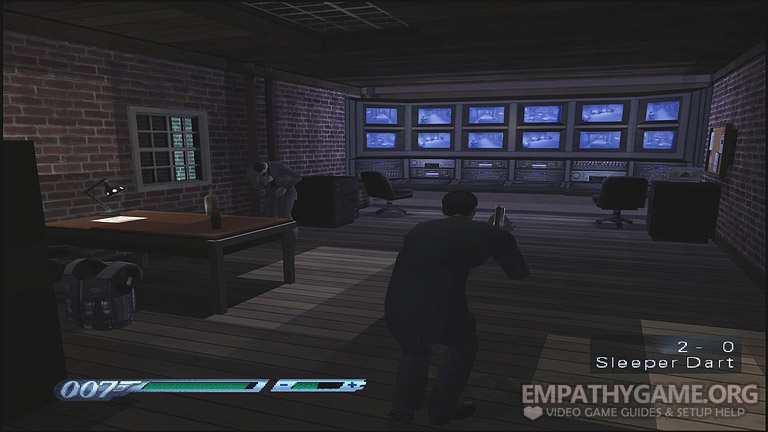
That constant variety is also a way of concealing uneven mechanics. Lock-on makes ordinary guards easy to defeat but struggles against awkwardly placed enemies; stealth equipment encourages ingenuity within scripted boundaries. The driving and optional Bond Moments often outshine the shooting. Fans of Pierce Brosnan’s improbable action will find a remarkably complete interpretation of the character, provided they accept the frustrating rules of a playable Bond film.
Cover Shooting Has More Tactics Than Its Lock-On Suggests
The third-person camera gives Bond a physical presence that his earlier first-person games could only imply. He presses against walls, leans around corners, moves between pieces of cover, and closes in to throw or strike enemies. Most gunfights involve acquiring a target, refining aim with the right stick, and firing from cover. A visible head is usually an easy shot. That accessibility sustains the pace, but can reduce guards to targets rather than threatening opponents.
There is more tactical detail here than that description suggests. Shots aimed at particular body parts can change what happens next: hitting an armed hand can force a guard to drop his weapon, while striking an exposed leg can interrupt a defensive posture. Against an enemy whose head remains protected, those reactions offer a reason to refine the aim instead of simply emptying ammunition into cover. This rewards more deliberate targeting than the lock-on initially suggests.
The same system can become obstructive when the enemy Bond needs to hit is too distant or positioned beyond the targeting system’s comfortable reach. A sniper on an elevated balcony may pose a threat before the available lock-on provides a useful response, making the problem feel less like poor marksmanship than a limitation of the controls. Closing the gap brings a different risk: at point-blank range, Bond can transition into melee when a deliberate gunshot would have been safer, even with other guards shooting. Ammunition pickups encourage advancing, but close combat does not always respond as intended. The shooting has clever details without consistent control.
Gadgets and Bond Moments Reward Ingenuity—Within Limits
Everything or Nothing feels most like Bond when the right solution is not another bullet. Bond Sense lets the action pause while nearby targets and interactive objects are examined and equipment is selected. This makes a chaotic room a brief planning exercise rather than a frantic weapon swap. The Q Spider slips through passages to scout, disable obstacles, or incapacitate guards. The Nano Suit temporarily conceals Bond but consumes battery power quickly.
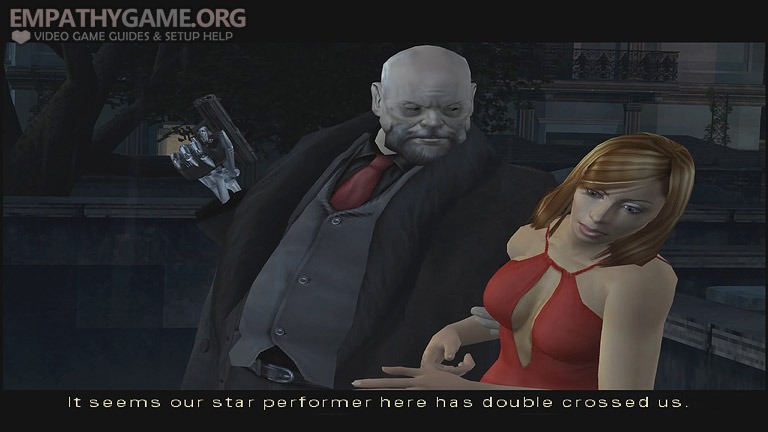
The Kiss Kiss Club demonstrates how these systems serve the fantasy. A straightforward approach involves surviving a noisy confrontation with armed guards. A more observant approach reveals a way to bring overhead lighting down on enemies. That environmental takedown is an optional Bond Moment, one of the special interactions rewarded for acting with resourcefulness or dramatic flair. Rappelling escapes and vehicle jumps offer similar rewards for noticing unconventional options.
These discoveries feel best when they emerge from observation. Too often, however, useful surfaces, rappel points, and gadget interactions are permitted only at specific scripted locations. A Q Spider may be indispensable in one corridor and irrelevant in the next, regardless of what looks physically possible. The game’s finest tricks reward creativity; the weakest simply require finding a predetermined trigger.
Stealth Is Satisfying Until Guard Awareness Becomes Unpredictable
Stealth adds a welcome counterweight to the louder action. Silenced shots, sleeper darts, concealed movement, and hand-to-hand takedowns allow Bond to remove isolated enemies without immediately provoking a firefight. In A Simple Exchange, hotel infiltration demands attention to cameras, patrols, and where fallen guards can be seen. Avoiding an alarm matters more than eliminating everyone.
Unfortunately, the feedback is not always dependable. A body left within a distant guard’s sightline can set off further discoveries, and vertical spaces with balconies make it difficult to judge who can see what. Silent takedowns also commit Bond to an animation, leaving uncertainty about how long he will remain exposed before control returns. When the mission demands absolute silence, an unexpected detection or lengthy animation can make failure feel arbitrary.
The strongest stealth sequences therefore balance caution with an escape plan. A sleeper dart can be safer than grappling a guard; a gadget can disable a camera before Bond moves. But this is not a stealth simulation: missions regularly require direct combat. Discretion is one part of his repertoire, not a universal solution.
Driving Provides the Campaign’s Most Distinctive Decisions
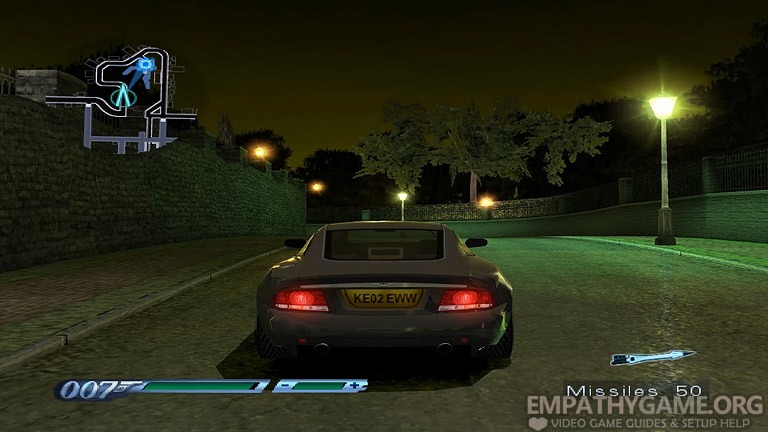
The vehicle missions are far more than disposable interruptions. Train Chase offers a genuine early decision: take the faster, less durable motorcycle along a shorter route, or choose the tougher Porsche with more weapon options and a longer pursuit. The destination remains the same, but the trade-off changes the pace of the chase and what risks seem sensible. The motorcycle encourages speed and precise avoidance; the car allows more punishment and greater firepower. That choice delivers improvisation often absent from the on-foot missions.
Other sequences shift between high-speed road pursuits, a demanding racing event in Redline, a motorcycle chase around the Pontchartrain Bridge, armed driving, and aerial combat. Changing hazards and rival drivers demand attention to the route. Gadgets such as mounted rockets and the Q Bike’s weapons contribute to the spectacle, but they also make tactical sense when a pursuit forces Bond to decide whether to evade an enemy vehicle or destroy it.
The quality is uneven. Sports cars and motorcycles tend to communicate speed more effectively than the comparatively cumbersome helicopter sections, while some apparent shortcuts end at invisible boundaries. A single collision in a timed sequence can force the repetition of scripted events, but the best vehicle missions genuinely change how Bond approaches an objective. Their momentum is central to the game’s identity.
A Convincing Bond Production with a Thin Emotional Center
The original storyline follows stolen nanotechnology associated with Dr. Katya Nadanova and the ambitions of former KGB operative Nikolai Diavolo. Bond encounters geologist Serena St. Germaine, NSA agent Mya Starling, and Jaws. Diavolo’s connection to Max Zorin from A View to a Kill adds familiar Bond lore without requiring knowledge of the film.
As drama, the story functions chiefly as a way to move from one elaborate danger to the next. Diavolo has the grandiose menace required of a Bond antagonist, but his ambitions are more memorable than his development. Serena and Mya contribute different roles to the investigation without gaining much room for independent characterization. The script prefers the next escape to developing the consequences of the previous one. It works as action cinema but leaves little emotional residue.
The production compensates with unusually strong casting. Pierce Brosnan voices Bond, while Judi Dench and John Cleese return as M and Q. Willem Dafoe lends Diavolo theatrical intensity, Richard Kiel reprises Jaws, and Heidi Klum, Shannon Elizabeth, and Mýa help complete the ensemble. Mýa also performs the original title song, and the orchestral score draws confidently on the series’ musical language. Character likenesses, sound design, and staging sell the illusion despite stiff facial animation. It is an extravagant extension of the Brosnan films, not a subtle espionage thriller.
Gold and Platinum Challenges Give Replays a Different Purpose
Campaign progression is straightforward: complete missions to advance the story, then revisit them to improve performance and discover missed Bond Moments. Mission scores award Gold medals and unlock extras rather than developing character levels or skill trees. The higher Platinum challenges add specific constraints—time limits, damage ceilings, or restrictions on how a mission can be completed—so the same level can become a very different problem on a second visit.
A careful first run can give way to a timed sprint past optional encounters. Bond Sense becomes particularly useful during those timed attempts because selecting equipment in that mode stops the mission clock. That small rule gives deliberate planning an advantage over frantic gadget cycling. Some Bond Moments also have implications beyond their immediate score: a particular optional action in an earlier late-game mission can make a supply cache accessible when the area is revisited. It is a pleasing exception to the idea that every secret exists only to award points.
The limitation is repetition. Once a route has been learned, a second attempt may be satisfying; several attempts against a strict timer can expose every clumsy movement, forced animation, and inflexible trigger. Platinum medals reward mastery, but sometimes mastery means accommodating the script rather than finding a better solution. Full completion suits dedicated medal hunters rather than everyone.
Co-op Turns Spectacle into a Test of Coordination
The separate two-player cooperative campaign is not the main story with a second Bond inserted beside the first. It follows MI6 operatives through their own missions, including chapters set in Tunisia, the Andaman Sea, and Egypt. Objectives demand synchronized switches, covering fire, careful movement through dangerous spaces, and occasional separation of duties. One agent might operate a mechanism while the other provides covering fire.
That design can also be unforgiving. Partners work with a limited shared supply of lives across successive chapter stages, so losses during an earlier turret encounter or lethal trap can leave the team poorly equipped to survive what follows. Reckless advances jeopardize both operatives, encouraging sensible pickup sharing and protection of the less experienced partner. The chapters are engaging with coordinated players and considerably harsher when one person rushes ahead.
Race and Scramble modes put alternative challenges around those cooperative missions, while Arena offers competitive battles for up to four people. Arena’s traps and smaller spaces can be amusing, but they lack the sense of purpose that makes the cooperative scenarios worthwhile. Co-op is stronger because its tension emerges from teamwork rather than another scripted stunt.
Final Verdict
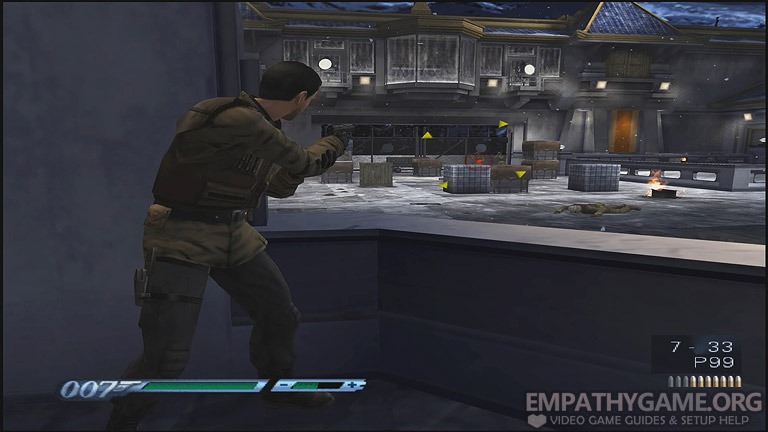
James Bond 007: Everything or Nothing remains an unusually successful attempt to make the entire Bond persona playable. It gives Brosnan rappelling escapes, dangerous environments, guarded locations, extravagant chases, and satisfying uses for Q’s gadgets. The movie-style cast, energetic score, and constant changes of pace make those activities feel like parts of one coherent adventure.
The compromises become harder to overlook when the game asks for precision. Headshots can trivialize combat until lock-on refuses a useful target; stealth loses credibility when enemy awareness is hard to read; timed stages reveal the inflexibility behind the spectacle. Gadgets offer less freedom than they promise. Yet the vehicle choices, optional Bond Moments, demanding medal challenges, and purposeful two-player co-op give the adventure more substance than its cinematic presentation alone might imply.
Those looking for freeform infiltration, exact shooting controls, or a consistently forgiving action game may struggle with its restrictions. For fans of Brosnan-era Bond and players who enjoy compact missions with dramatically different objectives, however, its imagination outweighs much of its friction. Everything or Nothing succeeds not because every mechanic is polished, but because so few Bond games have made the agent’s varied talents feel this central to the experience.
James Bond 007: Everything or Nothing Pros & Cons
James Bond 007: Everything or Nothing PC System Requirements
Official native Windows PC system requirements do not exist. Electronic Arts never released the 2004 home-console version of James Bond 007: Everything or Nothing for Windows. The specifications below describe the host-PC requirements for Dolphin and PCSX2, not official requirements published for the game itself.
Recommended Emulation Route: Dolphin (GameCube)
Dolphin publishes general desktop hardware guidance rather than an official Everything or Nothing-specific minimum/recommended specification. The following information is based on the emulator project’s published requirements.
DOLPHIN — PUBLISHED DESKTOP GUIDANCE:
OS: Windows 10 version 1903 or newer; Windows 11 is also compatible
CPU: SSE2-capable processor; Dolphin recommends a modern dual-core CPU around 3 GHz or faster
RAM: No strict game-specific RAM requirement is published by EA or Dolphin
GPU: Reasonably modern graphics hardware supporting Direct3D 11.1 or OpenGL 3.3
Recommended Graphics Support: Direct3D 11.1 or OpenGL 4.4-capable GPU
Graphics Backends: Vulkan, Direct3D, or OpenGL, subject to hardware and driver compatibility
Storage: Space for the emulator, save data, and your owned GameCube backup; an uncompressed GameCube disc image is approximately 1.4 GB
Controller: GameCube-style controls mapped to a compatible Windows gamepad or keyboard
Internet: Not required for ordinary offline single-player gameplay after local setup
PRACTICAL EDITORIAL TARGET FOR A COMFORTABLE WINDOWS SETUP:
OS: Windows 10 or Windows 11, 64-bit
CPU: Modern quad-core Intel Core or AMD Ryzen processor with good single-thread performance
RAM: 8 GB or more as a practical general-purpose PC target
GPU: Recent integrated or dedicated GPU with working Vulkan or Direct3D drivers
Graphics: Begin at native or 2x internal resolution; raise the resolution only while maintaining full emulation speed
Storage: Approximately 2 GB or more for an uncompressed GameCube backup and related files, plus emulator installation space
Note: The practical target above is editorial guidance, not a benchmark result or an official requirement for Everything or Nothing. Some less powerful computers may run the game well, while shader compilation, graphics drivers, demanding effects, and higher rendering resolutions can affect performance.
Alternative Emulation Route: PCSX2 (PlayStation 2)
PCSX2 publishes its own emulator system requirements. The following condensed guidance applies to the Windows host PC and should not be confused with original game specifications.
PCSX2 — PUBLISHED MINIMUM GUIDANCE:
OS: Updated Windows 10, 64-bit
CPU: x86-64 processor with SSE4.1, approximately 1500 or higher PassMark single-thread score, and two physical cores with simultaneous multithreading
RAM: 8 GB
GPU: Graphics support for Vulkan 1.1, Direct3D 11, or OpenGL 3.3; approximately 600 or higher PassMark G3D score
Additional Requirement: BIOS files dumped from an owned PS2 console
PCSX2 — MODERATE-LOAD GUIDANCE:
OS: Windows 11, 64-bit
CPU: x86-64 processor with AVX2, approximately 2000 or higher PassMark single-thread score, and four physical cores
RAM: 16 GB
GPU: Graphics support for Vulkan 1.3, Direct3D 12, or OpenGL 4.6; approximately 6000 or higher PassMark G3D score
VRAM: 4 GB
Controller: PlayStation-style controls mapped to a compatible gamepad or keyboard
See PCSX2’s official system requirements for complete platform-specific details and additional performance tiers. Meeting the general emulator specifications does not guarantee identical performance in every game.
Additional PC Performance and Setup Notes
- Start with default settings: Test the game before enabling large resolution increases, widescreen hacks, demanding texture filters, or unusual emulator overrides.
- Prefer a controller: A gamepad provides more natural analog movement, vehicle steering, aiming, and access to the original console control scheme.
- Preserve original timing: Higher internal rendering resolution does not automatically produce higher gameplay frame rates. Avoid forcing frame-rate changes without a verified game-compatible method.
- Widescreen setup: Prefer the original game’s widescreen option and match Dolphin’s aspect-ratio setting accordingly. If a cutscene, HUD, or menu looks distorted, test the default aspect ratio before applying additional hacks.
- Dolphin video issues: For corrupted prerendered cutscenes, disable Force Texture Filtering and try 1x anisotropic filtering before changing more advanced graphics settings.
- PCSX2 rendering: The emulator’s game wiki documents minor lighting/fire blending errors that can be addressed with Blending Accuracy set to at least Full, and a loading-screen scaling problem addressed through Screen Offsets.
- Storage and saves: Keep enough available space for game images, virtual memory cards, and save backups. Prefer ordinary in-game saves for long-term progress.
- Steam Deck: There is no native Steam release and therefore no official Steam Deck Verified or Playable rating for the game. Emulation through suitable Linux-compatible software is a separate, unofficial setup route, and individual performance or compatibility should not be assumed.
Video Trailer
Frequently Asked Questions
Is James Bond 007: Everything or Nothing worth playing in 2026?
Yes, especially for players who enjoy cinematic James Bond adventures, varied action missions, and the Pierce Brosnan era. Its combination of espionage gadgets, third-person combat, vehicle chases, and memorable set pieces remains appealing, although the older controls and lack of a native PC version make it less accessible than modern action games.
Is 007: Everything or Nothing based on a James Bond movie?
No. It tells an original story created for the game rather than adapting an existing Bond film. However, Pierce Brosnan voices Bond alongside Judi Dench as M, John Cleese as Q, and Willem Dafoe as Nikolai Diavolo, giving the adventure much of the presentation associated with a theatrical Bond production.
Is Everything or Nothing a sequel to 007: Nightfire?
Not directly. Everything or Nothing is a standalone Bond adventure with its own main storyline, although both games feature Pierce Brosnan’s interpretation of 007. The biggest gameplay difference is the switch from Nightfire’s first-person shooting to third-person action built around cover, melee combat, gadgets, and cinematic movement.
How long does it take to beat James Bond 007: Everything or Nothing?
A typical first playthrough of the single-player campaign takes approximately 10–15 hours, depending on difficulty, failures, and exploration for Bond Moments. Completing the higher-difficulty missions, earning Platinum medals, and playing the separate cooperative campaign can extend that considerably.
How many missions are in Everything or Nothing?
The single-player campaign contains 29 missions, ranging from brief cinematic sequences to longer combat, infiltration, and driving stages. Some missions emphasize conventional third-person shooting, while others focus on motorcycles, armed vehicles, rappelling, stealth, or specialized gadgets.
Is Everything or Nothing an open-world game?
No. It follows a mission-based structure with defined objectives and cinematic story progression. Certain driving stages provide alternate routes and room for improvisation, but there is no continuous open world where Bond can freely travel between every location.
What is Bond Sense, and how does it work?
Bond Sense is a special observation and equipment-selection mode that slows the surrounding action and lets Bond examine his environment. It helps identify interactive objects, potential tactical opportunities, and useful equipment choices. Learning to use it before rushing into dangerous areas can make several missions considerably easier.
What are Bond Moments in Everything or Nothing?
Bond Moments are special actions that reward players for solving situations in particularly inventive or character-appropriate ways. They can involve using environmental traps, finding unusual routes, performing dramatic vehicle stunts, or choosing a clever alternative to straightforward combat. Successfully triggering them contributes bonus points to the mission score.
Can you replay missions to collect missed Bond Moments?
Yes. Completed missions can be revisited, allowing players to experiment with alternative approaches, discover missed Bond Moments, and improve their scores. This is particularly useful when pursuing Gold medals because finding additional Bond Moments can contribute toward the required score.
How do Gold and Platinum medals work in Everything or Nothing?
Gold medals are earned by reaching a mission’s scoring target, with factors such as completion time, weapon efficiency, Bond Moments, and difficulty contributing to the result. Platinum challenges become available after meeting the required Gold and 00 Agent difficulty conditions. These challenges introduce additional objectives, such as finishing within a strict time limit, avoiding excessive damage, or limiting ammunition use.
What do Gold and Platinum medals unlock?
Gold medals unlock extras such as production photographs, additional characters, gadgets, and equipment or vehicle improvements. Platinum medals provide further rewards, including special gameplay modifiers and unlockable cheats such as unlimited ammunition, slow-motion driving, and the Platinum Gun. Pursuing these rewards is one of the main reasons to replay completed missions.
Which difficulty should beginners choose?
Operative is the most approachable setting for learning the movement, targeting, cover mechanics, gadgets, and vehicle controls. Agent provides a more balanced challenge, while 00 Agent demands better positioning and more careful use of equipment. Players interested in Platinum challenges will eventually need to complete missions on 00 Agent.
How does the Q Spider gadget work?
The Q Spider is a small remote-controlled device that Bond can send into areas he cannot safely enter himself. It can investigate narrow passages, approach electronic equipment, and perform certain mission-specific actions, including detonating an explosive charge when equipped. Moving it slowly is important because fast movement can alert nearby enemies.
How does Bond’s Nano Suit work?
The Nano Suit provides temporary camouflage that makes Bond much harder for enemies to detect. Its effectiveness depends on careful movement; moving too quickly can compromise the concealment effect. It is particularly useful during infiltration sequences where avoiding attention is more effective than fighting every guard.
Why won’t the rappel gadget attach to a wall?
The rappel system works only at suitable attachment points, not every wall or surface. If Bond cannot attach the line, try adjusting his position, stepping slightly away from the wall, and checking whether the intended ledge is within range. Some sections also require approaching a specific marked edge before the automatic descent animation activates.
Can you finish Everything or Nothing using stealth instead of combat?
Stealth is a significant part of the game, but a completely non-combat playthrough is not possible. Certain missions encourage silent takedowns, careful movement, the Nano Suit, and the Q Spider, while others require direct shootouts, vehicle combat, or scripted confrontations. The most effective approach is to adapt to each mission rather than relying exclusively on stealth or aggression.
What vehicles can you drive in Everything or Nothing?
The game features several vehicle sequences involving sports cars, armed cars, motorcycles, and other specialized vehicles. Bond uses equipment such as rockets, defensive gadgets, and the Q Bike’s weapons during high-speed pursuits. Some driving missions also contain shortcuts and optional stunt opportunities that contribute to Bond Moments or mission scores.
Does Everything or Nothing have a separate co-op campaign?
Yes. Its two-player cooperative mode contains missions and objectives designed specifically for two MI6 agents, rather than letting a second player join Bond’s normal single-player story. The cooperative storyline takes players through locations such as Tunisia, the Andaman Sea, and Egypt, with challenges involving synchronized switches, combat, infiltration, and teamwork.
Can both players control James Bond in cooperative mode?
No. The cooperative campaign features separate MI6 operatives rather than two versions of James Bond. Players can unlock additional multiplayer characters through progression, but the mode is designed around the agents completing their own operation instead of replaying the main campaign as Bond.
How many people can play Everything or Nothing in split-screen?
Cooperative missions support two players, while the competitive Arena mode supports up to four players locally. These modes have different objectives and player limits, so four-player campaign co-op is not available. When emulating the GameCube version through Dolphin, each local player needs a separately configured controller input.
What is the difference between Cooperative, Race, Scramble, and Arena modes?
Cooperative focuses on completing missions together, while Race adds a time-based challenge to the same general cooperative structure. Scramble introduces individual scoring competition while players still work through mission objectives. Arena is the dedicated competitive mode, allowing up to four players to fight one another in smaller battle environments.
Why is Arena mode locked when starting Everything or Nothing?
Arena maps and additional multiplayer characters are progression rewards rather than content that is entirely accessible from the beginning. Completing cooperative missions and their scoring objectives earns multiplayer points used to unlock more options. Playing through the cooperative campaign is therefore the intended way to open the competitive mode.
Does Everything or Nothing multiplayer have computer-controlled bots?
The original Arena mode does not provide conventional AI opponents that fill empty player positions. Its competitive battles are intended for human participants. Anyone expecting bot-based deathmatches similar to some earlier Bond shooters should be aware of this limitation.
Why is the cooperative campaign so difficult?
Co-op missions often demand close coordination, careful ammunition use, and precise timing, particularly when players must operate switches, defend separate positions, or survive lengthy encounters. Lives and mission progression can also make repeated failures costly. Conserving resources, sharing pickups, and keeping both agents alive is generally more effective than rushing separately into each encounter.
Can you play Everything or Nothing co-op online through Dolphin?
Potentially, yes. Dolphin’s Netplay feature can synchronize compatible local multiplayer sessions between computers, allowing players to use the game’s original two-player co-op mode over a network. This requires compatible emulator configurations and matching game data, and it is an emulator feature rather than a restored official EA multiplayer service.
Are the original Everything or Nothing online servers still active?
No. The original PlayStation 2 release supported online multiplayer through EA’s service, but that official service was discontinued. The GameCube and original Xbox versions focused on local multiplayer. Emulated local co-op and emulator-managed network sessions should not be confused with the original PS2 online infrastructure.
Can Everything or Nothing be played with a keyboard and mouse on PC?
Dolphin and PCSX2 can map keyboard inputs and other PC controls to the original console buttons, but the game does not have native Windows mouse aiming. A conventional gamepad remains the more natural option because the combat, analog movement, vehicle steering, and camera system were designed around console controllers.
Can you play the original Xbox version on Xbox Series X or Xbox One?
The original Xbox release is not included in Microsoft’s supported backward-compatibility catalogue for Xbox One or Xbox Series X|S. Owning the original disc therefore does not provide a supported modern-Xbox installation route. For Windows emulation, the GameCube version through Dolphin remains the recommended option described in this guide.
Who performs the Everything or Nothing theme song?
American singer Mýa performs the game’s title song, “Everything or Nothing.” She also appears in the story as NSA agent Mya Starling. The original music, voice performances, and cinematic opening help distinguish the game from Bond titles that rely primarily on familiar franchise music.
Still have questions? Check the James Bond Reddit community for game discussion, the Dolphin Emulator Forums for GameCube emulation and controller questions, or the Everything or Nothing GameFAQs guides for mission walkthroughs, Bond Moments, multiplayer challenges, and collectible rewards.
Sources & References
Key factual and technical information in this guide was checked against relevant official and established independent sources, including:
- Dolphin Emulator Compatibility Database — confirms the GameCube version’s Perfect compatibility rating and explains the project’s compatibility classifications.
- Dolphin Official FAQ — documents GameCube game-backup methods, supported image formats, emulator limitations, and game-file ownership guidance.
- PCSX2 Wiki — James Bond 007: Everything or Nothing — lists PS2 emulation compatibility, documented graphical issues, and game-specific configuration workarounds.
- PCSX2 Official Setup Documentation — explains system requirements, disc dumping, BIOS preparation, and Windows emulator setup.
- Metacritic — James Bond 007: Everything or Nothing — provides platform-specific review aggregates, publisher/developer information, and original release context.
- GameSpot — James Bond 007: Everything or Nothing Review — documents the original game’s story, cast, third-person action, cover mechanics, driving, Bond Moments, and other gameplay features.
Similar Games Like James Bond 007: Everything or Nothing
- 007: Blood Stone
- 007 First Light
- 007: Quantum of Solace
- James Bond 007: Nightfire
- Metal Gear Solid 4: Guns of the Patriots
- No One Lives Forever





Found something worth playing through DecideGame?
DecideGame.com is an independent gaming project run by Editor Zero. If this guide helped you discover a game, solve a problem, or find useful information, you can support DecideGame.com and help keep new and updated game guides coming.
DecideGame — PC Game Guides, Reviews & Setup Help