
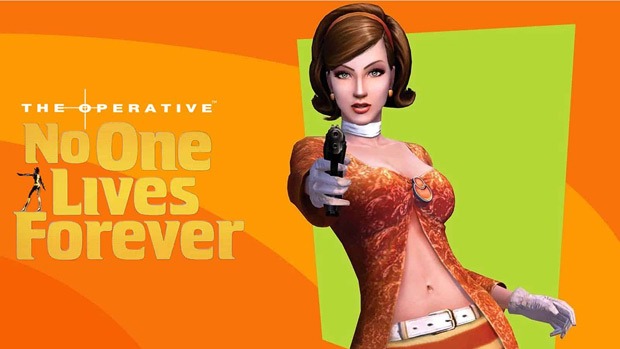
📅 Game released: 2000
Use this updated 2026 No One Lives Forever PC guide to check official download status and retail ownership, review modern Windows setup and system requirements, and understand the Game of the Year Edition, NOLF Modernizer, multiplayer, and mod support.
 By Editor Zero — independently researched, edited, and maintained.
Last updated: 2 October 2026
Last reviewed: 2 October 2026
Table of Contents
- Quick Summary
- Quick Facts
- Official PC Stores, Download & Installation
- The Operative: No One Lives Forever Review
- Pros & Cons
- PC System Requirements
- Frequently Asked Questions
- Similar Games
The Operative: No One Lives Forever Quick Summary
✔ Story-driven first-person spy shooter starring Cate Archer, an operative for UNITY fighting the criminal organization H.A.R.M. in a colorful 1960s-inspired world
✔ Missions mix gunfights, stealth, gadgets, disguises, intelligence gathering, vehicles, scripted set pieces, and humorous conversations instead of relying on uninterrupted shooting
✔ Similar to 007: Quantum of Solace through its espionage setting, first-person shooting, infiltration, gadgets, and movement between stealth and direct action
✔ A native Windows PC version exists, but no verified current official digital storefront offers a normal new purchase; existing retail ownership therefore remains important
✔ The Game of the Year Edition expands the PC release with the Rest and Relaxation episode, additional multiplayer content, official modding resources, and integrated updates
✔ Modern Windows players may encounter old DRM, widescreen, mouse, rendering, and frame-rate issues, while the unofficial NOLF Modernizer addresses several of these limitations
The Operative: No One Lives Forever Quick Facts
Official PC Store Status, Download & Installation
👇 Use the notes below to understand the current official PC availability status for The Operative: No One Lives Forever and avoid unsafe or unofficial acquisition options.
- Current digital availability: No verified normal digital purchase listing is available through Steam, Epic Games Store, Microsoft Store, or another major current PC storefront. This guide therefore does not provide a store button or imply that an official downloadable Windows copy can presently be purchased.
- GOG status: GOG currently maintains a Dreamlist page where users can vote to bring No One Lives Forever to GOG. The Dreamlist is a preservation/request page rather than a game purchase listing and does not provide ownership or a game download.
- Original retail ownership: The Windows release was sold on CD-ROM. Existing owners can use their genuine retail media, while buyers considering a second-hand copy should check which regional release and edition they are purchasing before relying on it for a modern PC installation.
- Game of the Year Edition: The expanded PC edition includes the Rest and Relaxation episode after the main campaign, additional multiplayer maps and skins, extra textures, the map editor, game-side source code, and the game’s integrated official updates.
- Retail copy protection: The original US and European Windows release uses SafeDisc 2, which creates a compatibility obstacle on modern Windows. The US and European Game of the Year Edition uses a simpler disc check, while some regional releases use different protection.
- Re-download status: Because there is no verified current account-based digital storefront edition, there is no normal Steam, GOG, Epic, or Microsoft library re-download route comparable to modern PC games.
- NOLF Modernizer: NOLF Modernizer is an unofficial open-source community modification for an existing installation. It addresses mouse behavior, selected performance problems, frame-rate control, modern display use, and multiplayer functionality; it does not include or replace ownership of the commercial game.
- Multiplayer: The original PC release supports multiplayer, but its former GameSpy online infrastructure has shut down. Community projects such as NOLF Modernizer provide unofficial replacement functionality rather than restored publisher-operated servers.
- Modding: Monolith officially released game-side source code and editing resources, helping establish a long-running modding scene. ModDB’s No One Lives Forever section hosts community projects, but these should be treated separately from the commercial game itself.
- Steam Deck: No Steam edition exists and Valve therefore provides no official Steam Deck compatibility rating. Any manually configured non-Steam installation should be treated as an unofficial compatibility project rather than supported Deck functionality.

The Operative: No One Lives Forever Review
Inventive spy missions, dry comedy, and uneven stealth make espionage wonderfully unpredictable.
The Operative: No One Lives Forever is strongest when a mission refuses to behave like the one before it. Monolith Productions built a first-person spy adventure around shooting, stealth, gadgets, surveillance, vehicles, exploration, and scripted spectacle, then wrapped those systems in a deliberately exaggerated version of late-1960s espionage fiction. Cate Archer may be sneaking past cameras in one scene, trading fire with H.A.R.M. guards in the next, and suddenly dealing with a snowmobile chase, underwater danger, or another absurdly cinematic complication a few minutes later.
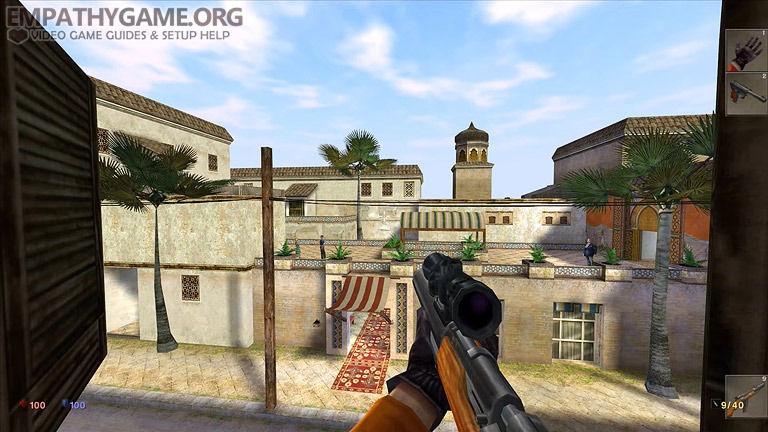
That constant change is the game’s defining strength. No individual system is as refined as the best dedicated shooter or stealth game, yet the campaign keeps finding new contexts for them. The result is less a pure tactical simulation than an authored spy adventure whose personality comes from variety: listening before shooting, choosing equipment, searching for intelligence, improvising when an infiltration fails, and discovering that the funniest reward for patience may simply be another conversation between bored henchmen.
Missions Keep Changing the Problem
No One Lives Forever rarely treats a level as a straight corridor between firefights. The opening assassination attempt in Morocco establishes that quickly by putting Cate in a protective sniper role rather than dropping her into a conventional assault. Later assignments move through offices, industrial facilities, hotels, alpine bases, a sinking freighter, and other spaces that use different combinations of infiltration, exploration, combat, gadgets, and set pieces. Even when the route is ultimately linear, the immediate problem changes often enough that the campaign seldom feels mechanically flat.
This variety matters because many objectives are simple on paper. Cate may need to enter a restricted area, recover information, photograph evidence, escort someone, sabotage equipment, or reach an extraction point. What gives those tasks character is the surrounding situation. A quiet approach can reveal a conversation that would be lost in a firefight. A gadget can open a side route. A camera may matter more than the guards around it. A failed stealth attempt can turn a controlled infiltration into a noisy escape instead of always producing an instant mission failure.
The weakness appears when the game decides there is only one acceptable rhythm. Mandatory stealth scenes can be far less forgiving than missions where silence is simply advantageous. Detection conditions are not always communicated cleanly, and once a sequence is built around avoiding a particular alarm or sightline, experimentation gives way to learning the intended path. Quicksave and quickload make those sections manageable, but the contrast is revealing: No One Lives Forever is most entertaining when its systems overlap and least convincing when one of them becomes a rigid script.
Combat Rewards Patience More Than Constant Movement
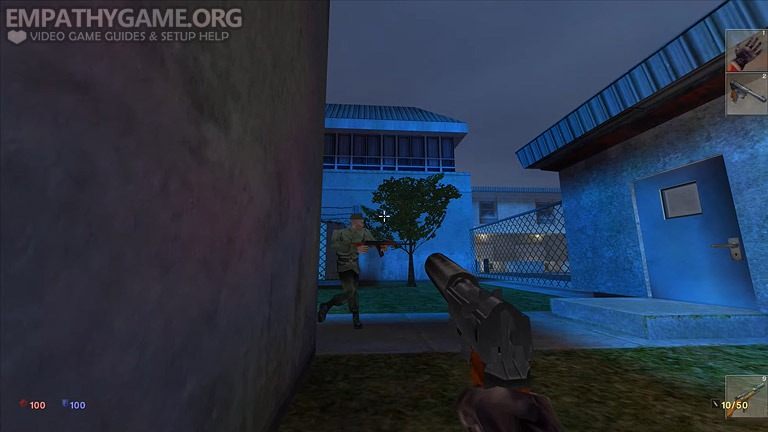
The gunplay looks conventional until movement starts affecting accuracy. The dynamic crosshair expands while Cate is moving and tightens when she settles, so accurate fire rewards a brief pause rather than constant strafing. With automatic weapons, that recovery can make aggressive stop-and-go shooting feel less responsive than a modern FPS. In practice, the game favors controlled positioning: find a useful angle, let the weapon settle, then place deliberate shots instead of expecting every burst to remain precise while moving.
That does not make the shooting lifeless. H.A.R.M. soldiers react visibly when hit, spent casings add small metallic details to the soundscape, and enemies sometimes use the environment in surprisingly expressive ways, including seeking cover or knocking over furniture for protection. The AI is inconsistent enough that a clever response can be followed by a guard behaving like a target in a shooting gallery, but the best encounters still create the sense that enemies are responding to a room rather than merely waiting in fixed positions.
The arsenal also has more personality than a basic damage ladder. Suppressed pistols reward quiet headshots, sniper weapons suit long sightlines, automatic guns become emergency tools when stealth collapses, and specialized ammunition creates situational choices. The scoped crossbow is especially distinctive because its slow reload punishes careless shots around groups, while bolts that remain lodged in enemies can be recovered. That turns ammunition conservation into part of the weapon’s identity: a precise kill can preserve both silence and resources.
Damage management reinforces the same cautious style. Armor absorbs most conventional punishment and can be replenished from pickups, while lost health is far more persistent during a mission. Taking a few careless hits therefore matters even when the encounter is won. Higher difficulties amplify that pressure because enemies become more accurate and more responsive to signs of Cate’s presence. The effect is not a full tactical shooter, but it gives positioning, armor preservation, and avoiding unnecessary chip damage more importance than the colorful spy-movie presentation initially suggests.
Stealth Is Clever Until Its Rules Turn Brittle
Stealth works best when the environment itself becomes information. Guards can react to footsteps, weapon fire, bodies, and other disturbances, while snowy areas add an unusually specific risk: Cate’s footprints can reveal where she has moved. Details like that make some spaces feel more simulation-minded than the game’s age suggests. Avoiding a patrol is not always enough if the evidence left behind can attract attention afterward.
The available tools support several styles of quiet play. Suppressed weapons remove threats at range, distractions can redirect attention, cameras encourage route planning, and the body-removal gadget can erase evidence that would otherwise expose an infiltration. Listening is also mechanically useful because guards often reveal their position through conversation before they are visible. The same habit rewards the player narratively, since waiting behind a corner may uncover one of H.A.R.M.’s workplace arguments instead of merely providing tactical information.
The problem is consistency. Enemy awareness can feel perceptive in one scene and strangely limited in another, and the transition from suspicious to fully alerted is not always as readable as in later stealth games. Some missions allow a mistake to evolve naturally into combat, which suits the game’s hybrid identity. Others treat detection as a hard failure condition. Those stricter moments expose how much the game relies on quicksaving and prior knowledge, because the player may understand what went wrong only after the mission has already decided the attempt is over.
That unevenness prevents the stealth from reaching the systemic confidence of Thief, but it also creates a useful tension. No One Lives Forever is not asking for ghost runs through every mission. It is usually more interested in giving Cate enough tools to begin with a plan, then letting the situation become messy. The most memorable infiltrations are therefore not necessarily the cleanest ones; they are the ones where a small mistake changes the mission without immediately ending it.
Gadgets Make the Spy Fantasy Mechanical
The gadgets are more than jokes attached to an ordinary shooter. A lock-picking barrette turns an accessory into an infiltration tool. Spy glasses double as a camera for intelligence work. Lipstick becomes an explosive. A cigarette lighter can act as a miniature welder. The robotic poodle exists to distract guard dogs, a concept ridiculous enough to fit H.A.R.M.’s world while still solving a practical problem. Santa’s Workshop gives these devices a place in the fiction before missions ask the player to recognize where they belong.
The best gadget moments happen when a tool changes how a space is read. A locked route stops being background decoration once Cate has the correct device. A photograph can become an objective. Later equipment can justify revisiting earlier missions because previously inaccessible secrets or intelligence become reachable. That makes gadget acquisition feel like expanding a vocabulary rather than simply increasing combat power.
Inventory access is less elegant. The PC version’s number-key hotkeys can be rebound to selected weapons and gadgets, but the expanding mission-specific toolset makes that arrangement increasingly awkward. Reassigning quick-access slots between assignments is a small inconvenience, yet it matters because the game often expects rapid switching between conventional weapons and highly specific devices. The spy toolkit is imaginative; the interface used to reach it can feel more cumbersome than the ideas deserve.
Cate Archer Gives the Comedy a Straight Face
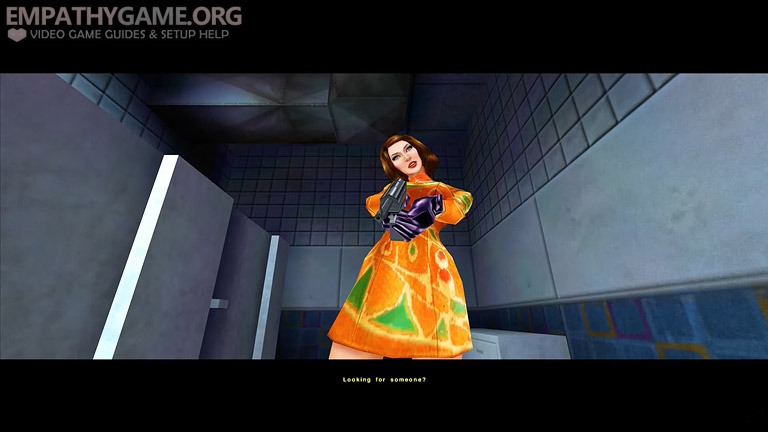
Cate Archer is the reason the parody has a center. She enters UNITY as an operative whose competence is repeatedly underestimated, and the script uses the sexism around her as both conflict and satire without making her the joke. Cate’s dry professionalism lets the surrounding cast become absurd. She can respond to condescension without losing control of the scene, while H.A.R.M.’s villains and employees behave as if international criminal conspiracy were merely another institution with bad management, petty rules, and office politics.
The funniest writing is often optional. Guards discuss relationships, hobbies, workplace complaints, management decisions, and nonsense with complete seriousness before Cate ever engages them. Intelligence documents extend the same idea by showing H.A.R.M. through memos, reports, and administrative trivia. The humor works because it is embedded in the spaces rather than delivered only through cutscenes. Sneaking slowly through a level becomes a way to discover characterization.
That relationship between comedy and play is unusually important. Charging into every room with an automatic weapon can erase conversations before they finish. A patient player hears more of the world and therefore understands more of its tone. Stealth is not merely the efficient option; it is occasionally the funnier one. Few shooters make restraint rewarding for reasons that have nothing to do with score, ammunition, or damage taken.
The art direction supports that identity. Bright interiors, extravagant costumes, bold signage, lounge-influenced music, and deliberately theatrical villains communicate the period more effectively than technical realism ever could. Character models and facial detail naturally show their age, and some animation is stiff beside newer shooters, but the visual language remains coherent. The presentation looks old; it rarely looks anonymous.
Intelligence Gives Replay More Purpose Than Completionism
There is no skill tree or conventional character-level grind. Progress comes from new equipment, mission knowledge, optional intelligence, hidden gear, and performance rewards. Collecting intelligence does more than fill an archive: stronger mission ranks can improve practical attributes such as health, armor capacity, ammunition, damage, accuracy, or stealth. Exploration therefore feeds back into later play without turning Cate into an RPG build.
Some intelligence and key mission items can also appear in different locations between runs. Berlin’s explosive charges are a notable example, and certain intelligence placements can vary as well. That small amount of rearrangement matters because it complicates pure route memorization. Replaying a mission for complete intelligence is not always a matter of following the exact same checklist through identical rooms; observation still matters, especially when the player is hunting the final missing document or objective item.
Mission Select gives those systems somewhere to pay off. Later gadgets can open secrets missed earlier, higher difficulties make stealth and armor management more demanding, and equipment choice can change how a familiar encounter unfolds. The campaign is still authored rather than systemic enough to transform completely on a second run, but it contains more reasons to revisit missions than simply replaying favorite set pieces.
The original competitive multiplayer modes are comparatively conventional beside the single-player campaign. Deathmatch and H.A.R.M. vs. UNITY extend the weapon set into competitive play, but they do not reproduce the campaign’s greatest strength: the constant collision of dialogue, gadgets, stealth, set pieces, and changing objectives. No One Lives Forever’s lasting identity is overwhelmingly tied to Cate’s missions.
Final Verdict
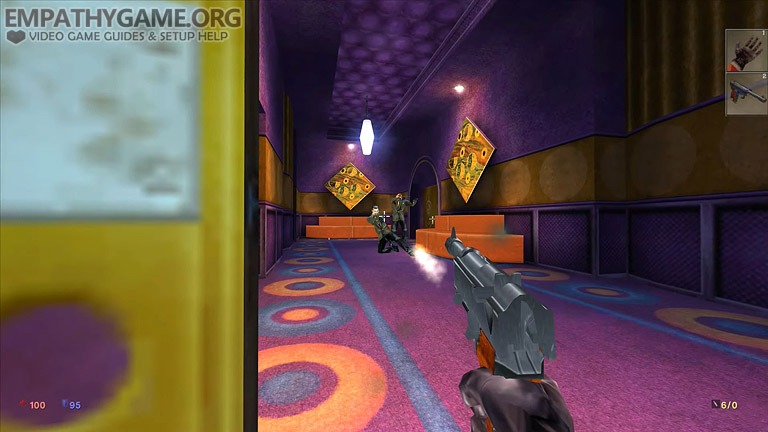
The Operative: No One Lives Forever endures because nearly every part of it serves the same fantasy. Cate is not simply a shooter protagonist holding novelty gadgets. She is an operative moving through missions where listening, sneaking, shooting, surveillance, strange equipment, elaborate escapes, and deadpan comedy continually overlap. The campaign’s variety keeps ordinary objectives from feeling ordinary, while Cate and H.A.R.M. give the world a tone that remains recognizable long after its technology has dated.
Its weaknesses are just as clear. Movement-sensitive accuracy can feel sluggish until its rhythm is understood, mandatory stealth is more brittle than the flexible missions around it, enemy awareness is inconsistent, and the hotkey interface makes an imaginative gadget set harder to manage than necessary. Yet even those rough edges often reveal interesting design ideas: armor preservation matters because health is difficult to recover, footprints can compromise a quiet route, and careful crossbow shots can be rewarded with reusable ammunition.
Players who want a polished modern stealth simulation or relentlessly precise gunplay will notice the age immediately. Players who value authored single-player campaigns, strong dialogue, mechanical variety, and games willing to change tone and objective from one mission to the next have much more to gain. No One Lives Forever is uneven in the places where genres meet, but that same collision of shooter, stealth game, spy parody, and adventure is exactly what gives it a personality that remains difficult to imitate.
The Operative: No One Lives Forever Pros & Cons
The Operative: No One Lives Forever PC System Requirements
ORIGINAL WINDOWS PC MINIMUM REQUIREMENTS:
OS: Windows 95 / 98 / ME / 2000
CPU: Intel Pentium II 300 MHz
RAM: 64 MB
GPU: 8 MB 3D hardware accelerator with Direct3D support
DirectX: DirectX 7.0 or higher
Storage: 400 MB free hard-drive space
Network: 56K modem or LAN connection for multiplayer
Sound Card: DirectX-compatible 16-bit sound card
Additional Notes: 4x CD-ROM drive, keyboard and mouse
Additional PC Performance and Setup Notes
- Historical specifications: The requirements above describe the original Windows release and should not be interpreted as a guarantee of compatibility with a modern operating system.
- Retail DRM: SafeDisc protection on affected original retail editions is a more significant modern-Windows obstacle than the game’s very low hardware requirements.
- Frame rate: The engine is safest at 60 FPS. Running substantially above that can alter animation timing and environmental audio behavior.
- Modern displays: Native widescreen presentation and interface scaling reflect the game’s age. NOLF Modernizer provides community improvements for wider displays and HUD scaling.
- Mouse and performance: NOLF Modernizer also addresses mouse stutter and selected performance problems, including issues that can appear with some integrated graphics hardware.
- Clean backups: Keep a backup of a working retail installation before experimenting with community modifications, texture projects, configuration edits, or compatibility tools.
Video Trailer
Frequently Asked Questions
Is The Operative: No One Lives Forever worth playing in 2026?
Yes, especially for players who enjoy story-driven shooters, stealth, spy gadgets, unusual mission scenarios, and dry 1960s espionage humor. Its gunplay, AI, and forced-stealth sections show their age, while getting the old PC version running smoothly can require more preparation than a modern game.
Is No One Lives Forever more of a shooter or a stealth game?
It is a first-person shooter with a substantial stealth layer rather than a pure stealth game. Many missions allow Cate Archer to sneak, distract guards, use silent weapons, or fight openly, although certain objectives impose stricter detection or alarm rules.
Do you have to stay undetected in every mission?
No. Most missions tolerate combat and alarms, but some espionage sections fail if an alarm is triggered or a specific detection condition is broken, so the game occasionally switches from optional stealth to mandatory stealth.
How do the difficulty settings work?
The PC version includes Easy, Normal, Hard, and Super Spy. Higher settings primarily make enemies more accurate and more responsive to sounds and other signs of Cate’s presence, making careless movement and loud combat increasingly risky.
Can you choose weapons and gadgets before missions?
Yes. After selecting a mission and reading its briefing, the PC version can let you customize Cate’s available weapons and gadgets, although required equipment and mission-specific restrictions still apply.
What kinds of spy gadgets does Cate Archer use?
The arsenal includes deliberately absurd spy-movie tools such as a lock-picking barrette, photographic spy glasses, a cigarette lighter that doubles as a welder, lipstick explosives, a belt-buckle zip line, and a robotic poodle used to distract guard dogs. Gadgets are often tied to objectives, alternate routes, hidden areas, or optional intelligence.
What are intelligence items, and are they worth collecting?
Intelligence items are optional documents, photographs, tapes, briefcases, and similar objects scattered through missions, often containing jokes or extra world-building. Collecting enough improves Cate’s mission rank and can award gameplay bonuses affecting areas such as health, armor, ammunition capacity, accuracy, damage, and stealth.
Can you replay completed missions?
Yes. Completed missions remain available through Mission Select, making it possible to revisit them for missed intelligence and secrets. Later equipment can also make some previously inaccessible areas or collectibles easier to reach.
Does No One Lives Forever have quicksave and quickload?
Yes. The original PC controls assign quicksave to F6 and quickload to F9, which is particularly useful during the game’s stricter stealth sequences and longer encounters.
What does the Game of the Year Edition add?
The Game of the Year Edition adds the post-campaign Rest and Relaxation mission, additional multiplayer maps and skins, extra textures, and official editing resources including the map editor and released game-side source code. The bonus single-player mission is the most important piece of content that distinguishes it from the standard PC release.
What is the Rest and Relaxation mission?
Rest and Relaxation is a bonus single-player episode set after the main campaign and included with the Game of the Year Edition. It should therefore be played after finishing the original story rather than treated as an early or mid-campaign mission.
Is the PlayStation 2 version the same as the PC version?
No. The PS2 port adds an exclusive prequel-style sequence involving Cate before her UNITY career, but it also changes controls and presentation and removes PC features including multiplayer. That exclusive story material was never incorporated into the Windows release.
Does No One Lives Forever have multiplayer or co-op?
It has competitive multiplayer but no cooperative campaign. The original PC multiplayer includes Deathmatch and H.A.R.M. vs. UNITY, an objective-based team mode; co-op was introduced in No One Lives Forever 2, not the first game.
Does No One Lives Forever support split-screen or local co-op?
No. The PC version has no split-screen or same-computer cooperative mode. Local multiplayer instead requires separate computers using the game’s LAN functionality.
Does No One Lives Forever support LAN multiplayer?
Yes. The PC release supports LAN play and allows players to host or join local multiplayer sessions without relying on the original internet server browser.
Are No One Lives Forever’s original online services still available?
The original GameSpy-based internet service is no longer operating. Community projects such as NOLF Modernizer replace that obsolete infrastructure and can provide working community multiplayer, but this is unofficial rather than publisher-operated online support.
Does No One Lives Forever work on Windows 10 and Windows 11?
It can, but an original installation should not be expected to behave like a modern Windows game. Old retail copy protection, the LithTech renderer, display scaling, input behavior, and certain graphics hardware can create compatibility problems, so results vary by edition and system.
Can No One Lives Forever run above 60 FPS?
Running substantially above 60 FPS is not recommended because the original engine can develop timing problems, including incorrect animation speed and environmental audio behavior. NOLF Modernizer includes a frame-rate cap specifically to keep the game near its intended behavior.
Does No One Lives Forever support widescreen and ultrawide monitors?
Modern resolutions can be used, but the unmodified game does not handle widescreen presentation as cleanly as a modern title, particularly with interface scaling. NOLF Modernizer improves widescreen behavior and HUD scaling, while very wide or high-resolution displays can still expose limitations in old menus and overlays.
Does No One Lives Forever have controller support on PC?
Some controller input is possible, but the PC version was designed primarily around keyboard and mouse and does not provide modern full-controller support. Contemporary Xbox-style controllers can therefore require extra mapping and are generally less straightforward than using mouse and keyboard.
What is NOLF Modernizer?
NOLF Modernizer is an unofficial open-source community modification designed for an existing No One Lives Forever installation. It addresses issues including mouse stutter, selected performance problems, 60 FPS limiting, modern display behavior, Intel graphics problems, and replacement multiplayer connectivity.
Does No One Lives Forever support mods?
Yes. Monolith released game-side source code and editing resources, and the Game of the Year package included tools useful for custom maps and modifications. There is no Steam Workshop because the game has no Steam release, so its modding ecosystem is based on traditional community tools and websites.
Can you buy No One Lives Forever on Steam or GOG?
There is no verified official Steam release or normal GOG purchase listing. GOG maintains a Dreamlist page where players can vote for the game to be brought to the service, but that page does not provide ownership of the game.
Still have questions? Check the No One Lives Forever Reddit community, GOG Dreamlist page, or NOLF Modernizer project for additional discussion, preservation information, and modern-PC technical help.
Sources & References
Key factual and technical information in this guide was checked against relevant archival, platform, and community sources, including:
- GOG Dreamlist — The Operative: No One Lives Forever — used to verify the game’s present GOG request/preservation status rather than treating it as a current GOG purchase listing
- PCGamingWiki — The Operative: No One Lives Forever — used for retail DRM, modern Windows compatibility, frame-rate behavior, GameSpy shutdown, requirements, widescreen, and technical setup context
- MobyGames — No One Lives Forever Windows Releases — used to verify the original Windows release, developer, publisher, and LithTech information
- MobyGames — No One Lives Forever Game of the Year Edition — used to verify the expanded edition and its additional campaign, multiplayer, source-code, and editing content
- NOLF Modernizer on GitHub — used to verify the unofficial community project’s frame-rate, mouse, performance, GOTY, and multiplayer features
- Metacritic — The Operative: No One Lives Forever — used to verify the original PC release’s critic Metascore
Similar Games Like The Operative: No One Lives Forever
- No One Lives Forever 2: A Spy in H.A.R.M.’s Way
- 007: Nightfire
- 007 First Light
- 007: Quantum of Solace
- Tom Clancy’s Splinter Cell: Chaos Theory
- Hitman World of Assassination


Found something worth playing through DecideGame?
DecideGame.com is an independent gaming project run by Editor Zero. If this guide helped you discover a game, solve a problem, or find useful information, you can support DecideGame.com and help keep new and updated game guides coming.
DecideGame — PC Game Guides, Reviews & Setup Help