

📅 Game released: 2026
Resident Evil Requiem combines Grace Ashcroft’s tense investigation with Leon S. Kennedy’s more forceful survival-horror action, letting players switch between first-person and third-person views. This PC guide compares official Steam and Epic Games Store purchase and download options, Standard and Deluxe content, the demo, system requirements, Steam Deck compatibility, and practical setup advice.
 By Editor Zero — independently researched, edited, and maintained.
Last updated: 7 November 2026
Last reviewed: 7 November 2026
Table of Contents
- Quick Facts
- Official PC Stores, Download & Installation
- Resident Evil Requiem Review
- Pros & Cons
- PC System Requirements
- Frequently Asked Questions
- Similar Games
Resident Evil Requiem Quick Facts
- Game: Resident Evil Requiem / Standard Edition / Deluxe Edition / Deluxe Kit
- Developer: Capcom
- Publisher: Capcom
- Genre: Survival Horror, Horror, Zombie Games, Shooter, Puzzle-Solving
- Release: February 27, 2026
- Platforms: Windows PC, PS5, Xbox Series X|S, Nintendo Switch 2
- PC Editions: Standard Edition and Deluxe Edition; the Deluxe Kit is also sold separately
- Cloud Access: GeForce NOW (Steam version; game ownership, a supported membership, and an internet connection required)
- Permanent extra content: Photo Mode and Leon Must Die Forever; the latter unlocks after completing the campaign
- Official Demo: Available through Steam and Epic Games Store; demo progress does not transfer to the full game
- Steam Deck: Playable; manual graphics configuration is recommended, and first-time setup requires internet access
- Engine: RE ENGINE
- Modes: Single-player campaign and the solo Leon Must Die Forever minigame; no official co-op, PvP, or split-screen
- Community: Official Resident Evil Requiem Website, Steam Discussions, Resident Evil Requiem Reddit
- PC modding: Nexus Mods hosts unofficial camera, field-of-view, visual, outfit, interface, and quality-of-life modifications; official mod tools and Steam Workshop support are not listed
- Metacritic score: 92/100 on PC
- IGN score: 9/10 for the same multiplatform release; IGN reviewed it on PS5
- OpenCritic average: 89/100 (multiplatform critic average)
- Steam user reception: Overwhelmingly Positive
Official PC Stores, Download & Installation
👇 Compare the official Steam and Epic Games Store options below before purchasing, downloading, installing, or choosing Resident Evil Requiem content.
- PC availability: The native Windows PC version is officially sold through Steam and Epic Games Store.
- Standard Edition: The base edition contains the complete single-player campaign plus permanent free additions such as Photo Mode and Leon Must Die Forever.
- Deluxe Edition: This package contains the base game and Deluxe Kit; it does not add a separate story campaign.
- Deluxe Kit: The kit adds two Grace costumes, three Leon costumes, two screen filters, four weapon skins, two charms, the Raccoon City Classic audio pack, and Files: Letters from 1998.
- Upgrade path: Standard Edition owners can buy the Deluxe Kit separately. Do not purchase the standalone kit when the Deluxe Edition is already in your library.
- Separate costume: Grace’s Apocalypse costume is a separate add-on rather than part of the Deluxe Kit, and the original soundtrack is also sold separately on Steam. Check package contents before buying extras.
- Official demo: Steam and Epic Games Store offer a demo covering part of the opening. Demo save data cannot be transferred to the full game.
- Steam DRM: Steam lists Denuvo Anti-Tamper with a limit of five different PC activations within one day.
- Offline play: Valve’s compatibility metadata says first-time setup requires an active internet connection, while the single-player game does not require a continuous connection afterward.
- Store ownership: Steam and Epic purchases are separate store entitlements; buying the game or an add-on on one storefront does not grant the equivalent ownership on the other.
- Steam features: Steam supports achievements, Steam Cloud, full controller support, Family Sharing, and a Playable Steam Deck rating; Deck users should expect to configure graphics settings manually.
- Cloud streaming: NVIDIA supports the Steam version through GeForce NOW. Cloud access requires a copy of the game, a compatible membership and region, and a reliable internet connection; it is not a separate game license.
- DualSense support: The PC version supports adaptive triggers, vibration, motion-sensor functions, and the light bar on DualSense. Capcom’s troubleshooting guidance notes that vibration requires a wired connection and native controller handling rather than Steam Input.
 Buy Resident Evil Requiem on Steam
 Buy Resident Evil Requiem on Epic Games Store
 Visit the Official Resident Evil Requiem Website
Resident Evil Requiem Review
Two very different survivors make familiar Resident Evil fears feel unpredictable again.
Resident Evil Requiem brings two sides of Capcom’s survival-horror series into the same campaign. Grace Ashcroft’s frightened, methodical investigation recalls the suffocating tension of Resident Evil 7: Biohazard, while Leon S. Kennedy brings the confidence and physicality of the action-focused remakes. Their approaches are so different that moving between them can change how an otherwise familiar room feels.
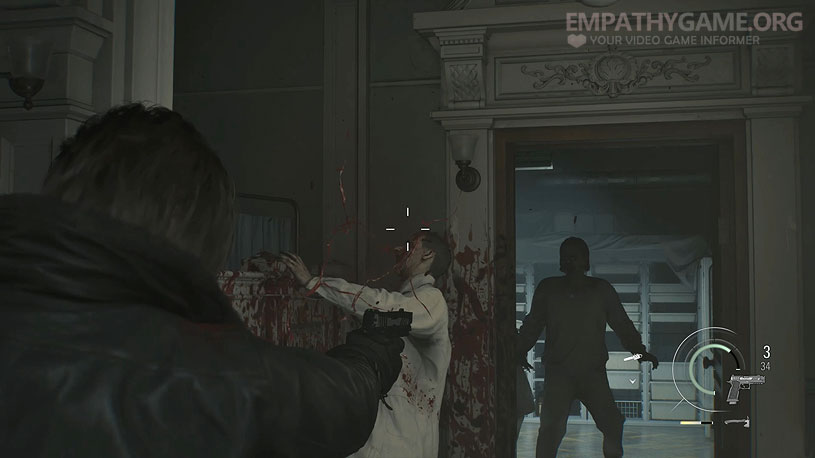
Grace must consider whether a fight is worth the ammunition, while Leon is better equipped to deal with threats that seemed impossible to confront earlier. There is satisfaction in both approaches, although the campaign does not balance them as evenly as its opening suggests.
At its best, Requiem understands that survival horror is not only about monsters jumping into frame. It is about the slow pressure of low ammo, the hallway you do not want to enter, the save room you are trying to reach, and the horrible feeling of realizing you probably wasted too many bullets in the last fight.
Story and Characters
FBI analyst Grace Ashcroft investigates disturbing deaths linked to a mysterious disease. She is observant and capable, but she is not trained to face every horror with a weapon. Her hesitation and visible fear make ordinary investigation feel hazardous.
Grace’s connection to Alyssa Ashcroft gives the case personal meaning. Alyssa survived the Raccoon City Incident and investigated Umbrella’s secrets, so the mystery carries consequences that reach beyond another outbreak. Grace is confronting a history that shaped her life before she fully understood it. The story is most compelling when that personal uncertainty remains at the center of her decisions.
Leon offers a deliberately different perspective. Years of confronting bioterror threats have made him skilled, resourceful, and often darkly funny under pressure. Where Grace tends to make the player anticipate danger, Leon’s arrival promises a chance to confront it. That difference can be exhilarating, especially when the two protagonists revisit places for which they have very different capabilities.
There is a cost to the structure. Grace initially appears to be the emotional center of the campaign, but the longer Raccoon City stretches increasingly favor Leon. His action sequences are entertaining, yet her investigation loses some momentum when she spends so much of the later journey away from the controls. The change is not simply a matter of counting minutes. It weakens the early impression that two equally important styles of horror will develop side by side.
Players drawn to Grace’s vulnerability and inherited family mystery may also appreciate Silent Hill f. Its 1960s Japanese setting, ritual imagery, and symbolic monsters create a very different nightmare, but Hinako’s story is similarly affected by pressures that existed before the supernatural danger appeared. In both games, the mystery becomes more unsettling when it reaches into personal identity rather than remaining an external threat.

Gameplay and Mechanics
Much of the campaign follows a familiar rhythm: explore an unsafe building, discover which routes are locked, collect supplies and clues, then decide how much risk is acceptable to reach the next objective. A corridor that Grace treats as an obstacle to avoid can become a place Leon is prepared to clear by force.
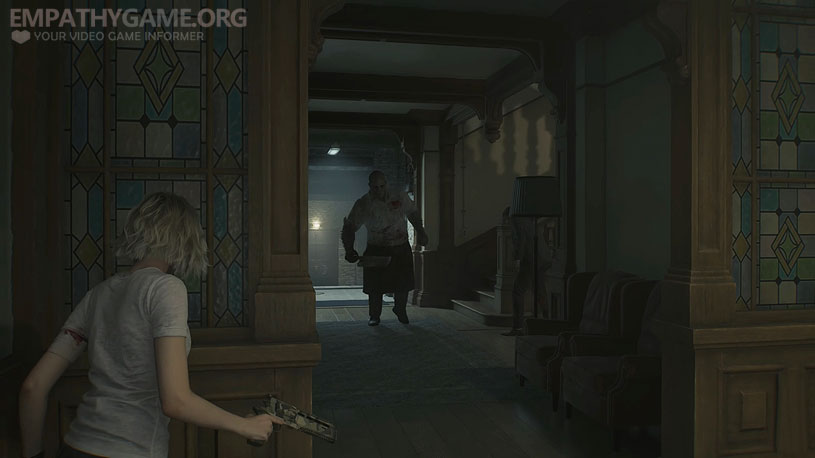
Grace’s limited inventory and ammunition make that calculation especially meaningful. Avoiding an infected patient may save several bullets, but it can also leave an enemy wandering a route you will need again. A quiet medical room with a useful item is not automatically a reward if collecting it draws attention to your position. Survival depends on knowing when to retreat, not just recognizing where to shoot.
The infected are more interesting than standard wandering targets. Some retain fragments of their former routines, such as a cleaner obsessively returning to dirty surfaces. Their behavior can change in response to a nearby mess or disturbance, making a room feel occupied by individuals rather than interchangeable enemies. Weapon-carrying infected can also create chaos among themselves. Watching before acting occasionally reveals a safer approach than opening fire immediately.
Leon has more direct answers: firearms, melee attacks, parries, and a hatchet that can defend him as well as finish weakened opponents. Yet his combat does not follow Resident Evil 4 Remake exactly. Pistol shots are not always a reliable route to a stagger, and his roundhouse kick is less useful for sweeping entire crowds. Keeping distance and reserving stronger weapons or environmental opportunities for dangerous enemies can matter more than repeatedly setting up a kick.
Two Perspectives Make a Big Difference
The option to play in first-person or third-person does more than change where the camera sits. First-person narrows the player’s awareness and brings uncomfortable details closer. Footsteps behind a wall, a half-open door, or movement at the edge of a flashlight beam can create more anxiety when you cannot easily see what surrounds the character.
That view feels especially suited to Grace. Her fear becomes easier to understand when the corridor fills the screen and a pursuing enemy is difficult to track without turning around. Third-person provides a clearer sense of distance and body movement, which can make navigation and combat easier to read.
The choice also helps explain why Requiem can appeal to people who enjoy different Resident Evil eras. Someone who found Resident Evil 7‘s first-person intensity exhausting can retain much of the atmosphere from a more comfortable view. Conversely, players who want the threat to feel uncomfortably close need not settle for the familiar over-the-shoulder presentation.
Survival Horror, Combat, and Resource Management
Resource management ties both protagonists together even when their weapons differ. A fight is never just about surviving the enemy directly ahead. It can cost healing items, ammunition, crafting materials, or space needed for something useful later. The best encounters encourage that calculation without making it feel like accounting.
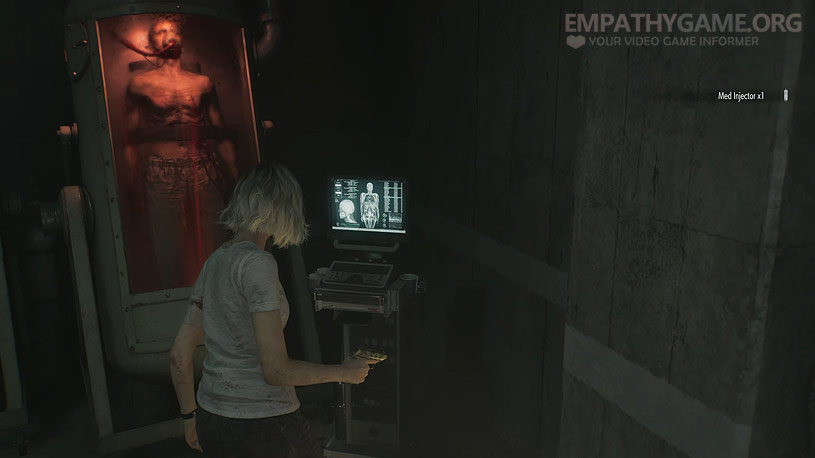
Grace’s infected-blood crafting makes this economy unusually disturbing. Blood from the environment and fallen creatures becomes material for useful supplies, including ammunition and injectors. It is a clever reversal: the infection that makes the care center frightening can also provide the means to survive it. The trade-off is uncomfortable because getting more from a corpse means approaching something that may not remain harmless.
Blister Heads make that uncertainty concrete. Some apparently defeated infected can return in a more aggressive mutated form as exploration advances. The important point is not memorizing one particular event that causes a transformation, but learning that a cleared hallway cannot always be trusted. A body left on the floor may become a problem precisely when you are carrying a valuable item back through the same space.
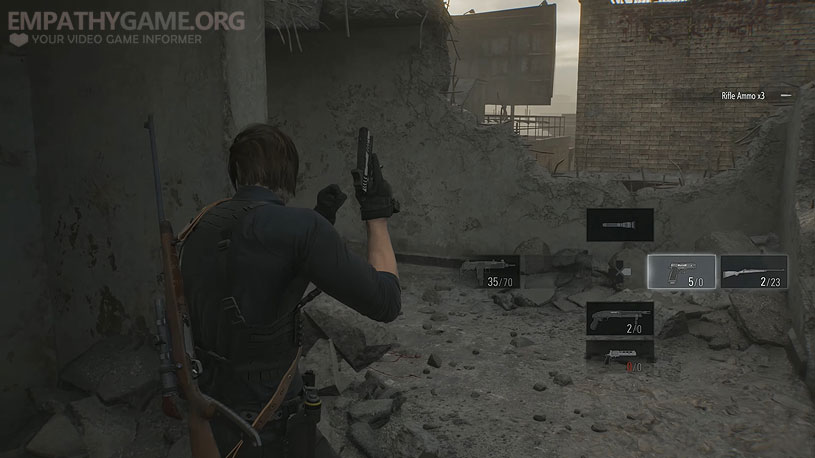
Leon replaces much of Grace’s vulnerability with preparation. His attaché case, weapon upgrades, hatchet, and more forceful combat options create satisfaction through equipment choices and execution. Shared locations add a particularly interesting consequence: enemies killed during Grace’s visit can remain dead when Leon returns. That continuity rewards decisive survival play, but it can also make his later sweep surprisingly quiet if Grace has already removed most of the opposition.
When the game keeps enough threats alive, Leon’s sections deliver a different pleasure from Grace’s. A crowded encounter demands positioning, quick reactions, and knowing which tool will create an opening. Players who prefer this aggressive survival-action rhythm may enjoy Resident Evil 3 Remake, another more direct entry that pushes combat and movement through collapsing urban spaces. It offers less sustained investigation, but a comparable urgency when enemies restrict the path forward.
World Building and Atmosphere
The Rhodes Hill Chronic Care Center is effective because its purpose and its condition are in constant conflict. Medical rooms should offer care and safety; here, their clinical surfaces, abandoned equipment, and traces of former routines make them profoundly unwelcoming. The remnants of Raccoon City carry another kind of dread, shaped by the knowledge of what happened there and how much of it remains unresolved.
Good Resident Evil locations need to feel like puzzles before they feel like battlefields, and Requiem understands that. A hallway is worth remembering because of the locked door halfway down it. An office becomes significant because of a clue that only makes sense later. Those connections make buildings feel like spaces to learn rather than corridors between scripted scares.
Lighting often leaves just enough information to create doubt. A flickering bulb reveals the shape of a room without confirming that it is empty. Uneven shadows give simple objects a threatening outline. The game is often at its most effective immediately after an encounter, when the danger seems to have passed but the environment has not become reassuring.
Sound strengthens that uncertainty. Heavy footsteps, wet movement, groans behind walls, and sudden stretches of silence make stopping to listen a reasonable survival decision. The infected’s remnants of personality add a troubling layer to it all. Hearing someone repeat a familiar human activity can be more disturbing than a conventional monster noise because it suggests how little of the person remains.
Puzzles, Investigation, and Exploration
Investigation gives Grace’s chapters a welcome change of pace. Documents, key items, locked routes, and environmental details make progress depend on noticing more than enemies. The most satisfying moments come when a place finally makes sense: a route reconnects, an item gives purpose to an earlier room, or an escape becomes possible because you remembered a shortcut.
The individual puzzles are not always as demanding as that exploration structure. Some care-center boxes, including the organ and quartz-related tasks, are heavily guided by nearby documents. Finding the relevant answer can become more important than reasoning toward it. This keeps the campaign moving, but it sometimes denies Grace’s investigative side the satisfaction of working something out independently.
Backtracking is more successful because returning somewhere familiar is rarely a neutral decision. Low supplies make a short detour feel costly, while altered enemy conditions can undo the confidence gained from learning a route. Even when a puzzle solution is straightforward, deciding how to reach its destination may still require thought.
If these slower elements are the main attraction, Resident Evil 2 Remake is a useful comparison. Its police station makes route memory, locked doors, and resource planning central to the experience. Requiem offers a broader mixture of horror and action, but its best exploratory stretches deliver a similar satisfaction when the layout of a building becomes something you understand rather than something you merely move through.
Grace’s analytical character helps these tasks feel appropriate to the story. Reading a report or reconstructing what happened in a hospital is more than a reason to delay the next gunfight. It is part of why she came there, even if the game occasionally makes the solution easier than the surrounding mystery deserves.

Replayability and Long-Term Appeal
The first journey through Resident Evil Requiem depends heavily on uncertainty. A repeat run changes the nature of that challenge. Knowing the map and enemy behavior allows more efficient routes, fewer wasted resources, and different decisions about which threats to eliminate. Switching camera perspectives can also change how familiar encounters feel, particularly during Grace’s most confined sections.
There is room to experiment with the relationship between the two protagonists as well. Leaving a dangerous enemy for Leon can make Grace’s route more nerve-racking while preserving a satisfying later confrontation. Clearing too thoroughly with Grace has the opposite effect. That gives repeated visits to shared locations a consequence beyond collecting every available item.
Faster completions, missed collectibles, tougher difficulty settings, and cleaner combat provide familiar Resident Evil incentives. Increased knowledge reduces the unknown, but the challenge shifts toward performing well under tighter constraints. A second run need not reproduce the first run’s fear to remain worthwhile.
Leon Must Die Forever takes that mastery in an arcade-like direction. Timed stages, changing routes, difficulty ranks, and enhancer combinations reward rapid adaptation more than careful investigation. Its stricter hatchet maintenance is an interesting complication: unlike the campaign, sharpening cannot simply be repeated at will. At higher ranks, some enemy combinations can therefore feel excessively dependent on having the right repair or parry resources available. The mode adds substantial combat replay value, but its randomness does not always produce equally satisfying challenges.
Final Thoughts
Resident Evil Requiem works because it understands the appeal of both cautious survival horror and confident action. Grace makes a familiar hallway feel dangerous through scarcity and uncertainty. Leon turns those dangers into opportunities for fast, forceful combat. Their differences give the campaign variety without erasing the importance of resource decisions.
The balance is less convincing later on. Grace deserves more playable space after her strong opening, and several puzzles offer answers too readily. Yet the care center’s interconnected layout, memorable infected behavior, and unsettling atmosphere make a lasting impression. The possibility that yesterday’s safe route may no longer be safe remains one of the game’s best sources of tension, closely tied to the appeal of classic Resident Evil.
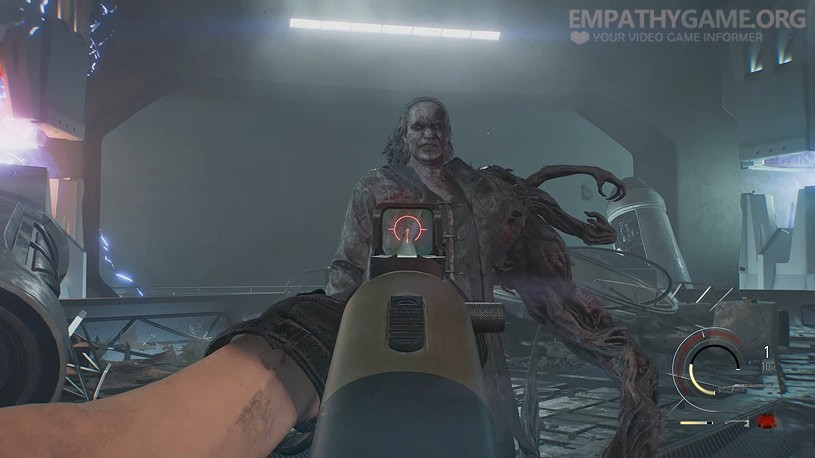
Players who enjoy learning hostile spaces, conserving supplies, and then mastering the combat systems will find plenty to appreciate. Those looking for a consistently Grace-led horror story, intricate deduction, or one sustained tone may find the latter half frustrating. Requiem is strongest when it lets its two approaches challenge each other rather than allowing one to take over.
Resident Evil Requiem Pros & Cons
- Pro: Grace’s vulnerable investigation and Leon’s heavier combat create two distinct but complementary survival-horror rhythms
- Pro: First-person and third-person cameras let players prioritize immersion, situational awareness, or familiar over-the-shoulder combat
- Pro: Interconnected locations, locked routes, puzzles, files, scarce resources, crafting, and backtracking preserve classic Resident Evil tension
- Pro: RE Engine presentation, sound design, Raccoon City history, and strong enemy staging make exploration consistently oppressive
- Pro: Photo Mode, Leon Must Die Forever, tougher ranks, unlocks, collectibles, and route mastery extend replay value
- Con: The shift from Grace’s slow horror to Leon’s larger action sequences can feel uneven for players who strongly prefer one style
- Con: Windows 11, an SSD, 16 GB RAM, and aggressive upscaling in the official targets limit compatibility with older PCs
- Con: The Deluxe Edition is mainly cosmetic and bonus material rather than a story expansion
- Con: Camera, field-of-view, path-tracing, and shader-related behavior may still require adjustment on some PC configurations
Resident Evil Requiem PC System Requirements
Official requirements: Capcom lists Windows 11 64-bit, DirectX 12, 16 GB RAM, and an SSD for both tiers. The minimum target is upscaled 1080p from a native 640p image at 30 FPS, while the recommended target is upscaled 1080p from 720p at 60 FPS.
MINIMUM:
OS: Windows 11, 64-bit
CPU: Intel Core i5-8500 / AMD Ryzen 5 3500
RAM: 16 GB
GPU: NVIDIA GeForce GTX 1660 6 GB / AMD Radeon RX 5500 XT 8 GB
DirectX: Version 12
Storage: Exact available-space amount is not listed in the current official PC requirements
Drive: SSD required
Target: Upscaled 1080p from native 640p, 30 FPS; frame rate may drop under heavy processing load
RECOMMENDED:
OS: Windows 11, 64-bit
CPU: Intel Core i7-8700 / AMD Ryzen 5 5500
RAM: 16 GB
GPU: NVIDIA GeForce RTX 2060 Super 8 GB / AMD Radeon RX 6600 8 GB
DirectX: Version 12
Storage: Exact available-space amount is not listed in the current official PC requirements
Drive: SSD required
Target: Upscaled 1080p from native 720p, 60 FPS; frame rate may drop under heavy processing load
Additional PC Performance and Setup Notes
- Install the game on an SSD and keep additional free space available for updates, shader caches, screenshots, temporary installation files, and mods.
- For path-tracing or upscaling visual problems, check the game and graphics-driver versions before trying community workarounds, and compare settings with a clean default configuration.
- If performance is unstable, test without path tracing, lower lighting, shadows, volumetric effects, mesh quality, and texture settings that exceed available VRAM, then compare the available upscaling modes.
- Valve rates the game Playable on Steam Deck. The default controller configuration, Deck icons, and interface text meet Valve’s checks, but graphics settings need manual configuration for good performance and first-time setup requires internet access.
- DualSense adaptive triggers, vibration, motion-sensor functions, and the light bar are supported on PC. Capcom’s troubleshooting guidance says vibration requires a wired connection and recommends disabling Steam’s PlayStation controller handling when using the native features.
- For crashes or progress problems, update the game, verify official files, remove outdated mods and ReShade files, disable unstable overclocks, close unnecessary overlays, and test a clean launch before reinstalling.
- Back up several manual saves before adding camera, field-of-view, outfit, script, or REFramework-based modifications because game updates can break compatibility.
Official Trailer
Note: Capcom’s official launch trailer presents Grace Ashcroft, Leon S. Kennedy, Raccoon City’s legacy, first-person fear, third-person combat, infected enemies, puzzles, and the game’s blend of survival horror and action.
Frequently Asked Questions
What is Resident Evil Requiem, and is it Resident Evil 9?
Yes. Resident Evil Requiem is the ninth mainline entry, combining FBI analyst Grace Ashcroft’s frightening investigation with veteran agent Leon S. Kennedy’s more aggressive survival-action chapters. Both stories connect to the legacy of Raccoon City.
Do I need to play earlier Resident Evil games first?
No. The main story is understandable on its own, though Resident Evil 2 Remake adds Leon and Raccoon City context. Resident Evil 4 Remake provides perspective on Leon’s combat style, while Resident Evil Village shows more of the series’ modern first-person horror approach.
Is Resident Evil Requiem open world?
No. Its campaign uses structured, interconnected survival-horror environments, with puzzles, locked doors, shortcuts, files, backtracking, and scripted action sequences rather than a seamless open-world map.
Can I change between first-person and third-person cameras?
Yes. You can switch perspectives during gameplay. First-person makes Grace’s confined environments feel more claustrophobic, while third-person improves awareness of nearby enemies and gives Leon’s combat a familiar over-the-shoulder view.
Is Resident Evil Requiem more horror or action?
Both. Grace often needs to avoid threats and weigh the cost of limited supplies, while Leon has heavier weapons and stronger close-range combat tools. The campaign deliberately alternates between the two approaches rather than committing to just one.
Does Resident Evil Requiem have co-op, split-screen, or multiplayer?
No. The main campaign and Leon Must Die Forever are single-player experiences. There is no official online co-op, local split-screen, or PvP mode.
Which difficulty and beginner approach should I use?
Start with the middle difficulty for a balanced first run. Read files for puzzle clues, check maps for unexplored rooms, save stronger ammunition for tougher enemies, and avoid fights that do not help you reach your objective.
What can I do after completing Resident Evil Requiem?
You can replay the story on different difficulties, improve completion ranks, find missed collectibles, try another camera perspective, and use unlocked extras. The additional Leon Must Die Forever mode provides a separate combat-focused challenge.
What is Leon Must Die Forever, and how do I unlock it?
It is a free additional single-player minigame built around timed combat stages, difficulty ranks, and enhancer combinations. Complete the main campaign to unlock it automatically; its faster, repeatable challenges play differently from Grace’s exploration-focused chapters.
Does the PC demo carry progress into the full game?
No. The official demo on Steam and Epic Games Store covers part of the early game, but Capcom states that its save data cannot be transferred to the full release. You will start the campaign again after purchasing it.
Is Resident Evil Requiem on PC Game Pass or Xbox Play Anywhere?
No PC Game Pass or Xbox Play Anywhere entitlement is listed for the game. Its Xbox Series X|S edition is a console product; for a native Windows purchase, use Steam or Epic Games Store.
Does the Steam version use Denuvo, and can I play offline?
Steam lists Denuvo Anti-Tamper with a five-different-PC-activations-per-day limit. Initial setup requires an internet connection, but Valve’s compatibility metadata does not require a continuous connection for single-player gameplay afterward.
What is the Steam Deck compatibility rating?
Valve lists the Steam version as Playable. Controls, prompts, and interface text meet Valve’s Deck checks, but graphics settings may need manual adjustment and first-time setup requires an internet connection.
Does the PC version support DualSense features?
Yes. The PC version supports adaptive triggers, vibration, motion-sensor functions, and the light bar. Capcom’s Steam troubleshooting guidance advises a wired connection for vibration and disabling Steam’s PlayStation Controller Support when using the game’s native controller features.
Are Resident Evil Requiem mods available?
Yes. Nexus Mods hosts unofficial camera, field-of-view, outfit, visual, interface, and quality-of-life changes. Back up saves and verify compatibility before using mods, as older files can interfere with the game after an update.
Still have questions? Check the Resident Evil Requiem community on Reddit, Steam Discussions, and the official Resident Evil Requiem website.
Sources & References
Key factual and technical information in this guide was checked against relevant official and established sources, including:
- Capcom Resident Evil Requiem platform announcement — verified the official release date, launch platforms, ninth-mainline status, and RE ENGINE
- Resident Evil Requiem on Steam — verified Steam editions, Deluxe content, system requirements, Denuvo, controller features, Steam Cloud, Steam Deck category, and user reception
- Resident Evil Requiem Demo on Epic Games Store — verified official demo availability, non-transferable demo saves, and PC requirement targets
- Resident Evil Requiem Steam News — verified Photo Mode, Leon Must Die Forever, DualSense feature support, and permanent PC fixes
- Resident Evil Requiem configuration on SteamDB — verified Steam Deck and SteamOS compatibility metadata, initial online setup, and offline single-player capability
- Resident Evil Requiem PC critic reviews on Metacritic — verified the PC Metascore
- NVIDIA GeForce NOW announcement — verified availability of the Steam release through NVIDIA’s cloud-streaming service
Similar Games Like Resident Evil Requiem
- Resident Evil 2 Remake
- Resident Evil 7: Biohazard
- Resident Evil 4 Remake
- Resident Evil Village
- Silent Hill f
- Silent Hill (1999)






Found something worth playing through DecideGame?
DecideGame.com is an independent gaming project run by Editor Zero. If this guide helped you discover a game, solve a problem, or find useful information, you can support DecideGame.com and help keep new and updated game guides coming.
DecideGame — PC Game Guides, Reviews & Setup Help