
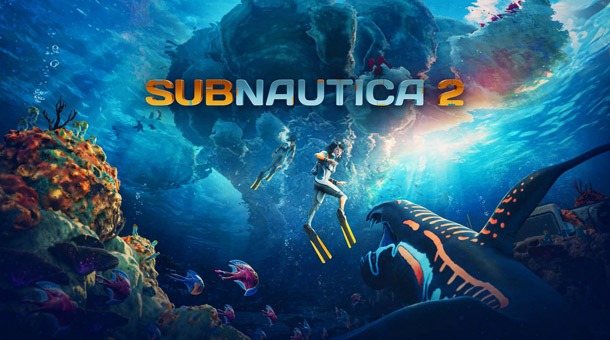
📅 Early Access started: 2026
Subnautica 2 takes underwater survival to a new alien planet, combining exploration, Bioscanner research, Biomods, customizable habitats, and optional four-player co-op. This PC guide compares official Steam, Epic Games Store, and Xbox download and installation options, Early Access and Game Pass access, Steam Deck support, system requirements, and practical setup considerations.
 By Editor Zero — independently researched, edited, and maintained.
Last updated: 13 November 2026
Last reviewed: 13 November 2026
Table of Contents
- Quick Facts
- Official PC Stores, Download & Installation
- Subnautica 2 Early Access Review
- Pros & Cons
- PC System Requirements
- Frequently Asked Questions
- Similar Games
Subnautica 2 Quick Facts
- Game: Subnautica 2 / Early Access / Xbox Game Preview
- Developer: Unknown Worlds Entertainment
- Publisher: Unknown Worlds Entertainment
- Genre: Survival, Crafting, Open World, Sci-Fi, Multiplayer
- Release: Early Access / Xbox Game Preview — May 14, 2026; full release: TBA
- Platforms: Windows PC, Xbox Series X|S
- Game Pass: Included with PC Game Pass and Game Pass Ultimate while it remains in the catalogue
- Xbox Play Anywhere: Supported by the Microsoft digital version across Xbox Series X|S, Windows PC, and compatible Windows handheld devices
- Modes: Single-player and optional online co-op for two to four players with cross-platform multiplayer
- Steam Deck: Verified
- Engine: Unreal Engine 5
- Community: Steam Discussions, Reddit Subnautica, Official Support
- PC modding: Unofficial Nexus Mods for Subnautica 2; updates can break compatibility, so back up saves and check mod versions after updating
- Metacritic score: N/A / Not scored (PC Early Access; no aggregate Metascore)
- IGN score: 7/10 (PC Early Access review)
- Steam user reception: Very Positive overall
Official PC Stores, Download & Installation
👇 Compare the official Steam, Epic Games Store, and Microsoft/Xbox options below before purchasing, downloading, installing, subscribing, or beginning a shared Subnautica 2 world.
- Early Access status: Subnautica 2 is an unfinished Early Access and Xbox Game Preview release. Its story, world, balance, performance, saves, and available features can change before version 1.0.
- PC availability: Steam, Epic Games Store, and Microsoft/Xbox Store provide official Windows PC access to the evolving base game.
- Early Access ownership: Unknown Worlds states that one Early Access purchase includes official additions and updates through version 1.0 and beyond; always check the chosen storefront for live pricing.
- Steam: Steam lists single-player, online co-op, cross-platform multiplayer, Steam Cloud, full controller support, and Family Sharing.
- Epic Games Store: Epic lists single-player, online multiplayer, co-op, controller support, and cloud saves.
- Microsoft / Xbox: The Microsoft digital edition supports Xbox Play Anywhere, Xbox cloud saves, Windows PC, Xbox Series X|S, cloud play, and compatible Windows handheld devices under the same Microsoft account.
- Game Pass: The Game Preview build is included with PC Game Pass and Game Pass Ultimate while it remains in the catalogue. A separate purchase provides ownership independent of future catalogue changes.
- Xbox Cloud Gaming: Cloud play is available through supported Xbox services and depends on the applicable subscription, region, device, network, and Xbox service terms.
- Co-op: Online sessions support two to four players, but the game is also designed to remain fully playable as a single-player survival experience.
- Cross-platform multiplayer: Supported PC and Xbox players can share sessions across compatible ecosystems. Everyone needs a compatible game build when joining the same world.
- Co-op features: Multiplayer includes proximity voice chat, player revives, emotes, direct item trading, shared exploration, and cooperative base building.
- Cloud saves: Steam, Epic, and Microsoft/Xbox provide their own save and cloud features. Do not assume that ownership or ordinary storefront cloud saves automatically transfer between unrelated store ecosystems.
- Steam Deck: Valve rates Subnautica 2 as Verified. External Bluetooth or USB controllers can require manually selecting the active controller through Steam’s Quick Access Menu.
- Unofficial mods: Official mod tools and Steam Workshop support are not listed. Back up important saves and disable incompatible community mods when troubleshooting crashes, missing content, or post-update problems.

 Buy Subnautica 2 on Epic Games Store
 Buy or Play Subnautica 2 with Xbox Play Anywhere
Subnautica 2 Early Access Review
A beautiful, unsettling alien ocean where better survival tools do not always mean greater freedom.
Subnautica 2 understands why diving into unfamiliar water can be more unsettling than fighting an enemy. Near the surface, there is color, movement and the reassuring possibility of turning back. Deeper down, visibility fades, the sea floor falls away and the distance to safety begins to matter more than whatever you came to find. This sequel preserves that uneasy attraction while moving the series to a new alien world with Bioscanner research, Biomods, more flexible habitats and optional four-player co-op.
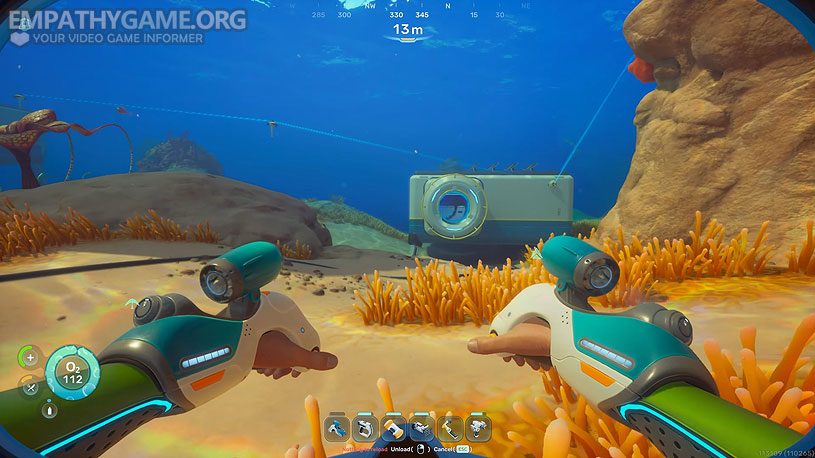
It is also an Early Access adventure, not a completed successor to the original. The story and deeper progression have not reached their final form, and some systems are less satisfying than the ideas behind them. That distinction matters because the game is already good at making a modest expedition feel consequential. A slightly longer oxygen supply or a new route through a reef can change the next hour of exploration. Yet making survival more convenient, or adding companions, does not automatically preserve everything that made the first Subnautica feel so lonely and mysterious.
Story and Setting
The CICADA colony mission leaves the Pioneers stranded on an unfamiliar ocean planet, with the AI NOA continuing to push them toward adaptation and investigation. Instead of simply following a disaster from a distance, the player is piecing together what happened through abandoned facilities, recordings, alien structures and discoveries scattered through the water. The premise is familiar in spirit, but the new world has its own questions. Human equipment suggests a planned future here; the surrounding ecosystem makes those plans seem increasingly fragile.
The stronger narrative moments grow naturally out of exploration. Reaching a deserted installation has a different effect from reading another instruction on the PDA. Its position, the route required to enter it and the objects left behind give the place meaning before the next recording begins. The Early Access story cannot yet offer a finished payoff, but these smaller discoveries give the ocean a history beyond its useful materials and dangerous wildlife.
NOA’s more frequent guidance is a trade-off. Clearer directions can prevent a newcomer from wandering without any idea what to investigate, while repeated voice prompts may interrupt the pleasure of discovering a route independently. It becomes particularly noticeable when several discoveries or PDA messages arrive close together. Players can still ignore an objective and explore, but there is a difference between being free to wander and feeling that the game is content to leave you alone. The original often trusted silence; this sequel sometimes seems reluctant to use it.
Survival, Crafting, and Deeper Progression
The basic rhythm remains compelling: collect materials, scan unfamiliar life, craft equipment, establish a habitat and travel farther before oxygen, thirst or a poor decision sends you home. An upgrade means more than a better number. A stronger oxygen supply changes which cave feels reachable. Better tools make an abandoned site worth revisiting. The Tadpole submersible turns a distant destination from an intimidating swim into an expedition that can be planned.
Adaptation gives this loop a clearer identity. Bioscanner research and Biomods connect progress to studying the planet itself rather than only manufacturing stronger technology. Improving the Pioneer feels thematically different from improving a vehicle or tool: the survivor is changing to meet the environment, not merely carrying more equipment into it. That distinction helps the sequel establish an idea of its own without abandoning the series’ practical survival foundations.
Some of the most welcome changes are quieter. Fabricators can use materials already stored in a habitat, reducing the routine of moving ingredients between lockers and a personal inventory. Tools and resources also occupy single inventory slots, so packing for a dive involves less awkward reshuffling than in the earlier games. These conveniences do not remove the need to prepare; they allow more time for the interesting decision, which is what to take and where to go.
Other systems move in the opposite direction. Compared with the original game’s Scanner Room, the Scanner Station’s focus on individual resource deposits can make a search feel like a sequence of separate errands. Selecting one target, travelling to it and returning without a clear sense of the deposit’s yield is less satisfying than mapping a useful cluster at once. The limitation is not that gathering requires effort. It is that the tool sometimes reduces uncertainty without giving enough information to make that effort feel intelligently directed.
Exploration Still Carries the Game
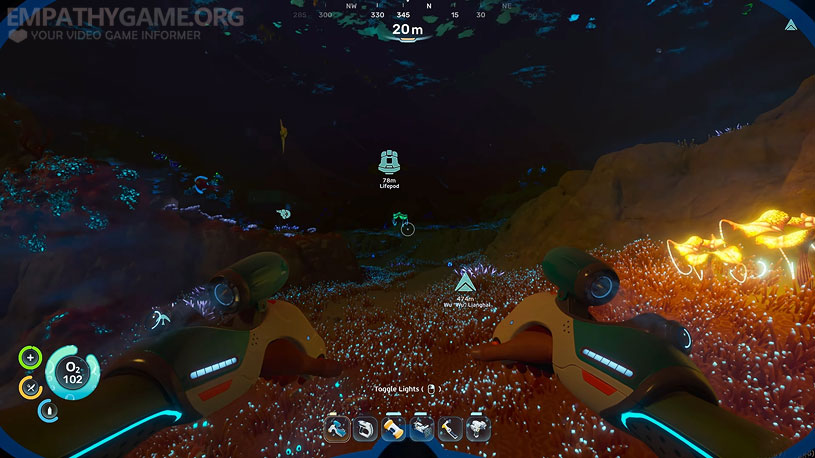
Exploration remains the reason to accept those compromises. Familiar reefs eventually become reference points rather than destinations. You learn where the terrain drops, which passages are easy to lose, where useful resources appear and which route brings the lights of home back into view. That mental geography develops because the ocean is not a flat series of objectives. It has layers, awkward entrances and depths that make even a short detour worth considering.
The Tadpole changes the scale of a journey without making its dangers irrelevant. It can serve as a mobile point of safety near an unfamiliar area, giving a diver a reason to leave the vehicle, investigate and return before the oxygen supply becomes a problem. The interesting part is the distance between those two decisions. A useful item just beyond a cave entrance might tempt a second search, until the way back stops looking as obvious as it did on arrival.
There is an unusually personal quality to this sort of navigation. Finding a passage through dark water feels more substantial when you later recognize it without a marker. The reward is not only the material brought home; it is knowing the environment a little better. That is why excessive guidance can be frustrating even when it is helpful. It risks replacing the satisfaction of working something out with the simpler satisfaction of following directions.
Dune: Awakening approaches the same survival calculation from a very different landscape. On Arrakis, heat, water, hostile travel and vehicles make distance expensive; here, oxygen, depth and unfamiliar marine life do the work. Both are strongest when crossing the environment demands preparation, not simply movement toward a map icon.
Co-Op Changes the Fear, but It Does Not Remove It
Four-player co-op changes the series’ atmosphere more than any single crafting feature. Alone, the quiet makes a distant creature call difficult to dismiss. In a group, an uncertain dive becomes a conversation, a rescue attempt or an argument over whether anyone remembered supplies. Losing the original’s isolation is a genuine cost, but cooperation introduces a different kind of vulnerability: one person’s curiosity can quickly become everybody’s problem.
The flexible division of labor is well suited to survival play. A teammate can gather food, another can scan a wreck, and another can expand the base while the rest investigate deeper water. Proximity voice chat, item trading and player revives give those tasks a social texture beyond simply occupying the same world. The most enjoyable coordination arises when the group decides what it needs, rather than when everyone follows the same marker.
Yet the story does not always benefit from that freedom. A region entered by one person or an object scanned elsewhere can trigger shared narrative information while the others are busy with something unrelated. In the opening hours, when small oxygen reserves already make it difficult to stay together, recordings can arrive without the context that would have made them meaningful. A coordinated crew may barely notice; friends who prefer independent exploration may find that the plot advances before they have experienced the discovery behind it.
Neither style is definitive. Solo exploration provides stronger narrative control and a more sustained sense of isolation. Co-op rewards communication and shared improvisation, even if it can blur the deliberate pacing of a mystery. The important question is not whether friends make the ocean less frightening. It is which kind of uncertainty you enjoy: being alone with what you cannot see, or relying on other people while everything goes wrong.
Base Building and Long-Term Survival
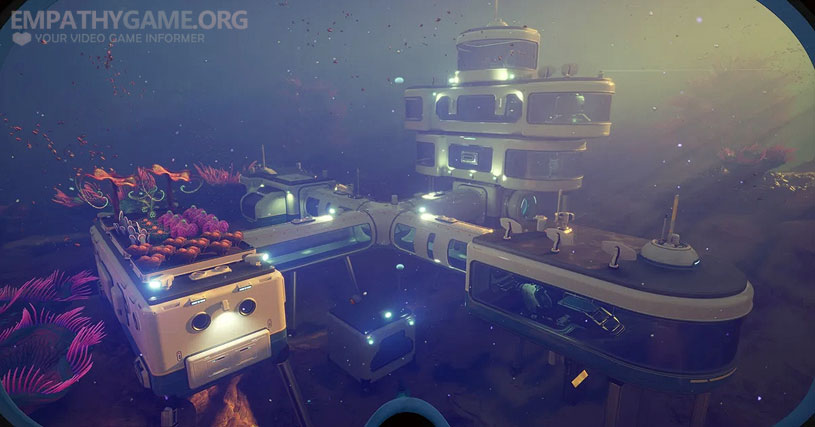
A habitat is more than a collection of rooms. It is where a dangerous expedition becomes a manageable routine: equipment is repaired or crafted, supplies are put away and the next route is considered. Windows facing the open sea and a few well-placed modules also provide something less practical. The alien ocean remains outside, but the interior begins to feel familiar. Seeing its lights after a difficult return is a distinct pleasure.
Location matters well beyond appearance. A promising site near the Wander area, for example, can become unpleasant when Mango Nibblers repeatedly disturb construction. The Alien Ruins offer a different combination of nearby food, useful landmarks and memorable night lighting. Power changes the calculation again. A convenient hydro current may be more valuable than access to distant thermal energy if connecting the latter requires extra infrastructure. Choosing where to settle is therefore a decision about daily life in that biome, not merely where a base looks best in a screenshot.
Even hydration can shape that decision. Gathering Water Slugs provides a recurring reason to venture out, but relying on nearby supplies becomes tedious when maintaining a distant base requires the same collection journey again and again. Survival friction is useful when it creates interesting choices; it becomes less persuasive when the only choice is repeating an errand. For a long-term home, nearby food, water, power and safe approaches matter as much as a view.
Co-op makes the base a shared project, with players contributing resources and creating a place to regroup between expeditions. That collaborative satisfaction has a distant cousin in Rust, although Rust’s hostile PvP and pressure to defend possessions make its buildings feel very different. In Subnautica 2, the more interesting threat is often the environment you must cross before reaching the door.
Creatures, Danger, and Atmosphere
The ocean needs wildlife that is worth watching, not merely avoiding. Small creatures lend movement and scale to a reef; larger shapes give open water a reason to feel exposed. The best encounters begin before an attack, when a shadow or unfamiliar call makes the player reconsider an otherwise sensible route. Survival tension depends as much on what a creature might do as on what it actually does.
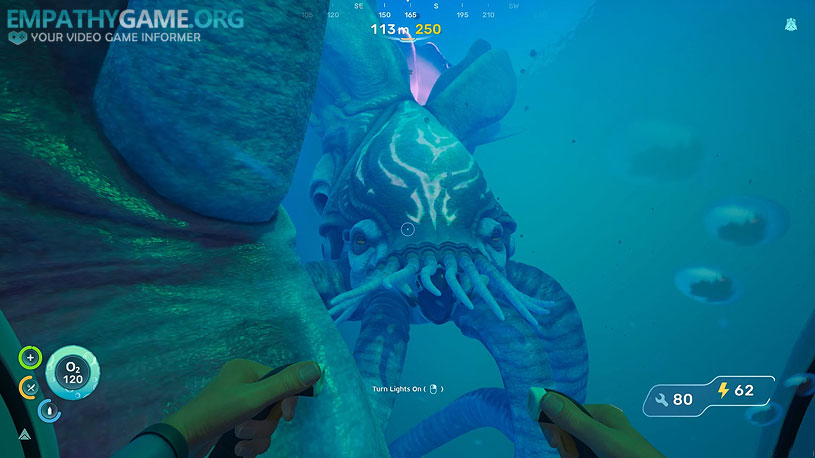
Sound is especially important here, but more noise is not necessarily more fear. When a small fish produces a deep, imposing call, that sound no longer reliably indicates scale. When threatening music begins before danger becomes visible, it can act as an early warning instead of making the unknown more unsettling. Neither behavior ruins the atmosphere, yet both show how delicately Subnautica’s tension depends on information. The most effective sound is often the one that makes you uncertain whether to keep swimming.
Bright reefs and strange plants still give the darker regions their impact. The game can be inviting without feeling safe, and its encounters rarely need constant fighting to make that point. A narrow opening, an oxygen warning and an unexplained noise can produce more tension than an extended battle. That balance between curiosity and self-preservation is still the sequel’s strongest atmospheric achievement.
Progression and Replayability
Progress is partly technological, partly biological and partly a matter of learning where the dangerous places are. Better equipment and Biomods expand the range of sensible expeditions, while optional discoveries can have unexpectedly practical consequences. Upgrade Biobeds in abandoned locations, for instance, can expand inventory or hotbar capacity. Their function has been made clearer, but they still illustrate why checking an apparently ordinary piece of equipment can be as valuable as finding another blueprint.
Replaying with different base locations, exploration priorities or companions changes the journey more than the underlying plot. A solo run encourages careful listening and self-directed investigation; a group can distribute responsibilities and cover ground differently. Neither removes the survival loop, and the limited Early Access narrative gives less reason to replay purely for story resolution. The lasting attraction is the opportunity to approach the ocean with better knowledge and a different plan.
Final Verdict
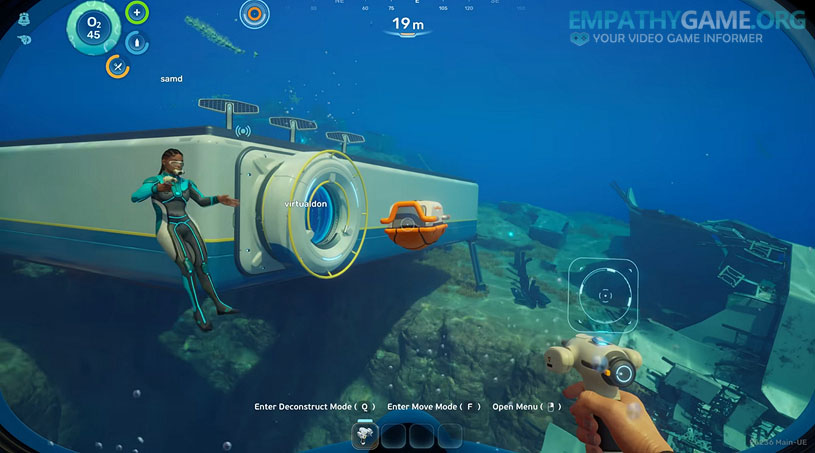
Subnautica 2 is at its best when it allows preparation and curiosity to compete. The Bioscanner, Biomods, Tadpole and more convenient crafting systems make survival feel more adaptable, while a well-chosen habitat turns an alien place into somewhere worth returning to. Cooperative expeditions add their own appeal without making solo exploration obsolete.
Its shortcomings are worth taking seriously. Repetitive resource tracking, intrusive guidance for some playstyles, uneven audio cues and occasional friction between shared discoveries and coherent storytelling can weaken the very uncertainty the series thrives on. More importantly, Early Access cannot yet offer the completeness of a finished campaign. Those wanting a fully resolved mystery may be better served by waiting.
For players happy to explore an evolving survival world, there is already something compelling beneath the surface. The sequel has not simply improved or diminished the original’s lonely formula. It has exchanged some of that solitude for flexibility and companionship, while leaving the most important question intact: how far are you prepared to go before turning back?
Subnautica 2 Pros & Cons
- Pro: Exploration still creates a powerful mixture of wonder, vulnerability, oxygen pressure, darkness, and fear of descending beyond a safe return route
- Pro: Scanning, Bioscanner research, Biomods, tools, resources, Tadpole expeditions, and customizable bases make practical upgrades feel connected to the alien ecosystem
- Pro: Optional four-player co-op supports shared exploration and building without preventing players from experiencing the story and survival loop alone
- Pro: Proximity voice chat, revives, emotes, item trading, and cross-platform multiplayer make co-op feel more deliberately integrated than a simple shared-world add-on
- Pro: Official PC access includes Steam, Epic, Xbox Play Anywhere, Game Pass, and Steam Deck Verified support
- Con: The Early Access story, world, vehicle selection, creature roster, late-game progression, and overall polish remain incomplete
- Con: Ongoing development can introduce or expose save, performance, co-op, building, and progression problems before later fixes arrive
- Con: Recommended hardware is substantially more demanding than the original Subnautica, particularly on the CPU side
- Con: Co-op changes the lonely atmosphere that defined the first game, even though solo play remains fully supported
Subnautica 2 PC System Requirements
Important: These are the official Early Access requirements. Because Subnautica 2 is still in development, hardware targets and practical performance can change before version 1.0.
MINIMUM:
OS: Windows 10 or Windows 11, 64-bit
CPU: Intel Core i5-8400 / AMD Ryzen 5 2600
RAM: 12 GB
GPU: NVIDIA GeForce GTX 1660 6 GB / AMD Radeon RX 5500 XT 6 GB
DirectX: Version 12
Storage: 50 GB available space
Internet: Broadband internet connection
Additional: 64-bit processor and operating system required
RECOMMENDED:
OS: Windows 11, 64-bit
CPU: Intel Core i7-13700 / AMD Ryzen 7 7700X
RAM: 16 GB
GPU: NVIDIA GeForce RTX 3070 8 GB / AMD Radeon RX 6700 XT 8 GB
DirectX: Version 12
Storage: 50 GB available space
Internet: Broadband internet connection
Additional: 64-bit processor and operating system required
Additional PC Performance and Setup Notes
- The Early Access build includes an FOV slider, sprinting on land and inside bases, expanded Biomod progression, improved building and storage behavior, and a range of performance and interface refinements.
- Supported NVIDIA hardware can use modern DLSS and Frame Generation options. When using frame generation, aim for a stable underlying frame rate first because generated frames do not replace the need for responsive base performance.
- When frame rates are unstable, lower shadows, water and fog effects, reflections, view distance, post-processing, foliage or creature density, and resolution scaling before reducing textures on a GPU with sufficient VRAM.
- Install the game on an SSD when possible even though the official requirements do not specify a drive type. World streaming, shader compilation, saves, and large updates generally benefit from faster storage.
- Steam Deck is Verified. Valve reports functional default controls, matching controller icons, legible interface text, suitable default graphics behavior, and successful SteamOS operation.
- For multiplayer problems, confirm that every player is fully updated, restart the game and storefront client, and verify that platform services are available before reinstalling.
- Verify game files through Steam, Epic, or the Xbox app and update GPU drivers before reinstalling when crashes, missing assets, or post-update problems begin.
- Disable unofficial mods when troubleshooting and keep several manual or cloud-backed saves. Early Access world, balance, and save systems can still change before version 1.0.
Official Trailer
Note: This official developer overview explains how Unknown Worlds designed four-player co-op, character animation, shared exploration, and cross-platform multiplayer for Subnautica 2.
Frequently Asked Questions
Do I need to play the first Subnautica or Below Zero before Subnautica 2?
No. Subnautica 2 tells a new story on a different alien planet. Returning players will recognize the survival approach and some series references, but prior knowledge is not required.
Is Subnautica 2’s full story available in Early Access?
No. You can explore several areas, progress through the available narrative, research wildlife, build bases, and use the Tadpole, but the story and world are not yet complete. Version 1.0 does not have a confirmed release date.
Is it better to buy Subnautica 2 in Early Access or wait?
Early Access makes sense if exploration, crafting, Biomods, base building, and optional co-op are enough for you and you accept an unfinished campaign. Wait for a fuller release if narrative resolution and stable long-term progression matter more.
Can I turn a single-player save into co-op and switch it back?
Yes. To convert a solo save, open Play Single Player, select the save, and choose Convert to Multiplayer. To switch back, use Host Multiplayer, select the save, and choose Convert to Single Player. The official support guide confirms the process.
How do four-player co-op and cross-play work?
Online co-op supports one host and up to three friends on supported PC and Xbox versions. Cross-platform multiplayer allows compatible ecosystems to join the same world; co-op includes proximity voice chat, revives, direct item trading, and shared base building. Use compatible game builds when joining.
Can friends play split-screen or run a dedicated server?
Local split-screen and a standalone dedicated-server product are not listed as supported options. The documented multiplayer experience is hosted online co-op.
Is Subnautica 2 included with PC Game Pass?
Yes. The Game Preview build is included with PC Game Pass and Game Pass Ultimate while it remains in the subscription catalogue. Buying the Microsoft edition separately provides ownership outside the subscription.
What does Xbox Play Anywhere mean for Subnautica 2?
An eligible Microsoft digital purchase gives access on Windows PC and Xbox Series X|S using the same Microsoft account, with supported Xbox cloud saves. A Steam or Epic purchase does not grant Xbox Play Anywhere ownership.
Can I move saves between Steam, Epic, and Xbox?
Xbox Play Anywhere supports save synchronization within Microsoft’s ecosystem. Steam and Epic offer their own cloud services; ordinary cloud saves should not be assumed to transfer automatically among unrelated stores.
What do the Bioscanner, Biolabs, and Biomods do?
The Bioscanner helps you study alien organisms, while Biolab research enables Biomods that adapt your Pioneer for specific survival conditions. It adds a biological route to progression alongside ordinary tool and equipment crafting.
Which difficulty modes are available?
Survival and Creative modes are officially documented. Survival retains the pressure of managing oxygen, food, water, and hostile environments; Creative is suited to players who primarily want to explore and build without the normal survival constraints.
What is the Tadpole, and why is it useful?
The Tadpole is the principal submersible in the Early Access experience. It makes longer exploration trips more manageable by extending mobility and supporting modular expedition planning, although venturing away from it still requires attention to oxygen and routes.
Is Subnautica 2 Steam Deck Verified?
Yes. Valve rates the Steam version as Verified. External controllers connected to a Steam Deck may need to be selected manually from Steam’s Quick Access Menu.
Does Subnautica 2 support mods?
Community-created mods exist, but official mod tools and Steam Workshop support are not listed. Back up important saves and check compatibility whenever the Early Access game is updated.
Can an Early Access update affect my saved world?
Yes. Changes to progression, the map, balance, or saves can affect an unfinished game’s worlds. Keep backups of important saves, and avoid moving valued saves to experimental builds without reviewing their compatibility rules.
Why can’t I join a friend’s co-op session?
Start by confirming that everyone is using compatible game versions and that the relevant online services work. Restart the game and storefront client, disable incompatible mods, and consult official support for persistent connection errors.
Still have questions? Check the official Subnautica support site, Steam Discussions, and the Subnautica community on Reddit.
Sources & References
Key game, platform, and technical details were checked against these sources:
- Official Subnautica 2 Website — game overview, four-player co-op, setting, and official community information.
- Steam — Subnautica 2 — Early Access status, Windows requirements, Steam features, Steam Deck rating, and user reception.
- Xbox — Subnautica 2 Game Preview — Xbox Play Anywhere, platform support, cross-platform co-op, cloud saves, and Xbox capabilities.
- Official Subnautica 2 Help Center — solo/co-op save conversion, difficulty modes, and mod-support status.
- Epic Online Services — Unknown Worlds interview — Unreal Engine 5 and cross-platform co-op architecture.
- Metacritic — Subnautica 2 — PC Early Access critic coverage and aggregate-score status.
- IGN — Subnautica 2 Early Access Review — applicable 7/10 PC Early Access review.
Similar Games Like Subnautica 2




Found something worth playing through DecideGame?
DecideGame.com is an independent gaming project run by Editor Zero. If this guide helped you discover a game, solve a problem, or find useful information, you can support DecideGame.com and help keep new and updated game guides coming.
DecideGame — PC Game Guides, Reviews & Setup Help