
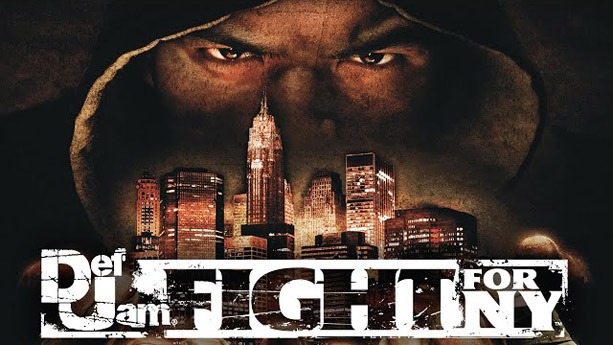
📅 Game released: 2004
Def Jam: Fight for NY turns New York street fights into a mix of wrestling, striking, submissions and environmental knockouts, with a customizable fighter caught between D-Mob and Crow. There is no official Windows game download; this guide compares PCSX2 emulation with an independent Xbox-to-PC recompilation project, explains lawful game-copy and BIOS setup, and covers controller options, widescreen fixes and emulator hardware requirements.
 By Editor Zero — independently researched, edited, and maintained.
Last updated: 7 November 2026
Last reviewed: 7 November 2026
Table of Contents
- Quick Facts
- Official PC Stores, Download & Installation
- Def Jam: Fight for NY Review
- Pros & Cons
- PC System Requirements
- Frequently Asked Questions
- Similar Games
Def Jam: Fight for NY Quick Facts
- Game: Def Jam: Fight for NY
- Developer: AKI Corporation (now syn Sophia) and EA Canada
- Publisher: EA Games / Electronic Arts
- Genre: Fighting, Brawler / Beat ’em Up, Multiplayer
- Release: September 20, 2004 (North America); no official Windows release
- Platforms: PS2, Xbox, GameCube
- Modes: Single-player Story and local multiplayer for up to four; no original online mode
- Recommended PC Route: PS2 edition via PCSX2, using an owned game backup and your own PS2 BIOS
- Unofficial PC Recompilation: DefJamFFNY-recomp runs recompiled original-Xbox code on Windows, macOS and Linux; requires a supported USA Xbox dump
- GameCube Alternative: Playable through Dolphin; the original GameCube edition has some audiovisual and presentation reductions
- Xbox Emulation: xemu labels the game Intro rather than playable in its published compatibility report
- PSP Related Game: Def Jam Fight for NY: The Takeover is a separate PSP adaptation/prequel with an altered campaign
- Engine: Not officially confirmed
- Community: Def Jam Reddit, PCSX2 Forums
- PC modding: No official PC mod tools; the independent recompilation project supports community texture packs and other unofficial modifications
- Metacritic score: 83/100 (PS2)
- IGN score: 8.7/10 (original game)
- Steam user reception: Not available on Steam
Official PC Store Status, Download & Installation
👇 There is no Electronic Arts PC edition of Def Jam: Fight for NY to buy or download. The established PCSX2 route and a newer independent Xbox recompilation both require legitimate game files supplied by the owner; they are not official PC storefront releases.
- Official Windows availability: Electronic Arts has not published a Windows version on Steam, Epic Games Store, GOG, Microsoft Store or the EA app. There is no verified EA-supported PC purchase, download, or activation route for this original console game.
- Recommended PS2 route: PCSX2 classifies the original PS2 version as Playable on Windows. It remains a well-documented option for owners of the PS2 disc and console, with control remapping, save support and upscaled rendering.
- New independent PC recompilation: The community-maintained DefJamFFNY-recomp project on GitHub translates the original Xbox game’s code into a native host application. Its author documents Windows, macOS and Linux support, widescreen rendering, controllers and local multiplayer. This is not an official EA release or an official prebuilt game download.
- Recompilation ownership requirement: The project requires a supported USA original-Xbox disc image or extracted game dump made from a copy you are lawfully entitled to use. A PS2 ISO, GameCube disc, PSP copy or a different-region Xbox dump cannot substitute for the verified Xbox game data. The project provides tools and code, not copyrighted game assets.
- Recompilation setup: Read the project’s installation instructions, then obtain the matching game-free application/setup package from its official GitHub Releases page. Select your supported Xbox dump and follow the project’s verification and local compilation steps before configuring display and inputs. Features and requirements can change between project releases.
- Community-project caution: The recompilation is independently developed, not publisher-supported, and its installers may be unsigned. Check the source repository, release notes, published hashes and Windows security warnings before running any third-party executable; avoid unofficial mirrors or packages promising a ready-to-play copyrighted game.
- GameCube alternative: Dolphin can run the GameCube edition, although the original GameCube release has documented soundtrack, voice-choice and arena-presentation reductions compared with the PS2/Xbox editions. Its game files must also come from a copy you can lawfully use.
- Original-Xbox emulator: xemu currently publishes an Intro compatibility classification for this game, with a reported inability to pass the loading screen in the tested build. That is a different approach from the independent Xbox recompilation, which does not run the game under xemu.
- PSP title distinction: Def Jam Fight for NY: The Takeover is an altered PSP adaptation/prequel, not the complete original PS2/Xbox/GameCube campaign; PPSSPP is relevant only if you specifically own and want to play that PSP title.
- PCSX2 PS2 BIOS: PCSX2 requires Sony PS2 BIOS files from your own PS2. Follow PCSX2’s official BIOS-dumping instructions. The emulator does not supply the BIOS.
- PS2 disc backup: Use PCSX2’s disc-dumping guide to create and verify an image of your own PS2 disc with a suitable computer optical drive, subject to local copyright and copying rules. This article does not provide commercial game images, ROM archives, Xbox disc dumps or BIOS downloads.
- Controller and graphics setup: For PCSX2, add your BIOS and own-disc backup, map the face/shoulder buttons and both analog sticks, then test default settings before upscaling. In the recompilation, configure your gamepad and picture mode in its own launcher; it has a separate control and rendering system from PCSX2.
 Get PCSX2 from the Official Website
 View Def Jam: Fight for NY on the Official Developer Archive

Def Jam: Fight for NY Review
Brutal environmental combat and unusually flexible fighting styles give this hip-hop brawler more depth than its celebrity premise suggests.
Def Jam: Fight for NY could easily have been remembered as a very specific early-2000s crossover: rappers, licensed clothes, a loud soundtrack and exaggerated street fights. What keeps it interesting is that the spectacle sits on top of a fighting system with real structure. AKI Corporation and EA Canada keep the grappling DNA of Def Jam Vendetta, then broaden it with five disciplines, style-specific knockout methods, active reversals, body-part submissions, crowd interaction and arenas designed to become part of the fight. A wall is not background decoration when it can turn a shove into a stun; a subway platform is not merely scenery when positioning near the track can decide the match.
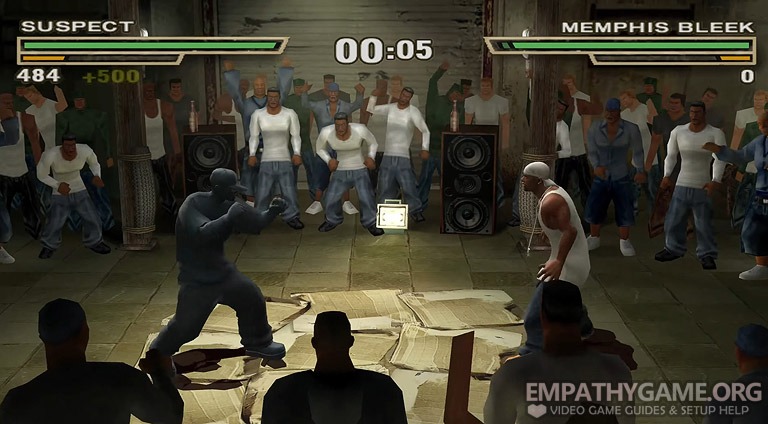
The game is at its best when those systems collide quickly and violently. It is less convincing as a perfectly balanced competitive fighter: some tactics are easier to exploit than others, crowded matches can become difficult to read, and the camera occasionally loses the clean view that the combat demands. The story is also more effective as attitude and momentum than serious drama. Even so, players who enjoy grappling, local multiplayer, character building and fights where the environment matters as much as a combo will find a remarkably distinctive design underneath the licensed swagger.
Combat Is About Creating a Finish, Not Emptying a Bar
The most important thing to understand is that damage and victory are not quite the same thing. An opponent becomes truly vulnerable once their health reaches the red Danger state, at which point the game opens several ways to finish the fight. Street Fighters can land a heavy power strike, Wrestlers can convert a hard grapple into a knockout, Kickboxers can end clinch sequences with decisive strikes, Martial Artists can use wall-assisted attacks, and Submission specialists pursue an entirely different win condition by destroying a specific body part. Weapons, environmental attacks and Blazin’ moves also become potential finishers once the opponent is properly weakened.
That structure gives a match a useful rhythm. Early exchanges are about building momentum, damaging health and creating positional advantages; the final phase is about recognizing which finishing route fits the fighter and the arena. Blazin’ mode illustrates the distinction well. Filling the momentum meter and landing one of its elaborate grapples can do huge damage, but it is not a magic knockout button. The reliable finish comes from starting the move while the opponent is already in Danger. Because recoverable health can creep back upward, waiting too long after creating that opening can turn a spectacular finisher into another damaging sequence rather than the end of the bout.
Defense is more active than simply holding block. Grapples are reversed by timing a punch or kick as the grab arrives, while strikes and weapon attacks use a separate reversal timing with block and directional input. That split matters because a player who learns only one defensive response remains vulnerable to the other half of the system. Successful reversals are especially valuable near walls or crowds, where turning an attack around can immediately create a stun, an environmental grapple or a finishing chance. The game looks chaotic, but its best one-on-one fights reward recognition and timing rather than pure button speed.
The Five Styles Change More Than Animation
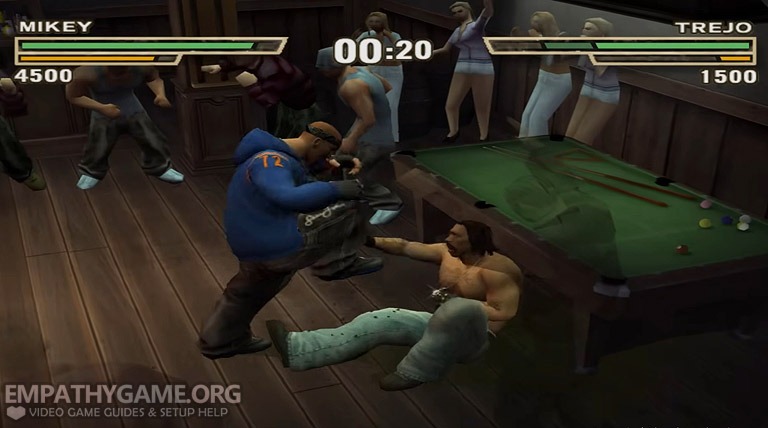
Street Fighting, Kickboxing, Martial Arts, Wrestling and Submissions each alter what a fighter is trying to accomplish. Street Fighting emphasizes heavy punches; Kickboxing gains dangerous clinch offense; Wrestling is built around damaging power grapples; Martial Arts trades some force for speed and movement; Submissions attack separate head, arm and leg health instead of relying only on the main life bar. The custom fighter can eventually combine three disciplines, which means progression changes not only statistics but the actual shape of the moveset.
The system is more particular than the simple phrase “choose three styles” suggests. The starting discipline acts as the base for the resulting hybrid, so two fighters using the same broad collection of styles can end up with different move sets when their primary style differs. That makes the first choice consequential even after later techniques are added. A Kickboxing-based hybrid can retain Thai-clinch pressure while gaining submission holds or wrestling throws, whereas another base style may reorganize the same ingredients around a different set of grapples and counters. It gives repeated Story runs a mechanical reason to experiment rather than merely changing cosmetics.
Submission fighting is the clearest example of hidden depth. Head, arm and leg damage are tracked independently, so scattering holds across all three areas is less effective than identifying a weakness and repeatedly attacking it. Regular attacks that visibly punish a limb can contribute to that body-part damage, while dedicated holds are what ultimately force the tap-out. The practical consequence is simple: a submission build has to think ahead. A flashy throw that deals general damage may be less useful than another arm attack if the opponent’s arm meter is already close to breaking.
The Arenas Are Part of the Moveset
Environmental combat is where Fight for NY separates itself most clearly from conventional arena fighters. Shoving an opponent into a wall can leave them stunned for a follow-up. Throwing them into spectators can let the crowd restrain them or help with an attack. Weapons appear around certain venues, but because weapon swings can be reversed, grabbing a bottle or pipe is not automatically safe against someone who reads the attempt.
The special arenas take the same idea further. In the subway match, controlling the edge of the platform matters because the train can produce an immediate finish. Demolition matches turn parked vehicles into both objectives and blunt instruments, encouraging throws into doors, hoods and windshields instead of neutral-space trading. Window and Inferno matches likewise make the boundary itself dangerous. These are not elaborate rule sets in the modern sense, but they successfully change how players value position. Standing with a nearly defeated opponent between your fighter and a wall, crowd or hazard is far more valuable than standing in open space.
This emphasis also creates one of the game’s balance problems. Environmental attacks and weapons can be so efficient that repeated use of safe setups sometimes overshadows the subtler parts of a character’s move list. The game partly pushes back through its scoring system: repeating the same move several times can incur a “Recycled Re-Run” penalty, while varied strikes, reversals, grapples and environmental attacks are rewarded. It is an elegant nudge toward stylish play, even if winning a difficult fight can still tempt the player toward whatever setup works most reliably.
Story Mode Gives the Custom Fighter a Real Arc of Progression
Story mode begins immediately after the events of Def Jam Vendetta, with D-Mob escaping police custody after the player’s future fighter crashes into the transport. From there, the created protagonist is pulled into a turf war between D-Mob’s crew and Crow, the Snoop Dogg-voiced rival trying to take over New York’s underground fight scene. Method Man appears as Blaze, Busta Rhymes as Magic and Redman as Doc, while figures such as Ice-T, Ludacris, Fat Joe, Danny Trejo, Carmen Electra and Henry Rollins fill out the cast.
The writing works because it rarely slows the game down enough for its absurdity to become a problem. Motivations can be thin, betrayals and alliances are often shaped by the need to set up the next fight, and the silent custom protagonist is more vessel than character study. Yet short cutscenes, committed performances and a clear turf-war structure keep the campaign moving. The celebrity casting also feels integrated rather than pasted over an unrelated fighting game: venues, clothing, dialogue and music all support the same grimy, theatrical New York fantasy.
More importantly, the campaign makes the created fighter feel progressively authored by the player. Development points improve upper-body strength, lower-body strength, speed, toughness and health, while new styles and Blazin’ moves expand the fighter’s options. Money goes toward clothing, tattoos, hairstyles and jewelry, and appearance feeds into charisma rather than existing as completely separate fashion dressing. The result is a progression loop where a character changes visually and mechanically at the same time. By the later fights, the difference between the opening single-style rookie and a three-style hybrid is substantial enough to make the growth visible in play.
Progression Encourages Variety, Even When the Safest Tactics Repeat
The campaign’s economy is simple but effective because each reward has a clear purpose. Development points strengthen the fighter or broaden the moveset; cash reinforces visual identity; victories unlock additional content. There is always something concrete to work toward, and the gym gradually changes how a custom fighter handles rather than only increasing damage numbers. Unlocking a second or third discipline is particularly satisfying because it can replace or reorganize grapples, create new submission access and change which situations feel comfortable.
The weakness is that the most efficient choices can flatten that variety. Once a dependable strike, grapple or environmental setup starts working against the AI, there is little mechanical reason to abandon it beyond the game’s scoring incentives and the risk of becoming predictable. Fast match pacing reinforces the habit: a safe sequence that quickly produces a stun and wall attack is easier to trust than exploring every directional grapple under pressure. The combat has more depth than it initially shows, but the campaign does not always force the player to use all of it.
Four-Player Chaos Is Both the Appeal and the Problem
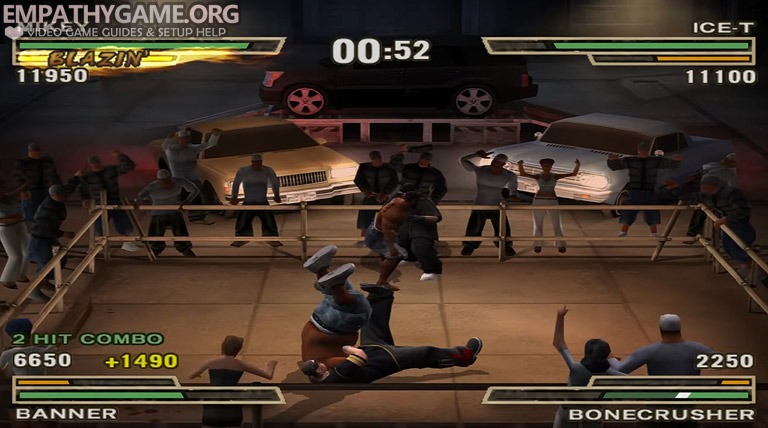
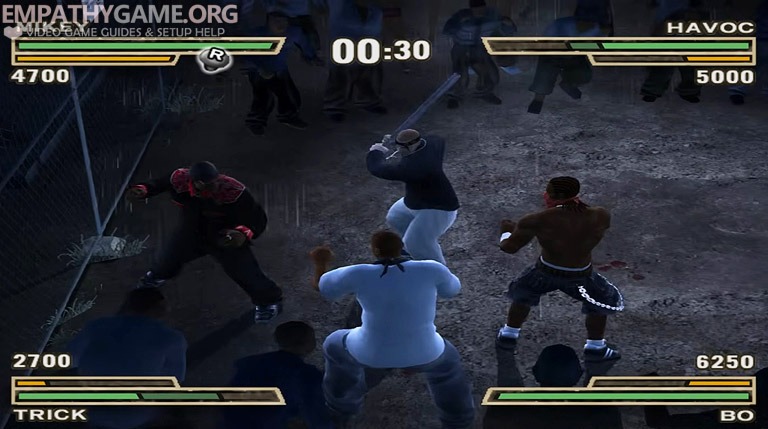
Battle mode is where the system’s messier side becomes a feature. Two-on-two fights and four-player free-for-alls turn controlled one-on-one spacing into opportunistic brawls. Double-team attacks, accidental friendly hits, crowd involvement and environmental hazards create the kind of sudden reversals that make local multiplayer memorable. The same mechanics that can feel exploitable against the CPU become much less predictable when several human players are fighting over the same wall, weapon or target.
Crowded matches also expose usability problems. Target selection can become awkward when several fighters occupy the same space, making it possible to attack the wrong opponent even when the intended target is obvious to the player. CPU behavior is not equally convincing across every mode either; team matches can produce surprisingly passive partners or opponents, while free-for-all AI may defend and reverse more aggressively. That inconsistency does not ruin Battle mode, but it means the best multiplayer experience comes from the human chaos rather than expecting every CPU configuration to provide the same challenge.
Presentation Makes Every Impact Feel Larger Than It Is
The visual technology has aged, but the direction still understands what the combat needs. Fighter models are exaggerated enough to read clearly, heavy grapples sell impact through animation and camera cuts, and environments are packed closely around the action so walls, crowds and props always feel within reach. The camera is the weak link. Near arena edges it can allow scenery or spectators to obstruct the view, which is especially frustrating in a system where a missed reversal window can lead directly into a wall attack or knockout sequence.
Sound does just as much work as the animation. Punches, slams and environmental collisions have a sharp, oversized quality that gives even familiar wrestling moves more violence than their inputs suggest. The hip-hop soundtrack, menu music and celebrity voices establish a remarkably consistent identity, while instrumental tracks during fights leave enough room for impacts and crowd reactions to dominate. The result is presentation with a specific period flavor rather than timeless polish, but that specificity is part of why the game remains so easy to recognize.
Final Verdict
Def Jam: Fight for NY succeeds because its licensed identity is tied directly to its mechanics. The five disciplines are not cosmetic labels; they determine how fighters attack, defend and finish. The custom-character system is not merely a wardrobe editor; style choices, statistics, Blazin’ moves and charisma make progression visible in the ring. The arenas are not backdrops; walls, crowds, vehicles, windows and subway tracks constantly reshape the safest and most dangerous positions.
Its weaknesses are just as tied to that design. Environmental tactics can become too efficient, the campaign sometimes lets repetitive setups carry more fights than the deeper move system deserves, and the camera is least reliable when precise positioning matters most. Four-player battles add tremendous local-multiplayer energy but also make targeting less precise, while uneven CPU behavior can make some match configurations feel less competitive than others. The story delivers attitude and memorable personalities more successfully than nuanced drama.
What remains is a fighting game with unusually strong mechanical identity. It is approachable enough for a group to understand within a few matches, yet there is meaningful depth in reversals, style hybrids, submission targeting, KO conditions and arena control for anyone who keeps experimenting. Players looking for tournament-style purity or perfectly readable competitive balance may find the chaos frustrating. Those who want grappling, character building, local multiplayer and fights where the room itself becomes a weapon will find something far harder to replace.
Def Jam: Fight for NY Pros & Cons
- Pro: Distinctive combination of wrestling, street fighting, kickboxing, martial arts and submissions
- Pro: Character-building Story mode with hybrid fighting styles, attributes, clothes, tattoos and Blazin’ moves
- Pro: Memorable hip-hop cast, soundtrack, voice acting and interactive urban arenas
- Pro: Up to four local players and a large selection of unlockable fighters and venues
- Pro: PCSX2 enables sharper PS2 rendering, while a separate community recompilation adds another ownership-based PC option
- Con: No official Windows release or normal PC storefront download; playing on PC requires original game assets and third-party tools
- Con: PCSX2 requires a separately dumped PS2 BIOS; the unofficial Xbox recompilation requires a different supported Xbox copy and local build
- Con: Camera, interface and some AI or difficulty spikes remain rough around the edges
- Con: Xbox emulation is not reliably playable in the published xemu report, and unofficial PC options can have setup or rendering quirks
Def Jam: Fight for NY PC System Requirements
Official Windows game requirements: None were published by EA because the original console game has no official native Windows edition. The specifications below are for PCSX2 itself, not EA game requirements. The independent recompilation project has separate host-computer and build requirements.
PCSX2 MINIMUM:
OS: Windows 10 version 21H2 LTSC or 22H2 (latest supported Windows 10 releases)
CPU: x86-64 with SSE4.1, PassMark single-thread rating ≥1500, two physical cores with SMT
RAM: 8 GB
GPU: Vulkan 1.1, Direct3D 11 Feature Level 10.0, or supported OpenGL 3.3
GPU Performance: PassMark G3D Mark rating ≥600
Additional: BIOS dumped from your own PS2 console
PCSX2 MODERATE / RECOMMENDED TIER:
OS: Windows 11
CPU: x86-64 with AVX2, PassMark single-thread rating ≥2000, four physical cores
RAM: 16 GB
GPU: Vulkan 1.3, Direct3D 12, or OpenGL 4.6
GPU Performance: PassMark G3D Mark rating ≥6000
VRAM: 4 GB
Additional: BIOS dumped from your own PS2 console
UNOFFICIAL XBOX RECOMPILATION — DOCUMENTED HOST PREREQUISITES:
OS: Windows 11 x64 is the project’s documented tested Windows environment
GPU: Direct3D 11-capable graphics hardware for the Windows build
Storage: Allow at least 12 GiB of temporary build headroom, plus space for the Xbox dump and required compiler/build tools
Additional: Supported USA Xbox game dump; local compilation/build steps and possible Microsoft C++ build-tool installation
The community recompilation prerequisites are project documentation, not official minimum or recommended game specifications; they may differ between release versions. See the project documentation before setting it up.
Additional PC Performance and Setup Notes
- Emulator expectations: PCSX2 warns that performance varies by game and settings. Its compatibility database lists the PS2 version as Playable on Windows; that is not a frame-rate guarantee for every computer.
- Upscaling: Start with default PCSX2 settings and increase internal resolution gradually. This sharpens edges but does not replace original textures or models.
- Widescreen on PCSX2: The PCSX2 game page marks a widescreen patch as available. In a current PCSX2 build, select the game, open its Properties and check the Patches page for an available 16:9 patch; enable it and set the graphics aspect ratio to 16:9. PCSX2 also documents a global Apply Widescreen Patches option. See the official patch-system documentation. If your game revision lacks a compatible patch or the HUD/cutscenes frame incorrectly, return to 4:3 rather than merely stretching the image.
- Widescreen in the recompilation: The independent Xbox recompilation documents an actual widescreen display mode in its launcher, separate from PCSX2 patches. Select its widescreen display option after a valid build; check the project’s release notes for any aspect-ratio or menu limitations.
- PCSX2 lighting: The PCSX2 wiki documents a minor lighting artifact for some configurations. Consult the game-specific compatibility notes before relying on old third-party graphics hacks.
- Saves and controllers: Keep ordinary in-game memory-card saves, not only emulator save states. For local multiplayer, configure every player input before starting a match. The recompilation keeps its own saves, controller bindings and settings, which are not interchangeable with PCSX2 by default.
Official Trailer
Note: This archived IGN-hosted PlayStation 2 trailer shows the original Fight for NY presentation, celebrity fighters, street arenas and combat style, while the written guide adds current PC-release status, console-version comparison, PCSX2 setup, BIOS and owned-disc guidance, and emulator requirements.
Frequently Asked Questions
Can you download Def Jam: Fight for NY officially on Windows?
No. EA never released an official Windows edition, and there is no legitimate PC storefront purchase or download for the original game. PCSX2 and the independent Xbox recompilation are third-party projects that require game files you are entitled to use.
Is the community Def Jam: Fight for NY PC recompilation the same as PCSX2?
No. PCSX2 emulates the PS2 game and requires your own PS2 BIOS and game backup. DefJamFFNY-recomp independently rebuilds code from a supported original-Xbox dump into a host application; it is not an EA port or an Xbox game running inside xemu.
Can I use a PS2 ISO for DefJamFFNY-recomp?
No. The project requires a compatible USA Xbox dump and explicitly does not accept PS2 or GameCube game images. A properly owned PS2 copy is useful for the PCSX2 route instead.
Which version is best to play on PC?
For owners of the PS2 release, PCSX2 is the best-documented starting point and its game page labels Fight for NY Playable. Owners of a supported Xbox copy may also investigate the newer community recompilation, weighing its unofficial status and setup requirements. The published xemu report remains at Intro.
Is Def Jam Fight for NY: The Takeover the same game?
No. The PSP release is an altered adaptation/prequel with a different campaign structure and content; it is not simply the original console game running on a handheld.
Can you create a fighter and finish a full story in Fight for NY?
Yes. Story mode follows a custom character drawn into the conflict between D-Mob and Crow. You can develop attributes, buy clothes and accessories, and add fighting styles as the campaign progresses.
What are the five fighting styles?
Streetfighting, Kickboxing, Martial Arts, Wrestling and Submissions. Each has its own attack and knockout emphasis, so combining disciplines can change more than a character’s animations.
Does the order in which I learn fighting styles matter?
Yes. A created fighter can combine up to three styles, and the order can influence the resulting hybrid move set. If you care about particular signature techniques, plan the sequence before committing upgrades.
Which fighting style is easiest for beginners?
Streetfighting favors direct heavy strikes; Wrestling is a natural option if you prefer grabs and throws. Neither is universally best, especially once your custom fighter begins combining styles.
Why did a Blazin’ move fail to knock my opponent out?
A Blazin’ attack can inflict significant damage without ending a fight. For a reliable finishing opportunity, first drive the opponent into the flashing Danger state, then activate Blazin’ and execute the grapple before they recover.
How do knockouts and submissions differ?
Ordinary knockouts depend on creating a Danger-state opening and landing an appropriate finisher or environmental attack. Submission specialists instead focus damage on a chosen body part until an opponent can no longer continue.
Do crowds, weapons and walls affect matches?
Yes. Some arenas allow wall attacks, breakable objects, improvised weapons and crowd-assisted interactions. Positioning near those opportunities can change how quickly a weakened opponent can be finished.
How do you unlock additional fighters and venues?
Playing Story and Battle content unlocks more characters and arenas through game progression and reward points. Story mode also opens additional moves and customization options for your created fighter.
Does Def Jam: Fight for NY support co-op, split-screen or online multiplayer?
Story is single-player, not cooperative. Battle mode supports up to four local players in a shared arena view rather than conventional split-screen. The original console releases did not include official online multiplayer; remote-play tools are unofficial.
Can four people play through PCSX2 or the independent PC recompilation?
The original PS2 release supports up to four local players with its multiplayer adapter setup, and PCSX2 supports multiple configured controllers. The independent recompilation also documents local multiplayer; check that project’s controller setup guidance before starting a four-player match.
Can I play with keyboard controls?
PCSX2 supports keyboard mapping, and the recompilation documents keyboard and controller input. A gamepad is preferable for analog movement, grappling and right-stick actions such as Blazin’ activation.
How do I enable widescreen without stretching the image?
For PCSX2, verify that your game revision has a supported widescreen patch and enable it through the game’s Patches settings, then select 16:9. The independent recompilation has its own widescreen display option. If either method causes presentation issues, use the original 4:3 mode.
Why does lighting sometimes look strange on PCSX2?
PCSX2 documents a minor lighting issue for Fight for NY in some configurations. Check the current PCSX2 game page before trying older user-made graphics workarounds.
Do I need to play Def Jam Vendetta first?
No. Fight for NY has a followable custom-fighter story even if you have not played Vendetta. The earlier game adds context for returning characters and relationships.
Still have questions? Check the Def Jam: Fight for NY Reddit community, PCSX2 Forums, or the independent recompilation project for further discussion and setup help.
Sources & References
The original release, console compatibility, emulator hardware guidance and independent community PC project were checked against these primary and established technical sources:
- syn Sophia — Def Jam Fight for NY — original developer archive and console-release identity
- PCSX2 Wiki — Def Jam: Fight for NY — PS2 compatibility, supported widescreen patch, multiplayer and graphics notes
- PCSX2 — System Requirements — official emulator minimum and moderate hardware tiers
- PCSX2 — Dumping BIOS and Dumping Discs — official ownership-based PS2 BIOS and game-backup guidance
- PCSX2 — Writing Patches — how the emulator handles and activates widescreen patches
- DefJamFFNY-recomp — GitHub Project — independent Xbox recompilation, supported owner-supplied dump, releases and setup prerequisites
- xemu — Def Jam: Fight for NY — original-Xbox emulator compatibility report and its test-date limitation
Similar Games Like Def Jam: Fight for NY
- The Warriors
- Yakuza 0 Director’s Cut
- Yakuza Kiwami
- Sleeping Dogs: Definitive Edition
- Bully: Scholarship Edition
- GTA San Andreas




Found something worth playing through DecideGame?
DecideGame.com is an independent gaming project run by Editor Zero. If this guide helped you discover a game, solve a problem, or find useful information, you can support DecideGame.com and help keep new and updated game guides coming.
DecideGame — PC Game Guides, Reviews & Setup Help