
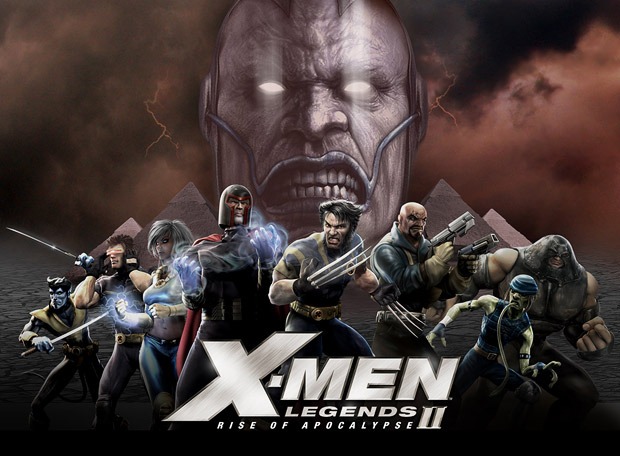
📅 Game released: 2005
Use this updated 2026 X-Men Legends II: Rise of Apocalypse PC guide to check official download availability, understand legitimate retail-disc ownership and installation, compare four-player co-op options, review original system requirements, and explore Windows compatibility, controller support, and community mods.
 By Editor Zero — independently researched, edited, and maintained.
Last updated: 21 October 2026
Last reviewed: 21 October 2026
Table of Contents
- Quick Summary
- Quick Facts
- Official PC Stores, Download & Installation
- X-Men Legends II: Rise of Apocalypse Review
- Pros & Cons
- PC System Requirements
- Frequently Asked Questions
- Similar Games
X-Men Legends II: Rise of Apocalypse Quick Summary
✔ Comic-book action RPG in which the X-Men and Magneto’s Brotherhood form an uneasy alliance against Apocalypse, travelling from Genosha and the Savage Land to Egypt and other dangerous locations.
✔ Build a four-mutant squad, switch heroes during battles, combine distinctive superpowers, solve ability-based obstacles, and develop character skills and equipment through an enemy-filled campaign.
✔ Similar to Marvel: Ultimate Alliance through its four-hero Marvel squad, real-time action-RPG combat, cooperative play, powers, equipment, and character progression.
✔ A native Windows PC edition was released commercially, but no verified official digital PC storefront presently sells it; original physical PC copies are the relevant legitimate ownership format.
✔ The PC game supports up to four players together locally, while its original GameSpy-dependent online service is no longer operating.
✔ Historic SafeDisc disc protection complicates modern Windows use; the original PC game supports widescreen gameplay, and unofficial community projects offer additional controller and modding options.
X-Men Legends II: Rise of Apocalypse Quick Facts
Official PC Store Status, Download & Installation
👇 Check the game’s legitimate Windows ownership and download status before searching for a copy: X-Men Legends II has an original PC release, but no verified official digital PC purchase option.
- Native Windows version: Activision originally published a Windows PC edition alongside the console game. This is a real PC port, not a console-only release that must be emulated.
- Official digital-store status: No verified purchase page for this game is available on Steam, GOG, Epic Games Store, or Microsoft Store. The original PC release is not included in a verified current official PC subscription or cloud-gaming catalogue.
- Legitimate ownership: An authentic original retail PC copy is the relevant purchase format to look for through lawful second-hand channels. Condition, completeness, disc readability, and compatibility matter; ownership of a console edition does not grant a Windows copy.
- Retail installation: With your own PC disc and a compatible computer, use the disc’s original installer and retain the media and any accompanying documentation. The 2005 setup was designed for Windows 98, ME, 2000, and XP, not modern Windows.
- SafeDisc warning: Original retail PC protection uses SafeDisc. Its legacy driver is unsupported on modern Windows, meaning an original disc may install but still fail to launch on Windows 10 or 11. Compatibility mode alone is not a guaranteed solution; this guide does not offer protection-bypass files or workarounds.
- Re-download and accounts: Owning a retail PC disc does not automatically grant a Steam, GOG, Epic, Xbox, or Activision account entitlement. No official modern digital re-download programme for this title was verified.
- Multiplayer access: Up to four players can play together locally on one suitably configured PC. The game’s historical GameSpy-based online functionality is no longer an available official matchmaking service; third-party online experiments should not be mistaken for restored official support.
- Version differences: The original Windows edition features playable Pyro and Sabretooth from the outset. The PSP release is a different port with its own extra characters and missions; those PSP additions are not official PC DLC.
- Editions and subscriptions: No official PC remaster, complete-edition upgrade, story expansion purchase, Xbox Play Anywhere entitlement, or Game Pass version was verified. Do not confuse this game with the separately released Marvel: Ultimate Alliance series.

X-Men Legends II: Rise of Apocalypse Review
A dream team of rival mutants brings flexibility to a repetitive but rewarding action RPG.
Wolverine and Magneto rarely belong on the same side, let alone the same four-person team. X-Men Legends II: Rise of Apocalypse makes that unlikely partnership its best idea. With Apocalypse threatening both factions, Raven Software lets the X-Men and Brotherhood combine powers across a comic-book world built for destruction. It is less a tactical superhero simulation than a fast action RPG where choosing who fights alongside whom becomes the most interesting decision.
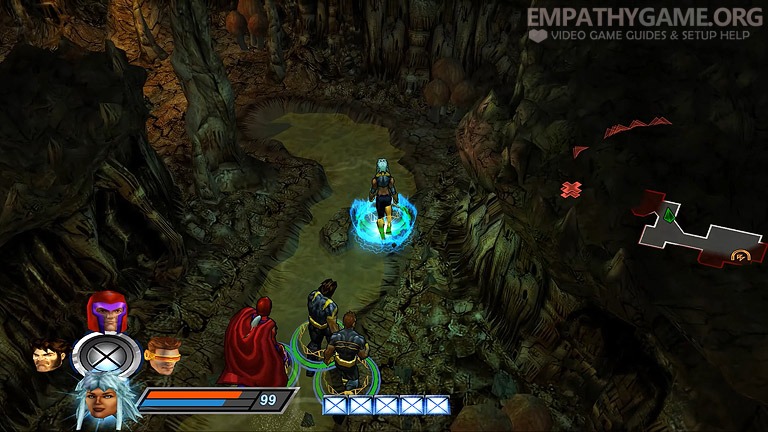
The sequel expands the original’s roster, encourages specialized builds, and makes cooperation central. Its pleasures are immediate: switch from a brawler to a flying mutant, throw an enemy into the scenery, then coordinate a power combo. Yet the structure rarely evolves beyond clearing rooms, collecting equipment, and reaching the next objective. The characters offer more variety than the enemies or missions consistently deserve. Marvel fans willing to experiment with teams will find plenty to enjoy; players seeking demanding tactics or complex exploration may not.
Four-Mutant Teams Make Character Choice Matter
Each mission revolves around four active mutants. One fights under direct control while three follow AI instructions, and switching between them is quick enough to make a change of approach part of ordinary combat. Wolverine can push into a knot of enemies with close-range attacks; Cyclops and Bishop can work from a safer distance; Magneto adds crowd control and the ability to manipulate parts of the environment. Juggernaut turns heavy objects and enemies into blunt instruments. Few individual moves are complicated, but placing them within a team makes them more useful.
Strong squads are built around complementary jobs rather than four favorites. A durable frontliner protects ranged attackers, while flight, bridge-building, or telekinesis helps the party reach places brute force cannot. Specific lineups trigger team bonuses, encouraging combinations that look strange in a comic but make sense on the selection screen. Replacing a hard hitter with a support mutant can smooth exploration at the cost of damage. Optimization is optional, but noticing how characters strengthen one another is where the system gets interesting.
Combat Has More Texture Than Power-Spamming Suggests
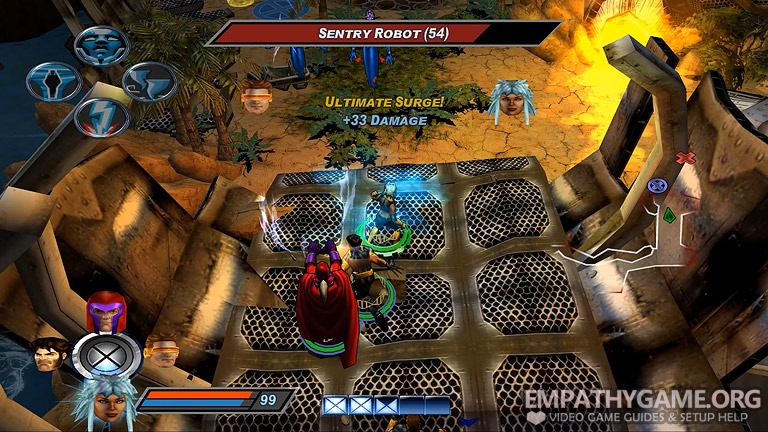
At first glance, fighting seems to mean alternating basic punches with the strongest available mutant ability until the room is empty. That approach works often enough to expose a genuine weakness in encounter design. Beneath it, however, lies a more expressive melee system. Light and heavy attacks can be chained into combinations that stagger or launch opponents, with jumps and aerial strikes adding options beyond standing still and repeating a special move. Throws, destructible objects, and knockback attacks make position matter when several enemies crowd a narrow room.
Power combos reward a different kind of timing. Two compatible attacks landing close together can produce an experience bonus, so simply filling the screen with impressive effects is not always the smartest route. A quick melee power such as Wolverine’s Feral Slash needs a different rhythm when paired with a slower strike such as Storm’s Lightning Strike. Leadership abilities make successful coordination more valuable, and the Call Allies command gives solo players a way to encourage teammates to participate. It is a small but meaningful distinction: teamwork improves progression even when a combo does not directly multiply damage.
As energy and Xtreme abilities grow, spectacle begins to overtake precision. Cyclops can sweep crowds with optic blasts, while Magneto’s destructive attacks make clustered foes look helpless. These powers suit the fantasy, but optimized rotations can end encounters before ordinary enemies offer much resistance. Damage types and enemy resistances sometimes reward changing characters; too many other fights surrender to the widest attack.
Bosses break the routine with mixed success. Sauron’s airborne phases demand evasion until he lands, while Archangel’s later fight uses environmental objectives and multiple stages. Both show the combat can support challenges beyond sheer damage, making long stretches of interchangeable enemies feel like a missed opportunity.
Exploration Occasionally Demands a Different Kind of Team
Five acts move through Genosha, the Savage Land, secure facilities, city streets, and Egyptian temples. Despite those changing backdrops, much of the route consists of corridors, switches, barriers, and enemy-filled rooms. Xtraction Points let the squad save, reorganize, and revisit earlier locations, providing useful pauses in an otherwise brisk dungeon crawl.
The Elemental Tomb offers a clearer example of the design’s possibilities. Retrieving its elemental skulls calls for more than winning fights: one rests atop a raised column that requires flight, while another is approached by creating a bridge. A team built around Wolverine, Juggernaut, Cyclops, and Iceman may be excellent at fighting but still need a flier such as Magneto to reach the elevated objective. Here, the roster acts like a collection of exploration tools rather than a list of different damage animations.
These moments give comic-book powers a purpose, but they can also become administrative work when a missing ability sends the team back to an Xtraction Point for one interaction. Few environments develop the idea into sustained puzzles. Hidden equipment, collectibles, and permanent stat rewards make detours worthwhile, but most exploration remains structured rather than truly free-form.
An Entertaining Alliance with Less Conflict Than It Deserves
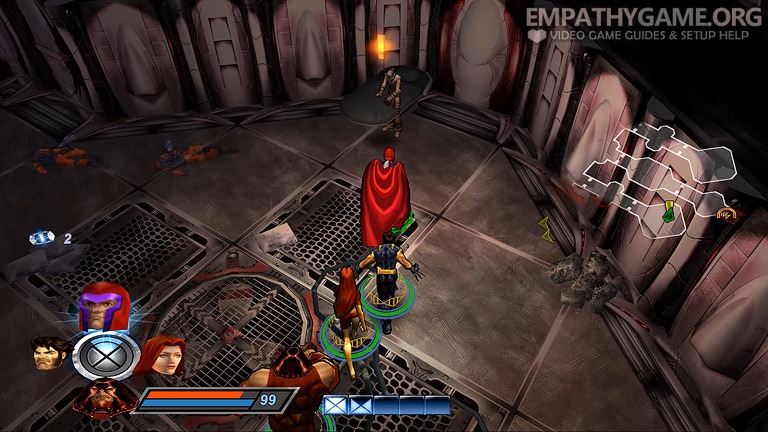
Apocalypse gives bitter enemies a plausible reason to cooperate. With mutants abducted and both factions endangered, Xavier and Magneto can work together without resolving their differences. Quicksilver gives Magneto a personal stake, while Mister Sinister and the Horsemen supply suitably theatrical opposition. The premise promises ethical friction that the dialogue seldom develops.
Smaller character interactions carry more weight. Forge can react differently to a Brotherhood member than to an X-Man, and certain encounters acknowledge particular heroes in the active group. These brief exchanges make the roster feel like a cast of personalities instead of interchangeable ability sets. They also reward paying attention to whom the player controls outside combat, even though the dialogue does not produce meaningful branching decisions.
Revisiting earlier locations also exposes conversations trapped at an earlier point in the plot. Recovering missed items is welcome, but characters speaking as though the crisis has not advanced undermines continuity. Comic-styled designs, bold silhouettes, and extravagant powers sustain the crossover atmosphere; Patrick Stewart lends Xavier welcome gravitas. Repeated combat lines and a serviceable orchestral score leave less of an impression.
Progression Rewards Specialization, but Its Balance Is Uneven
Levels grant attribute and skill points for resilience, energy, striking power, speed, signature attacks, boosts, and passive improvements. Random equipment adds armor, gloves, and belts with offensive or defensive modifiers. The right skills can change a mutant’s purpose within the team, making investment choices more rewarding than the underlying combat initially suggests.
Jean Grey is a particularly good illustration of the build system’s range. Investing in telekinetic and psychic abilities makes her an effective ranged or control-oriented contributor; developing her Phoenix-related combat potential can instead support a more aggressive, close-quarters approach. The latter is not necessarily the simplest or strongest path, but it changes how she fits within the squad. That matters more to replayability than unlocking another costume or merely raising everyone’s damage values.
There are traps beneath the apparent freedom. Some skills deliver substantially more value per point than alternatives, and certain support effects do not behave as helpfully as their descriptions suggest. Rogue’s Heal, for example, can remove beneficial team boosts along with harmful effects, undermining a lineup built around temporary enhancements. It is an unusually revealing flaw: a character who looks useful on a skill screen can interfere with the very strategy she was supposed to support.
Equipment management is another drag. Drops pile up, higher-level gear can remain unusable for ages, and comparisons or inventory clearing take too many steps. Automatic allocation saves time but can scatter points across skills that do not fit a deliberate build. For enthusiasts, specialization is a major strength; for everyone else, maintaining four inventories interrupts the action.
Hard Mode and the Danger Room Reveal Odd Incentives
Difficulty is stranger than tougher enemies suggest. Experience rewards decline when an enemy’s level differs substantially from the active team’s average, even when that enemy is stronger. A squad falling behind on Hard can therefore earn less experience from the very fights that should help it catch up. Managing the level gap and carrying over developed characters matters alongside combat skill.
Danger Room scenarios test the system from the opposite direction. Combat drills, character challenges, and teamwork exercises provide an alternative to pushing through another mission, but not every objective rewards maximizing damage. In a teamwork challenge that requires coordinated hits, a heavily upgraded party can destroy targets before the second attack registers. Reducing attack strength or using a smaller group, such as Cyclops with Jean Grey, can work better than sending in four overpowered characters.
Co-op Brings the Squad to Life, While the Camera Struggles
Solo play works because AI companions can be set for aggression, preferred attacks, and healing. Ranged mutants can hang back as a melee fighter advances, and swapping leaders helps correct a poor choice. Yet allies follow broad instructions rather than adapt intelligently to a changing encounter. Coordinated combos are consequently less reliable without human input.
With friends, encounters gain a social rhythm. One person anchors the frontline while others freeze enemies or time ranged strikes to finish a combo. Team selection becomes a shared decision, especially when a puzzle calls for swapping a favorite bruiser for a flier. The basics are accessible enough that newcomers can contribute without memorizing skill trees.
The shared camera is co-op’s biggest obstacle. As people spread apart, it retreats to keep everyone visible, making crowded effects difficult to read. Staying together helps visibility but limits independent movement. Stiff animation, busy menus, and repeated enemy behavior reveal the game’s age, although its bold character art and oversized powers remain appealing.
Replay Value Comes from Builds Rather Than New Adventures
Unlockable heroes, costumes, collectibles, and Danger Room exercises encourage further play. Completed-game progression can be carried into another run, making Hard mode and different builds more attractive. A team organized around Magneto’s support and movement plays differently from one focused on Wolverine and Juggernaut’s melee pressure.
Still, story outcomes and missions barely change, and familiar enemy waves become predictable. A second playthrough is most rewarding for players curious about squad combinations or skill specialization, not those hoping for a substantially different adventure.
Final Verdict
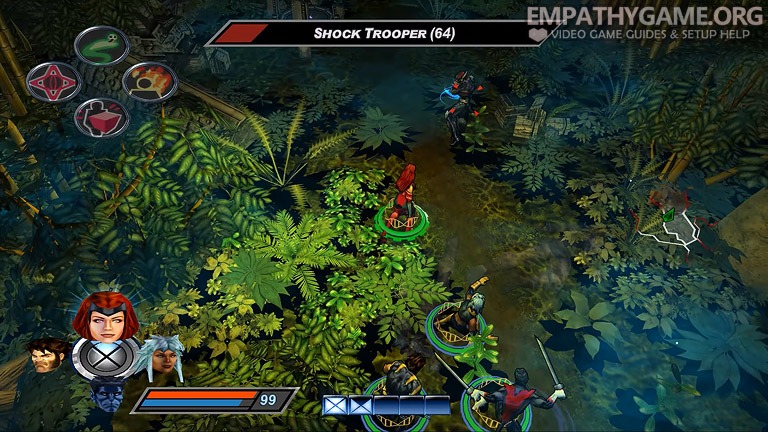
X-Men Legends II: Rise of Apocalypse succeeds by making its cast more important than any individual dungeon. Switching from Wolverine’s close-quarters aggression to Magneto’s control, discovering why a flight-capable mutant is essential for a particular objective, and coordinating attacks that earn experience all give the four-person structure a purpose beyond putting famous characters on the screen. The X-Men and Brotherhood alliance adds enough personality to make that experimentation feel like a Marvel crossover rather than an anonymous fantasy RPG with superhero skins.
Its weaknesses are not difficult to locate. Too many areas rely on repeated enemy groups, the equipment interface slows down the enjoyable fighting, and the best combinations can erase challenges before their mechanics matter. Difficulty and optional training sometimes expose awkward balancing choices rather than consistent tactical depth. The narrative likewise offers entertaining interactions without fully exploring the tensions behind its premise.
There is more depth here than the button-mashing reputation suggests, especially for anyone willing to learn melee sequences, build complementary squads, or play cooperatively. X-Men fans and action-RPG tinkerers are its natural audience. Those who want elaborate encounters or consistently inventive exploration will find a shallower adventure. But as a lively superhero dungeon crawler—and a clear precursor to the Marvel: Ultimate Alliance formula—it remains worth playing with those limits in mind.
X-Men Legends II: Rise of Apocalypse Pros & Cons
X-Men Legends II: Rise of Apocalypse PC System Requirements
These are the original Windows PC release’s historical minimum and recommended specifications, not verified performance targets for Windows 10 or 11. The original retail specification also assumes period-compatible graphics drivers and installation media.
ORIGINAL WINDOWS PC REQUIREMENTS:
MINIMUM:
OS: Windows 98 / ME / 2000 / XP
CPU: Intel Pentium III 1.2 GHz or AMD Athlon 1.2 GHz
RAM: 256 MB
GPU: DirectX 9.0c-compatible 64 MB card, such as NVIDIA GeForce2 or ATI Radeon 7500; hardware 3D acceleration required
DirectX: DirectX 9.0c
Storage: Approximately 2.5 GB free, plus around 400 MB for the Windows swap file in published retail-era specifications
Sound Card: DirectX 9.0c-compatible sound hardware
Installation Media: Compatible original CD-ROM/DVD-ROM drive; period specification lists a 16x CD-ROM drive
RECOMMENDED:
OS: Windows 98 / ME / 2000 / XP
CPU: Intel Pentium 4 or AMD Athlon XP around 2 GHz
RAM: 512 MB
GPU: DirectX 9.0c-compatible 128 MB card, such as NVIDIA GeForce3 or ATI Radeon 8500
DirectX: DirectX 9.0c
Storage: Approximately 2.5 GB free, plus the original system’s swap-file allowance
Sound Card: DirectX-compatible sound hardware
Controls: Keyboard and mouse; compatible USB gamepad supported with configuration
Additional PC Performance and Setup Notes
Modern Windows and the retail disc: The low hardware requirements do not establish modern operating-system compatibility. SafeDisc’s original disc-validation driver can prevent an otherwise installed game from launching on Windows 10 or 11. If the aim is faithful original-disc operation, compatible period hardware and operating-system support are more relevant than the power of a modern GPU. A virtual machine is not a guaranteed answer because legacy 3D acceleration and disc protection may still fail.
Widescreen: The PC version supports widescreen resolutions natively, with horizontal field of view adapting to the selected aspect ratio. Select a suitable 16:9 resolution from the game’s display options when available; ordinary 16:9 gameplay does not require an unofficial widescreen patch. Some prerecorded video material retains its original framing or borders. See the WSGF widescreen report for the original retail version’s display behavior.
Controller configuration: The original PC release may leave gamepad actions unassigned, particularly for additional local players. Start with the game’s Controls / Advanced menu and configure each controller before a co-op session. For owners of a working installation who want optional modern gamepad defaults, the unofficial XML2 Fix release page provides a community-created controller compatibility tool. The author’s documented installation places its dinput.dll next to XMen2.exe in the game folder; back up existing files first, read the release instructions, and remove the added DLL to revert. It is not an Activision product and does not resolve game ownership or SafeDisc limitations.
Display-settings launch issue: For some successfully installed copies that fail to open for reasons unrelated to disc protection, PCGamingWiki documents the Resolution value under HKEY_CURRENT_USER\SOFTWARE\Activision\X-Men Legends 2\Settings\Display. An experienced user can export that registry key before adjusting the value to an actual supported desktop resolution. This is a configuration troubleshooting step, not a universal fix for startup failures.
Mods and save backups: MarvelMods’ X-Men Legends II Character Mod Catalog documents a large selection of fan-made characters and related improvements. Read each mod’s game-version and installation requirements, avoid mixing incompatible replacements, and back up saves before making changes. The commonly documented Windows save folder is %USERPROFILE%\Documents\Activision\X-Men Legends 2\Save\.
Official Trailer
Note: This original Xbox-era trailer showcases the X-Men and Brotherhood alliance, mutant combat, and the threat posed by Apocalypse. The written guide focuses on the distinct Windows PC version, its purchase status, cooperative options, and compatibility details.
Frequently Asked Questions
Is X-Men Legends II: Rise of Apocalypse worth playing in 2026?
Yes. Its four-mutant team system, distinctive superpowers, unlockable characters, and cooperative campaign still make it an appealing Marvel action RPG, especially for X-Men fans. Repetitive combat and dated controls are the main gameplay compromises, while running an original PC copy on modern Windows can require additional compatibility planning.
Do I need to play the first X-Men Legends before X-Men Legends II?
No. Rise of Apocalypse continues the series but introduces its central conflict clearly enough for newcomers. Playing the original first provides additional context for the characters, relationships, and earlier events, but it is not required to understand the alliance against Apocalypse.
Is X-Men Legends II an open-world game?
No. The campaign follows a structured sequence of five acts containing interconnected levels, missions, and headquarters areas rather than one continuous open world. There is room to explore for equipment and collectibles, and activated Xtraction Points allow travel between previously visited locations.
How many playable characters are in the PC version of X-Men Legends II?
The original Windows version contains 20 playable characters, including Pyro and Sabretooth, who are exclusive to the PC edition among the main console and Windows releases. Fifteen characters are initially available, Pyro and Sabretooth become selectable at the first Xtraction Point, and Deadpool, Iron Man, and Professor X require special unlock conditions.
How do you unlock Deadpool in X-Men Legends II?
Complete the main campaign once to unlock Deadpool as a playable character. He becomes available for subsequent playthroughs, including a new game started with previously completed character progression.
How do you unlock Iron Man in X-Men Legends II?
Collect at least four Homing Beacons in each of the game’s five acts. Doing so opens a secret portal near Beast or Forge at headquarters; the first four acts provide pieces of Iron Man’s armor, while the final act lets you rescue and unlock him after obtaining the required pieces.
How do you unlock Professor X in X-Men Legends II?
Collect the necessary Danger Room discs and complete every Danger Room training scenario. The basic completion awards are sufficient; achieving the higher optional Adamantium and Vibranium awards for every challenge is not required to unlock Professor X.
What is a good beginner team in X-Men Legends II?
Wolverine, Magneto, Iceman, and Scarlet Witch make a flexible starting combination. Wolverine handles close combat, Magneto contributes ranged damage and exploration abilities, Iceman provides freezing and bridge-building powers, and Scarlet Witch supplies useful support and healing. There is no universally best team, so experiment with characters whose powers suit your preferred approach.
How do team bonuses work in X-Men Legends II?
Certain four-character combinations activate special bonuses to damage, experience, resistance, health, or energy. For example, Magneto, Juggernaut, Scarlet Witch, and Toad form the Brotherhood of Evil team for bonus experience, while Storm, Iceman, Sunfire, and Magneto form Forces of Nature for additional resistances. Some bonuses also depend on costumes, including the Age of Apocalypse outfits.
Why can’t my team reach certain areas or solve some environmental puzzles?
Some obstacles require specific mutant abilities rather than ordinary attacks. Flight, teleportation, Might, telekinesis, and bridge-building can provide access to otherwise unreachable locations or objects. Keep characters with complementary traversal abilities available, and return to an Xtraction Point to change your squad when necessary.
Do characters outside your active team still gain experience?
Yes, but inactive characters receive substantially less experience than the mutants actively participating in combat. Frequently replacing your entire squad can leave reserve characters underleveled, so concentrating on a reliable core team is generally more efficient. You can still rotate characters when specific powers or team bonuses are useful.
Can you reset skill points in X-Men Legends II?
Yes. Beast or Forge can redistribute a character’s allocated skill points in exchange for Tech Bits. The price increases with repeated resets for the same character, so experimenting with automatic skill allocation early and specializing later can be a practical approach.
How do power combos work in X-Men Legends II?
Power combos occur when different characters hit an enemy with compatible attacks within a short timing window. They award bonus experience rather than a direct damage multiplier, and characters with Leadership abilities can make these combinations more rewarding. In single-player, the Call Allies command helps coordinate attacks from computer-controlled teammates.
How do you unlock and use Xtreme powers?
Characters can begin learning Xtreme powers at level 15, provided the relevant skill has been purchased. These special attacks consume charges filled by collecting Xtreme tokens, with four tokens required to fill one charge. The charge pool is shared across the team, so using one character’s Xtreme attack reduces the charges available to everyone else.
What is the Danger Room used for in X-Men Legends II?
The Danger Room contains training scenarios that teach combat mechanics, provide experience, and test individual characters or team skills. Additional training missions become available through collectible Danger Room discs, and completing every required scenario unlocks Professor X. Separate multiplayer sparring and skirmish activities also provide challenges outside the normal campaign.
What do Data Discs, Sketch Books, and Tech Stations do?
Data Discs increase your carrying capacity for health and energy packs when collected in sets of four. Sketch Books unlock concept artwork, while Tech Stations provide permanent improvements such as additional attribute points, health, or energy to the character who activates them. These rewards make exploring side rooms and hidden areas worthwhile.
How do you save your game and travel using Xtraction Points?
Activate a blue Xtraction Point by walking over it, then interact with it to save, change your active team, revive fallen characters, or travel to another activated Xtraction Point. Previously visited acts can also be selected through the travel menu. The original PC version supports ten save slots, making multiple saves useful before important encounters or collectible searches.
What is Blink’s portal ability used for?
After rescuing Blink, the Blink Portal option allows you to return to your act’s headquarters from many locations without locating another Xtraction Point. This is useful for visiting shops, managing equipment, or preparing for difficult encounters. The ability has a cooldown and cannot be used in every area, including certain boss locations.
Can dead characters be revived in X-Men Legends II?
Yes. A defeated teammate can be revived through the Change Team menu at an Xtraction Point by paying a Tech Bits fee that depends on the character’s level. Some mutant abilities can also revive allies during combat, so losing a teammate does not permanently remove that character from your roster.
Can you return to previous acts to collect missed items?
Yes. Activated Xtraction Points allow travel back to accessible areas from earlier acts, making it possible to search for overlooked Homing Beacons, Danger Room discs, and other collectibles. However, previously completed story events do not necessarily reset, so collecting important items during your initial exploration is still advisable.
What should you do when your inventory becomes full?
Return to headquarters and sell unwanted equipment to Beast or Forge, move selected items into storage, or discard low-value gear. The game limits how much unequipped equipment you can carry, and older PC versions have documented stability problems associated with excessive stored items and additional loot drops. Keeping both inventory and storage reasonably clear can help reduce these problems.
Does X-Men Legends II have New Game Plus?
Yes. After completing the campaign, you can start another game using characters and progression from a completed save rather than beginning with the default roster and levels. Completing Normal also unlocks Hard difficulty, providing a reason to replay with developed abilities, alternative teams, and previously unlocked heroes.
How long does it take to finish X-Men Legends II?
A typical main-story playthrough takes approximately 20–25 hours, depending on difficulty, combat efficiency, and exploration. Searching for collectibles, completing Danger Room challenges, unlocking additional heroes, and experimenting with alternate teams can extend the experience considerably.
Does X-Men Legends II support four-player split-screen or couch co-op on PC?
The Windows version supports local cooperative play for up to four players on one computer, but it uses a shared camera rather than four independent split-screen views. Players control different members of the same mutant squad, and the camera adjusts to keep the group visible. Controllers must be configured correctly for additional players.
Can another player join an existing X-Men Legends II campaign on PC?
Yes. The PC version includes a Players option in the in-game menu for adding or removing local participants during an adventure. Configure each player’s controller and controls first; additional participants take control of available teammates rather than starting separate campaign characters.
Can you play X-Men Legends II online or through LAN on PC?
The original Windows release supported online multiplayer through GameSpy, but those official services have shut down. A separate native LAN mode is not documented, and the game does not offer modern cross-platform matchmaking. Unofficial community networking projects should not be confused with restored publisher-supported multiplayer; local same-screen co-op remains the original offline multiplayer option.
Does X-Men Legends II work on Windows 10 and Windows 11?
The native PC release was designed for much older Windows versions, and its original SafeDisc protection is incompatible with modern Windows installations. Some owners encounter installation, startup, display, or controller problems even when their hardware easily exceeds the historical requirements. Compatibility mode alone cannot guarantee that an original retail copy will launch successfully.
How do you unlock the Age of Apocalypse costumes in X-Men Legends II?
The Age of Apocalypse costumes become available after completing Act II and advancing into Act III. They provide alternate appearances for many characters and can activate a special team bonus when four eligible heroes wear their Age of Apocalypse outfits together. Not every character has an eligible costume.
Still have questions? Check the MarvelMods X-Men Legends community for character modifications and PC-specific technical discussions, or visit the X-Men Legends II PC GameFAQs board for walkthrough discussions, unlockable-character questions, and gameplay help.
Sources & References
Key factual and technical information in this guide was checked against relevant official and established historical or community sources, including:
- Activision’s original release announcement — Windows PC availability, original release, four-mutant teams, locations, and multiplayer features.
- PCGamingWiki — X-Men Legends II — retail DRM, unavailable digital distribution, GameSpy shutdown, PC co-op, saves, and compatibility notes.
- Widescreen Gaming Forum report — original PC version’s native widescreen behavior and video-framing limitations.
- WorthPlaying’s contemporary Activision setup documentation — historical PC operating systems, processor, memory, graphics, DirectX, and original installation instructions.
- MobyGames Windows-version credits — original development credits and the Alchemy game engine.
- Metacritic PC critic reviews — version-specific aggregate and contemporary critic scores.
Similar Games Like X-Men Legends II: Rise of Apocalypse
- Marvel: Ultimate Alliance
- Marvel: Ultimate Alliance 2
- X-Men Origins: Wolverine
- Deadpool
- Spider-Man: Shattered Dimensions
- Spider-Man: Web of Shadows





Found something worth playing through DecideGame?
DecideGame.com is an independent gaming project run by Editor Zero. If this guide helped you discover a game, solve a problem, or find useful information, you can support DecideGame.com and help keep new and updated game guides coming.
DecideGame — PC Game Guides, Reviews & Setup Help