
📅 Game released: 2008
Fallout 3 is a single-player open-world RPG that sends a Vault 101 survivor into the ruined Capital Wasteland, where exploration, V.A.T.S. combat, character builds, and difficult choices shape the search for a missing father. This PC guide compares official Steam, Epic Games Store, GOG, and Microsoft/Xbox download and installation options, explains the Game of the Year Edition and its five expansions, and covers system requirements, Steam Deck, mods, and Windows setup.
 By Editor Zero — independently researched, edited, and maintained.
Last updated: 9 November 2026
Last reviewed: 9 November 2026
Table of Contents
- Quick Facts
- Official PC Stores, Download & Installation
- Fallout 3 Review
- Pros & Cons
- PC System Requirements
- Frequently Asked Questions
- Similar Games
Fallout 3 Quick Facts
- Game: Fallout 3 / Fallout 3: Game of the Year Edition
- Developer: Bethesda Game Studios
- Publisher: Bethesda Softworks
- Genre: RPG, Open World, Post-Apocalyptic, First Person Shooter (FPS)
- Release: October 28, 2008
- Platforms: Windows PC, PS3, Xbox 360
- Game of the Year Edition: Includes Operation: Anchorage, The Pitt, Broken Steel, Point Lookout, and Mothership Zeta
- DRM-Free Option: GOG provides offline installers and does not require GOG Galaxy, activation, or a continuing internet connection for normal single-player use
- Steam Deck: Playable for the Steam Game of the Year Edition
- Engine: Gamebryo (Bethesda-customized TES Engine)
- Multiplayer: None; Fallout 3 is a single-player game
- Community: Bethesda Support, Steam Discussions, Fallout 3 Reddit Community
- PC modding: Nexus Mods for Fallout 3 hosts unofficial patches, tools, interface changes, visuals, quests, and gameplay overhauls
- Metacritic score: 91/100 on PC
- IGN score: 9.6/10 for the original multiplatform release
- Steam user reception: Very Positive overall (Steam Game of the Year Edition)
Official PC Stores, Download & Installation
👇 Compare the official Steam, Epic Games Store, GOG, and Microsoft/Xbox PC options below before purchasing, downloading, or installing Fallout 3.
- Steam: Steam sells both the original base game and a separate Game of the Year Edition product, so check your library before purchasing another copy.
- Game of the Year Edition: The complete package includes Operation: Anchorage, The Pitt, Broken Steel, Point Lookout, and Mothership Zeta; many community modding guides and large setups expect all five add-ons.
- Epic Games Store: Epic sells the Game of the Year Edition with all five add-ons and lists cloud-save support.
- GOG: GOG sells the Game of the Year Edition as a DRM-free release with offline installers; GOG Galaxy is optional.
- Microsoft/Xbox PC: Microsoft sells a native Windows PC version of Fallout 3: Game of the Year Edition through its Xbox/Microsoft Store listing.
- PC Game Pass: The Microsoft/Xbox PC listing includes the Game of the Year Edition with PC Game Pass, so check your active subscription before buying another PC copy.
- Duplicate purchases: Steam’s base game and GOTY Edition use separate product listings, and the base-game DLC can also be purchased separately; confirm what you already own before buying the complete package.
- Games for Windows Live: Modern PC storefront builds no longer depend on the retired Games for Windows Live service. Old guides that tell you to install the client or add an
xlive.dllworkaround should not be followed automatically. - Steam Deck: Valve rates the Steam Game of the Year Edition as Playable rather than Verified.
- Mod compatibility: Advanced tools can depend on the exact storefront executable. The Fallout Anniversary Patcher documents support for Steam, GOG, and Epic versions, so verify tool requirements before building an FOSE-heavy setup on another storefront build.
- Offline play: Fallout 3 has no multiplayer requirement. GOG provides the clearest launcher-independent option because its offline installer does not require activation or an ongoing connection.
 Buy Fallout 3: Game of the Year Edition on Steam
Buy the Fallout 3 Base Game on Steam
 Buy Fallout 3: Game of the Year Edition on Epic Games Store
 Buy Fallout 3: Game of the Year Edition on GOG
 Buy or access Fallout 3: Game of the Year Edition on Microsoft / Xbox Store

Fallout 3 Review
A remarkably absorbing wasteland RPG whose curiosity, scarcity, and hidden choices still outweigh its clumsy gunplay and ageing technology.
Fallout 3 is at its best when the planned destination stops mattering. The search for the Lone Wanderer’s missing father gives the journey a direction, but the Capital Wasteland constantly interrupts it with more interesting questions: What is broadcasting from that ruined radio tower? Why is a settlement built around an unexploded bomb? Is the distant structure worth the ammunition, radiation, and weapon condition it may cost to investigate? Bethesda’s first 3D Fallout succeeds because exploration is not merely space between quests. It is the main source of tension, progression, storytelling, and identity.
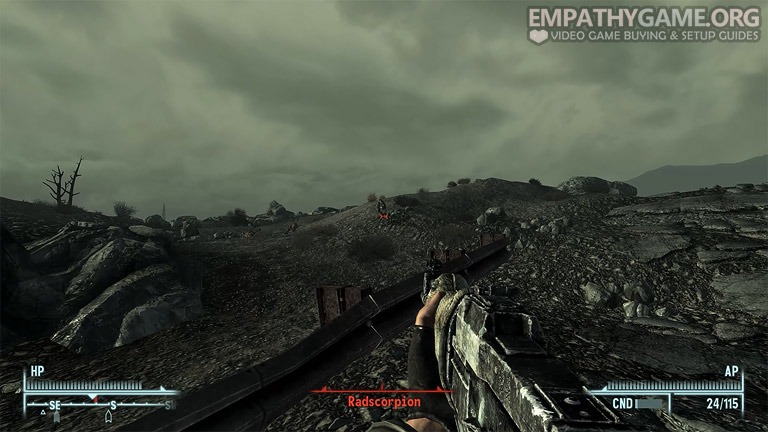
Time has been much less generous to the physical act of playing it. Real-time shooting feels loose, third-person movement is stiff, faces struggle to carry serious conversations, and the interface often demands extra patience. Yet V.A.T.S. turns rough combat into tactical problem-solving, equipment decay makes duplicate weapons useful, and a restrained set of marked side quests leaves room for unlabelled discoveries. It suits players willing to trade modern polish for atmosphere, systemic freedom, and the pleasure of finding something the game never insisted they see.
Leaving Vault 101 Makes Uncertainty the Main Attraction
The extended Vault 101 opening remains one of the most effective introductions to an open-world RPG because it gives the outside world a meaningful contrast. Childhood scenes establish James, Amata, the Overseer, the G.O.A.T. aptitude test, the Pip-Boy, and the enclosed social order before an emergency turns familiar corridors hostile. Repeat playthroughs expose how long this tutorial lasts, but its deliberate confinement makes the eventual escape feel larger than a simple loading transition.
When the vault door closes behind the Lone Wanderer, the screen blooms under unfamiliar daylight and the ruined horizon offers almost no comforting instruction. Megaton is visible in the distance, yet the landscape does not frame it as the only valid route. Springvale, an abandoned school, damaged houses, distant overpasses, and scattered mailboxes all compete for attention. That first descent illustrates the game’s central strength: curiosity is encouraged before safety is established.
The early hours can feel closer to survival horror than the later power curve suggests. Ammunition is limited enough to discourage careless bursts, Stimpaks are precious, radiation complicates food and water, and weapons deteriorate until their declining damage becomes a concern. A trip through a metro station with a weak hunting rifle, a handful of shells, and no certainty about what is around the next corner carries genuine pressure. The low mechanical hum, feral-ghoul cries, dim emergency lighting, and confusing junctions turn ordinary navigation into an ordeal. That vulnerability eventually recedes as skills, equipment, caps, and companions accumulate, but it gives the first part of the journey a harsh texture that Fallout 4 rarely matches with its smoother shooting and more generous crafting economy.
V.A.T.S. Holds Together Combat That Has Aged Badly
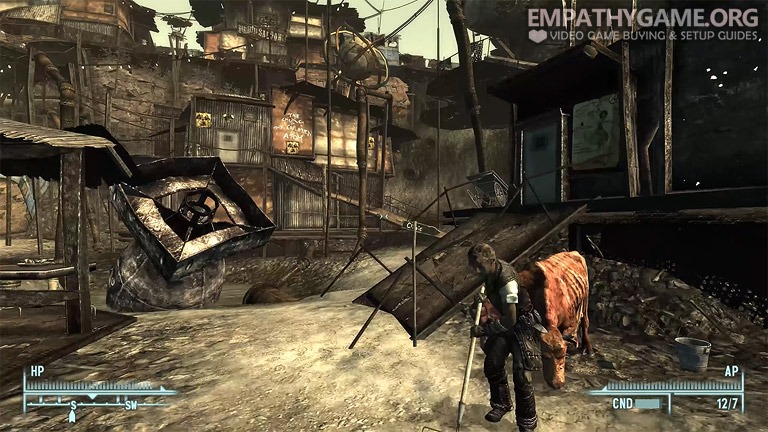
Fallout 3 presents itself partly as a first-person shooter, but its real-time gunplay was awkward even by late-2000s standards and now feels especially imprecise. Iron sights are absent from the original system, weapon feedback is inconsistent, enemies sometimes absorb repeated hits without convincing reactions, and movement lacks the responsiveness expected from a dedicated shooter. Third person is useful for viewing armour and checking the surroundings, not for precise combat.
V.A.T.S. is therefore not a decorative alternative; it is the system that gives combat structure. Activating it pauses the action, displays hit percentages for individual body parts, and spends Action Points to queue attacks. The percentages turn positioning, distance, weapon choice, Perception, and skill investment into readable decisions. A low-chance headshot may waste scarce ammunition, while targeting a raider’s weapon arm can reduce incoming accuracy. Crippling a leg slows a charging melee enemy, and damaging an exposed weapon may remove the most immediate threat without simply inflating damage numbers.
A typical encounter becomes a rhythm rather than a pure test of aim. Open with V.A.T.S. to injure a dangerous limb, move behind cover while Action Points recover, use manual fire at close range, then re-enter V.A.T.S. before the enemy closes. Explosives specialists can place mines in doorways before retreating, while melee characters spend Action Points to convert uncertain swings into committed attacks.
The cinematic slow motion remains entertaining, but repetition exposes its limitations. Camera angles can collide with walls, and frequent use interrupts the pace. The alternative is worse: without V.A.T.S., weak weapon handling becomes the centre of every fight. Combat works because the role-playing layer compensates for the shooting layer, not because the two are equally strong.
Scarcity Turns Scavenging Into Character Progression
The wasteland’s clutter has practical meaning because almost every expedition consumes something. Ammunition, medicine, RadAway, chems, food, armour condition, and carrying capacity create a chain of small decisions. A desk full of pre-war money is valuable because it weighs nothing. A duplicate rifle is not automatically vendor trash because it can be used for repairs. A bottle of irradiated water may be undesirable in Megaton and lifesaving in a tunnel when health is low.
Repair is one of the systems that best connects exploration to combat. Combining two damaged weapons raises the condition of the surviving item, improving its effectiveness while reducing inventory weight. This makes raider equipment useful even when it is not better than the weapon already equipped. A high Repair skill extends that advantage, allowing scavenged parts to maintain stronger gear instead of forcing repeated visits to merchants. The result is a satisfying loop: enter a ruin under-equipped, search every room, sacrifice unwanted duplicates, and emerge with fewer items but a more dependable loadout.
The Super-Duper Mart section of Moira Brown’s Wasteland Survival Guide demonstrates how these pressures overlap. The location promises food and medicine, but raiders occupy its aisles and back rooms. Searching thoroughly can replenish supplies, expose terminals and locked areas, and complete an optional objective, yet every extra room increases the risk of damage and ammunition loss. The reward is not just a quest update. It is the feeling that the trip has changed the character’s immediate chances of surviving the next one.
This balance is strongest before the economy loosens. Later levels provide abundant caps, specialised weapons, powerful perks, and companions capable of carrying extra equipment. Broken Steel’s tougher enemies restore danger through durability, not the early fear of running out. Fallout 3 is not a full survival simulation, but its scarcity gives ordinary containers a value that many larger open worlds struggle to sustain.
The Best Stories Sit Away From the Main Road
The central story is functional rather than flexible. Searching for James draws the Lone Wanderer through Galaxy News Radio, Rivet City, Vault 112, the Jefferson Memorial, the Brotherhood of Steel, and the Enclave, eventually widening a family mission into a conflict over Project Purity. It provides strong images and several memorable set pieces, but it repeatedly defines the protagonist through the father they are following. The main quest also narrows as it approaches its conclusion, leaving less room for the improvisation encouraged by the wider world.
Side quests are more confident because they begin with strange local problems rather than an obligation to save the region. The Power of the Atom turns Megaton’s unexploded bomb into an immediate test of greed, loyalty, and consequence. Tenpenny Tower begins as a dispute over access and prejudice, then denies the comfort of an uncomplicated solution. The Replicated Man investigation in Rivet City can be approached through conversation, records, and conflicting claims about identity. Oasis asks whether one person’s suffering should outweigh the future of a community. These quests are remembered not because there are hundreds of them, but because each has a recognisable premise and usually changes something tangible.
Moira’s Wasteland Survival Guide is the clearest example of a long side quest earning its place. Its assignments send the Lone Wanderer into radiation, minefields, dangerous shops, mirelurk territory, and a RobCo facility, often with optional conditions that reward taking greater risks. The character’s feedback changes the guide’s tone and final benefit, while skill and SPECIAL checks create responses that fit different builds. It is humorous without being mechanically empty, and it repeatedly turns an absurd request into a practical reason to explore a new part of the map.
Fallout 3’s quest log is comparatively restrained, so optional work rarely feels like a wall of chores waiting to be cleared. A marked quest may lead across several districts and remain memorable because it has a distinct conflict, while an unmarked situation can be discovered, understood, and resolved without announcing itself as formal content. Compared with the more compact, conversation-heavy hubs of The Outer Worlds, the Capital Wasteland places more trust in distance, silence, and accidental discovery. The trade-off is weaker narrative concentration, but the world feels less arranged around the player’s arrival.
The Capital Wasteland Is Hostile, Dense, and Sometimes Exhausting
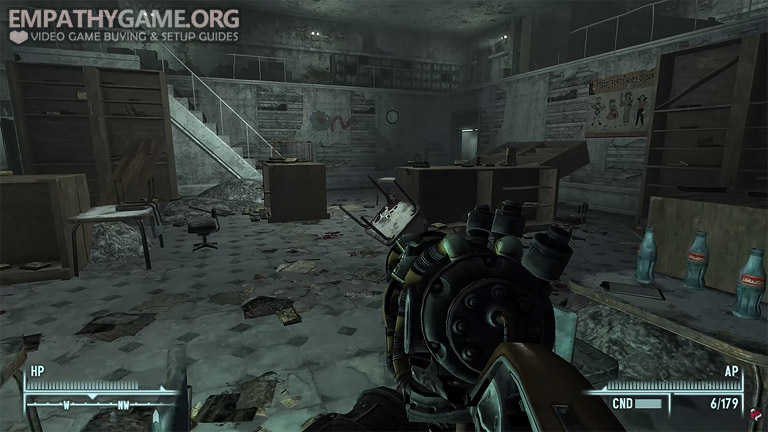
Washington, D.C. gives Fallout 3 a visual identity that survives its ageing textures and narrow colour palette. The Washington Monument, Capitol Building, Lincoln Memorial, Jefferson Memorial, and ruined museums transform familiar civic symbols into landmarks inside a broken battlefield. Galaxy News Radio’s broadcasts and 1940s and 1950s music add warmth without erasing the devastation. Cheerful advertising, retro-futurist technology, skeletons posed around failed shelters, and terminal entries about ordinary lives create a tone that shifts between satire, grief, and horror without settling into one mood.
The environmental storytelling is often denser than the formal narrative. A seemingly minor office building can contain employee correspondence, security logs, improvised barricades, and evidence of what happened after the bombs. Vaults function as self-contained tragedies built around social experiments rather than interchangeable dungeons. The Dunwich Building uses architecture, audio, and fragmented records to create dread with little exposition. Andale appears peaceful until domestic details reveal why its hospitality feels wrong. None of these locations needs the main plot to justify its existence.
The same design can become oppressive. Downtown rubble blocks direct routes and funnels travel through metro tunnels whose signage and similar interiors are difficult to read. Learning the network eventually makes D.C. feel interconnected, but early visits involve backtracking through green-grey corridors. Reused offices also blur together during long sessions, making the wasteland monotonous outside its major landmarks.
That hostility is partly why discovery feels earned. Following a weak radio signal may lead to a trapped survivor, a hidden bunker, or a story with no quest marker. Climbing over debris to reach an unexplored doorway can produce a skill book, a unique weapon, a bobblehead, or nothing more than a carefully staged scene. The rewards are inconsistent in numerical value but unusually strong in narrative value. The map encourages a habit of checking one more room because it repeatedly proves that small spaces can contain something authored rather than procedurally filled.
SPECIAL Builds Matter Most Before They Become Too Flexible
SPECIAL attributes, skills, Tag Skills, and perks give the Lone Wanderer a clear identity during the early and middle game. Intelligence increases the skill points available at level-up, Agility supports V.A.T.S. through Action Points, Endurance improves durability, and Luck influences critical performance. Skills then determine practical access: Speech can bypass violence or improve a reward, Science opens terminals, Lockpick exposes alternate routes and caches, and a combat specialisation determines which weapons are dependable rather than merely available.
A persuasive scavenger with strong Repair, Speech, and Small Guns approaches problems differently from an explosives specialist or stealthy energy-weapons character. One build may talk past a guard and hack a terminal; another may enter through a locked service door; a third may accept the frontal fight and rely on mines to control the room. Not every quest supports all of those approaches, and the Karma system often reduces morality to visibly good or evil choices, but the combination of dialogue checks, access skills, and combat investment gives many encounters more than one workable shape.
The game is also full of reactions that are easy to miss because they are not advertised as branching content. During the Vault 101 escape, refusing Amata’s pistol does not simply delete the object from the scene; she can use it herself when threatened. Wearing the Mechanist costume during the relevant part of Moira’s research opens special dialogue that acknowledges the disguise. These are small consequences, but they make role-playing feel less like selecting a labelled branch and more like testing whether the world notices a plausible action.
Balance weakens over a long campaign. Intelligence is disproportionately useful because its benefit compounds across levels, while some perks provide modest percentage bonuses beside others that reshape combat or conversation. Skill books, bobbleheads, level gains, and the raised cap from Broken Steel eventually allow a careful character to become competent at almost everything. That broad power suits the fantasy of a veteran wanderer, but it erodes the sharp differences that make the opening hours so replayable.
Characters Carry More Personality Than Their Faces Can Show
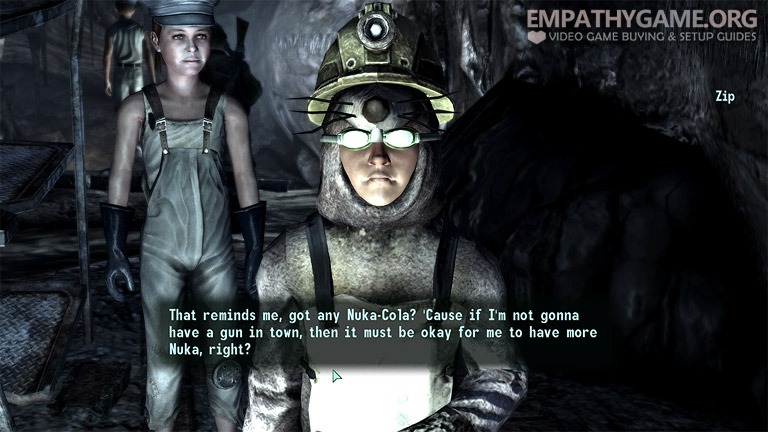
The cast works through writing and performance rather than animation. Moira Brown’s relentless optimism turns dangerous fieldwork into comedy without making her cruel. Three Dog uses Galaxy News Radio to connect distant actions with public reputation, giving the player a rare sense that news travels beyond the settlement where a decision occurred. Fawkes complicates the usual presentation of Super Mutants, while Charon, Jericho, Star Paladin Cross, and Dogmeat reflect different moral paths and practical needs.
Companions are useful but unreliable. They carry equipment and can turn difficult fights, yet pathfinding, aggression, and permanent death make them liabilities in tight interiors. Their limited development also feels thin beside later RPG companions: strong introductions are rarely followed by relationships of equal depth.
Dialogue has a similar split. Distinctive characters and dark humour give settlements personality, but repeated voices, stiff posture, and close-up framing expose the technology. Emotional scenes can look mechanical even when the writing works; imagination supplies much of the expression that the faces cannot.
PC Controls and Mods Add Flexibility
On PC, keyboard and mouse controls make inventory management, aiming, and hotkeys convenient, while controller support preserves the console-style interface. The larger advantage is flexibility: interface improvements, visual changes, restored details, additional quests, balance changes, and large overhauls can reshape the experience long after a first playthrough.
That freedom works best when it serves a clear goal. A cleaner interface can make inventory management easier to read, while restrained visual changes can sharpen the wasteland without replacing its bleak art direction. Larger overhauls can turn a familiar route through D.C. into something substantially different, but they also move the experience farther from Bethesda’s original balance and pacing.
The unmodified game remains worth judging on its own. Fallout 3’s strongest qualities—exploration, atmosphere, quest design, scarcity, V.A.T.S., and environmental storytelling—do not depend on a total conversion. PC simply gives returning players more ways to preserve, reinterpret, or deliberately transform those strengths after they understand what the original game is trying to do.
Replayability Comes From Curiosity Rather Than a Checklist
Fallout 3 supports repeat playthroughs through different builds, Karma paths, companion requirements, quest outcomes, missed bobbleheads, unique equipment, and five expansions. The add-ons vary sharply: The Pitt stands out for a morally uncomfortable conflict, Point Lookout for atmosphere and open exploration, while Operation: Anchorage and Mothership Zeta lean more heavily on linear combat. Broken Steel matters most structurally because it extends progression and allows the world to continue beyond the original finale.
The deeper reason to return is that the map hides more than one playthrough naturally reveals. A main-road character may never visit the Republic of Dave, discover every radio signal, explore each vault, or notice that an outfit changes a conversation. Another run can ignore Project Purity for dozens of hours and still produce a coherent journey built from scavenging, local disputes, and self-imposed goals. Because many discoveries are not presented as mandatory icons, finding one years later feels plausible rather than manufactured.
Replayability diminishes once skills converge and the main story’s limits are understood. A strong second run benefits from a deliberate identity—an explosives specialist, evil opportunist, or no-fast-travel scavenger—that preserves difficult choices. The systems and hidden reactions are present; the player often supplies the discipline that keeps them meaningful.
Final Verdict
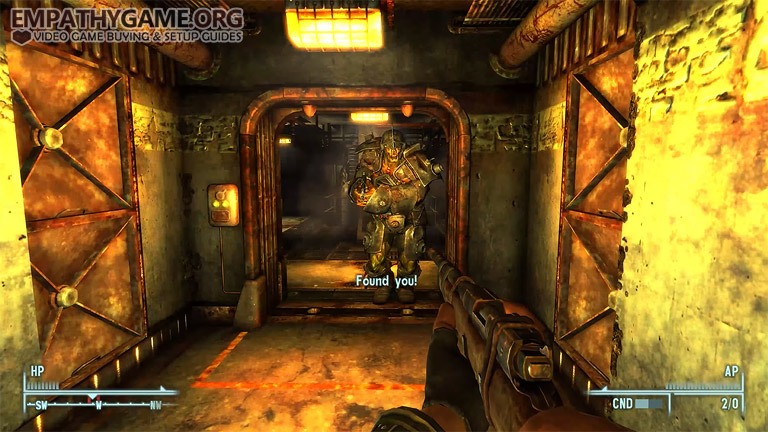
Fallout 3 remains compelling because the Capital Wasteland makes attention feel valuable. Its finest moments are not the largest battles or the loudest story scenes, but the decisions to follow a signal, search a forgotten floor, enter a settlement that feels wrong, or spend the last few rounds investigating a place that may contain nothing useful. Scarce early resources, equipment repair, V.A.T.S., access skills, memorable side quests, and quietly reactive details give those detours mechanical weight.
Its age is impossible to separate from the experience. Real-time shooting is clumsy, third-person control is awkward, companions can behave poorly, the metro network is confusing, and the main quest offers less freedom than the world around it. Modern action-RPGs are smoother, clearer, and generally more forgiving of rough combat and navigation.
They are not necessarily better at producing Fallout 3’s particular loneliness. Players who need polished gunplay, expressive animation, or tightly paced storytelling may find the friction overwhelming. Those who enjoy slow exploration, scavenging under pressure, environmental storytelling, flexible character builds, and side content that does not behave like a checklist will find an RPG whose most important destination is usually the one discovered by accident.
Fallout 3 Pros & Cons
- Pro: The Capital Wasteland rewards exploring ruined monuments, metro tunnels, isolated settlements, and abandoned vaults
- Pro: SPECIAL, skills, perks, dialogue checks, and quests support different character builds and decisions
- Pro: V.A.T.S. adds tactical limb targeting and positioning to otherwise dated real-time gunplay
- Pro: Optional side quests and unmarked discoveries deliver memorable stories and moral choices
- Pro: The GOTY Edition includes five expansions; Broken Steel extends the campaign and level cap
- Con: Modern Windows startup and stability problems can require troubleshooting
- Con: Loose gunplay, stiff movement, facial animation, and third-person controls feel dated
- Con: Some metro routes are confusing, companions behave unreliably, and later builds lose specialization
- Con: Complex FOSE and overhaul mod setups demand careful load orders and save management
Fallout 3 PC System Requirements
Important: Bethesda’s published hardware specifications are legacy requirements written for Windows XP and Vista. They remain the official baseline for the original PC release, while GOG lists Windows 10 for its GOTY build. Modern Windows 10/11 compatibility and stability are separate from raw hardware performance.
OFFICIAL LEGACY MINIMUM:
OS: Windows XP / Windows Vista
CPU: 2.4 GHz Intel Pentium 4 or equivalent
RAM: 1 GB on Windows XP / 2 GB on Windows Vista
GPU: DirectX 9.0c-compatible graphics card with 256 MB VRAM; NVIDIA GeForce 6800 or better / ATI Radeon X850 or better
DirectX: Version 9.0c
Storage: 7 GB available space
Sound Card: DirectX 9.0c-compatible
Controller: Xbox 360-compatible controller supported
OFFICIAL LEGACY RECOMMENDED:
OS: Windows XP / Windows Vista
CPU: Intel Core 2 Duo processor
RAM: 2 GB
GPU: DirectX 9.0c-compatible graphics card with 512 MB VRAM; NVIDIA GeForce 8800 series / ATI Radeon HD 3800 series
DirectX: Version 9.0c
Storage: 7 GB available space
Sound Card: DirectX 9.0c-compatible
Controller: Xbox 360-compatible controller supported
Modern storefront context: GOG lists Windows 10, 2 GB RAM, 7 GB of storage, DirectX 9.0c graphics, and no support for Intel integrated graphics in its GOTY requirements. Bethesda’s older requirements page still contains a Games for Windows Live line, but present PC storefront builds no longer rely on that retired service.
Additional PC Performance and Setup Notes
- Launch the clean game once before installing mods so Fallout 3 can generate its configuration files and detect the display hardware.
- Use the official storefront’s file-verification or repair function before reinstalling when the launcher opens but the game fails, files disappear, or a mod leaves the installation in an uncertain state.
- Do not install old Games for Windows Live clients or copy legacy
xlive.dllworkarounds into a modern storefront installation unless a specific, verified setup explicitly requires something different. - If old configuration files survive from a previous install and the game crashes before reaching the menu, back them up and let Fallout 3 generate fresh configuration files before adding other fixes.
- Bethesda’s support documentation includes a two-core
Fallout.iniworkaround for some multicore systems. Use the official instructions or a maintained technical guide rather than copying unexplained values from an old forum post. - The engine can behave poorly at very high frame rates. A sensible frame-rate cap or a proven modern timing fix can reduce physics, animation, dialogue, and scripting problems.
- Use a mod manager and add changes gradually. Test the game after essential utilities and bug fixes before stacking interface, texture, quest, balance, and gameplay mods on top.
- FOSE-based setups may need the Fallout Anniversary Patcher, which documents support for Steam, GOG, and Epic versions and requires a legitimate installed copy.
- The Updated Unofficial Fallout 3 Patch targets the complete game with all five official DLC packs and has additional dependencies; follow its maintained requirements rather than an older installation video.
- Do not install the older Unofficial Fallout 3 Patch and the Updated Unofficial Fallout 3 Patch together unless a maintained guide explicitly instructs you to do so.
- Tale of Two Wastelands is an advanced project that runs Fallout 3 content through Fallout: New Vegas. It requires legitimate compatible copies of both games and should be treated as a separate setup rather than a normal Fallout 3 mod.
- Back up saves before removing scripted mods, changing major overhauls, rebuilding a load order, or moving between standalone Fallout 3 and a Tale of Two Wastelands installation.
Official Trailer
Note: This official E3 trailer introduces Vault 101, the ruined Capital Wasteland, Washington landmarks, Super Mutants, Brotherhood of Steel forces, weapons, V.A.T.S. combat, and Fallout 3’s post-nuclear atmosphere, while the written guide adds PC storefronts, GOTY content, PC Game Pass, system requirements, Steam Deck support, mods, Windows compatibility, and setup guidance.
Frequently Asked Questions
Should I buy the base game or Fallout 3: Game of the Year Edition?
The GOTY Edition is the more complete choice for new players because it includes all five official expansions. Steam also sells the original base game separately, so check which version you already own before buying.
Does Fallout 3 require Games for Windows Live?
No. Modern storefront builds no longer require the retired Games for Windows Live client. Do not install old xlive.dll fixes simply because an outdated guide recommends them.
Can Fallout 3 be played offline on PC?
Yes, its campaign is entirely single-player. The GOG GOTY Edition is the clearest launcher-independent option, with DRM-free offline installers; other storefronts may have their own download, sign-in, or offline-mode procedures.
Why does Fallout 3 crash or fail to start on Windows 10 or 11?
Legacy configuration files, graphics detection, unsupported integrated GPUs, overlays, missing older runtimes, or conflicting mods can cause problems. First launch a clean installation, verify files, and consult the setup notes above; different PCs may require different fixes.
Does Fallout 3 support a controller on PC?
Yes. The original PC release supports an Xbox 360-compatible controller, as well as keyboard and mouse. Modern controller behavior can depend on the device and storefront configuration.
Can I play Fallout 3 entirely in third person?
Yes. You can switch between first-person and third-person views during exploration and combat, although precise shooting and navigating narrow interiors generally work better in first person.
What is a good beginner SPECIAL build?
Intelligence provides more skill points, Agility supplies Action Points for V.A.T.S., and Endurance makes early mistakes easier to survive. Repair, Speech, Lockpick, Science, and one chosen combat skill give a flexible first character useful options.
Are skill points, perks, and bobbleheads permanent decisions?
Most SPECIAL and perk selections meaningfully affect progression, and skill books or bobbleheads provide additional permanent boosts. Saving before important level-ups helps if you want to compare builds, while later levels can reduce the differences between specialists.
Does karma affect the story and companions?
Yes. Karma and quest choices can influence reactions, available companions, rewards, and ending narration. The game has fewer detailed faction-reputation systems than Fallout: New Vegas.
Can companions die permanently in Fallout 3?
Yes. Companions can be killed during normal play, so it is sensible to save before difficult encounters. Their survival depends on the situation, level, and equipment; there is no universal built-in revival option.
What is the maximum level, and can you continue after the main ending?
The original base game has a level cap of 20 and a final quest that ends play. With Broken Steel installed and enabled, the cap rises to 30 and the campaign continues after that original ending.
In what order should I play the Fallout 3 DLC?
There is no required order. Operation: Anchorage and The Pitt can fit into a developing playthrough; Point Lookout is more demanding, Mothership Zeta emphasizes combat, and Broken Steel matters most around the main-story finale.
Are all five expansions needed for Fallout 3 mods?
Not for every mod, but many major community patches and large setups require Fallout 3 GOTY and all five DLC packs. Read each mod’s exact requirements and dependencies before installing it.
What are FOSE and the Fallout Anniversary Patcher?
FOSE extends Fallout 3 scripting for advanced mods. The Fallout Anniversary Patcher helps supported Steam, GOG, and Epic executables work with FOSE-oriented mod setups; compatibility depends on the storefront build.
What is the Updated Unofficial Fallout 3 Patch?
It is a community project intended to fix game and DLC records, scripts, dialogue, and other problems. Its maintained requirements include dependencies and the complete DLC set, so do not mix installation advice from unrelated old patch guides.
Can Fallout 3 and New Vegas be combined with Tale of Two Wastelands?
Yes. Tale of Two Wastelands is a separate advanced setup that runs Fallout 3 content through the Fallout: New Vegas engine. It requires compatible legally owned copies of Fallout 3 GOTY and New Vegas Ultimate Edition; it is not an ordinary mod for a standalone Fallout 3 installation.
Can uninstalling mods damage Fallout 3 save files?
Yes. Removing scripted mods or changing a complex load order mid-playthrough can break quests and save data. Use a mod manager, add mods gradually, and keep manual backups before major changes.
Still have questions? Check the Bethesda Fallout 3 support hub, Steam Discussions, or the Fallout 3 Reddit community for additional setup and gameplay help.
Sources & References
Key factual and technical details in this guide were checked against the sources below.
- Bethesda — Fallout 3 official game page — links to the official Bethesda Fallout 3 page and original release identity.
- Bethesda Support — Fallout 3 PC system requirements — verified the published legacy minimum and recommended hardware specifications.
- Steam — Fallout 3: Game of the Year Edition — verified GOTY contents, Steam Deck Playable status, Metacritic display, and overall Steam user reception.
- GOG — Fallout 3: Game of the Year Edition — verified DRM-free offline installers, optional GOG Galaxy use, Windows listing, and GOTY contents.
- Microsoft / Xbox — Fallout 3: Game of the Year Edition — verified the native Windows PC listing and PC Game Pass availability.
- PCGamingWiki — Fallout 3 — used for modern PC compatibility, storefront-version, Games for Windows Live removal, engine, display, and modding context.
Similar Games Like Fallout 3





Found something worth playing through DecideGame?
DecideGame.com is an independent gaming project run by Editor Zero. If this guide helped you discover a game, solve a problem, or find useful information, you can support DecideGame.com and help keep new and updated game guides coming.
DecideGame — PC Game Guides, Reviews & Setup Help