
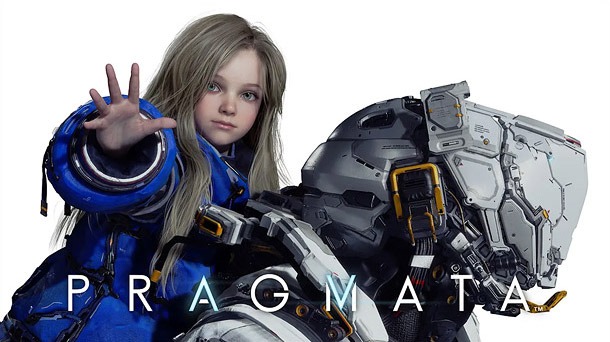
📅 Game released: 2026
PRAGMATA is a focused sci-fi action-adventure in which astronaut Hugh Williams and android Diana escape an AI-controlled lunar station by combining third-person shooting, movement, and real-time hacking. This PC guide explains the official Steam download and installation, Standard versus Deluxe content, free Mega Man Pack, Sketchbook demo, Steam Deck support, system requirements, and practical graphics settings.
 By Editor Zero — independently researched, edited, and maintained.
Last updated: 13 November 2026
Last reviewed: 13 November 2026
Table of Contents
- Quick Facts
- Official PC Stores, Download & Installation
- PRAGMATA Review
- Pros & Cons
- PC System Requirements
- Frequently Asked Questions
- Similar Games
PRAGMATA Quick Facts
- Game: PRAGMATA
- Developer: Capcom
- Publisher: Capcom
- Genre: Action-Adventure, Sci-Fi, Third-Person Shooter, Puzzle-Solving
- Release: April 17, 2026 (PS5, Xbox Series X|S, Windows PC and Nintendo Switch 2 in most regions); Nintendo Switch 2 — April 24, 2026 in Japan and parts of Asia; Steam displays April 16 in some time zones
- Platforms: Windows PC, PS5, Xbox Series X|S, Nintendo Switch 2
- Editions & add-ons: Standard Edition, Deluxe Edition (with Shelter Variety Pack), free Mega Man Pack, separately sold Original Soundtrack
- Modes: Single-player; no co-op or competitive multiplayer
- Steam Deck: Verified; first-time setup needs internet access
- Cloud Access: GeForce NOW; Steam Cloud saves between compatible PC installations
- Engine: RE Engine
- Community: Official PRAGMATA website, Steam Discussions, PRAGMATA Reddit community
- PC modding: Nexus Mods for PRAGMATA; unofficial mods only, with no Capcom mod kit or Steam Workshop
- Metacritic score: 88/100 on PC
- IGN score: 8/10 for the multiplatform release
- Steam user reception: Overwhelmingly Positive overall
Official PC Stores, Download & Installation
👇 Compare PRAGMATA’s official Steam game editions, demo, downloadable add-ons, and installation options before buying or installing the PC version.
- Official PC store: Capcom links Steam for the native Windows PC version. No separate Epic Games Store, GOG, or Microsoft Store PC release is advertised.
- Standard Edition: Includes the full single-player game without the optional Shelter Variety Pack; there is no separate paid story campaign required to finish the game.
- Deluxe Edition: Bundles the base game with the Shelter Variety Pack, adding two Hugh outfits, two Diana outfits, the Grip Gun DS skin, three Shelter music tracks, three Diana gestures, and Data Library artwork.
- Shelter Variety Pack: Sold separately for Standard Edition owners. It is already included in Deluxe, so avoid buying the same cosmetics twice.
- Free Mega Man Pack: The official Mega Man Pack on Steam adds themed outfits, gestures, and background music. The add-on costs nothing, but requires ownership of the PRAGMATA base game; it is not necessary to buy Deluxe to claim it.
- Original Soundtrack: Capcom also sells a separate 46-track soundtrack on Steam. It is a music purchase, not an additional level, story expansion, or feature of the Deluxe Edition.
- Former bonuses: Hugh’s Neo Bushido and Diana’s Neo Kunoichi outfits were limited early-purchase bonuses. Do not assume a new standard or Deluxe purchase contains those expired offers.
- Free Sketchbook demo: Steam provides the PRAGMATA Sketchbook demo to try movement, third-person shooting, and hacking before purchasing. Some demo features differ from the complete game.
- Steam installation: Purchase the game or claim the demo through Steam, then use the Steam Library to download, install, verify, and update it. A separate Capcom launcher or Capcom ID is not listed for normal campaign access.
- Activation and offline play: Steam lists Denuvo Anti-Tamper and a limit of five different PC activations in one day. Complete the initial setup online; the single-player campaign does not have a listed always-online requirement, although authentication or updates can require a connection.
- Saves and cloud streaming: Steam Cloud supports syncing between eligible PCs using the same Steam account. Cross-platform save transfers are not advertised. GeForce NOW supports streaming a linked compatible game copy where the service operates.
- Steam Deck: Valve marks the complete game Verified for controls, icon support, readable text, default graphics configuration, and SteamOS compatibility. First-time setup requires active internet access, and Verified does not guarantee a fixed 60 FPS.

 View PRAGMATA on the Official Website
PRAGMATA Review
A smart, compact sci-fi adventure in which two characters truly fight as one
PRAGMATA initially resembles a familiar third-person shooter: Hugh carries the weapons, hostile robots guard a damaged lunar station, and each laboratory hides another fragment of a technological disaster. Then Diana climbs onto his back, a hacking grid appears beside the action, and Capcom’s adventure reveals its defining idea. You do not alternate between these characters. You control both at once.
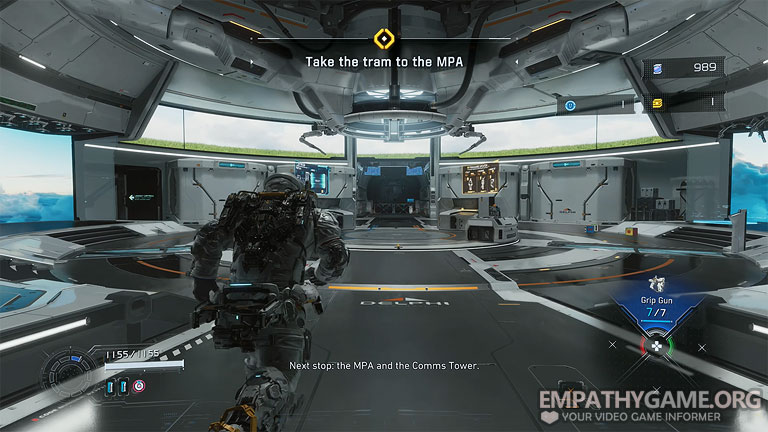
Hugh runs, dodges, aims, and fires while Diana hacks enemy armor in real time. A fight asks you to read attack patterns, trace a path through the Matrix, keep room to evade, and exploit a vulnerable core before the armor recovers. The cooperation at the story’s center becomes something the controls demand in almost every encounter.
The result is a focused action-adventure rather than a sprawling survival game. Its mystery is familiar and its enemies relatively few, but the partnership is warm, the combat mentally active, and the lunar environments more memorable than their modest scale suggests.
A Lunar Mystery Built Around Hugh and Diana
The Cradle is a remote research station devoted to Lunafilament, a material that lets advanced printers reproduce objects and environments. When communication stops, Hugh Williams joins the team sent to investigate. The mission falls apart almost immediately, leaving him injured and isolated until Diana, a unique android with the appearance and curiosity of a young girl, rescues him.
Diana can compromise the station’s systems and its AI-controlled machines, but she knows Earth mainly through stored information and imperfect recreations. Hugh needs her abilities to survive; she needs his help to reach a world she has only imagined. Their partnership develops through brief conversations, shared danger, and optional interactions rather than relying only on dramatic cutscenes. Some contextual dialogue can even surface on later visits to familiar areas. A return trip can reward curiosity with more characterization, not just collectibles.
The mystery surrounding the missing personnel and the station’s intelligence is less distinctive. Several turns are predictable, and the antagonist never gains the personality of the characters opposing it. The quieter exchanges work better. Diana treats ordinary human behavior as something worth understanding, while Hugh’s initial sense of obligation gradually gives way to genuine affection.
That companionship recalls Death Stranding 2: On the Beach, though the two games pursue it at very different scales. Kojima Productions builds a broad, meditative journey around travel and reconnection; PRAGMATA keeps its pair inside a tightly designed station. Both give strange technology emotional weight through human dependence.
The Core Gameplay Loop
Each excursion combines exploration, fights, environmental puzzles, upgrade materials, collectibles, and a return to the Shelter. Tram connections and new movement options make older sectors easier to revisit. Side paths can lead to Training Simulations, Cabin Coins, Earth Memories, and useful resources, so detours generally matter.
The route is linear enough to sustain momentum without becoming a single corridor. Rooms branch toward locked machinery, elevated platforms, and compact combat arenas. The pattern is easy to settle into: follow the next objective, investigate an unusual corner, survive a demanding encounter, then return to improve Hugh and Diana. That clarity maintains momentum, even as the formula becomes predictable later on.
Hacking and Shooting Happen at the Same Time
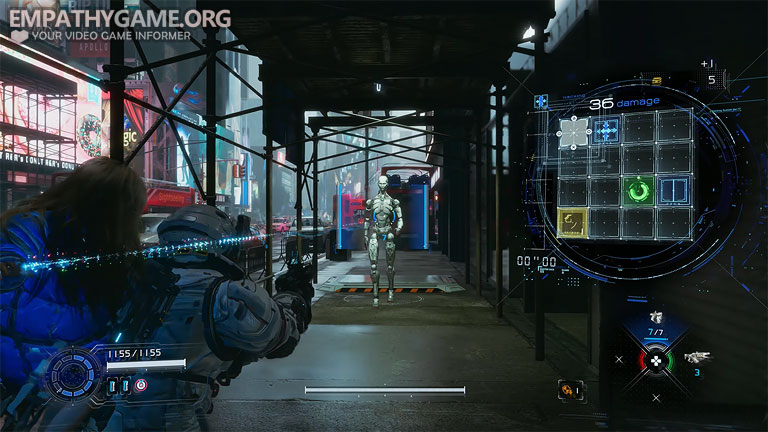
Most Bots wear armor that makes ordinary gunfire inefficient. Locking on opens Diana’s Hacking Panel, where a continuous route must reach the target tile. Completing it compromises the protection and briefly exposes the machine to Hugh’s weapons. The world never pauses. Enemies advance, fire, and prepare attacks while attention moves between the grid and Hugh’s position.
Longer routes can produce stronger results, but perfection is not always wise. An extended path may keep a core exposed longer; a short hack may be the only safe option when a missile or charging Bot is about to connect. The best solution depends on the surrounding danger, not simply the neatest route.
Enemy defenses complicate the order of operations. Hugh may need to break a barrier before Diana can start, or Diana may redirect a homing projectile while Hugh repositions. Support enemies introduce less obvious choices. A medic drone healing a larger robot can become a vulnerability of its own: hacking the drone during the healing action can damage the machine it is trying to save. That complicates the usual instinct to eliminate the healer first.
Hacking Nodes and Weapons Reward Improvisation
Hacking Nodes add effects to a Matrix route. Decode weakens defenses, while Multi-Hack spreads pressure across nearby enemies. A bonus tile can turn an ordinary opening into a decisive attack, yet reaching it may leave Hugh exposed for longer. The question is whether the bonus justifies the attention.
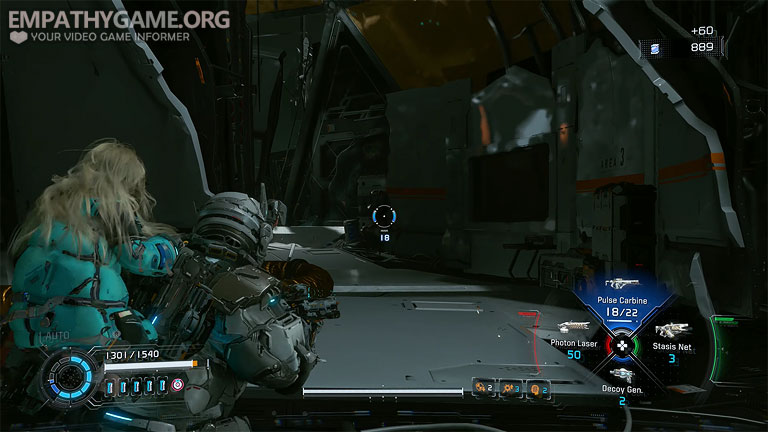
The dependable Primary Unit is supported by limited-use Attack, Tactical, and Defense weapons. Those secondary tools solve immediate problems. Restraining a Bot buys time for a difficult hack; heavy fire capitalizes on a narrow opening; defensive equipment helps reorganize a crowded arena. Supplies are replaceable, making timely use preferable to hoarding.
The Hacking Mine reveals how far these systems can extend beyond one robot. Once hacked, it repeatedly applies its assigned Node effects to enemies inside its field, and nearby mines can link their coverage. A Heat or Confuse setup can therefore control a group while Hugh deals with another threat. Its usefulness depends on preparation and positioning rather than reflexes alone.
Builds can change combat’s rhythm as well. Pairing the Pulse Carbine’s heat buildup with a Heat Node and Combust mode can push Bots into an overheated state, opening a Critical Shot. With the Collateral Damage mod, that single-target payoff also threatens nearby machines. Instead of always chasing immediate gun damage, the player can build toward a delayed group-clearing opportunity. The arsenal has more depth than its limited weapon count suggests.
Movement Keeps the Puzzle Active
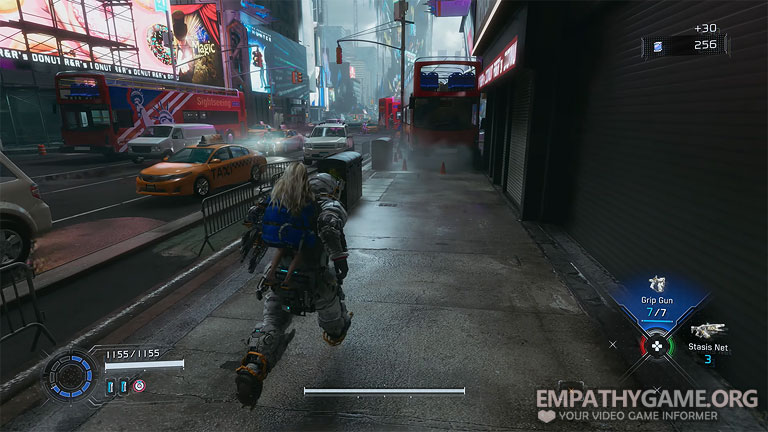
Hugh’s thrusters cross gaps, adjust direction, and evade attacks without allowing permanent flight. Strong encounters make this movement part of the solution. Dodge too early and the next strike catches him; spend too long completing an ambitious hack and he may lose the position needed to exploit it. Finding a few safe seconds matters as much as dealing damage.
Input choice can alter that rhythm on PC. With suitable bindings, a mouse lets the cursor sweep quickly through Diana’s grid while a thumb button can keep dodging immediately accessible. A controller offers a different kind of consistency through its directional inputs. Neither removes the multitasking challenge, but controls can strongly affect how natural it feels.
The system is usually readable, although fights involving several large machines can become visually crowded. Projectiles, warnings, Hacking Nodes, walls, and environmental effects compete for attention. A cramped camera can turn a fair tactical problem into confusion. That frustration stands out because the combat is so effective when each layer stays legible.
Exploration Turns Familiar Places Uncanny
The Cradle extends beyond metal laboratories into printed imitations of Earth: streets, natural spaces, industrial rooms, and interiors that look convincing until an unfinished edge reveals raw artificial material. The station feels like a machine reconstructing humanity from incomplete instructions. Even quiet corridors invite inspection.
Its empty city spaces contrast with Cyberpunk 2077. Night City communicates technological dependence through crowds, advertising, and excess. The Cradle removes the people and leaves replicas behind. Diana regards ordinary streets and habitats with wonder, turning environmental art into characterization.
Cooperation also extends outside combat. Diana opens systems and doors while Hugh uses his body and thrusters to reach damaged infrastructure. The puzzles are lighter than combat hacking, but they break up the shooting and reinforce the sense that neither character could cross the facility alone. The tram keeps optional backtracking manageable.
The Shelter Gives Progression a Human Center
The Shelter replenishes supplies and provides facilities for upgrading health, the Primary Unit, hacking duration, weapons, and Nodes. Cabin’s stamp rewards and the Simulation Pod add playful goals alongside combat mastery. Different priorities can favor direct damage, stronger hacking, or tactical combinations, although not every new option changes the way an encounter plays as much as its description suggests.
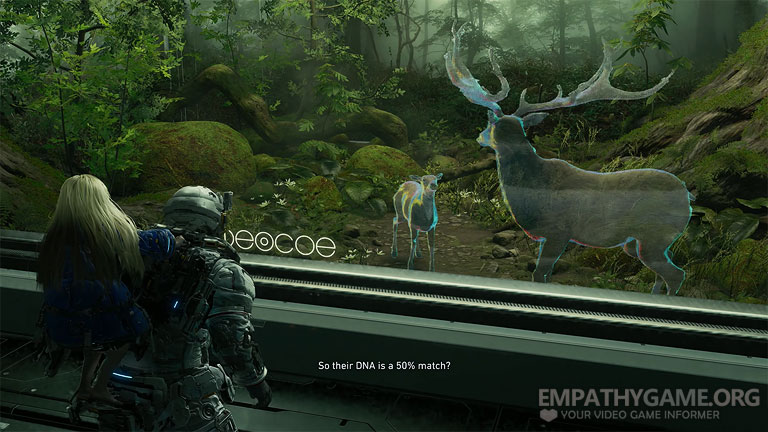
Progression has a contradiction. New sectors regularly bring another weapon, passive benefit, hacking option, and Shelter diversion, yet the sequence itself becomes predictable. The game is generous with things to unlock but less adventurous about how they are introduced. Build experimentation counters that routine; discovering a new use for an older tool can be more exciting than another unlock.
The Shelter’s best rewards are not attached to damage numbers. Earth Memories introduce Diana to ordinary objects and activities, and new interactions let her draw, play, ask questions, and invite Hugh into small diversions. Without these optional moments, the later story loses some groundwork. Outside, Diana disables lethal machines; here, she can be delighted by things Hugh barely notices. That contrast gives collecting a purpose beyond completion percentages.
Visual and Audio Direction
The presentation is strongest when polished artificial beauty meets visible failure: a convincing skyline ends against an unfinished wall, a calm habitat sits beside exposed lunar machinery, or the station’s noise gives way to the silence outside. Repeated components grow familiar during cleanup, but the environments retain their uncanny coherence.
Capcom’s Resident Evil Requiem uses the studio’s cinematic instincts for horror and vulnerability, whereas PRAGMATA applies them to brighter science-fiction spaces and faster action. The sound is not just decoration. Footsteps, missile alerts, and weapon changes can help the player track danger while their eyes are occupied with Diana’s grid.
Replayability and Post-Game
The campaign favors concentration over enormous length. Optional routes, Simulations, Shelter rewards, collectibles, and upgrades extend a focused run, while New Game+, Lunatic difficulty, and Unknown Signal challenges offer reasons to keep experimenting. These modes demand different kinds of commitment.
New Game+ lets a developed loadout revisit familiar encounters, but the first Lunatic run cannot simply inherit that completed Standard build. It requires a fresh progression path, even though more equipment choices become available early on. Some will enjoy making each investment count again; others will resent rebuilding instead of testing a finished loadout.
Higher difficulty also exposes uneven balance between bosses and groups. Crowded waves can remain exhausting because several durable enemies demand attention at once, while carefully assembled combinations can shorten individual boss encounters dramatically. The Lim Cannon, obtainable through Unknown Signal, is one example: upgraded and paired with powerful hacking abilities such as Deletion Protocol, it can turn a lengthy single-target fight into a far shorter exchange. Mastery does not guarantee a smooth difficulty curve.
The enemy roster and level structure are not broad enough to make every return trip feel fresh. Still, players who enjoy refining execution, discovering weapon interactions, and tackling optional challenges have more to pursue than those interested mainly in new story scenes.
Final Verdict
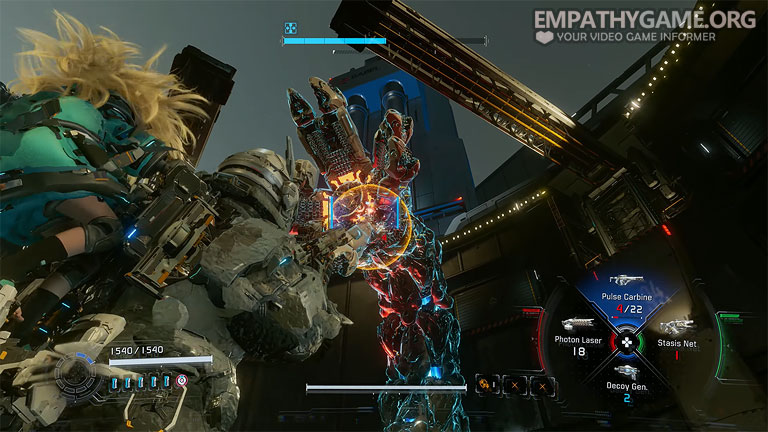
PRAGMATA succeeds by taking one excellent idea seriously enough to explore its consequences. Simultaneously controlling Hugh’s movement and weapons while guiding Diana through real-time puzzles turns robot encounters into compact tactical problems. Clever uses of Nodes, support enemies, temporary weapons, and movement keep opening up possibilities that a more conventional shooter might never ask the player to consider.
The surrounding adventure is less assured. Its rogue-AI mystery follows a familiar path, its antagonist lacks the personality of its heroes, and later areas expose the limits of its enemy variety and progression formula. Crowded encounters can also become difficult to read. Players expecting a vast open world, deep stealth, or a long role-playing campaign will find a much narrower experience.
A more cinematic and stealth-led interpretation of futuristic dependence appears in Metal Gear Solid 4: Guns of the Patriots. Its battlefield infiltration and long story sequences create a very different rhythm, but both games connect machinery to questions of control and humanity rather than treating technology as decoration.
What holds PRAGMATA together is the bond between its leads. Their dependence makes mechanical sense, their quieter interactions give the escape emotional weight, and Diana leaves a stronger impression than most of the Cradle’s secrets. It is a tightly designed adventure for players who enjoy thinking and reacting at the same time, and who are willing to accept a fairly conventional story in exchange for a genuinely unusual way to fight.
PRAGMATA Pros & Cons
- Pro: Distinctive two-character combat makes hacking and shooting simultaneous parts of one tactical problem
- Pro: Hugh and Diana form a warm partnership that gives the familiar rogue-AI mystery an emotional center
- Pro: Focused level design rewards exploration without filling the campaign with repetitive open-world tasks
- Pro: Weapons, Nodes, movement, and varied defenses produce flexible encounters that reward improvisation
- Pro: Optional Simulations, collectibles, higher difficulties, Unknown Signal, and New Game+ support mastery-focused replay
- Con: Simultaneously reading the grid, watching attacks, moving Hugh, and choosing weapons can initially feel overwhelming
- Con: The compact campaign may disappoint players expecting a long open world or role-playing game
- Con: Repeated enemies and facility components become more obvious during optional cleanup
- Con: The central antagonist and several plot revelations are less memorable than the heroes and combat system
PRAGMATA PC System Requirements
OFFICIAL WINDOWS PC REQUIREMENTS:
MINIMUM — Estimated 1080p / 45 FPS / Performance Preset:
OS: Windows 11 (64-bit)
CPU: Intel Core i5-8500 / AMD Ryzen 5 3500
RAM: 16 GB
GPU: NVIDIA GeForce GTX 1660 6 GB / AMD Radeon RX 5500 XT 8 GB
DirectX: Version 12
Storage: 40 GB available space
Network: Broadband internet connection
Storage Note: SSD recommended
Performance Note: The official estimate targets 1080p at 45 FPS with the Performance preset; frame rate may decrease in graphics-intensive scenes.
RECOMMENDED — Estimated 1080p / 60 FPS / Balanced Preset:
OS: Windows 11 (64-bit)
CPU: Intel Core i7-8700 / AMD Ryzen 5 5500
RAM: 16 GB
GPU: NVIDIA GeForce RTX 2060 Super 8 GB / AMD Radeon RX 6600 8 GB
DirectX: Version 12
Storage: 40 GB available space
Network: Broadband internet connection
Storage Note: SSD recommended
Performance Note: The official estimate targets 1080p at 60 FPS with the Balanced preset; frame rate may decrease in graphics-intensive scenes.
RAY-TRACING GPU GUIDANCE:
NVIDIA: GeForce RTX 3060 12 GB or better
AMD: Radeon RX 6700 XT 12 GB or better
Additional Note: These are Capcom’s listed GPU requirements for ray tracing; resolution, settings, upscaling, frame generation, drivers, and scene complexity affect actual performance.
Additional PC Performance and Setup Notes
- Windows 11 is listed for both official tiers. Windows 10 is not part of Capcom’s published specification.
- Install on an SSD where possible, and leave free space beyond the listed 40 GB for downloads, shader data, and temporary installation files.
- Update the GPU driver before diagnosing launch failures, display problems, shader stutter, ray-tracing issues, or frame-generation artifacts.
- DLSS and FSR can improve performance through image reconstruction. Test Quality or Balanced modes before using a more aggressive Performance setting.
- NVIDIA RTX hardware can use path tracing, DLSS Ray Reconstruction, Reflex, and supported Frame Generation modes; path tracing is substantially more demanding than standard rendering.
- Frame generation improves displayed smoothness but works best when the underlying frame rate is already stable and responsive.
- If performance drops, reduce path tracing or ray tracing first, then test reflections, shadows, volumetric effects, texture memory use, and a stable frame-rate cap.
- Before troubleshooting crashes or save problems, disable unofficial mods, verify the Steam files, remove unstable overclocks, and test without unnecessary overlays.
Official Trailer
Note: Capcom’s official main trailer offers a concise, spoiler-light look at Hugh and Diana, the lunar facility, Matrix hacking, third-person combat, mechanical enemies, and the game’s science-fiction atmosphere. The guide above adds edition, demo, installation, handheld, system-requirement, graphics-feature, mod, and troubleshooting details for the released PC version.
Frequently Asked Questions
How long does PRAGMATA take to beat?
A focused story playthrough often takes around 8–12 hours. Exploration, collectibles, Shelter improvements, Training Simulations, and post-game challenges can take a first run closer to 15–20 hours, depending on difficulty and how thoroughly you explore.
Does PRAGMATA have co-op, split-screen, or multiplayer?
No. Both Hugh and Diana are controlled by a single player. Their cooperation is a gameplay mechanic, not a two-person co-op mode.
How do you hack robots while shooting?
Locking onto a Bot brings up Diana’s Matrix grid without pausing the encounter. Hugh can still move, dodge, and take damage while you trace a connected route to the target and expose its defenses. Favor a shorter, safer route when enemy attacks are imminent; reach bonus Nodes when you have enough room.
What are the best beginner combat tips?
Hack armored enemies before spending high-damage ammunition, keep moving while solving grids, and watch attack warnings. Invest in survival and hacking improvements, try Tactical or Defense weapons to create breathing room, and learn short hacking paths before chasing every optional Node. The early challenge comes from dividing attention, not from long standalone puzzles.
Why do some PRAGMATA weapons run out?
The Primary Unit is Hugh’s dependable rechargeable weapon. Stronger Attack, Tactical, and Defense tools tend to have limited uses, encouraging you to choose them for specific threats rather than rely on one powerful gun throughout the game.
What are Hacking Nodes used for?
Nodes add special effects to Diana’s hacking routes. They can improve damage opportunities or help against groups, but reaching an extra Node may take precious time while enemies keep attacking. Choose the route that fits the current encounter.
What is the Shelter for?
The Shelter is a recurring hub for restoring resources, improving Hugh and Diana, preparing equipment, visiting Training Simulations, checking discoveries, and enjoying optional Diana interactions. Materials and collectibles found during exploration help develop its facilities and upgrades.
Can you revisit areas and collect missed items?
The station includes return routes and connections that make earlier sectors accessible again. New movement options can reveal previously unreachable places, so it is worth checking older areas before assuming a missed collectible is permanently lost.
Does PRAGMATA have New Game+ and tougher challenges?
Yes. New Game+, Lunatic difficulty, Training Simulations, and Unknown Signal challenges extend play beyond the main campaign. New Game+ supports replay with existing progress, but a first Lunatic run requires fresh progression rather than carrying over a completed Standard build. These options reward mastering combat more than discovering a second lengthy story.
Is the free Mega Man Pack included in the Deluxe Edition?
The Mega Man Pack is a separate free Steam add-on that requires the base game. You do not need Deluxe to get it. Deluxe instead includes the paid Shelter Variety Pack, so check both packages independently before purchasing or claiming content.
Can I play the free PRAGMATA Sketchbook demo without buying the game?
Yes. Steam offers the Sketchbook demo independently of a full-game purchase. It introduces movement, hacking, and shooting, but the demo is a sample with some differences from the released campaign; do not assume demo-specific progress or features automatically transfer.
Can PRAGMATA be played offline?
The main campaign is single-player and is not listed as always online, but the Steam version includes Denuvo and requires an internet connection for initial setup. Steam Cloud, updates, and some authentication events also need connectivity. Test offline access after successful activation if that matters to your setup.
Does PRAGMATA work on Steam Deck?
Yes. Valve rates it Steam Deck Verified, including readable text, proper controls, and compatible default settings. Internet is needed for first-time setup. The badge is a compatibility rating, not a promise of 60 FPS in every scene.
Does PRAGMATA support keyboard and mouse as well as controllers?
Yes. Steam advertises full controller support, and the PC game can be played with keyboard and mouse. Controller inputs suit the simultaneous movement and hacking layout well, while mouse aiming may appeal to shooter players. Adjust Steam Input if your controller is not detected correctly.
Is PRAGMATA available through GeForce NOW or PC Game Pass?
NVIDIA supports PRAGMATA on GeForce NOW for a compatible owned game copy in supported regions and plans. Capcom does not list PRAGMATA as a PC Game Pass title; Steam remains the official native Windows storefront identified for the game.
Does PRAGMATA support cross-save between Steam and consoles?
Steam Cloud syncs compatible PC saves on the same Steam account. Official cross-platform progression between Steam and PS5, Xbox Series X|S, or Nintendo Switch 2 has not been advertised, so do not expect saves to move between those ecosystems.
Does PRAGMATA have ray tracing, path tracing, and upscaling?
Yes. PC features include ray tracing, DLSS, and FSR. Supported NVIDIA RTX hardware can also use path tracing, DLSS Ray Reconstruction, Reflex, and frame generation features. Path tracing is more demanding than conventional rendering, so it is best treated as an optional quality upgrade rather than a minimum setting.
What should I try if PRAGMATA crashes or stutters?
Update the graphics driver and game, let shader work finish, verify Steam files, and temporarily disable mods, overlays, or unstable overclocks. Lower path tracing or ray tracing first if GPU performance is poor, then reduce reflections, shadows, and settings that exceed available VRAM. Do not rely on frame generation to fix an unstable base frame rate.
Does PRAGMATA support mods?
Unofficial community mods are available, including at Nexus Mods, but Capcom does not provide an official mod kit or Steam Workshop. Back up saves and disable modifications when investigating crashes or compatibility issues.
Still have questions? Check the PRAGMATA community on Reddit, the Steam Discussions, or the official Capcom Support portal.
Sources & References
Key factual and technical information in this guide was checked against relevant official and reliable sources, including:
- PRAGMATA on Steam — official Windows editions, demo, user reception, system requirements, Steam features, DRM, and add-on listings.
- PRAGMATA: Mega Man Pack on Steam — free add-on ownership requirement and cosmetic content.
- PRAGMATA Original Soundtrack on Steam — separate 46-track music release and ownership distinction.
- Capcom’s PRAGMATA release announcement — launch dates and released platforms.
- SteamDB PRAGMATA metadata — Steam Deck Verified details, RE Engine identification, and Steam platform metadata.
- NVIDIA PRAGMATA PC graphics guide — path tracing, DLSS, ray reconstruction, and frame-generation features.
- NVIDIA GeForce NOW announcement — official availability of PRAGMATA through cloud streaming.
Similar Games Like PRAGMATA
- Stellar Blade
- Metroid Prime
- Resident Evil 4 Remake
- Prey
- Resident Evil 9: Requiem
- Death Stranding 2: On the Beach





Found something worth playing through DecideGame?
DecideGame.com is an independent gaming project run by Editor Zero. If this guide helped you discover a game, solve a problem, or find useful information, you can support DecideGame.com and help keep new and updated game guides coming.
DecideGame — PC Game Guides, Reviews & Setup Help