
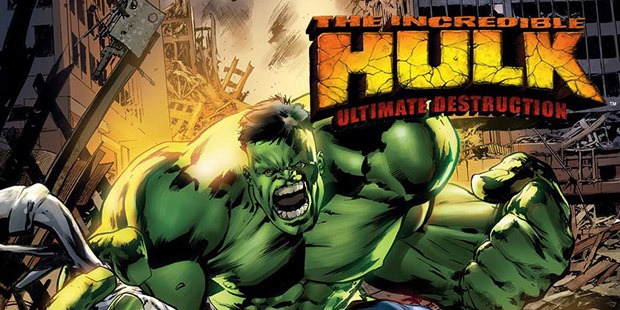
📅 Game released: 2005
Use this updated 2026 Hulk Ultimate Destruction PC guide to check official download status, choose the Xbox version through xemu, compare Dolphin and PCSX2 alternatives, prepare your own lawful game backup, and review emulator system requirements and setup guidance.
 By Editor Zero — independently researched, edited, and maintained.
Last updated: 27 September 2026
Last reviewed: 27 September 2026
Table of Contents
- Quick Summary
- Quick Facts
- Official PC Stores, Download & Installation
- The Incredible Hulk: Ultimate Destruction Review
- Pros & Cons
- PC System Requirements
- Frequently Asked Questions
- Similar Games
The Incredible Hulk: Ultimate Destruction Quick Summary
✔ Open-world action-adventure built around giving Hulk extraordinary mobility and destructive freedom across a city, military badlands, rooftops, streets, and bases
✔ Hulk can leap enormous distances, run up buildings, climb structures, throw vehicles, smash scenery, fight military forces, and turn environmental objects into improvised weapons
✔ Similar to Spider-Man: Web of Shadows through its open-world superhero movement, vertical city traversal, melee combat, escalating powers, and comic-book setting
✔ Story missions are mixed with free-roaming destruction, side challenges, boss battles, collectibles, Smash Point progression, and a large unlockable combat move set
✔ There is no native Windows edition; the recommended PC emulation route is the original Xbox version through xemu using a lawful backup of a copy you own
✔ GameCube through Dolphin is the simpler secondary route, while the PS2 edition through PCSX2 remains another viable option for owners of that version
The Incredible Hulk: Ultimate Destruction Quick Facts
Official PC Store Status, Download & Installation
👇 The Incredible Hulk: Ultimate Destruction has no native Windows storefront release, so use the official emulator resources and ownership-based setup notes below rather than third-party game-file sources.
- Native PC status: The original release was made for Xbox, PS2, and GameCube. There is no verified native Windows, Steam, Epic Games Store, GOG, or Microsoft PC edition to purchase and install.
- Recommended emulator: The Xbox version through xemu is the preferred route for this guide. xemu’s game-specific compatibility tracker rates Ultimate Destruction as Perfect and describes it as playable from start to finish without noticeable issues in the submitted test.
- Why Xbox first: The Xbox edition is the strongest original console version for presentation. Contemporary testing found fewer frame-rate drops than the GameCube version, and Xbox uniquely supported output up to 720p in addition to the 480p modes available across all three releases.
- xemu system files: xemu is a full-system Xbox emulator and requires several Xbox system files in addition to the game itself. Follow xemu’s official Required Files documentation and use only system data you are legally entitled to use.
- Game copy required: xemu does not include The Incredible Hulk: Ultimate Destruction. Use a lawful backup created from a physical Xbox copy you own and follow xemu’s official game-backup documentation. This guide does not provide or direct readers to third-party copyrighted game files.
- Dolphin alternative: Owners of the GameCube release can use Dolphin. This is a useful alternative when you prefer a simpler emulator setup and already own the GameCube disc. Dolphin provides official documentation for backing up GameCube discs.
- PCSX2 alternative: Owners of the PS2 version can use PCSX2. Its compatibility wiki lists Ultimate Destruction as Playable, although some tested configurations document graphical or upscaling adjustments. PCSX2 also requires a BIOS dumped from your own PS2 console.
- Controller setup: A modern Xbox, PlayStation, or other PC-compatible gamepad is strongly recommended because the game was designed around analog console controls. Map both sticks, triggers, shoulder buttons, face buttons, and D-pad before adjusting graphics settings.
- Graphics setup: Begin with the emulator’s default game settings and verify normal gameplay before increasing internal rendering resolution or applying game-specific enhancements. Higher rendering resolution can clean up the image substantially, but it does not replace the original textures, geometry, animations, or camera system.
- Save protection: Keep ordinary in-game saves and back up the emulator’s save or virtual-storage data before testing unofficial patches, texture projects, unusual rendering hacks, or major configuration changes.
 Get xemu from the Official Website

The Incredible Hulk: Ultimate Destruction Review
Its movement, weaponization, and environmental combat sell Hulk’s power better than its repetitive missions can contain it.
The Incredible Hulk: Ultimate Destruction works because nearly every major system answers the same question: what should it feel like to control the Hulk? The answer is not simply “hit harder.” Hulk crosses whole blocks with charged jumps, runs up skyscrapers without breaking stride, smashes through traffic, tears vehicles apart for weapons, and turns military hardware back on the forces pursuing him. Movement, combat, destruction, and progression feed into one another so naturally that even traveling to the next objective can become its own improvised action sequence.
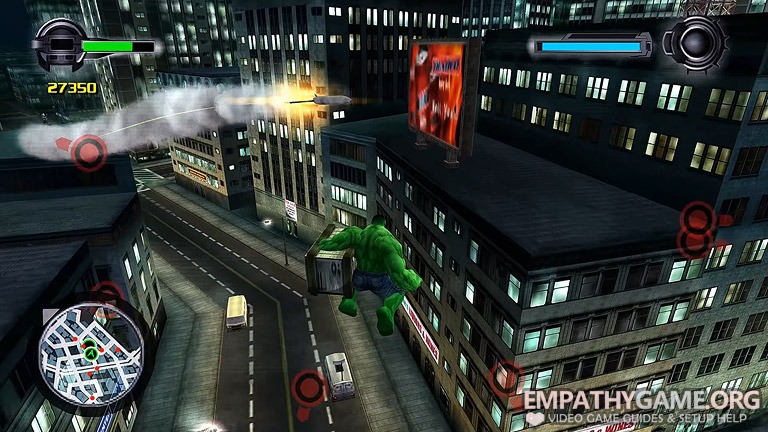
That coherence matters more than the size of the world. The City and Badlands are not especially sophisticated sandboxes by modern standards, and the campaign repeatedly falls back on escorts, retrievals, defenses, and chases. Enemy pressure can also become noisy rather than tactical when missiles, tanks, helicopters, and Hulkbusters pile into the same encounter. Yet the game keeps recovering because controlling Hulk is expressive enough to make ordinary situations entertaining. The appeal is strongest for players who enjoy mastering movement, experimenting with combat tools, and creating their own chaos between structured objectives rather than expecting a densely simulated open world.
Traversal Turns the City Into a Playground
Ultimate Destruction understands that Hulk’s mobility is part of his power fantasy, not a pause between fights. Holding a jump to build distance, launching over rooftops, correcting the arc with an Air Dash, then landing in a sprint gives traversal a rhythm closer to an arcade movement game than a conventional open-world brawler. Walls barely interrupt that flow because Hulk can run straight up them, while vertical surfaces become launch points rather than boundaries. Even before the more advanced moves arrive, crossing the City feels fast enough that taking a direct route is often less interesting than chaining rooftops, wall runs, and long jumps together.
The environment also rewards curiosity in ways that go beyond smashing props for points. Large inflatable objects can be grabbed and used to float or gain unusual height, turning what looks like scenery into a strange traversal toy. A flattened bus can become a shield and later a makeshift board for grinding through streets. These interactions are silly, but they reinforce an important quality: the world is most convincing when ordinary objects stop behaving like ordinary objects once Hulk touches them.
There are limits to the spectacle. The City looks more destructible than it really is. Vehicles, street furniture, military equipment, smaller structures, and selected buildings can be demolished, but many large buildings remain fixed parts of the map, and the collapses of destructible structures are more canned than the surrounding physics suggest. That prevents Ultimate Destruction from becoming a true city-level destruction simulator. What saves the illusion is density: there is usually something nearby to throw, break, weaponize, climb, or use as a route.
Weaponization Gives Combat Its Identity
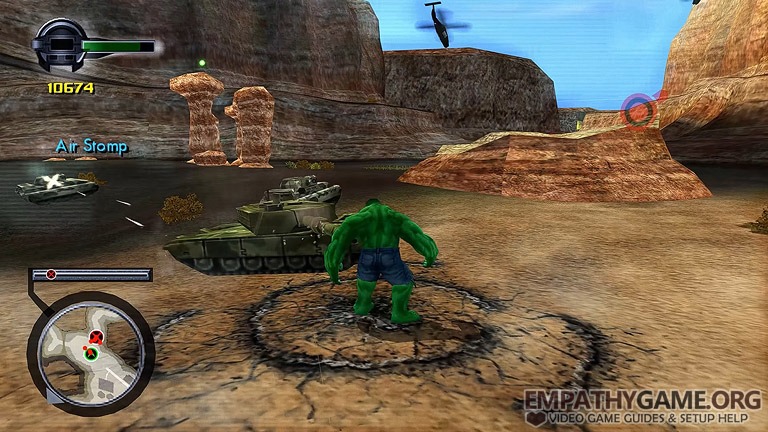
The combat system is strongest when Hulk fights with the environment rather than merely inside it. Basic punches, kicks, grabs, throws, ground slams, and aerial attacks already cover more situations than a simple beat ’em up requires, but weaponization is what gives encounters their personality. A car can be torn apart and wrapped around Hulk’s fists for heavier punches. A larger vehicle can become a shield. Poles and signs become clubs or projectiles. Military equipment can be repurposed instead of treated only as a target.
That creates useful tactical shifts without asking the player to manage an inventory. A helicopter hovering beyond comfortable melee range can be answered by hurling a vehicle or using captured missiles. A cluster of armored enemies encourages area attacks or heavier improvised weapons. A bus shield changes the immediate problem from dealing damage to surviving concentrated fire long enough to reposition. The same street can therefore produce different combat depending on what objects survived the opening seconds.
Critical Mass and Devastator attacks add another layer by rewarding sustained aggression and destruction with access to spectacular crowd-clearing moves. Their value becomes clearest when the military response escalates and the screen fills with overlapping threats. At the same time, that escalation exposes one of the game’s roughest edges. Repeated knockdowns and incoming missiles can interrupt Hulk’s attacks so often that a battle shifts from empowering to irritating. Some smaller Hulkbusters and other enemies also fall into exploitable patterns, while AI can struggle around scenery. Boss fights generally use the mechanics better because they give movement, targeting, and heavy attacks a clearer purpose rather than simply increasing the number of attackers.
The Best Missions Set a Goal and Get Out of the Way
The campaign is linear even though its two main regions are open for free roaming between missions. That structure suits a game whose sandbox is stronger than its storytelling ambitions: story markers provide direction, while challenges and spontaneous destruction let the player break away whenever the mission design becomes restrictive.
The strongest objectives provide a clear target and allow Hulk’s systems to solve the problem. Destroying military installations, fighting through heavy opposition, or defending a location works because movement and destruction remain useful throughout. More constrained escorts, fetch sequences, and pursuits are less comfortable. They expose the camera and lock-on system, punish collateral chaos that is enjoyable elsewhere, and sometimes ask a character built for overwhelming force to behave with awkward precision.
One of the campaign’s funniest exceptions is an infiltration sequence in which Hulk can hollow out a truck and use it as a disguise to enter a military base. It is mechanically simple, but it works because the joke is still expressed through Hulk’s physicality rather than through a conventional stealth system. Moments like this give the campaign personality without pretending the game should become something it is not.
The optional challenges are similarly effective when they isolate one part of Hulk’s moveset. Checkpoint races test route planning and aerial control; rescue events make quick vertical navigation more important than destruction; survival and destruction contests reward efficient crowd control; stranger diversions turn cars into field-goal attempts or ask Hulk to stay airborne using oversized props. The variety is broader than the main campaign’s objective design, although many challenges become more interesting as score chases than as one-time events.
Progression Changes More Than Hulk’s Damage Output
Smash Points are an unusually good fit for the fantasy because they make destructive play productive. Missions and challenges provide large rewards, but simply causing havoc also pushes Hulk toward new abilities. The result is a progression loop that rarely feels detached from the action: the things that are entertaining in the moment also finance the next set of tools.
More importantly, upgrades expand movement and utility as well as raw damage. Air Dash improvements change how reliably Hulk can correct long jumps and cross rooftop gaps. New weaponizations make additional pieces of scenery tactically relevant. Stronger grabs, aerial attacks, defensive options, and Devastators widen the number of ways an encounter can be solved. Hulk begins powerful, but the later moveset feels meaningfully more expressive rather than just numerically stronger.
This also affects challenge difficulty in a way the game does not always communicate clearly. A medal target attempted immediately after it appears may be substantially harder than the same challenge revisited after buying better Air Dashes or other movement tools. Fast Mover routes in particular become easier to optimize once aerial correction is stronger. That can make early medal chasing feel inconsistent, but it also gives returning to old challenges a satisfying sense of mastery: improved results come from both better execution and a more capable Hulk.
Small Character Details Keep the Destruction From Feeling Empty
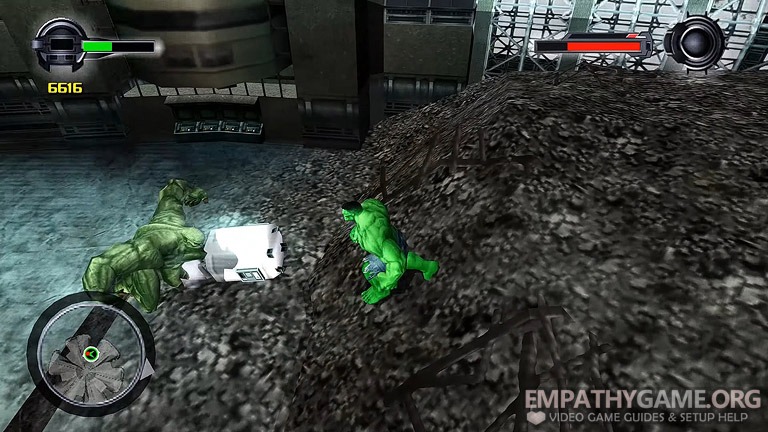
The story centers on Bruce Banner and Doc Samson trying to control or cure the Hulk condition while Emil Blonsky and military forces push the conflict toward increasingly dangerous confrontations. It is functional comic-book storytelling rather than a deep character drama, and that is the right proportion for a game whose mechanics do most of the characterization. Banner provides context and restraint; Hulk provides the actual identity of play.
Removing the playable Banner stealth sections from Radical’s earlier Hulk game is especially important. The campaign no longer keeps taking away its best mechanics in order to remind the player that Banner exists. Instead, his presence is carried by cutscenes, mission briefings, and voice work. Neal McDonough gives Banner a controlled seriousness, while Ron Perlman lends Blonsky an appropriately heavy presence without requiring the plot to dominate the pace.
Some of the most memorable characterization is almost incidental. Hulk treats civilians differently from hostile soldiers: setting down a grabbed civilian produces a gentler animation, including a small pat on the head, while attempts to strike civilians can result in a dismissive flick rather than the repeated attacks used against enemies. In a sandbox built around collateral damage, that tiny rule communicates more about this version of Hulk than another page of exposition would.
Presentation Sells Weight Better Than Detail
The visual technology is unmistakably from its console generation. Buildings repeat, streets are sparsely detailed by modern standards, character models are simple, and the City functions more as a destructible arena than a believable urban ecosystem. The camera can also become troublesome when Hulk is moving vertically or fighting multiple enemies at different heights.
What has aged better is the sense of mass. Hulk’s animation, sound effects, debris, impact reactions, and the speed of environmental destruction make attacks feel heavy even when the underlying geometry is crude. Cars crumple into tools, pavement erupts under large attacks, traffic scatters, and military hardware turns a street into a chain of explosions. The art direction does not need fine detail when the screen is constantly emphasizing force and consequence.
That physical clarity is also why the controls remain one of the game’s greatest achievements. A character with well over a hundred moves could easily have become cumbersome, yet the core actions are readable enough that traversal and combat can blend together without constant menu consultation. The camera and targeting occasionally lag behind the speed of the action, but the basic relationship between input and Hulk’s movement remains remarkably direct.
Replayability Depends on Enjoying the Moveset Itself
There is plenty to revisit: forty optional challenges, medal targets, collectible comic covers, a harder difficulty, free-roam destruction, and Replay Story, which lets a completed campaign be started again with purchased moves retained. The latter is especially appropriate because it removes the slowest part of a repeat playthrough—the wait for the full moveset—and lets early missions be approached with abilities that were originally unavailable.
Still, this is not a sandbox that keeps generating new systems after the campaign. Once most techniques are unlocked, the City and Badlands reveal their limits, and side activities recycle familiar actions. The game’s lasting value therefore depends on whether moving and fighting as Hulk remains enjoyable after the rewards become less important. For players who like shaving seconds from challenge routes, experimenting with weaponizations, or simply turning a military response into an improvised stunt sequence, that mechanical pleasure can carry a surprising amount of replay time. Players looking for branching quests, build variety, or a world that changes meaningfully in response to them will find much less to uncover.
Final Verdict
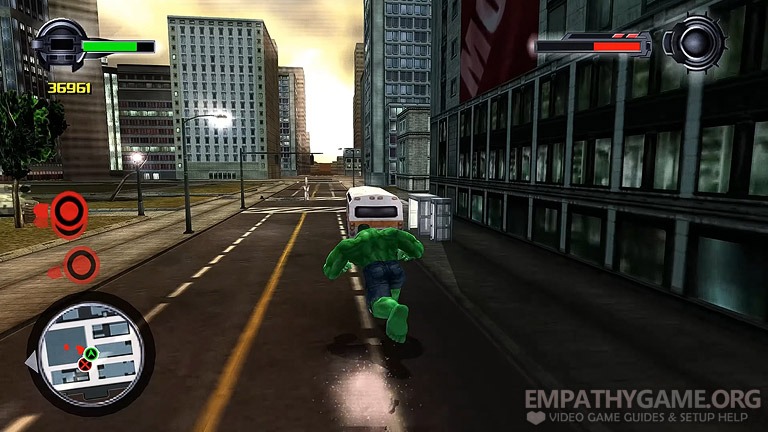
The Incredible Hulk: Ultimate Destruction remains distinctive because it does not treat super strength as a combat statistic. Strength changes traversal, turns scenery into equipment, shapes mission design, fuels progression, and makes the environment part of nearly every encounter. Charged leaps, wall running, Air Dashes, vehicle weaponizations, Devastator attacks, and escalating military opposition all support the same fantasy instead of competing for attention.
The campaign surrounding those systems is less consistent. Escorts, retrievals, repetitive enemy pressure, occasional camera friction, uneven AI, and selective rather than universal building destruction show the boundaries of the design. The City is a convincing playground more than a convincing place, and once the moveset is fully unlocked, replayability depends heavily on enjoying the mechanics for their own sake.
For players who want elaborate quests or a living open world, that limitation is substantial. For players who want a superhero game where crossing a block can involve a rooftop launch, an air correction, a captured missile, a bus turned into a shield, and a landing that scatters traffic, it is exactly the point. Ultimate Destruction succeeds because it makes Hulk’s physical identity playable at almost every moment, and few licensed action games build their entire design around a character with this much consistency.
The Incredible Hulk: Ultimate Destruction Pros & Cons
The Incredible Hulk: Ultimate Destruction PC System Requirements
Official native PC requirements: None. The Incredible Hulk: Ultimate Destruction has no native Windows release, so Radical Entertainment and VU Games did not publish official Windows minimum or recommended specifications for this game.
The specifications below describe the recommended xemu emulator route rather than an official Hulk PC port.
xemu — Recommended Xbox Emulation Route
OS: Windows 10 or a newer vendor-supported Windows release; xemu also supports macOS and Linux
GPU: OpenGL 4.0-compatible graphics hardware
CPU: xemu does not publish a fixed CPU minimum for this game; emulator performance varies by system and title
RAM: xemu does not publish a fixed game-specific RAM minimum
Xbox system data: MCPX boot ROM image, compatible flash ROM/BIOS, and Xbox hard-disk image are required by xemu
Game: Compatible backup created from a legally owned Xbox copy of The Incredible Hulk: Ultimate Destruction
Controller: Modern PC-compatible gamepad recommended
Graphics drivers: Keep the latest stable driver available for your GPU installed
Alternative Emulator Notes
Dolphin / GameCube: Dolphin supports modern 64-bit PC platforms and recommends graphics hardware supporting Direct3D 11.1 or OpenGL 4.4, with at least 2 GB RAM. Windows builds also require the 64-bit Visual C++ redistributable specified on Dolphin’s official download page.
PCSX2 / PS2: PCSX2’s general minimum Windows guidance calls for a supported Windows 10 release, an x86-64 CPU with SSE4.1 and a PassMark single-thread score of at least 1500, two physical CPU cores with SMT, 8 GB RAM, and graphics support for Vulkan 1.1, Direct3D 11, or OpenGL 3.3. Game-specific performance can require more hardware.
PCSX2 BIOS: A PlayStation 2 BIOS dumped from a console you own is additionally required for the PS2 route.
Additional PC Performance and Setup Notes
- Start with xemu’s normal settings and confirm that story missions, cutscenes, combat, and free roaming behave correctly before increasing rendering resolution.
- If a graphics enhancement produces visual problems, return to the default rendering configuration before applying unrelated fixes.
- A controller is preferable to keyboard-only mapping because Ultimate Destruction relies heavily on analog movement, camera control, targeting, jumping, and combinations of shoulder and face buttons.
- Higher internal resolution improves edge clarity but cannot turn the console assets into a native modern-PC remaster.
- For Dolphin or PCSX2, test a clean default configuration first. Game-specific hacks should solve an observed problem rather than being enabled pre-emptively.
- Keep normal in-game saves in addition to emulator snapshots or save states so long-term progress is not dependent on one emulator build or state format.
Official Trailer
Note: This archival IGN-hosted Xbox trailer shows Hulk’s high-speed traversal, combat, environmental destruction, military opposition, and open-world power fantasy, while the written guide adds native-PC availability status, Xbox-versus-GameCube-versus-PS2 guidance, lawful backup information, and emulator setup details.
Frequently Asked Questions
Is The Incredible Hulk: Ultimate Destruction worth playing in 2026?
Yes, especially if you want a superhero game built around unrestricted movement, environmental destruction, improvised weapons, and a large unlockable combat move set. Its camera, mission structure, and console-era presentation show their age, but the core Hulk power fantasy remains unusually distinctive.
Is The Incredible Hulk: Ultimate Destruction officially available on PC or Steam?
No. The game was released for Xbox, PS2, and GameCube and never received a native Windows or Steam edition. Playing an owned console copy on PC therefore requires emulation rather than a normal PC installation.
What is the best emulator for The Incredible Hulk: Ultimate Destruction on PC?
xemu is the recommended route for this guide because its compatibility tracker rates the original Xbox version as Perfect, meaning the submitted compatibility test completed the game without noticeable gameplay issues. Dolphin for GameCube and PCSX2 for PS2 are also legitimate alternatives for owners of those versions.
Which console version of Ultimate Destruction is best to emulate?
The original Xbox version is the strongest overall choice for this guide because it combines excellent reported xemu compatibility with the best display options of the original console releases. The GameCube version through Dolphin is a good alternative when simpler emulator setup is more important, while the PS2 version remains viable through PCSX2.
Does xemu require original Xbox system files?
Yes. xemu emulates the original Xbox hardware and requires compatible Xbox system data in addition to a backup of the game you own. xemu does not provide Microsoft’s proprietary Xbox files or copyrighted game data, so those need to come from hardware and media you are legally entitled to use.
Can The Incredible Hulk: Ultimate Destruction be played on Steam Deck?
Yes through emulation rather than through an official Steam release. xemu provides Linux builds and supports x86-64 Linux systems, including environments suitable for SteamOS, but Ultimate Destruction itself has no Valve Steam Deck compatibility rating because no Steam edition exists.
Does The Incredible Hulk: Ultimate Destruction have multiplayer or co-op?
No. Ultimate Destruction is a single-player game and does not include campaign co-op, competitive multiplayer, online multiplayer, or split-screen play.
Is Ultimate Destruction an open-world game?
Yes, although the campaign itself progresses through a largely linear sequence of story missions. Between missions you can freely explore the City and Badlands, complete challenges, collect items, earn Smash Points, fight responding military forces, or simply cause destruction.
Is The Incredible Hulk: Ultimate Destruction a sequel to Hulk (2003)?
No. Although Radical Entertainment developed both games, Ultimate Destruction is not a direct continuation of the Ang Lee movie tie-in. It instead uses an original story inspired more broadly by Marvel’s Hulk comics and features characters such as Doc Samson, General Ross, Emil Blonsky, and the Abomination.
Do you play as Bruce Banner in Ultimate Destruction?
Not during normal gameplay. Bruce Banner appears in the story and cutscenes, but the playable action focuses on Hulk, avoiding the Banner stealth sections found in the earlier Hulk game.
Can Hulk destroy every building in the City?
No. The environment is highly interactive, but the entire city cannot be flattened building by building. Vehicles, street objects, military equipment, smaller structures, and selected buildings can be destroyed, while many major city buildings remain permanent parts of the map.
How do Smash Points work in Ultimate Destruction?
Smash Points function as the game’s main progression currency. You earn them through missions, challenges, destroying objects, defeating enemies, and other activities, then spend them on additional attacks, weaponizations, health improvements, and other Hulk abilities as they become available.
Do I need to complete the Challenge Missions?
No, most challenges are optional and are not required simply to advance the main story. They are useful for earning additional Smash Points, practicing Hulk’s movement and combat systems, and chasing Bronze, Silver, and Gold performance rewards.
What is Critical Mass in Ultimate Destruction?
Critical Mass gives Hulk access to his most powerful Devastator attacks after the relevant energy gauge has been filled. Using a Devastator consumes Critical Mass energy, so these attacks are best reserved for large groups, powerful military units, or moments when overwhelming damage is useful.
What is Adrenaline Surge?
Adrenaline Surge is an emergency state that activates when Hulk’s health becomes dangerously low. It allows him to perform a Devastator attack even when normal Critical Mass conditions are not available, giving the player a last opportunity to turn a difficult fight around.
What does weaponization mean in Ultimate Destruction?
Weaponization lets Hulk transform ordinary environmental objects into specialized weapons. Cars can become steel fists, larger vehicles can become shields or improvised boards, poles can become clubs or spears, and even incoming military equipment can sometimes be turned against enemies.
How do Jump Markers work?
Jump Markers act as fast-travel points between unlocked locations. Activating them while exploring makes later movement between parts of the City, Badlands, and the Church hub much faster than crossing the entire environment manually.
Why does the military keep sending stronger enemies after Hulk?
Free-roam destruction increases the game’s emergency response, eventually attracting increasingly serious military opposition. This creates an escalating sandbox loop where smashing more of the environment can turn casual exploration into fights against soldiers, helicopters, tanks, Hulkbusters, and other heavy units.
Does Ultimate Destruction have New Game Plus?
It has a similar feature called Replay Story. After completing the campaign, Replay Story lets you begin the story again while retaining the moves you previously unlocked, and completing the game also unlocks a harder difficulty setting.
Are there unlockable Hulk skins and playable characters?
Yes. Collectibles and progression unlock cosmetic extras and special codes, including alternate Hulk appearances such as Gray Hulk and Joe Fixit. Completing the story also unlocks access to an Abomination appearance for subsequent play.
What do the collectible comic books unlock?
There are 60 collectible comic-book covers spread across the game’s areas. Finding them unlocks extras such as artwork, special codes, cosmetic appearances, gameplay modifiers, and other bonus content rather than simply increasing a completion percentage.
How long does The Incredible Hulk: Ultimate Destruction take to finish?
A straightforward story playthrough is roughly in the 10–15 hour range, but the total can increase substantially if you complete challenge missions, search for comic books and other collectibles, purchase more moves, chase medals, or use Replay Story.
Why can higher resolution scaling cause problems in xemu?
xemu’s game-specific compatibility tracker rates Ultimate Destruction as Perfect for normal gameplay but separately identifies resolution scaling as a known game-specific issue. If increasing the rendering scale causes visual problems, return to the normal scale before changing unrelated emulator settings.
Can Ultimate Destruction be modded on PC?
There is no official PC modding system, Steam Workshop, or developer toolkit because no native PC edition exists. Community texture replacements and other emulator-specific modifications may exist for individual console versions, but compatibility varies, so back up your emulator configuration and normal game saves before experimenting.
Still have questions? Check the Hulk Reddit community, official xemu FAQ and support guidance, or Dolphin Emulator support forum for additional help and community discussion.
Sources & References
Key factual and technical information in this guide was checked against relevant established and emulator-project sources, including:
- xemu — The Incredible Hulk: Ultimate Destruction Compatibility — game-specific Xbox emulation status and reported compatibility
- xemu — Required Files and Disc Images — Xbox system-file requirements, game-backup format, and ownership-based disc guidance
- Dolphin Emulator — Ripping Games — official GameCube game-backup guidance for the alternative Dolphin route
- PCSX2 Wiki — The Incredible Hulk: Ultimate Destruction — PS2 emulation status, test configurations, and game-specific graphics notes
- Metacritic — The Incredible Hulk: Ultimate Destruction — original platforms, release date, developer, publisher, and platform-specific critic scores
- GameSpot — The Incredible Hulk: Ultimate Destruction Review — original console-version performance, display differences, gameplay characteristics, and historical review score
Similar Games Like The Incredible Hulk: Ultimate Destruction
- Prototype (2009)
- Ultimate Spider-Man
- Spider-Man: Web of Shadows
- Spider-Man 2 (2004)
- X-Men Origins: Wolverine
- Spider-Man: Shattered Dimensions





Found something worth playing through DecideGame?
DecideGame.com is an independent gaming project run by Editor Zero. If this guide helped you discover a game, solve a problem, or find useful information, you can support DecideGame.com and help keep new and updated game guides coming.
DecideGame — PC Game Guides, Reviews & Setup Help