
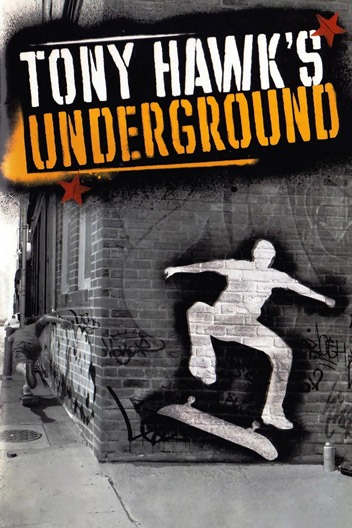
📅 Game released: 2003
Use this updated 2026 Tony Hawk’s Underground PC guide to check official download availability, understand ownership and Windows compatibility, review original system requirements, configure controllers, explore PARTYMOD, and learn about multiplayer before returning to the streets.
 By Editor Zero — independently researched, edited, and maintained.
Last updated: 13 October 2026
Last reviewed: 13 October 2026
Table of Contents
- Quick Summary
- Quick Facts
- Official PC Stores, Download & Installation
- Tony Hawk’s Underground Review
- Pros & Cons
- PC System Requirements
- Frequently Asked Questions
- Similar Games
Tony Hawk’s Underground Quick Summary
✔ Story-driven arcade skateboarding adventure in which a customizable New Jersey skater rises from neighborhood amateur to professional, with friendship, ambition, sponsorships, and rivalry driving the campaign
✔ Classic Tony Hawk combo mechanics combine manuals, reverts, grinds, transfers, special tricks, wallplants, and the new ability to step off the skateboard, run, climb, and reconnect tricks through Caveman moves
✔ Similar to Tony Hawk’s Underground 2 through its custom-skater campaign, arcade trick combinations, on-foot movement, large skating environments, character progression, and creative editing tools
✔ Nine main skating environments span locations such as New Jersey, Manhattan, Tampa, San Diego, Hawaii, Vancouver, Slam City Jam, Moscow, and New Jersey’s expanded story setting, with individual goals, competitions, secret areas, and free-skating opportunities
✔ A native Windows version exists but was released through limited regional retail distribution and is not available through a verified modern official PC storefront; its original SafeDisc protection also complicates modern Windows compatibility
✔ Community projects such as PARTYMOD improve aspects of the original PC experience, while split-screen and LAN multiplayer remain distinct from the discontinued official GameSpy online service
Tony Hawk’s Underground Quick Facts
Official PC Store Status, Download & Installation
👇 Use the notes below to understand Tony Hawk’s Underground’s official PC availability, historical retail ownership, Windows installation limitations, and legitimate compatibility resources without relying on unauthorized game-file sources.
- Native Windows release: Tony Hawk’s Underground received an official Windows PC port developed by Beenox, separate from the original Neversoft console releases. It was distributed through limited regional retail channels, particularly in Australia, rather than receiving the widespread PC distribution associated with Underground 2.
- Official PC stores: No authorized digital listing for the original game was verified on Steam, GOG, Epic Games Store, or Microsoft Store. Consequently, there is no official modern PC purchase button or standard digital installation route to recommend. The existence of newer Tony Hawk releases on these platforms does not mean they include Underground.
- Physical ownership: Original Windows retail discs may be available through legitimate secondhand sellers, subject to stock and regional differences. Before purchasing, confirm that the package is the original Tony Hawk’s Underground for Windows, includes the required discs and documentation, and is not Underground 2 or a console version. A physical copy does not guarantee successful installation or activation on a modern computer.
- SafeDisc limitation: The original Windows retail release uses SafeDisc copy protection. Modern Windows versions, including Windows 10 and Windows 11, do not support its legacy driver, so compatibility mode alone cannot resolve every original-disc launch problem. Avoid unidentified replacement executables, unofficial game packages, or instructions intended to defeat copy protection.
- Installing an owned copy: If you own the original Windows retail edition, begin with its authentic installation media and documentation. Preserve the original files and back up your saves before making supported configuration changes. Consult established technical documentation for display, input, and compatibility problems, while recognizing that modern-Windows operation is not guaranteed.
- PARTYMOD for THUG1: The community-developed PARTYMOD project provides improvements to controller handling, window management, custom resolutions, configuration, and other behavior of the original PC port. It is unofficial, requires an existing installed game, and must not be confused with a licensed copy or official Activision support. Read its compatibility and installation notes before modifying game files.
- THUG Pro distinction: THUG Pro is a separate fan-made project built around Tony Hawk’s Underground 2 PC. It is not the original Tony Hawk’s Underground campaign, a remaster of THUG1, or an official replacement for the first game’s retail Windows version. Its features, requirements, and multiplayer systems should not be treated as features of the original game.
- Multiplayer and accounts: The original PC game supports local split-screen, LAN play, and historical online multiplayer. Its original GameSpy online service is discontinued, so normal official online matchmaking should not be expected. Community-maintained networking solutions may exist but are unofficial and require separate verification.

Tony Hawk’s Underground Review
A brilliantly expressive skating career whose bold detours rarely match the board beneath your feet.
Tony Hawk’s Underground makes a small change to the series’ perspective that has surprisingly large consequences: this time the aspiring professional is a character you create, not a famous skateboarder whose career you inherit. The journey begins in an unglamorous New Jersey neighbourhood, with childhood friend Eric Sparrow sharing the dream and the possibility of being noticed by the right people.
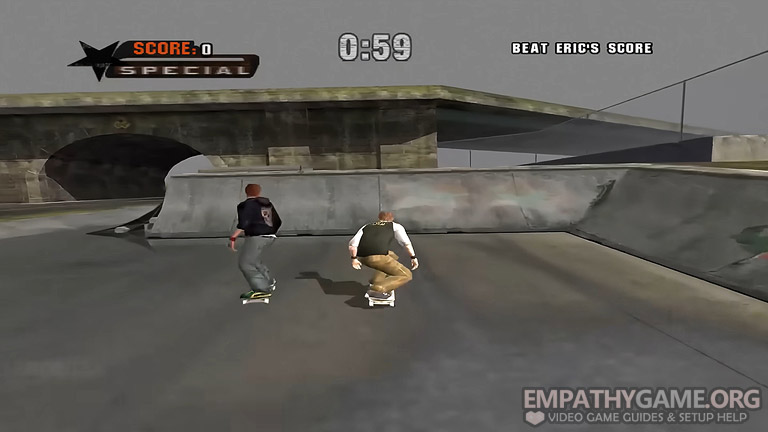
The story provides a welcome reason to care about progression, but the game earns its lasting appeal somewhere less cinematic. A street full of rails and ledges becomes a puzzle about speed, balance, and how many tricks can be connected before touching down safely. Running and climbing expand that vocabulary, sometimes ingeniously. Driving missions and rigid objectives are much less successful. The result is a confident arcade skating game wrapped in a slightly ungainly adventure: rewarding for anyone who loves inventing increasingly improbable lines, and less convincing when it insists that skating should share the spotlight with everything else.
Every Street Is a Possible Combo
The skating retains the immediate readability of the earlier Pro Skater games. A kickflip earns points; landing into a grind opens the next opportunity; a manual carries the score across flat ground; a revert connects a quarter-pipe landing to whatever lies beyond it. A bench becomes the approach to a railing, a sloped wall redirects momentum, and a rooftop is valuable because of the line that continues after the drop.
That freedom depends on managing competing risks. Repeating tricks reduces their scoring value, while every additional grind or manual demands sustained balance. Spin too late, carry a trick past the landing, or enter a narrow rail at a bad angle, and a promising score disappears in a bail. Specials raise the potential reward, but they also tempt players into longer animations when a modest flip would be safer.
Wallplants and spine transfers broaden the possibilities further. A wallplant can reverse direction at a dead end, while a spine transfer carries the skater between opposing ramps and into another part of a course. Not every addition feels effortless, though. On the PlayStation 2 control scheme, revert and spine transfer share a button, so a poorly timed input near transition ramps can send the skater across the gap instead of linking a landing into a manual. It is a small irritation with a large consequence when a long combo is at stake.
One of the subtler techniques is Spacewalk, a flatland move that can build momentum while a manual is active. Repeated reverts and flat-ground connections gradually bleed away speed; Spacewalk provides a way to recover movement without banking the score. Mastery is not just remembering more trick commands. It is understanding how momentum, animation time, terrain, and the balance meters interact, then finding a way out of a situation that appeared to have no clean exit.
Getting Off the Board Changes the Route, Not Always for the Better
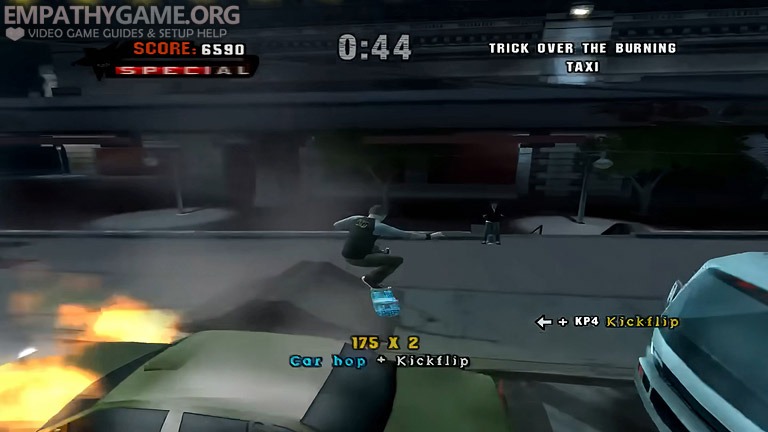
The signature new movement option is to step off the skateboard. Running and climbing provide access to rooftops and elevated walkways that cannot always be reached through normal skating. Its best use, however, is within a combo. Dismounting starts a short countdown, and re-entering on the board with a Caveman before it expires preserves the trick sequence. A skater can turn sharply, cross an otherwise awkward gap, and resume the line without settling the score. Every second spent off the board becomes a trade-off between finding a better position and losing the entire combination.
This is an ingenious escape hatch, but it never feels as polished as the skating underneath it. Running lacks the precision needed for careful platforming, ledge grabs can interrupt the pace, and the camera is less reliable when the game asks for deliberate movement on narrow structures. The vehicle sections make the contrast starker. Instead of finding routes and improvising tricks, the player is often simply trying to complete an errand while tolerating a clumsier set of controls.
Story Goals Can Reward Mastery or Fight the Rules
Story Mode replaces the old chain of largely isolated career challenges with objectives given by people scattered across the levels. At its best, the design makes an unfamiliar piece of a city intelligible. At its worst, a supposedly urgent story task amounts to collecting objects or travelling between markers with little relation to the skating.
The hardest setting reveals just how narrow some challenges can become. In Tampa’s Prove Yourself, a high rotation must be connected through a revert, with an additional revert-to-manual continuation on Sick difficulty. The nearby Wallplant Combo objective similarly turns a straightforward-looking wallplant into a sustained balance exercise, asking the skater to keep a manual alive through a line of cones. Here, increased difficulty tests actual mechanics rather than just raising an arbitrary points threshold.
Other goals are less consistent about what qualifies as success. Hawaii’s Wallows Combo Bowls expects a series of bowl jumps joined through revert-to-manual transitions. Since getting off the board and using a Caveman can preserve a combo elsewhere, a skater might reasonably try that method and still fail to satisfy the goal. Such moments expose the tension between the game’s flexible trick system and objectives built around one particular solution.
There is at least a useful concession to pacing. Available objectives can be selected through the View Goals menu, which jumps directly to the chosen task instead of requiring another journey to its mission-giving pedestrian. The four difficulty settings also give newcomers room to learn and veterans more stringent requirements, although isolated Sick-mode missions can feel far tougher than the surrounding campaign.
Big Levels Offer Character, but Not Always Continuous Flow
The locations help sell the career journey. New Jersey’s worn streets suit the amateur beginnings, while Manhattan packs rails, traffic, ledges, and elevated routes into a denser urban playground. Tampa has recognisable skate-park spaces built for technical challenges; Hawaii combines resort scenery with the Wallows bowls and more elaborate transfers. Moscow, meanwhile, supplies a different architectural silhouette and some awkwardly placed obstacles that demand more deliberate route planning.
The drawback is scale without perfect continuity. A long, exciting grind may end in open space that requires an unremarkable journey to the next useful obstacle. Compared with tighter earlier levels, some of Underground’s larger maps feel like collections of excellent spots separated by travel.
Story events also change how certain places look. Night lighting and rain alter the atmosphere of familiar districts, while Moscow’s snow gives the campaign another distinctive mood. These changes create a sense that time and circumstances are moving forward. Yet the variants are linked to story moments rather than a straightforward weather or time-of-day selector in ordinary Free Skate. A location can look particularly striking during one chapter, then be difficult to revisit in that same mood without replaying a relevant goal or scene.
A Personal Career with a Broad, Cartoonish Rivalry
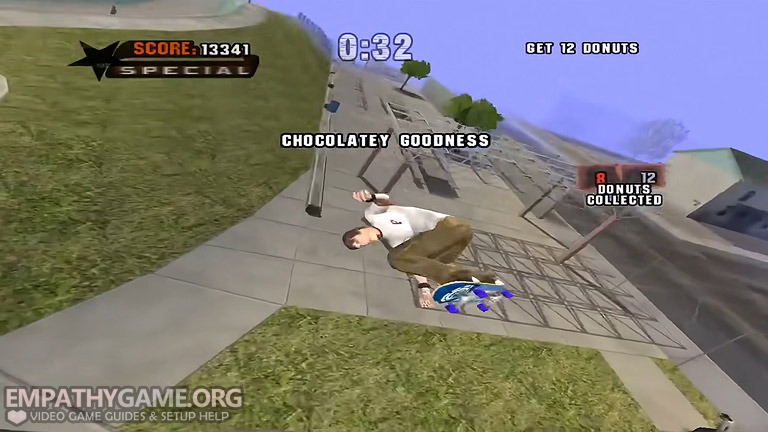
The decision to centre an unknown skater creates stakes that the original career format never really needed. Meeting Chad Muska and attracting the attention of sponsors means something because the protagonist starts outside that world. The friendship with Eric Sparrow offers the campaign its more interesting conflict. Both characters want to escape their ordinary beginnings through skating, but recognition and competition steadily change what success means to each of them.
Unfortunately, the writing often trades believable tension for exaggerated attitude. Eric’s behaviour becomes easier to read as a mechanism for creating the next conflict than as the evolution of a complicated friendship, and several episodes are structured as excuses for another challenge. Professional skaters add credibility through cameos, competitions, and trick lessons, but they are more convincing as familiar figures inhabiting the world than as deeply developed characters.
The presentation is unmistakably early-2000s: baggy clothes, skate-video editing, conspicuous branding, chunky character models, and a willingness to be ridiculous. Facial animation and spoken dialogue have aged, but the streets retain enough colour and distinct shape to remain readable at speed. Music does much of the atmospheric work. The Clash, NOFX, and Deltron 3030 sit within an unusually broad selection of punk, rock, and hip-hop, making an aimless session feel just as connected to the game’s identity as a story competition.
Progression Is Earned Through What You Actually Learn
Skater improvement is one of Underground’s smartest structural decisions. Rather than assigning stat increases only as rewards for finishing missions, it presents technique-based challenges: sustain grinds, hold manuals, land demanding combinations, or complete particular kinds of movement. Success improves the relevant attribute, so extra speed, balance, or airtime feels linked to a skill the player has demonstrated.
Professional skaters provide additional trick-learning challenges that expand the available special moves and slots. These are easy to mistake for incidental side content because the main storyline can move forward without every optional lesson being complete. They matter much more when pursuing total completion. Clearing the campaign and finishing all 129 goals are different ambitions, and the latter includes professional challenges that are not always grouped with the obvious story tasks. Their distinct markers make them particularly easy to overlook when checking the remaining objectives.
Progression rewards both the skater’s statistics and the player’s technical skill. After enough practice, the best lines rely more on familiar combinations and memorised terrain than on discovering fundamentally new ways to skate. Long-term appeal depends on enjoying route refinement after the unlocks lose their novelty.
Creation Tools and Multiplayer Keep the Tricks Going
There is plenty to do outside the campaign. Create-A-Park allows ramps, rails, gaps, and unlikely structures to be arranged into custom courses. Create-A-Trick lets players combine and adjust existing trick animations, while deck and skater customization reinforce the fantasy of owning a style rather than selecting a professional’s preset identity. The strongest creative addition is Create-A-Goal, which lets a designer place a mission-giving pedestrian and starting position, select an objective, and build a challenge around a particular line or area.
These tools make a custom park more than a showcase of ramps. A creator can arrange collectibles across difficult jumps or design a score challenge around a particularly demanding sequence of obstacles. Optional names, dialogue, and completion messages give the creator a little storytelling control, although entering substantial text through the original gamepad-oriented interface is tedious. The editor is expressive, not effortless, and its slower interactions betray the age of the design more than the basic idea does.
Free Skate is the most uncomplicated alternative: there is no story justification to satisfy, only terrain to explore and a personal line to improve. Competitive modes such as Graffiti and score battles make that same space meaningful in a different way. In Graffiti, scoring tricks on obstacles claims them, encouraging quick decisions about whether to defend a valuable object or move elsewhere for an easier takeover. Score contests instead reward consistency under pressure.
Final Verdict
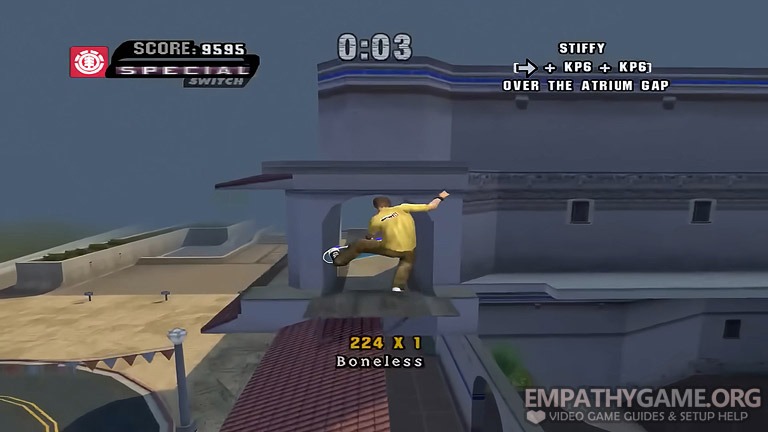
Tony Hawk’s Underground is most compelling when the career framework gives familiar skating mechanics a personal sense of purpose without getting in their way. The custom protagonist, imaginative city layouts, skill-based stat growth, and versatile combo system create a rare mixture of arcade immediacy and long-term mastery.
There are clear limitations. Walking and driving never match the feel of the board, certain goals impose unexpectedly rigid solutions, and the rivalry works better as a motivation than as nuanced drama. Still, few arcade sports games make a railing, rooftop, or empty street feel so full of possibility. Players who enjoy experimenting with tricks and shaving errors out of a difficult line will find an absorbing skateboarding adventure. Those looking for realistic board physics, refined platforming, or consistently inventive story missions are likely to be less persuaded by the detours.
Tony Hawk’s Underground Pros & Cons
Tony Hawk’s Underground PC System Requirements
The following specifications describe the original Windows PC edition, not Tony Hawk’s Underground 2, THUG Pro, or an emulated console release. The original minimum requirements were designed for Windows 98/ME/2000/XP-era computers and are not modern Windows performance recommendations.
ORIGINAL WINDOWS PC MINIMUM REQUIREMENTS:
OS: Windows 98, Windows ME, Windows 2000, or Windows XP
CPU: Intel Pentium III 800 MHz or AMD Athlon 800 MHz
RAM: 256 MB
GPU: DirectX 9.0c-compatible graphics card with at least 32 MB VRAM; historical examples include NVIDIA GeForce 2, ATI Radeon 7500, or Matrox Parhelia
DirectX: DirectX 9.0c
Storage: Approximately 2.7 GB total free space, including the original installation and Windows swap-file allowance
Sound Card: DirectX-compatible sound hardware
RECOMMENDED REQUIREMENTS:
No reliably verified separate official recommended specification tier was found for the original Windows edition. Its historical minimum requirements should not be interpreted as a guarantee of compatibility or good performance on Windows 10 or Windows 11.
Additional PC Performance and Setup Notes
Modern Windows compatibility: Tony Hawk’s Underground is an older 32-bit Windows game originally designed for operating systems and graphics drivers that are no longer standard. Modern computers generally have far more processing power than the game requires, but installation, legacy copy protection, display handling, and input support can still prevent normal operation. SafeDisc incompatibility is a separate issue from graphics performance and cannot be solved simply by upgrading hardware.
Controller configuration: The original PC version includes configurable keyboard and gamepad bindings. A modern USB controller is usually more comfortable for the game’s directional trick inputs, manuals, reverts, and long combos, but automatic compatibility with contemporary Xbox or PlayStation controllers should not be assumed. PARTYMOD replaces the original input handling with a more modern SDL2-based system and can help with controller detection and configuration. Check bindings for both players before attempting split-screen.
Widescreen and display settings: The original Windows release was developed around older display formats and does not provide the same modern resolution flexibility as contemporary PC games. Community tools, including PARTYMOD, can improve custom-resolution handling, aspect ratios, and window behavior. Apply only fixes appropriate to the original THUG1 version and avoid stacking incompatible graphics modifications.
Frame rate and stability: Higher system specifications do not automatically eliminate problems associated with legacy timing, display modes, or input behavior. Start with conservative graphics settings, verify that the game launches and saves correctly, and change one configuration setting at a time. Modified game installations may behave differently from an untouched retail edition.
Save data and modifications: Back up your existing saves and configuration files before installing community fixes or modifying the game directory. Older applications installed in protected Windows folders can also encounter file-permission or VirtualStore behavior, which may affect where changed settings and saved files appear.
Multiplayer performance: Two-player split-screen and local-area-network play were built into the original PC release. LAN sessions require appropriate local networking and compatible installations, while the discontinued original online services should not be mistaken for a functioning official matchmaking system.
Video Trailer
Frequently Asked Questions
Is Tony Hawk’s Underground worth playing in 2026?
Yes. Its story-driven career, excellent arcade skating, memorable environments, and extensive customization still make it one of the series’ most distinctive entries. Players who enjoy creative trick combinations and progression will find plenty to appreciate, although awkward vehicle missions and compatibility problems with the original PC version are important drawbacks.
Has Tony Hawk’s Underground received an official remake or remaster?
No official remake or remaster of the original Underground campaign has been released. Tony Hawk’s Pro Skater 1 + 2 and Tony Hawk’s Pro Skater 3 + 4 are separate collections that revisit earlier games in the series; neither contains Underground’s complete story, original level collection, or career progression.
Is Tony Hawk’s Underground an open-world game?
It features large, freely explorable skating environments rather than one continuous open world. Locations such as New Jersey, Manhattan, Tampa, Hawaii, and Moscow contain multiple objectives, hidden areas, and skating opportunities, but progression between them follows the Story Mode campaign.
Can you play as Tony Hawk in Tony Hawk’s Underground Story Mode?
Story Mode primarily follows a skater you create and customize, rather than one of the professional skaters. Tony Hawk and other professionals appear throughout the game and can be selected in other modes, including Free Skate.
How do you find unfinished goals in Tony Hawk’s Underground?
Open the pause menu and check the View Goals section to identify available or unfinished Story Mode objectives. Also look for professional skaters offering special challenges, since these are easy to overlook when concentrating only on the main story missions.
How do you increase your skater’s stats in Tony Hawk’s Underground?
Stats improve by completing specific skating challenges rather than simply spending points earned from missions. The Skater Progress menu shows requirements such as maintaining grinds, performing multiple tricks in a combo, or completing difficult maneuvers; improving these attributes makes later challenges easier.
What do professional skater challenges unlock?
Completing challenges offered by professional skaters can unlock additional special trick slots and expand your available moves. These optional encounters are worth seeking out because they improve customization and provide extra goals beyond the main story.
Can you get off your skateboard without ending a combo?
Yes. The Run Out and Caveman mechanics let you temporarily step off your board, change direction, and return to skating while preserving a combo. A short timer limits how long you can remain off-board, so you must reconnect to a skating trick before it expires.
What difficulty should beginners choose in Tony Hawk’s Underground?
The game offers four difficulty settings: Too Easy, Beginner, Normal, and Sick. Beginner provides a gentler introduction to the skating mechanics, while Normal suits players familiar with earlier Tony Hawk games. Sick increases goal demands and time pressure and is better suited to experienced players looking for difficult challenges.
Can you freely drive vehicles in Tony Hawk’s Underground?
Vehicles appear in certain missions, and some become available outside their original objectives after being unlocked. However, driving is a secondary feature with limited handling and activities, not a fully developed vehicle sandbox comparable to Grand Theft Auto.
Do you need to complete every goal to finish Story Mode?
No. Story progression usually requires completing enough objectives to advance each chapter, rather than clearing every available challenge. Finishing all 129 Story Mode goals is a separate completionist objective that unlocks additional cheat options and rewards.
Can you create your own tricks, skate parks, and goals?
Yes. Create-A-Trick lets you assemble and customize skating animations, while Create-A-Park provides tools for building playable environments. Create-A-Goal also allows custom objectives, giving players ways to design challenges beyond the standard campaign.
Can you keep skating after finishing Tony Hawk’s Underground?
Yes. Free Skate allows you to explore unlocked environments without following the main story objectives, and you can return to missed challenges or pursue additional collectibles. Replaying Story Mode on harder difficulties provides further goals and unlockable rewards.
What do the secret tapes unlock in Tony Hawk’s Underground?
Collecting secret tapes unlocks bonus videos rather than advancing the main storyline. Finding three tapes unlocks Bails 1, six unlocks Bails 2, and collecting all nine unlocks the Always Hard video.
How do you unlock the classic School II, Venice, and Hangar levels?
These three Tony Hawk’s Pro Skater 2 levels are unlocked by finding special hidden THPS2 icons. School II’s icon is in New Jersey near the train station, Venice’s is accessible through the tiki statue in Hawaii, and Hangar’s is hidden inside a building in Moscow. These collectibles are separate from the ordinary secret tapes.
Which secret characters can you unlock in Tony Hawk’s Underground?
Story Mode difficulty rewards include Iron Man for completing the campaign on Beginner, Gene Simmons on Normal, and the sewer creature T.H.U.D. on Sick. Additional unlockable characters and playable pedestrians provide further incentives to explore and complete optional challenges.
Does Tony Hawk’s Underground have an alternate ending?
Yes. Completing Story Mode a second time can trigger an alternate ending involving Eric Sparrow. It changes the final confrontation rather than creating an entirely separate storyline, so players interested in seeing it can replay the campaign without needing a different narrative route.
How long does Tony Hawk’s Underground take to complete?
Experienced players can finish the main story in roughly 6–10 hours, while newcomers or players completing more optional goals may take considerably longer. Unlocking secret content, completing all goals, improving stats, and discovering gaps can extend playtime substantially.
Does Tony Hawk’s Underground have multiplayer or story co-op?
The original game includes competitive multiplayer modes, but its Story Mode is designed for one player. Multiplayer focuses on skating challenges and score-based competition rather than two players progressing through the campaign together.
Does Tony Hawk’s Underground support split-screen on PC?
Yes. The original Windows version supports two-player local competitive multiplayer through horizontal or vertical split-screen. Each player needs a correctly configured control setup, and modern controller compatibility may require additional configuration or community improvements.
Can Tony Hawk’s Underground be played over LAN?
Yes. The original PC edition supports local-area-network multiplayer for up to eight players. Participants need compatible installations and appropriate network configuration; LAN functionality is separate from the game’s discontinued official internet matchmaking service.
Can you still play Tony Hawk’s Underground online?
The original GameSpy-based online service is discontinued, so its historical official matchmaking is no longer available. Community projects such as PARTYMOD provide unofficial alternatives using OpenSpy, but connectivity, player availability, and compatibility depend on the community setup rather than Activision-operated servers.
Does Tony Hawk’s Underground PC support Xbox or PlayStation controllers?
The original Windows port supports controllers through its older DirectInput system, but modern Xbox and PlayStation devices may not map correctly without adjustments. PARTYMOD replaces the input system with SDL2-based handling and provides configurable controller support, including Xbox- and PlayStation-style button prompts.
What is the difference between PARTYMOD and THUG Pro?
PARTYMOD for THUG1 is a community patch focused on improving the original Tony Hawk’s Underground PC port while preserving its gameplay and campaign. THUG Pro is a separate fan-made skating project based around Tony Hawk’s Underground 2, so it should not be mistaken for the original Underground story or an official remaster.
Why won’t Tony Hawk’s Underground start on Windows 10 or Windows 11?
The original retail PC release uses legacy SafeDisc protection that is incompatible with modern Windows systems. Older graphics, input, and display behavior can create additional problems. Community compatibility projects may help with some issues, but successful operation depends on the particular installation and is not guaranteed by compatibility mode alone.
Where are Tony Hawk’s Underground PC save files stored?
The original Windows version normally stores saves inside the Game\Save folder within its installation directory. On newer Windows systems, files written beneath protected locations such as Program Files may instead appear under the user’s AppData\Local\VirtualStore directory. Check both locations before backing up or moving an existing installation.
Still have questions? Check the Tony Hawk’s Pro Skater Reddit community for gameplay and unlockable discussions, the PCGamingWiki Tony Hawk’s Underground page for technical documentation, or the PARTYMOD GitHub issues for community-reported compatibility and controller problems.
Sources & References
Key factual and technical information in this guide was checked against relevant official and community sources, including:
- Activision — Original Tony Hawk’s Underground Release Announcement — confirms the original launch, publisher, core story-driven design, customization features, and console release context.
- Activision — Tony Hawk’s Underground Engine Technology — identifies the proprietary engine technology used for the original game.
- MobyGames — Tony Hawk’s Underground Windows Releases — documents the regional Windows retail release, Beenox porting credits, and historical publication details.
- PCGamingWiki — Tony Hawk’s Underground — provides original Windows requirements, retail DRM information, modern compatibility notes, multiplayer specifications, and community technical references.
- PARTYMOD for THUG1 — Developer Repository — documents the unofficial controller-input replacement, custom display options, configuration improvements, and compatibility limitations.
- Metacritic — Tony Hawk’s Underground — verifies the historical console review aggregation and distinguishes the reviewed console platforms from the later Windows edition.
Similar Games Like Tony Hawk’s Underground
- Tony Hawk’s Underground 2
- Jet Set Radio Future
- SSX Tricky
- Burnout Paradise
- GTA San Andreas
- The Simpsons: Hit & Run


Found something worth playing through DecideGame?
DecideGame.com is an independent gaming project run by Editor Zero. If this guide helped you discover a game, solve a problem, or find useful information, you can support DecideGame.com and help keep new and updated game guides coming.
DecideGame — PC Game Guides, Reviews & Setup Help