
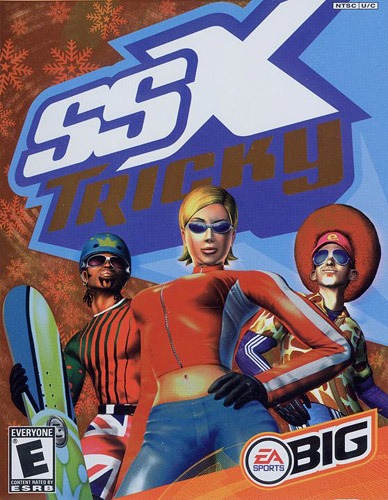
📅 Game released: 2001
Use this updated 2026 SSX Tricky PC guide to check official download availability, compare PS2, GameCube, and Xbox emulation through PCSX2, Dolphin, and xemu, review emulator system requirements, and configure controllers, graphics, and game backups before returning to EA’s arcade snowboarding classic.
 By Editor Zero — independently researched, edited, and maintained.
Last updated: 9 October 2026
Last reviewed: 9 October 2026
Table of Contents
- Quick Summary
- Quick Facts
- Official PC Stores, Download & Installation
- SSX Tricky Review
- Pros & Cons
- PC System Requirements
- Frequently Asked Questions
- Similar Games
SSX Tricky Quick Summary
✔ Fast-paced arcade snowboarding game from EA Sports BIG that combines downhill racing, exaggerated aerial tricks, aggressive competitors, colorful characters, and spectacular courses inspired by professional extreme-sports events.
✔ World Circuit progression alternates between Race and Showoff competitions, rewarding medals, improved rider attributes, boards, outfits, and access to additional courses and characters.
✔ Similar to Tony Hawk’s Underground 2 through its trick-based extreme-sports gameplay, combo experimentation, character progression, score challenges, and rebellious presentation, although SSX Tricky focuses on downhill snowboarding rather than skateboarding.
✔ The original console editions were released for PS2, GameCube, and Xbox, with a separate Game Boy Advance adaptation. There is no official native Windows PC edition or normal PC storefront installation.
✔ The recommended way to experience the original console gameplay on PC is the PlayStation 2 edition through PCSX2 using a lawful backup of an owned disc and the required PS2 BIOS. Dolphin provides a simpler alternative for GameCube owners.
✔ Local two-player competition, expressive rider personalities, an energetic soundtrack featuring Run-D.M.C.’s “It’s Tricky,” and the balance between racing and elaborate trick chains remain central to its appeal.
SSX Tricky Quick Facts
Official PC Store Status, Download & Installation
👇 SSX Tricky has no official native Windows PC version or normal PC game download. The options below explain how owners of the original console releases can configure compatible emulators on a PC using their own authorized game backups.
- Native PC availability: Electronic Arts has not released the original SSX Tricky as a Windows PC game. No verified Steam, Epic Games Store, GOG, EA App, or Microsoft PC storefront listing offers a native version for installation.
- Best console version: The original PlayStation 2 release is the recommended version for the fullest traditional SSX Tricky experience. Its DualShock 2 layout provides four shoulder buttons for the game’s trick system, whereas the GameCube and Xbox ports make compromises to accommodate their different controller layouts.
- Best emulator: PCSX2 is the preferred option for emulating the PS2 release. It supports modern Windows systems, configurable controllers, graphics upscaling, save states, and virtual memory cards. The PCSX2 compatibility wiki lists the North American SSX Tricky release as Playable on Windows.
- GameCube alternative: Dolphin is an excellent alternative for an owned GameCube copy. Dolphin’s game-specific compatibility documentation rates SSX Tricky highly and reports no active configuration problems. It does not require a separately supplied GameCube system BIOS for normal gameplay, making initial setup simpler than PCSX2.
- Xbox alternative: xemu emulates the original Xbox release. Its community compatibility database rates SSX Tricky Perfect, although reported visual issues can still exist. The Xbox version has enhanced visual effects but changes the trick-button arrangement, and original-hardware reviews documented uneven frame rates. xemu also needs additional Xbox system files.
- Owned PS2 disc: Use an authorized backup of your own SSX Tricky PlayStation 2 disc. PCSX2 documents how physical PS2 discs can be copied into ISO images using compatible computer optical drives. Follow the official PCSX2 disc-dumping guide rather than using unverified game-file distributors.
- PS2 BIOS requirement: PCSX2 requires proprietary PlayStation 2 BIOS files, which are not included with the emulator. The project’s official BIOS-dumping instructions explain how to obtain the necessary files from a PS2 console you own.
- GameCube disc backup: Dolphin can open GameCube ISO/GCM images and its own RVZ format. A compatible GameCube or Wii can be used to create a backup of an owned GameCube disc through the process explained in Dolphin’s official disc-ripping documentation. Ordinary computer DVD drives generally cannot read GameCube discs directly.
- Game-file responsibility: Neither emulator includes SSX Tricky. Readers must provide their own game media and are responsible for the source, legality, and security of any files they obtain or create. Ownership of a physical disc does not automatically authorize downloading someone else’s copy. This guide does not provide third-party copyrighted game images or links to unauthorized copies.
- PCSX2 installation: Download PCSX2 from its official website, install the Windows build, complete the first-run wizard, and select the BIOS extracted from your own console. Add the folder containing your authorized SSX Tricky disc image to the game library, configure the controller, and launch the title. Begin with default emulator settings before making adjustments.
- Dolphin installation: Install Dolphin, add the folder containing your owned GameCube backup, and configure an emulated GameCube controller. Dolphin supports automatic graphics-backend selection, custom button mappings, and higher internal resolutions. For widescreen, consult the SSX Tricky compatibility page rather than enabling the generic widescreen hack.
- Controller selection: An Xbox controller, PlayStation controller, or another compatible USB/Bluetooth gamepad is strongly recommended. For PCSX2, verify that L1, L2, R1, and R2 are mapped separately because these inputs are important to the PS2 trick controls. Keyboard mapping is possible but considerably less convenient for simultaneous steering, jumping, grabbing, and spinning.
- Local multiplayer: The original console versions support two-player local competition. PCSX2 and Dolphin can map two separate PC controllers to their respective virtual console ports, allowing the original local multiplayer mode to be used without an online service.
 Get PCSX2 from the Official Website
Get Dolphin from the Official Website

SSX Tricky Review
Outrageous tricks and inventive courses make arcade snowboarding thrilling, even when crashes and repetition interrupt the flow.
SSX Tricky understands something that realistic snowboarding games rarely attempt: a mountain can be more entertaining when it behaves like an enormous amusement park. Its slopes twist through frozen cities, industrial structures, steep cliffs, and elaborate stunt arenas, inviting riders to abandon sensible racing lines in pursuit of impossible jumps. Winning matters, but looking spectacular on the way down is almost as important.
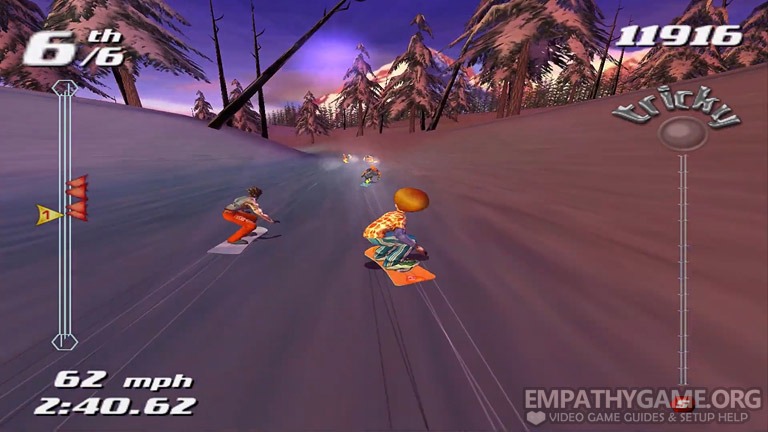
EA Canada’s follow-up to the original SSX builds its identity around a clever relationship between tricks and speed. Landing grabs, spins, and exaggerated Uber moves generates Adrenaline for boosting, turning aerial showmanship into a practical racing resource. The redesigned courses support this approach with branching routes, hidden passages, rails, and enormous drops. Distinctive competitors, aggressive rivalries, and a reactive electronic soundtrack make even familiar runs feel like noisy sporting spectacles.
It is an excellent foundation, though not an entirely smooth one. Jump preparation demands more commitment than the colorful presentation suggests, collisions can punish minor mistakes, and opponents sometimes remain suspiciously close despite clean riding. Much of the World Circuit also relies on revisiting the same courses. Yet few arcade sports games connect spectacle and competition this effectively. The appeal lies in learning how to turn apparently reckless stunts into controlled advantages.
Tricks Are More Than a Way to Show Off
The central pleasure of SSX Tricky comes from treating every jump as a decision rather than an automatic opportunity for points. Grabs, rotations, flips, and grinds replenish the Adrenaline meter, which powers a temporary speed boost. A rider who avoids every ramp might maintain a clean downhill line but eventually lose ground to someone who uses modest tricks to sustain acceleration. The system creates a satisfying cycle: build speed, find airtime, land something worthwhile, and carry the resulting momentum into the next section.
Uber tricks push that cycle toward theatrical absurdity. Once the meter is full, riders can perform special animations that make ordinary snowboarding physics seem irrelevant. Characters spin around their boards, contort through elaborate poses, and occasionally appear to have forgotten that gravity exists. Landing six Uber tricks fills the TRICKY indicator and grants unlimited boost for the remainder of the run. Reaching that state transforms the pace, allowing sustained acceleration without constantly replenishing the meter.
The interesting question is whether an Uber trick is worth performing at a particular moment. Its lengthy animation can sacrifice more time than the resulting boost saves, especially on a small jump or when approaching a difficult landing. A quick grab off a shallow rise may be the better racing choice, while a large, predictable gap provides enough airtime to justify a special move. Once permanent boost becomes available, some of that calculation disappears. It is an exhilarating reward, but securing it early can make the remaining race less strategically demanding.
Successful riding therefore involves more restraint than the presentation advertises. Launching into every available trick feels spectacular but is not always fast. The strongest runs distinguish between jumps that generate useful Adrenaline and those that leave the rider floating while competitors race underneath.
The Best Landings Begin Before Takeoff
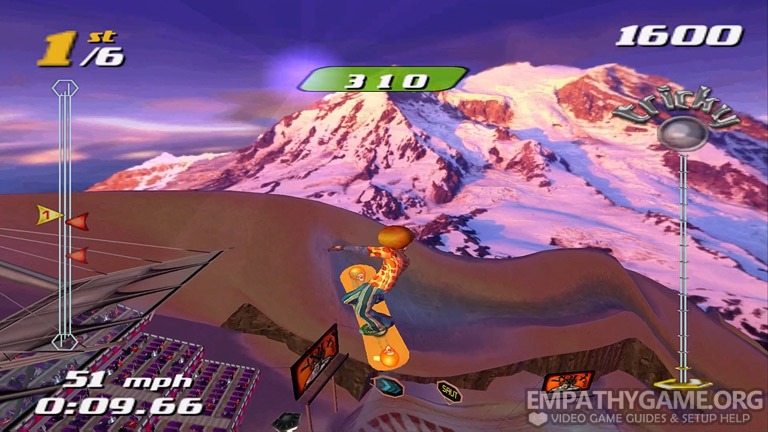
The controls have considerably more commitment than their arcade appearance implies. Charging a jump and pre-winding a rotation require preparation before reaching a ramp. Under the default control arrangement, crouching to prepare a jump restricts steering, so approaching at the wrong angle can leave little opportunity for correction. A rider who begins charging while still drifting toward the edge may launch in the wrong direction despite pressing the appropriate inputs.
This creates an enjoyable learning curve. A reliable jump begins with positioning the board, choosing the takeoff point, and deciding how much rotation the available airtime can support. Releasing directional inputs before landing helps prevent an unnecessary extra spin, while ending grabs early gives the rider time to recover a stable posture. A successful landing often depends less on frantic midair corrections than on the decisions made several seconds earlier.
That precision is not always matched by the surrounding collision system. Clipping a rail support, catching an awkward slope, or hitting an obstacle while accelerating can interrupt an otherwise controlled sequence. The camera sometimes struggles to communicate the precise landing area during complicated jumps, particularly where the course changes elevation sharply. Recovering costs speed, and a single crash can undo the advantage earned through several clean tricks. The underlying mechanics reward practice, but the occasional harsh collision makes failure feel less deserved than it should.
Every Course Hides a Different Racing Line
SSX Tricky features seven extensively reworked courses from the original game alongside two new locations, Garibaldi and Alaska. Their value comes less from sheer quantity than from the number of ways each course can be approached. The most obvious downhill path is rarely the only useful one. Hidden passages, elevated rails, alternate slopes, and carefully positioned ramps create opportunities to exchange distance for speed, airtime, or a safer landing.
Garibaldi introduces this philosophy with a dramatic opening drop that offers substantial airtime before the race has properly settled. Its approachable layout makes it suitable for learning when to commit to an Uber trick and when to finish a rotation early. Alaska represents the opposite extreme. Steep icy sections, abrupt changes in elevation, and enormous jumps demand confident positioning at high speed. A small error that would be recoverable on Garibaldi can become disastrous when the ground drops away beneath the board.
The more artificial venues give the game much of its personality. Merqury City Meltdown places urban obstacles and crossing routes in the rider’s path, making awareness of the surroundings nearly as important as outright speed. Tokyo Megaplex resembles a mechanical stunt playground, with tunnels, half-pipes, rails, and powerful air vents creating an environment that feels closer to an obstacle course than a conventional mountain. The distinction matters: one location rewards confident downhill commitment, while another demands knowledge of a complicated arrangement of hazards and alternative paths.
Repeated runs gradually change how these environments are understood. A shortcut that initially looks faster may lead to an awkward landing or bypass a useful opportunity to build Adrenaline. Conversely, a longer-looking route can provide the height needed for an Uber trick that establishes permanent boost earlier. Even unusual quirks become part of advanced route knowledge: the manual reset function can propel a rider forward at certain locations, creating unintended shortcuts exploited in specialized runs. Such tricks sit outside the intended racing design, but they illustrate how thoroughly the courses and their boundaries have been investigated.
Showoff Changes the Meaning of a Good Route
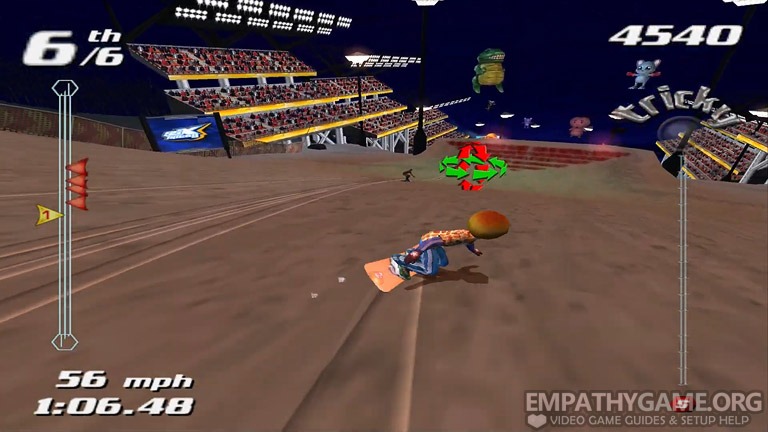
Race and Showoff share the same basic movement system but reward noticeably different decisions. Racing emphasizes maintaining speed, avoiding crashes, and choosing shortcuts that minimize travel time. Showoff prioritizes trick scores, placing additional stunt opportunities and floating multipliers along the courses. A line that wastes several seconds during a race can become the most valuable approach in a scoring event if it passes through a high-value multiplier with enough airtime for a difficult trick.
This gives Showoff an enjoyable planning element. Instead of simply performing the largest possible stunt whenever a ramp appears, high scores depend on matching the trick to the location. A large jump beneath a multiplier pickup can justify an elaborate Uber animation, whereas a smaller gap may reward a simpler combination completed safely. Repeating familiar tricks also brings diminishing returns, encouraging variation rather than endless reliance on one reliable move.
There is a limitation to this design. Scoring often revolves around identifying particularly valuable jumps and executing oversized tricks at those specific locations. The resulting rhythm can feel like a sequence of isolated scoring opportunities rather than one continuous freestyle performance. Characters with favorable airtime and quick, valuable Uber animations can further shape the most effective approach; Mac’s relatively quick Sad Sack move, for instance, gives trick-focused runs an attractive option.
Showoff remains engaging because its objectives genuinely change how a course is explored, although score optimization can eventually narrow experimentation toward a few especially productive locations and tricks.
Rivals Turn Racing Into a Personal Contest
SSX Tricky has little interest in telling a conventional story. Instead, its narrative personality comes from the competitors themselves. Eddie’s exuberant confidence, Mac’s youthful energy, Moby’s imposing presence, and Psymon’s confrontational attitude establish recognizable identities through animation, dialogue, and their behavior around other riders. The roster feels like a group of exaggerated personalities competing for attention rather than a collection of interchangeable character models.
The Friend or Foe system makes those personalities more consequential. Attacking another rider can damage the relationship, encouraging retaliatory aggression in subsequent World Circuit events. Friendly opponents may behave more supportively, while hostile competitors create opportunities for shoves, confrontations, and increasingly pointed verbal exchanges. These reactions give the competition a social dimension without requiring a scripted campaign. A race is not merely against an anonymous field; it can carry the consequences of earlier encounters.
The system also exposes a weakness in the racing AI. Rivals often remain close enough to threaten the player even after stretches of strong riding, creating the impression that comfortable leads are difficult to maintain. That can undermine the satisfaction of executing a near-perfect run. Yet the crowded racing also has an entertaining consequence: competitors remain within range to exchange attacks, warnings, and taunts rather than disappearing from the event entirely. The same behavior that sometimes weakens competitive fairness helps maintain the sense of a chaotic sporting rivalry.
Repeated dialogue inevitably becomes familiar, and an opponent’s interference can be particularly irritating when it leads directly into an awkward obstacle or jump. Still, the personalities provide something many arcade racers lack: memorable relationships between competitors that extend beyond their finishing positions.
The Soundtrack Is Part of the Spectacle
The audiovisual presentation commits to the same extravagance as the mechanics. Riders twist through exaggerated animations, courses glow with distinctive colors, and environmental silhouettes remain easy to recognize even where texture detail reveals the game’s age. The animation is especially important because it makes impossible tricks visually satisfying rather than reducing them to abstract score calculations. A successful Uber move feels like a small performance in its own right.
Music supplies the other half of that personality. The soundtrack blends electronic music, breakbeats, energetic percussion, and Mixmaster Mike’s scratches, while Run-D.M.C.’s “It’s Tricky” punctuates moments of heightened action. The audio is interactive rather than simply a playlist accompanying the descent. Musical intensity and scratching respond to events such as impressive tricks and changes in momentum, helping different sections of a race feel more dramatic.
Subtler transitions are equally effective. The mix can become subdued during extended airtime before returning with greater force on landing, while alternate sections of a course can introduce a different musical atmosphere. These shifts make familiar movement actions feel significant without interrupting the ride. They are particularly well matched to a game where the difference between a successful stunt and a painful crash may be decided in the final instant before touching snow.
The recognizable musical cues and character remarks can become repetitive across a long World Circuit campaign. Nevertheless, the relationship between sound, animation, and player action gives SSX Tricky a distinctive audiovisual identity that survives the aging of its underlying graphics.
World Circuit Rewards Mastery More Than Variety
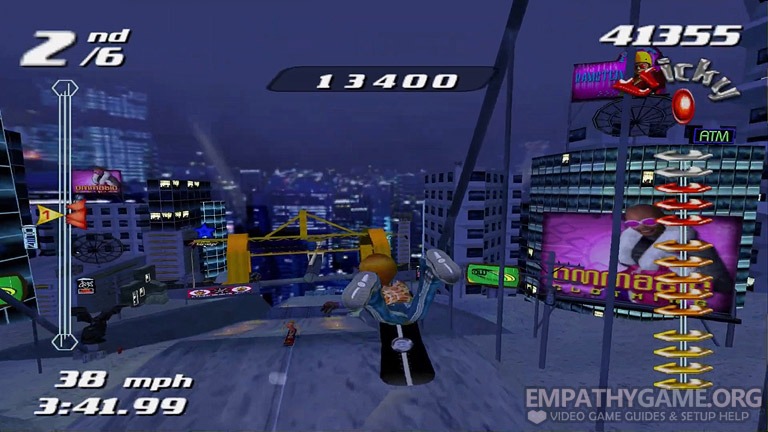
World Circuit provides the main long-term structure, moving riders through Race and Showoff competitions while rewarding medals, improved attributes, equipment, and additional unlocks. Speed, Edging, Stability, and Tricks can be developed as progress is made, allowing a selected character to become more capable across successive events. The system gives familiar courses a practical purpose: repeated competitions gradually improve both the rider’s abilities and the player’s understanding of the terrain.
Board selection adds a layer that the visible character ratings do not completely explain. Alpine boards emphasize racing speed, Freestyle boards favor tricks, and BX boards offer a middle ground. Because boards influence performance and attribute potential, a rider who appears unsuited to racing on basic statistics can become competitive with appropriate equipment. Choosing between outright pace and reliable aerial handling creates a modest but meaningful decision before an event.
The Trick Book introduces another kind of mastery, asking each character to complete specific moves across successive chapters for unlockable outfits and an eventual Uber board. Its weakness is how strictly some entries recognize the required trick. Adding an unnecessary spin or another move can prevent a seemingly successful attempt from counting, even though ordinary play encourages creative combinations. Trick Practice helps teach the inputs but does not itself complete the relevant progression challenges. The resulting contradiction can make an otherwise playful trick system feel unexpectedly procedural.
Unlocking everything requires substantial repetition. World Circuit repeatedly returns to familiar courses, and although different riders, equipment choices, and medal targets provide reasons to continue, the basic event structure changes relatively little. The most enjoyable reason to revisit a mountain is usually discovering a better line or improving a difficult landing, not simply earning another cosmetic reward.
Local Competition Adds Another Test of Skill
Single Event provides a welcome alternative to the longer progression structure, particularly through two-player split-screen competition. Racing another person changes the value of shortcuts and attacks because both competitors can exploit mistakes in real time. Familiarity with the courses becomes a tactical advantage, and the satisfaction of stealing a win after a risky jump is different from overcoming computer-controlled opponents.
Split-screen introduces a practical compromise, however. Dividing the display reduces the visible space around each rider, making it harder to judge landing positions, obstacles, and complicated rotations while airborne. A trick that feels manageable with the full single-player view can become noticeably less reliable when each competitor occupies a smaller portion of the screen. The mode remains entertaining, especially when both players know the courses, but the reduced readability adds difficulty that does not come from the underlying trick system.
Freeride offers a calmer alternative for learning unfamiliar terrain and experimenting without competitive pressure. Together, these options extend the value of the courses beyond World Circuit, although they cannot completely disguise the limited variety of objectives.
Final Verdict
SSX Tricky succeeds because its absurdity has a mechanical purpose. The extravagant Uber tricks are not merely visual rewards; they feed a boost system that changes how riders approach jumps, shortcuts, and racing lines. The courses become progressively more interesting as their hidden paths and elevation changes are understood, while the colorful cast and reactive soundtrack make even repeated events feel energetic and distinctive.
The game is not without meaningful flaws. Steering restrictions during jump preparation demand patience, inconsistent collisions can destroy carefully built momentum, and aggressive rivals sometimes make clean racing feel less decisive than it should. Showoff scoring can become concentrated around especially valuable stunt locations, while World Circuit asks for considerable repetition to complete character progression and unlocks. Even local multiplayer carries a visibility penalty that makes ambitious tricks harder to judge.
Those weaknesses matter, but they rarely erase the pleasure of mastering a difficult course. The strongest moments come from understanding exactly when to risk a long Uber trick, when to preserve speed with a simpler jump, and which route provides the best opportunity to do both. Players seeking realistic snowboarding physics, a substantial narrative, or a constantly changing career structure may find the design limited. Those who enjoy demanding arcade movement, expressive characters, and spectacular races built around meaningful trick decisions will find SSX Tricky remarkably rewarding. Its greatest achievement is making every successful landing feel like both a performance and a victory.
SSX Tricky Pros & Cons
SSX Tricky PC System Requirements
SSX Tricky has no official native Windows PC system requirements because Electronic Arts did not release the original game for Windows. The specifications below apply to running the PCSX2 emulator, not to a native SSX Tricky PC edition.
PCSX2 maintains general minimum and higher-performance hardware guidance. Actual SSX Tricky performance depends on the computer, graphics settings, emulator build, and selected game region.
PCSX2 MINIMUM EMULATOR REQUIREMENTS:
OS: Windows 10 (supported recent versions), 64-bit
CPU: x86-64 processor supporting SSE4.1, with at least two physical cores and approximately 1500 PassMark single-thread performance
RAM: 8 GB
GPU: Graphics hardware supporting Vulkan 1.1, Direct3D 11, or compatible OpenGL 3.3 features; approximately 600 PassMark G3D performance or better
Storage: Space for PCSX2, PS2 BIOS files, virtual memory cards, and an authorized SSX Tricky disc image
Controller: Compatible gamepad recommended; keyboard support available
Additional Notes: A BIOS extracted from your own PlayStation 2 is required. Meeting minimum emulator requirements does not guarantee full-speed gameplay at enhanced resolutions.
PCSX2 MODERATE-PERFORMANCE GUIDANCE:
OS: Windows 11, 64-bit
CPU: Four physical cores, AVX2 support, and approximately 2000 or higher PassMark single-thread performance
RAM: 16 GB
GPU: Approximately 6000 PassMark G3D performance, 4 GB VRAM, and support for a modern graphics API such as Vulkan 1.3 or Direct3D 12
Storage: Sufficient local space for the game backup and emulator data; SSD storage is convenient but is not an official SSX Tricky requirement
Controller: Xbox, DualShock, DualSense, or another compatible gamepad with individually mapped shoulder buttons
Additional Notes: These are PCSX2’s general moderate-performance targets, not SSX Tricky-specific benchmark results. Higher internal resolutions and demanding graphical effects can require additional GPU performance.
Additional PC Performance and Setup Notes
PCSX2 graphics: Begin with the Automatic graphics renderer and native internal resolution. Once the game is running correctly, experiment with 2x or 3x internal scaling for sharper edges and cleaner presentation on modern monitors. Increase resolution gradually rather than assuming that more scaling always improves the experience.
Vulkan and Direct3D are supported rendering options on compatible Windows hardware. PCSX2 recommends Automatic as the normal starting point because renderer behavior and hardware compatibility can differ. If a scene shows graphical artifacts or unusual effects, first return to the default settings before trying another renderer or software rendering as a diagnostic step.
Game speed: Avoid unlocking the game speed or using arbitrary frame-rate patches without checking compatibility. SSX Tricky depends heavily on timing for jump preparation, spins, grabs, landings, and rival interactions. An incorrect speed modification can affect the feel of the original game.
Controls: Open PCSX2’s Settings > Controllers menu, enable a supported input source, and use Automatic Mapping when available. SDL is the recommended input source for most controllers. Confirm that both analog sticks, directional inputs, face buttons, and all four shoulder buttons respond correctly before starting World Circuit.
Players accustomed to a modern Xbox controller should remember that the original PS2 version was designed around a different face-button and shoulder-button arrangement. Keeping the emulated DualShock 2 inputs logically grouped is usually more useful than forcing the game into a modern racing-game control layout.
Two-player setup: Configure the first controller in PCSX2’s Controller Port 1 and the second controller in Port 2. If one controller operates both riders or the second player is not recognized, check the input-device assignment and automatic mapping for each port separately.
Disc-image verification: PCSX2 includes a disc-image verification function in game properties. If the game freezes during loading or behaves unexpectedly, checking the integrity of the backup is more useful than immediately applying unofficial fixes.
Save files: Use the game’s normal memory-card save system for long-term progress. Emulator save states can be helpful for practice, but ordinary in-game saves are generally the safer foundation for preserving World Circuit medals, rider attributes, and unlockables. Back up the relevant PCSX2 memory-card data before reinstalling or changing major configurations.
Dolphin widescreen: Dolphin’s SSX Tricky compatibility documentation distinguishes the game’s internal widescreen presentation from the emulator’s generic widescreen hack. Use the game’s Animorphic display option with Dolphin’s aspect-ratio setting on Auto when appropriate, rather than forcing the widescreen hack, which the compatibility documentation does not recommend for this title.
GameCube and Xbox version differences: The GameCube release benefits from Dolphin’s well-documented compatibility and straightforward setup, but its controller layout does not provide the same four easily accessible shoulder inputs as the PS2 version. The Xbox version adds visual enhancements, though its original release also received criticism for fluctuating performance and altered trick controls. Emulation quality depends on the selected emulator and computer rather than those historical console results alone.
Steam Deck and handheld PCs: There is no Steam Deck Verified or Playable rating for a native SSX Tricky release because the original game has no Steam app. PCSX2 and Dolphin can be used on supported handheld operating systems, but emulator setup, controls, and performance are separate from Valve’s native-game verification system.
For the official emulator specifications and configuration reference, consult PCSX2’s system requirements, graphics configuration documentation, and controller setup guide.
Video Trailer
Frequently Asked Questions
Is SSX Tricky worth playing in 2026?
Yes. SSX Tricky remains enjoyable for its exaggerated snowboarding physics, outrageous Uber tricks, memorable characters, energetic soundtrack, and competitive downhill courses. Its older controls and repeated tracks require some patience, but players who prefer fast arcade sports games over realistic snowboarding simulations will find plenty to enjoy.
Is SSX Tricky a remake of the original SSX?
No. SSX Tricky is an expanded follow-up to the original SSX, reworking familiar courses while adding new locations, riders, animations, voice performances, and a much more elaborate trick system. It shares much of the first game’s structure but offers substantially more personality and freestyle possibilities. SSX 3 is a separate subsequent entry.
What is the difference between Race, Showoff, Time Challenge, and Freeride?
Race focuses on finishing ahead of rival snowboarders, while Showoff rewards the highest trick score before reaching the finish. Time Challenge is a race against the clock, and Freeride provides an untimed practice environment without competitive scoring. World Circuit uses Race and Showoff events for career progression, while Time Challenge belongs to Single Event.
How do I unlock more courses in SSX Tricky?
Progress through World Circuit’s Race events and earn a medal by finishing third or better in the final round of each course. New venues become available as you advance and can subsequently be selected in other game modes. Simply completing courses in Single Event or Freeride does not unlock them.
How do I unlock Untracked and Pipedream?
Untracked is a bonus course unlocked through World Circuit racing progression, culminating in earning a medal on Alaska. Pipedream is unlocked by earning medals across the regular World Circuit Showoff courses. Both are additional challenges beyond the standard course selection.
How do I unlock all the characters in SSX Tricky?
Eddie, Elise, Moby, and Mac are available at the beginning. Additional riders, including Zoe, Brodi, JP, Kaori, Marisol, Psymon, Seeiah, and Luther, unlock as you collect gold medals in World Circuit Race and Showoff events. Different riders have individual attributes, preferred board types, and signature tricks.
What do Edging, Speed, Stability, and Tricks actually do?
Edging affects turning control, Speed influences downhill pace, Stability helps your rider stay balanced and recover from rough situations, and Tricks improves aerial maneuverability. World Circuit medals award experience points that can be assigned to these attributes. Each rider has different skill potential, and the selected board can also change the effective attribute limits.
Which board type is best for racing or performing tricks?
Alpine boards favor speed and are suited to racing, while Freestyle boards emphasize aerial tricks and Showoff scoring. BX boards provide a compromise between the two, making them a practical choice for learning the game. There is no universally best board because rider attributes, preferred board type, and event objectives all affect performance.
Does the Adrenaline boost actually make you faster?
Yes. Activating Adrenaline provides an extra burst of speed, with a stronger boost available at higher meter levels. Successfully landing tricks replenishes Adrenaline, while falling or spending too long without performing tricks reduces it. Building meter on safer jumps and saving boost for useful straights or difficult sections is generally more effective than using it indiscriminately.
How do you perform Uber tricks in SSX Tricky?
Fill the Adrenaline meter until the Uber indicator activates, then launch into the air and perform the appropriate grab-and-tweak input combination for your rider and board. The activation window lasts a limited time, and the trick animation must finish before landing. Large jumps are preferable because many Uber tricks take considerably longer than ordinary grabs.
Why can’t my character perform their signature Uber trick?
Each rider’s unique signature Uber requires their preferred board type. For example, Eddie’s signature move requires a Freestyle board, so switching him to an incompatible board type prevents that specific animation even if the Adrenaline meter is full. General Uber tricks and character-specific Uber tricks also use different input combinations.
How do you get unlimited boost or enter full TRICKY mode?
Successfully land Uber tricks to fill the letters of the TRICKY indicator. Once all six letters are filled, the rider gains unlimited Adrenaline for the remainder of that run, allowing sustained boosting without draining the meter. Reaching this state early can provide a major advantage during both races and trick-focused events.
Why are my completed tricks not registering in the Trick Book?
The Trick Book records only eligible tricks from the rider’s currently active chapter, performed successfully using the required board type. Completing a move from a later chapter before unlocking that chapter will not count, and Trick Tutorial attempts do not register as completed entries. Check the active chapter and the input instructions in the pause menu before trying again.
How do I unlock new outfits and Uber boards?
Each rider has six Trick Book chapters, normally containing five tricks each. Completing a chapter unlocks an outfit, while finishing the entire Trick Book rewards that rider’s Uber board. Other boards are tied to rider-ranking progression, so medals and attribute improvements also contribute to your equipment collection.
What is the best way to earn high scores in Showoff mode?
Prioritize large jumps, varied grabs, spins, flips, and successfully completed Uber tricks while collecting the floating score-multiplier crystals. Yellow crystals multiply a trick’s score by two, orange by three, and red by five. Showoff courses also contain extra ramps and trick opportunities, so their highest-scoring routes can differ substantially from the fastest racing lines.
Why do repeated tricks earn fewer points?
SSX Tricky reduces the points awarded when you repeatedly perform the same trick. This encourages players to vary grab combinations, rotations, and Uber tricks instead of relying on one high-scoring move. Learning several reliable trick combinations is particularly valuable when pursuing Showoff gold medals.
Why does my Showoff run sometimes end before I reach the finish?
Showoff events include timed checkpoints that must be reached before the countdown expires. Missing one ends the run and causes you to lose the accumulated score, even if you performed difficult tricks earlier. Balance ambitious aerial combinations with enough forward progress to reach each checkpoint safely.
How can I jump farther and avoid crashing on large gaps?
Build speed before approaching the ramp, crouch to charge your jump, and release close to the takeoff edge rather than too early. Use Adrenaline boost where appropriate, avoid unnecessary rotations during difficult crossings, and level the board before landing. Practicing individual gaps in Freeride is useful because some shortcuts require a particular approach angle and speed.
Does SSX Tricky support two-player split-screen?
Yes. The original PS2, GameCube, and Xbox versions support two-player local competitive split-screen in Single Event, including Race and Showoff. Compatible emulators can reproduce this feature when two controllers are configured. The game supports a maximum of two local players, not four-player split-screen.
Can two players complete World Circuit together?
No. World Circuit progression is designed for an individual rider, while the two-player competitive mode is accessed through Single Event. Two people can race or compete for trick scores on unlocked courses, but they cannot jointly progress through a cooperative World Circuit campaign.
Does SSX Tricky have online multiplayer, LAN, or cross-play?
No. The original console releases were designed around offline single-player and local two-player competition rather than internet matchmaking or LAN sessions. They have no official cross-play or cross-progression system. Emulator-based remote-play arrangements are unofficial ways of extending local play, not original online features.
Is SSX Tricky available on Steam or through the EA app?
No. Electronic Arts has not released a native Windows version of the original SSX Tricky through Steam, the EA app, or another verified official PC storefront. The original console game can be played through compatible PC emulators using an appropriately obtained game backup, as explained in the installation section above.
Why are some grab tricks missing or different in the GameCube version?
The original GameCube controller has fewer dedicated shoulder buttons than the DualShock 2, so SSX Tricky uses a modified grab layout that does not expose every PS2 combination in the same way. The GameCube version also has an alternate expanded-control cheat that changes the available grab inputs, although it can be awkward to use. Simply remapping a modern controller in Dolphin does not automatically change the game’s original control logic.
Still have questions? Check the SSX Reddit community, PCSX2 Forums, or Dolphin Forums for additional gameplay advice, emulator troubleshooting, controller configuration help, and community discussion.
Sources & References
Key factual and technical information in this guide was checked against relevant emulator documentation, compatibility resources, and historical game reviews, including:
- PCSX2 — System Requirements — official minimum and moderate emulator hardware guidance, supported operating systems, processors, graphics APIs, and memory requirements.
- PCSX2 — Dumping BIOS — official requirements for obtaining PS2 BIOS files from an owned console and preparing them for emulator use.
- PCSX2 — Dumping Discs — official documentation for creating and verifying backups of physical PlayStation 2 game discs.
- PCSX2 Wiki — SSX Tricky — game-specific compatibility information, platform details, and reference material for the PlayStation 2 version.
- Dolphin Emulator Wiki — SSX Tricky — GameCube compatibility, configuration recommendations, and the game’s widescreen presentation behavior.
- xemu — SSX Tricky Compatibility — community-tested original Xbox emulation status and documented compatibility observations.
- Metacritic — SSX Tricky — historical critic reception and separate platform review aggregates.
- GameSpot — SSX Tricky Xbox Review — comparative information about the Xbox, PS2, and GameCube versions, including graphics, trick controls, and performance differences.
Similar Games Like SSX Tricky
- Tony Hawk’s Underground 2
- Tony Hawk’s Underground
- Jet Set Radio Future
- Burnout 3: Takedown
- Burnout Paradise
- Sonic Heroes




Found something worth playing through DecideGame?
DecideGame.com is an independent gaming project run by Editor Zero. If this guide helped you discover a game, solve a problem, or find useful information, you can support DecideGame.com and help keep new and updated game guides coming.
DecideGame — PC Game Guides, Reviews & Setup Help