
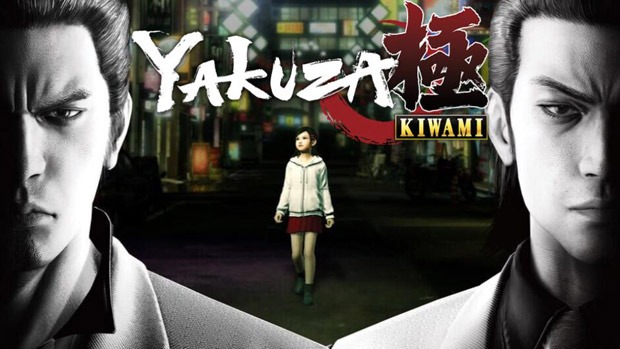
📅 Game released: 2016
Yakuza Kiwami remakes Kazuma Kiryu’s first crime drama with four fighting styles, Majima Everywhere, and a dense Kamurocho full of side stories. This PC guide compares official Steam and DRM-free GOG download options, explains Legacy save compatibility, and covers system requirements, Steam Deck, controllers, mods, and installation.
 By Editor Zero — independently researched, edited, and maintained.
Last updated: 12 November 2026
Last reviewed: 12 November 2026
Table of Contents
- Quick Facts
- Official PC Stores, Download & Installation
- Yakuza Kiwami Review
- Pros & Cons
- PC System Requirements
- Frequently Asked Questions
- Similar Games
Yakuza Kiwami Quick Facts
- Game: Yakuza Kiwami / current Steam release / Yakuza Kiwami Legacy
- Developer: Ryu Ga Gotoku Studio
- Publisher: SEGA
- Genre: Action-Adventure, Action RPG, Fighting, Brawler / Beat ’em Up, Crime Drama
- Release: January 21, 2016 (Japan, PS3/PS4); Windows PC: February 19, 2019; newer Steam PC version: December 11, 2025
- Platforms: Windows PC, PS3, PS4, PS5, Xbox One, Xbox Series X|S, Nintendo Switch, Nintendo Switch 2 (version features vary)
- Audio: Japanese voice acting; text and subtitle languages vary by edition and storefront; no official English dub
- Modes: Single-player story and side activities; no co-op or online multiplayer campaign
- Steam Deck: Verified for the current Steam release, with supported default controller layout, readable interface text, and SteamOS compatibility
- Engine: RGG Studio’s pre-Dragon Engine technology also used for Yakuza 0; not the Dragon Engine of Yakuza Kiwami 2
- Community: Reddit Yakuza / Like a Dragon, Steam Discussions, Like a Dragon Portal
- PC modding: Separate Yakuza Kiwami (2025) mods and Yakuza Kiwami Legacy mods libraries; choose mods for the exact installed version
- Metacritic score: 80/100 (2019 PC version; original remake reception, not a separate 2025 review aggregate)
- IGN score: 7.9/10 (original remake, PS4 review)
- Steam user reception: Very Positive overall (newer Steam app; review category may change)
Official PC Stores, Download & Installation
👇 Compare the official PC versions below before purchasing, downloading, installing, transferring saves, or adding mods.
- Current Steam release: This is the normal Steam choice for a new buyer. It uses a separate app from the older Legacy release, adds interface and subtitle languages, and restores the songs Receive You [Reborn] and Bleed to the western release while keeping the same main story and gameplay.
- Yakuza Kiwami Legacy: Owners of the original Steam release keep access to it. It is no longer the normal new-purchase listing, but it remains relevant for existing saves and for older community mods.
- Save-data warning: SEGA states that Legacy save data cannot transfer to the current Steam release. Treat it as a new installation and a new playthrough rather than an automatic upgrade of an existing campaign.
- Existing-owner price: SEGA announced a discounted purchase for eligible Legacy owners. Sign in to Steam and check the live price on your own account, because eligibility and regional pricing are determined by the storefront.
- GOG: GOG sells a DRM-free PC build that requires no activation or online connection to play. Its store page uses a different, older hardware-requirement profile, so check that page rather than applying the current Steam requirements to every PC edition.
- Microsoft Windows 10 edition: SEGA ended new purchases of the older Windows 10 version. Existing owners retain access, achievements, presence, and cloud-save features where supported; the linked Microsoft page is therefore a Legacy reference, not a current buy recommendation.
- Edition and DLC: The base purchase contains the complete main story. There is no required Ultimate Edition, subscription, season pass, or major gameplay expansion to assemble before playing.
- Installation: Install through the client attached to the version you bought, keep enough space for the download and temporary update files, then allow the first launch to create configuration and save folders before changing files or adding mods.
- Controller setup: The current Steam page lists full controller support for Xbox and PlayStation controllers plus the Steam Input API. If inputs double or fail, test one controller, disconnect virtual or duplicate devices, and compare Steam Input enabled versus disabled.
- Steam Deck: Valve rates the current Steam app Verified. That covers compatibility criteria, but a stable frame-rate cap and conservative settings can still provide steadier battery life and frame pacing.
- Mods and version checks: The newer Steam version now has a separate Nexus Mods library, while many long-established music, texture, and gameplay changes belong to Legacy. Never assume a Legacy executable patch works with the newer app; read the supported-version notes and keep backups.


 View the Legacy Windows 10 Listing

Yakuza Kiwami Review
A compact crime tragedy carried by bruising combat and Kamurocho’s strange humanity.
Calling the Yakuza series “Japanese GTA” explains the criminals and the city, but misses almost everything that makes it distinctive. Yakuza Kiwami is not a sandbox for stealing cars or causing chaos. It is a directed action RPG about loyalty, guilt, and the cost of taking responsibility, set in a neighborhood where one intimidating ex-yakuza keeps finding people who need his help.
That contrast gives the remake its identity. Kazuma Kiryu can leave a severe Tojo Clan confrontation, flatten a gang with a bicycle, sing karaoke, tune a miniature racing car, expose a scam, and return to a murder mystery without seeming like a different character. He takes even the ridiculous problems seriously. As a result, the comedy rarely damages his dignity, and the central tragedy never completely smothers the life of the city.
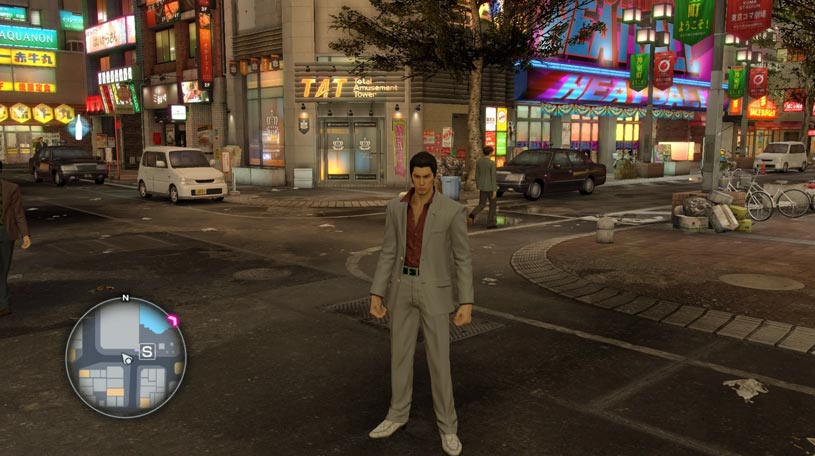
Kamurocho Makes a Small World Feel Personal
Kamurocho, the fictional entertainment district inspired by Tokyo’s Kabukicho, is tiny beside a conventional open-world map. That is often an advantage. Restaurants, bars, shops, arcades, alleys, and underground spaces sit close enough together that useful places become familiar landmarks rather than icons forgotten after one visit. The city asks for attention, not long-distance travel.
Repeated walks create a particular kind of attachment. You learn where to buy recovery items, which corner tends to start trouble, where Pocket Circuit hides, and which route will get you across town with fewer interruptions. Neon lights and busy streets establish the setting, but routines make it believable. A larger map could offer more scenery; Kamurocho gradually acquires a memory. Even the suspicion that Goro Majima might be waiting around the next corner changes how an ordinary journey feels.
The density also gives substories room to work. Optional encounters range from scams and social misunderstandings to genuinely vulnerable strangers and spectacular nonsense. Their production values and writing are uneven, yet they reveal something the main conspiracy cannot show as efficiently: Kiryu is dangerous because he can fight, but admirable because he repeatedly chooses to stop and help.
This is where a comparison with GTA 4 helps. Both use a criminal city to examine loyalty and consequences, but their rhythms differ. Liberty City is a broad driving space shaped by missions and satire. Kamurocho is a walkable neighborhood where the smallest personal interruption may matter more than the journey to the next objective.
Kiryu Returns to a City That Moved On
Kiryu accepts blame for a murder he did not commit. Ten years later, he leaves prison to find the Tojo Clan unstable, his closest relationships damaged, and ten billion yen missing from the organization. His search brings him to Haruka, a young girl whose history connects the missing money to people Kiryu has spent years trying to find. The mystery supplies momentum, but the real subject is what happens to loyalty when time and circumstances change the people involved.
Kiryu’s bond with Haruka gives the plot its human center. His protectiveness is expressed through ordinary acts of care rather than constant speeches about honor. Akira Nishikiyama carries the deeper tragedy. Additional scenes in the remake show the pressure, humiliation, grief, and resentment that reshape Kiryu’s sworn brother during his absence. These moments make Nishiki easier to understand without excusing his choices. The story can still race through revelations with the bluntness of its PlayStation 2 origins, but its emotional stakes remain clear.
Playing Yakuza 0 Director’s Cut first makes those relationships richer. Spending longer with Kiryu, Nishiki, and Majima in the prequel changes how their later encounters read. Kiwami works as an entry point because it remakes the original story, though it is especially effective as the painful consequence of a friendship the player has already come to know.
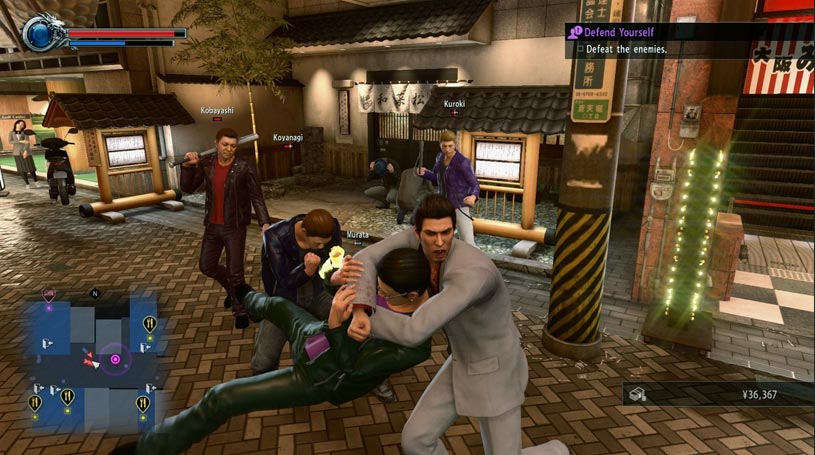
Four Styles Turn Street Fights Into Improvisation
Combat uses the four-style foundation associated with Yakuza 0. Brawler balances grabs, counters, and dependable punches. Rush sacrifices heavy impact for quicksteps and rapid attacks. Beast is slower but turns bicycles, signs, and other street furniture into crowd-clearing weapons. Dragon is Kiryu’s signature style, stripped of much of its power after prison and gradually restored through a separate progression path. The styles are not merely four animation sets; each changes which risks are worth taking.
Rush can circle a fast opponent, Beast can interrupt a crowd, and Brawler can control a more measured duel. Positioning also determines which Heat Actions become available, turning walls, weapons, and nearby objects into exaggerated finishers. These animations make routine fights feel physical, even after the novelty wears off. But longer combinations carry a cost. Some players find Kiwami’s groups quicker to close in than those in Yakuza 0, which makes watching nearby enemies and choosing shorter strings feel more important than blindly finishing every combo.
Dragon complicates the idea that unlocking more moves always makes combat smoother. Even as its strength returns, some regular combinations can feel comparatively slow, especially when Kiryu lacks the Heat or conditions needed for faster attacks. Advanced techniques such as the Double Finisher and Quickstep Cancel also consume Heat. That creates a meaningful tension: using an impressive move can reduce the resource that helps the style maintain momentum. Switching to Rush to evade and rebuild pressure may remain sensible long after Dragon begins to resemble its former self.
Bosses expose the combat system’s rougher edges. Some reward careful dodging, Heat management, and reading openings. Others block repeatedly, interrupt attacks, wield troublesome weapons, or absorb so much punishment that a duel feels stubborn rather than demanding. When a boss kneels to recover health, the intended answer is often a matching Kiwami Heat Action while Kiryu has enough Heat. The particularly confusing part is that the opening tutorial demonstrates such a response before the relevant Extreme abilities necessarily become available through ordinary upgrades. Understanding the visual cue does not mean Kiryu can execute the move yet.
Nor is every Heat finisher equally effective throughout a long encounter. Repeating the same Heat Action against one opponent can produce diminishing damage, making alternative weapons and environmental finishers more valuable than repeatedly chasing the easiest prompt. This is an appealing incentive to experiment, although the game communicates it poorly. Once Kiryu acquires powerful counters, the balance can swing in the opposite direction, with certain fights becoming dramatically easier. Kiwami has more tactical texture than its simple button combinations suggest, but it does not always explain that texture at the moment it matters.
Majima Everywhere Is Rivalry, Comedy, and Grind
Goro Majima can interrupt ordinary travel through street challenges, disguises, minigames, and increasingly strange ambushes. His persistence restores Dragon abilities, tying Kiryu’s lost strength to a rival who refuses to let him remain diminished. It is a smart idea because a mechanical upgrade has a character-based reason to exist: Majima wants to fight the Kiryu he remembers, not the weakened man who came out of prison.
At its best, Majima Everywhere makes a familiar street unpredictable. An ordinary errand turns into a duel, a harmless activity hides an elaborate joke, and Majima’s theatrical commitment becomes funnier because Kiryu is so unwilling to play along. His changing fighting styles also make him a recurring opponent worth learning rather than just another random encounter.
The problem is the amount of repetition required to complete the system. Some encounters depend on obscure conditions, and another ambush can be exhausting when the player only wants to reach a story marker. Dragon’s restoration is also not solely a Majima project. Komaki’s training depends on items purchased with Coliseum points, creating a separate stretch of arena fighting before certain valuable techniques can be learned. That extra requirement makes sense as martial-arts discipline, but it can leave story-focused players using an incomplete Dragon style far longer than expected. The frequent street fights also sit awkwardly beside main-story scenes that behave as though Majima has been absent.
Side Activities Give the Tragedy Room to Breathe
Karaoke, batting, gambling, mahjong, arcade games, hostess interactions, restaurants, and Pocket Circuit are more than a checklist. They regulate the story’s tone. A long crime-drama sequence feels heavier because Kamurocho can be playful afterward, while a ridiculous detour gives the next act of violence a sharper contrast. Kiryu’s willingness to treat small concerns with complete seriousness is what joins these different moods together.
Pocket Circuit is a particularly good example of a small activity becoming a substantial game of its own. Building miniature cars for specific tracks is not simply a matter of fitting the fastest motor. Longer races can punish an aggressive battery choice, while weight, stability, and the placement of a boost can determine whether a promising build lasts to the finish. A car that dominates the opening laps may lose its advantage late. The challenge is in understanding why a setup fails, and in making a modest adjustment instead of assuming more speed will solve everything.
MesuKing, the insect-themed card battler, hides another kind of depth behind its absurd presentation. Its rock-paper-scissors exchanges initially look like guessing, but card strengths matter, and some opponents have readable habits or tells. Recognizing those tendencies can make a match feel less arbitrary, even if chance remains part of it. Neither minigame explains all its subtleties particularly well, and not every diversion will appeal to everyone. Mahjong can be an obstacle to completion in its own right. Still, these activities reward a curious player who is willing to investigate their rules instead of treating them as distractions.
Substories are equally uneven and essential. Some repeat scams or end with a routine fight; others deliver compact character pieces that would fit a television episode. Together they reinforce a theme the central plot occasionally states too loudly: family and loyalty are built through actions, not simply inherited through an organization.
A Faithful Remake Still Carries Old Bones
Kiwami rebuilds the first game with sharper presentation, a more flexible combat framework, added Nishiki scenes, re-recorded performances, and extra side material. It does not rebuild every underlying idea. Several chapters send Kiryu between simple objectives, supporting characters disappear before they have fully developed, and the conspiracy sometimes advances through sudden revelations rather than patient investigation.
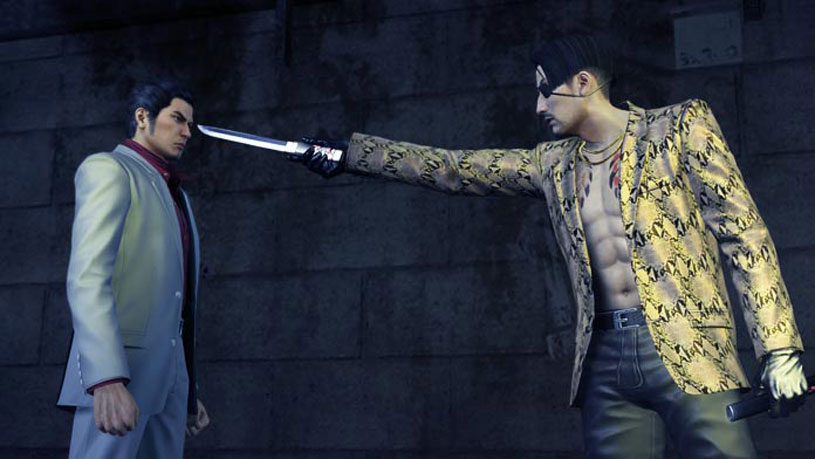
The mismatch is clearest after Yakuza 0. The two games share much of their visual and combat language, but Kiwami’s shorter source story cannot give every relationship the same space. Cramped cameras during fights, frequent street encounters, abrupt pacing, and a few frustrating bosses make the age of the underlying design visible. Someone arriving from the sprawling prequel might mistake the remake’s focus for a lack of ambition.
Yet that smaller scale has its own value. Important characters and conflicts arrive quickly, the central story asks for a manageable commitment, and Premium Adventure lets players revisit unfinished substories, minigames, upgrades, and the Completion List after the credits. A focused playthrough and an exhaustive completion run can therefore look very different. The remake is strongest when it lets the player decide how deeply to engage with the city’s countless interruptions.
Final Verdict
Yakuza Kiwami succeeds because its contrasting qualities belong together. Kiryu’s seriousness makes the comedy funnier. Kamurocho’s limited footprint makes it more familiar. The violence gives his patience with strangers greater meaning. Beneath the conspiracy and clan politics is a story about people failing one another, surrounded by smaller stories in which someone chooses not to walk away.
It is not a seamless remake. Boss recovery mechanics are awkwardly introduced, Dragon’s best techniques take commitment to restore, Majima’s interruptions can become tiresome, and the original narrative structure remains visible. Some of the friction comes from ambitious systems that deserve better explanation; some simply comes from old design.
For players drawn to character-driven crime drama, expressive brawling, a dense urban setting, and side content that can be compassionate and absurd in the same evening, Kiwami is still a rewarding journey. Those expecting an unrestricted sandbox or the breadth of Yakuza 0 may prefer something else. The map is small, but the people and routines within it give the city a personality that is difficult to replace.
Yakuza Kiwami Pros & Cons
- Pro: Kiryu, Nishiki, Haruka, and Majima anchor an emotional crime drama about loyalty, guilt, and chosen family
- Pro: Dense Kamurocho design makes streets, shops, substories, and minigames feel more personal than a much larger map
- Pro: Four styles, environmental weapons, Heat Actions, and progression make street combat expressive and satisfying
- Pro: Majima Everywhere connects a memorable rivalry to Dragon-style growth and unpredictable comedy
- Pro: Current Steam and DRM-free GOG options serve different ownership and compatibility priorities
- Con: Legacy Steam saves do not transfer to the newer release, and some older mods require version-specific replacements
- Con: Some bosses rely on blocking, recovery, weapons, or interruption in ways that feel frustrating rather than demanding
- Con: Majima Everywhere and random fights can become repetitive when the player wants uninterrupted story progress
- Con: Chapter pacing, camera behavior, and supporting-character development still reveal the age of the original design
Yakuza Kiwami PC System Requirements
OFFICIAL STEAM PC REQUIREMENTS FOR THE CURRENT RELEASE:
MINIMUM:
OS: Windows 11 64-bit
CPU: Intel Core i3-8100, 3.6 GHz / AMD Ryzen 3 2300X, 3.5 GHz
RAM: 8 GB
GPU: NVIDIA GeForce GTX 960 4 GB / AMD Radeon RX 460 4 GB / Intel Arc A380 6 GB
DirectX: Version 12
Storage: 31 GB available space
Additional notes: Low settings at 1080p / 30 FPS; CPU must support AVX and SSE4.2 instruction sets
RECOMMENDED:
OS: Windows 11 64-bit
CPU: Intel Core i5-8600K, 3.6 GHz / AMD Ryzen 5 2500X, 3.6 GHz
RAM: 16 GB
GPU: NVIDIA GeForce GTX 1070 8 GB / AMD Radeon RX Vega 56 8 GB / Intel Arc A750 8 GB
DirectX: Version 12
Storage: 31 GB available space
Additional notes: High settings at 1080p / 60 FPS; CPU must support AVX and SSE4.2 instruction sets
Additional PC Performance and Setup Notes
- Store-specific requirements: The figures above belong to Steam app 3717330. GOG currently lists Windows 11 too, but its DRM-free build has a different, older processor and graphics minimum. Use the requirements displayed for the exact edition you install.
- Windows 10: Steam app 3717330 officially lists Windows 11. GOG also lists Windows 11 in its current storefront requirements. Older builds may behave differently, but do not treat legacy compatibility reports as a guarantee of supported Windows 10 operation.
- Controller problems: Connect one controller before launch, remove duplicate virtual devices, and compare Steam Input enabled with it disabled. Use the appropriate Xbox or PlayStation layout instead of stacking multiple remapping tools.
- Crashes or black screens: Verify the installed files, update the GPU driver and Windows, disable conflicting overlays, remove recent executable hooks or mods, and test a clean configuration before reinstalling the entire game.
- Stutter or uneven frame pacing: Close heavy background applications, test V-Sync and a sensible frame-rate cap, reduce resolution or demanding effects one step at a time, and keep the game on healthy storage with free space for updates.
- Steam Deck: The current app is Verified, but a stable cap, moderate brightness, and adjusted graphics can trade peak smoothness for steadier battery life. Legacy and GOG installations are separate compatibility cases.
- Mods: Restore original files before troubleshooting. Check the exact mod build: the newer Steam release and Legacy have separate Nexus Mods pages, and a DLL or executable patch designed for one is not automatically compatible with the other.
Official Trailer
Note: SEGA’s official PC trailer presents Kiryu, Kamurocho, the central crime drama, fighting styles, Heat Actions, substories, and minigames, while the written guide adds current storefront, Legacy-save, Steam Deck, requirement, mod, and troubleshooting context.
Frequently Asked Questions
Should I play Yakuza 0 before Yakuza Kiwami?
Either order works because Kiwami remakes the first main Yakuza story. Playing Yakuza 0 Director’s Cut first provides stronger context for Kiryu’s friendship with Nishikiyama, Majima’s personality, and the families that shape Kamurocho.
Can I carry my Yakuza Kiwami Legacy save into the newer Steam release?
No. SEGA confirms that save data does not transfer from the original Steam Legacy app to the newer Steam release. Keep Legacy installed if you want to continue that particular save, or start a separate campaign in the newer edition.
Does the newer Steam release change the story or gameplay?
The main story and combat remain the same. The newer release adds more interface and subtitle languages, and its western PC release restores the songs Receive You [Reborn] and Bleed. It is a separate Steam app, not a save-compatible update to Legacy.
Is Yakuza Kiwami a multiplayer or co-op game?
No. Kiwami is a single-player action-adventure with a story campaign, optional substories, fighting challenges, and minigames. It does not have online co-op or a separate competitive multiplayer mode.
Are Steam and GOG PC requirements identical?
No. The newer Steam app lists a Windows 11, DirectX 12, 31 GB configuration and requires AVX/SSE4.2 CPU support. GOG sells a separate DRM-free build with an older hardware-requirement profile. Consult the particular storefront before purchasing or upgrading a PC.
Can I use Yakuza Kiwami Legacy mods with the newer Steam version?
Not automatically. Nexus Mods maintains separate libraries for Yakuza Kiwami (2025) and Legacy. Use the exact version required by each mod and back up the original files before modifying executables or game data.
What is Majima Everywhere, and is it required?
Goro Majima repeatedly challenges Kiryu around Kamurocho through street encounters and unusual situations. The system is important for restoring much of the Dragon of Dojima style, but fully completing it is not required to finish the main story.
Which of Kiryu’s four fighting styles should beginners use?
Brawler is a versatile starting point, Rush helps with dodging fast bosses, and Beast excels against groups and nearby objects. Dragon starts weakened and improves through training, story progress, and Majima Everywhere, becoming a strong later-game option.
How can I interrupt a boss recovering health?
Learn the Kiwami Heat Actions for the relevant fighting styles, keep enough Heat available, and use the matching prompt when the boss starts glowing and recovering. Suitable regular Heat Actions can also interrupt some recovery phases. Carrying Heat-restoring items helps avoid being stranded with an empty gauge.
Does Yakuza Kiwami have English voice acting?
The official newer Steam release uses Japanese voice acting. English and several other languages are supported for interface text and subtitles, but an official English voice track is not included.
How long does Yakuza Kiwami take to finish?
Expect roughly 15–20 hours for a largely story-focused run, depending on difficulty and detours. Substories, Pocket Circuit, Majima Everywhere, minigames, and Completion List goals can add many more hours.
Can I keep exploring after the ending?
Yes. Premium Adventure allows exploration and optional activities after the main story. The game also offers additional replay and challenge options, including Climax Battles. Keep a separate cleared-game save before starting a new run.
Does Yakuza Kiwami work with PC controllers and Steam Deck?
Yes. The newer Steam release lists full Xbox and PlayStation controller support, and Valve rates that Steam app Verified for Steam Deck. These ratings and input features do not automatically describe the separate Legacy or GOG installations.
Why is my controller activating two inputs or not responding correctly?
Check that only one active controller or virtual gamepad is connected. Then test Steam Input enabled versus disabled, remove overlapping remapping layers, and confirm that the game is using the intended Xbox or PlayStation layout before troubleshooting other files.
Still have questions? Check the Yakuza / Like a Dragon community on Reddit, Steam Discussions, or the official SEGA support overview.
Sources & References
Key version, PC requirements, ownership, and reception details were checked against these official and specialist sources:
- SEGA Support — Yakuza Kiwami Overview — Steam Legacy save incompatibility, discounted purchase eligibility, and edition differences.
- Steam — Yakuza Kiwami — current Steam app, PC requirements, language support, input options, and Steam Deck rating.
- GOG — Yakuza Kiwami — DRM-free ownership, offline installation, and GOG-specific hardware requirements.
- SEGA — Product Changes and Existing-Owner Offers — discontinued Windows 10 purchase option and version-entitlement distinctions.
- Nexus Mods — Yakuza Kiwami (2025) — separate modding library for the newer PC release.
- Metacritic — Yakuza Kiwami — historical critic aggregate and platform-specific reception.
Similar Games Like Yakuza Kiwami



Found something worth playing through DecideGame?
DecideGame.com is an independent gaming project run by Editor Zero. If this guide helped you discover a game, solve a problem, or find useful information, you can support DecideGame.com and help keep new and updated game guides coming.
DecideGame — PC Game Guides, Reviews & Setup Help