
📅 Game released: 2008
Metal Gear Solid 4: Guns of the Patriots follows an aging Solid Snake through a cinematic stealth mission shaped by private armies, OctoCamo, and the Patriots’ control of warfare. Its Master Collection Version brings the former PS3 exclusive to Windows PC. This guide compares the standalone game with Master Collection Vol. 2 and covers official Steam purchase and download options, installation, system requirements, Steam Deck compatibility, and performance considerations.
 By Editor Zero — independently researched, edited, and maintained.
Last updated: 10 November 2026
Last reviewed: 10 November 2026
Table of Contents
- Quick Facts
- Official PC Stores, Download & Installation
- Metal Gear Solid 4 Review
- Pros & Cons
- PC System Requirements
- Frequently Asked Questions
- Similar Games
Metal Gear Solid 4 Quick Facts
- Game: Metal Gear Solid 4: Guns of the Patriots – Master Collection Version
- Developer: Kojima Productions (original); Konami (Master Collection Version)
- Publisher: Konami
- Genre: Stealth Action, Tactical Espionage, Action-Adventure
- Release: Original PS3 — June 12, 2008; Windows PC (Master Collection Version) — August 27, 2026
- Platforms: Original: PS3; Master Collection Version: Windows PC, PS5, Xbox Series X|S, Nintendo Switch, Nintendo Switch 2
- PC Presentation: Up to 3840×2160 internal/output resolution and a maximum 60 fps
- Steam Deck: Verified on Steam (standalone MGS4)
- Engine: Original game built on proprietary Kojima Productions technology; the specific PC-port technology is not officially detailed
- MGS4 Modes: Single-player only in the Master Collection Version; original Metal Gear Online is excluded
- Steam Features: Single-player, achievements, trading cards, Steam Cloud, and Family Sharing
- Community: Reddit Metal Gear Solid, Steam Discussions, Official Master Collection Vol. 2 Website
- PC modding: No official mod tools or Steam Workshop; third-party visual, ultrawide, and frame-rate modifications exist but are unofficial and build-dependent
- Metacritic score: PC Master Collection Version — N/A / Not scored; original PS3 game — 94/100
- IGN score: PC Master Collection Version — N/A / Not scored; original PS3 game (IGN US) — 10/10
- Steam user reception: Overwhelmingly Positive overall (standalone MGS4)
Official PC Stores, Download & Installation
👇 Compare the two official Steam choices below before buying and installing Metal Gear Solid 4 on PC.
- Official Windows store: Steam sells the native PC release. No official GOG, Epic Games Store, Microsoft Store for Windows, or PC Game Pass version is listed by Konami.
- Standalone purchase: Metal Gear Solid 4: Guns of the Patriots – Master Collection Version can be bought separately if MGS4 is the only game you want.
- Standalone contents: The individual package includes the full single-player game, Metal Gear Solid 4 Database, digital Screenplay Book, and digital Master Book.
- Collection purchase: Master Collection Vol. 2 includes MGS4, Metal Gear Solid: Peace Walker (HD Collection version), both main games’ Screenplay and Master Books, Metal Gear: Ghost Babel, and Metal Gear Solid: Digital Soundtrack Vol. 2.
- Collection-only extras: Ghost Babel and Digital Soundtrack Vol. 2 are not included when MGS4 or Peace Walker is purchased individually.
- Which edition to choose: Standalone MGS4 is enough for Old Snake’s campaign and its companion books; choose Vol. 2 if you also want Peace Walker, Ghost Babel, and the second digital soundtrack. Compare local Steam prices and bundle ownership before checkout.
- Former preorder bonuses: Cardboard Camouflage for MGS4 and Peace Walker’s LOVE BOX uniform were preorder incentives. Do not assume a new post-launch purchase grants them; check the actual Steam package contents.
- Vol. 1 save bonus: Qualifying Master Collection Vol. 1 save data under the same account and on the same system unlocks Gold Camouflage in MGS4 and a Gold uniform in Peace Walker.
- MGS4 multiplayer: The original Metal Gear Online component is not included, so the Master Collection Version of MGS4 is single-player.
- Peace Walker online: Peace Walker separately supports online play for up to six players; cross-play is not supported.
- Steam features: The standalone page lists achievements, trading cards, Steam Cloud, Family Sharing, and single-player support.
- PC display and Steam Deck: Konami lists up to 4K output/internal rendering and a maximum 60 fps. Valve rates the standalone MGS4 release Verified for Steam Deck; this is not a guarantee of 4K or 60 fps on handheld hardware.
- Windows requirement: Windows 11 64-bit is the only OS listed in the official Steam specifications, so Windows 10 should not be assumed supported.
- Installation and storage: Buy the desired package through Steam, install to an SSD, and reserve at least 25 GB for standalone MGS4 or 34 GB for the complete Vol. 2 package, plus extra working space. Use Steam’s Verify integrity of game files option if installation files are damaged.
 Buy Metal Gear Solid 4 on Steam
Buy Master Collection Vol. 2 on Steam

Metal Gear Solid 4: Guns of the Patriots Review
A cinematic stealth finale where every victory costs Old Snake something.
Metal Gear Solid 4: Guns of the Patriots asks players to do two very different things: study a battlefield closely, then surrender control while its story explains why that battlefield exists. Directed by Hideo Kojima, it follows an older, rapidly deteriorating Solid Snake through a world where private military companies have turned conflict into a business. The stealth is more flexible than the game’s reputation for marathon cutscenes suggests, but the balance between playing and watching is never comfortable for everyone. That tension is part of the experience. Snake can improvise with camouflage, weapons and gadgets, yet his journey is moving toward an ending he has little power to change.
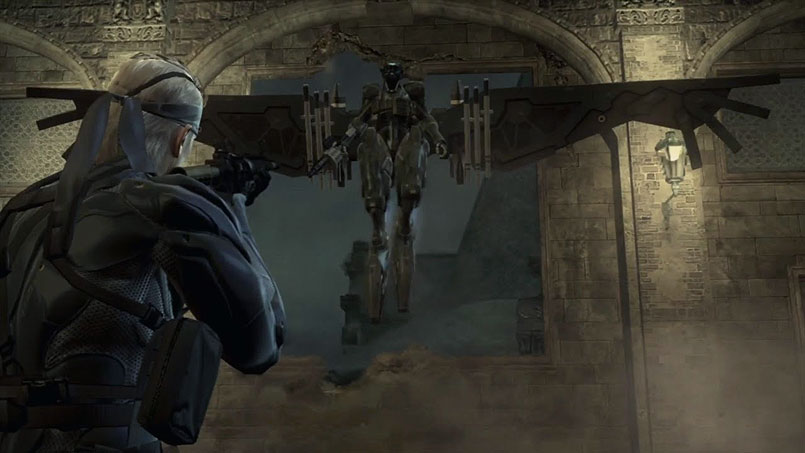
Calling it a movie with gameplay overlooks how often those two halves inform each other. The war economy is not merely described in dialogue; Snake scavenges the very weapons that sustain it. His failing body is not only a plot device; stress and exhaustion can interfere with his performance. When these ideas connect, the campaign feels unusually personal for a game full of mechanized soldiers and extravagant boss fights. When they do not, the long explanations and abrupt changes in pace are hard to ignore.
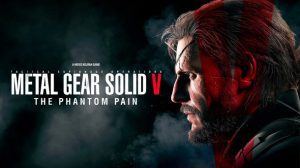
For a more open-ended approach to camouflage, CQC and tactical weapons, Metal Gear Solid V: The Phantom Pain develops the infiltration sandbox much further. Metal Gear Solid 4 is more tightly directed, and that difference matters. Even Hitman World of Assassination, with its disguises and patient study of patrols, gives players more room to experiment within a single location. MGS4 gives its systems a stronger narrative destination, but less uninterrupted space to explore them.
A War Story That Feels Expensive, Strange, and Personal
War in Metal Gear Solid 4 has become a managed industry. Private armies fight proxy conflicts while nanomachines monitor soldiers, ID-locked firearms restrict who can use a weapon, and combat itself creates demand for more equipment. It is a deliberately exaggerated vision, but the underlying idea is unsettling: when enough people profit from a conflict, ending it threatens the system built around it.
Snake, now called Old Snake, is an awkward fit for that world. He is still capable of extraordinary things, but his accelerated aging gives familiar actions a different weight. The series once presented him as someone who could survive almost anything through experience and stubbornness. Here, those qualities are not enough to stop his body from failing. Otacon remains the steady voice beside him, while Liquid Ocelot and the Patriots’ machinery of control give the mission its urgency.
The writing rarely trusts a quiet implication when it can deliver a lengthy explanation. Returning characters such as Raiden, Meryl and Naomi carry substantial history, and the game frequently stops to untangle it. For players familiar with the earlier titles, these reunions can make even an ordinary conversation feel consequential. For newcomers, the same scenes may seem to demand several games’ worth of emotional investment in advance. The story’s sincerity is convincing; its discipline is less consistent.
Stealth Gameplay Built Around Battlefield Awareness
The early acts are distinctive because Snake is not always the center of the fighting. In the Middle East, militia and PMC troops exchange fire across ruined streets whether or not he interferes. South America develops a similar tension in different terrain, with vegetation, patrols and local forces complicating the route. Instead of treating every guard as an isolated puzzle, the player must first understand who is fighting whom and where attention is directed.
A useful decision may be to help militia suppress a PMC position, slip behind the soldiers while they are distracted, or avoid the conflict entirely. Snake can crawl under broken cover, wait for a patrol to separate, or take a calculated risk with a silenced weapon. The game seldom marks a single correct path. The satisfaction comes from reading a busy space well enough to cross it without becoming its next crisis.
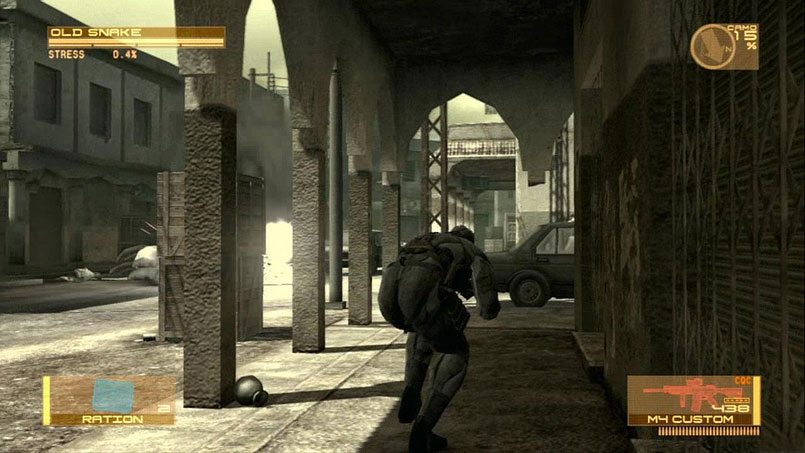
OctoCamo makes that attention to surroundings more tactile. Press Snake against concrete, dirt or metal and his suit adopts the surface’s appearance. The mechanic encourages looking for concealment in textures that other games would leave as decoration. A stretch of broken pavement or an unremarkable wall can become part of a route; lying still at the right moment can matter more than a perfect headshot.
There is a limit to this freedom, though. When a firefight is crowded with enemies and reinforcements, engaging with the situation can be less dependable than creeping around its outer edge. Some players will find the most reliable solution is simply to crawl past the interesting systems the game has assembled. At the opposite extreme, Drebin’s convenient supply of ammunition makes fighting through an area viable. MGS4 offers tactical options, but its encounter design does not always give those options equal reasons to be used.
The European act changes the rules again. Following a resistance operative through patrolled streets can initially feel like a rigid tailing mission, especially after the open battlefields. Yet the operative’s movements and interactions leave some room for repositioning and anticipating the next crossing rather than staying directly behind him. More intriguingly, a civilian trench coat paired with an alternate FaceCamo lets Snake blend in among ordinary people, provided he keeps his weapons out of sight and behaves inconspicuously. It is social stealth rather than OctoCamo’s physical concealment. The sequence remains tightly controlled, but it rewards a different kind of observation.
Weapons, Gadgets, and Tactical Freedom
Drebin’s weapons service gives Snake an arsenal that earlier games rarely placed at his fingertips. Battlefield firearms are ID-locked, so he must have them unlocked before use. Duplicate finds become Drebin Points, which can be spent on ammunition, new weapons and attachments. The system makes a practical connection between the story’s war economy and the player’s behavior: every scavenged rifle has value even when it is not the one Snake intends to carry.
There are meaningful choices within that abundance. Suppressors, tranquilizer rounds and CQC support a careful, non-lethal route; assault rifles, shotguns, explosives and heavier weapons make a noisy recovery possible when stealth collapses. A scope or another attachment can change where a particular gun is useful, rather than simply increasing a number on a menu. On less demanding runs, however, readily available supplies can soften the consequences of making mistakes. Stealth remains satisfying, but it is not always necessary to succeed.
The gadgets are better when they change how an encounter is understood. The Solid Eye provides night vision and battlefield information, helping Snake distinguish a hidden threat from environmental clutter. The Metal Gear Mk. II can scout ahead and interact with objects remotely. Close-quarters combat gives him an answer when an enemy gets too close for careful aiming. These tools make a quiet approach feel considered rather than passive, even if some areas are too short to explore every possibility.
That slower, equipment-led approach has a close relative in Tom Clancy’s Splinter Cell: Chaos Theory, which places more sustained emphasis on light, sound and discreet infiltration. Watch Dogs 2 approaches the idea from another direction, using cameras, drones and remote interference to create openings. Both help clarify MGS4’s particular strength: its gadgets are embedded in a battlefield with its own moving priorities, rather than existing solely to solve a room.
The Beauty and the Beast Unit Makes Every Boss Fight Feel Unsettling
The Beauty and the Beast Unit gives the campaign some of its most distinctive encounters. Laughing Octopus, Raging Raven, Crying Wolf and Screaming Mantis are powerful enemies shaped by trauma and military technology, but the battles are memorable for how differently they ask Snake to respond.
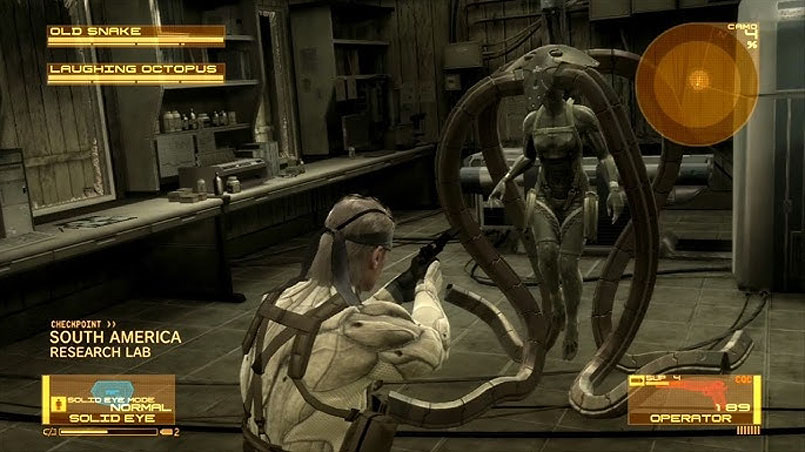
Laughing Octopus turns an enclosed space into a guessing game, disguising herself and hiding among objects that seemed harmless moments before. The fight rewards checking movement and reading the room instead of relying on firepower. Raging Raven pushes in the opposite direction, using aerial attacks and vertical space to force constant repositioning. Crying Wolf makes distance and visibility central to a tense hunt through snow, while Screaming Mantis embraces the series’ stranger traditions of psychological tricks and fourth-wall play.
Their names and theatrical identities echo FOXHOUND from the original game, but they are not merely a new set of familiar villains. The aftermath of each battle tries to expose the human suffering beneath the spectacle. That approach can be effective and uncomfortable at once. Some revelations are delivered so explicitly that they leave little room for interpretation, and the movement between trauma, stylized combat and sexualized presentation can be jarring. Still, these encounters have ideas beyond reducing an enemy’s health bar.
Shadow Moses and the Power of Nostalgia Done Right
The return to Shadow Moses is one of the campaign’s strongest narrative decisions. Its familiar helipad and corridors are quieter and more desolate than memory suggests. The base has aged along with Snake, and revisiting it allows the game to convey that change through spaces rather than speeches. Recognizing a doorway before anyone explains where it leads is a different pleasure from discovering somewhere new.
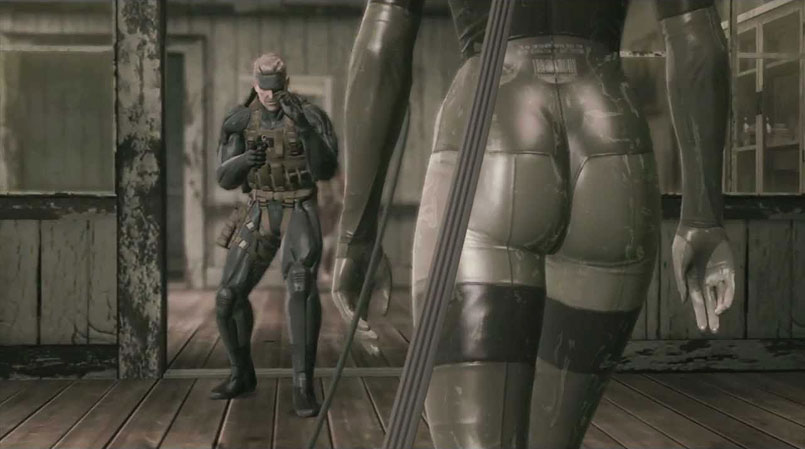
A brief playable sequence recreating the look and camera of the original MGS1 makes that distance almost physical. The older presentation returns for a moment before the game brings Snake back to the abandoned facility. It is fan service with a purpose: the location once represented the height of his abilities, whereas returning to it exposes how much has changed.
The gameplay trade-off deserves attention too. Shadow Moses is populated largely by Gekko and smaller robotic sentries rather than the human patrols that gave the opening acts their versatility. A machine cannot be interrogated, held up or fooled by a civilian disguise in the same way. The shift supports the atmosphere of an emptied military installation, but it also sidelines parts of the stealth toolkit just as players may have grown comfortable experimenting with them. Emotionally, the chapter looks backward beautifully; mechanically, it offers a narrower type of infiltration.
Progression, Replayability, and Player Choice
MGS4 does not have a conventional skill tree. Progression comes from acquiring equipment, learning patrol behavior and discovering what its tools can do under different conditions. Drebin Points keep recovered weapons useful and make customized loadouts easier to build across repeat runs. Yet the economy has an odd ceiling: players who deliberately collect or farm large amounts of currency can eventually purchase almost everything they want. At that point, more points stop creating interesting decisions. The pleasure shifts from shopping to making better use of the equipment already owned.
That is where the emblem challenges, different difficulty settings and non-lethal or no-alert goals become important. An ordinary run may allow a missed shot to become a firefight. A more restrictive run turns that same mistake into a reason to rethink the entire route. The strongest replay value comes from understanding the rules well enough to impose more demanding ones, not from an endless stream of new content.
Snake’s Stress and Psyche gauges add a smaller, easily overlooked layer. Sustained strain, including extended exertion in demanding environments, can lower Psyche and make aiming less steady before the next enemy appears. Taking cover or resting inside a cardboard box or drum can help him recover. Even familiar comic props have a practical role here. Cigarettes can calm Snake at a health cost, while certain tracks on his iPod provide effects such as steadier aim or stronger non-lethal stun. The music player is not purely a collectible jukebox, and the choice between calming down, staying hidden and pressing forward contributes to the sense of managing a vulnerable person rather than an invincible operative.
Series fans also have plenty of less obvious reasons to revisit the campaign: codec conversations, hidden items, alternate boss approaches, small environmental interactions and references that become clearer once the larger story is understood. Those details are rewarding, although the unavoidable commitment to long cinematic stretches can make a fresh run less appealing to someone who mainly wants to revisit the stealth.
Its Excess Is Part of Its Identity
Metal Gear Solid 4 can move from a convincing observation about manufactured warfare to a prolonged explanation or an absurd visual gag with very little warning. It sometimes feels as though every supporting character needs closure and every unanswered question needs a speech. The result is uneven, not simply because the cutscenes are long, but because they repeatedly interrupt a stealth system that is genuinely worth spending more time with.
Yet reducing all that excess would also change what the game is trying to accomplish. Kojima connects aging, loyalty, technology and the treatment of soldiers as replaceable tools with an unusually direct emotional commitment. Some scenes push too hard, and not every twist is persuasive. Others work precisely because the game refuses to treat Snake’s final mission as just another operation.
Players interested in another character-driven science-fiction adventure shaped by advanced technology may also appreciate PRAGMATA. Its partnership between Hugh and Diana connects real-time hacking and combat to questions of survival and identity. The structure is different, but it offers another example of technology shaping both action and character relationships.
Final Verdict
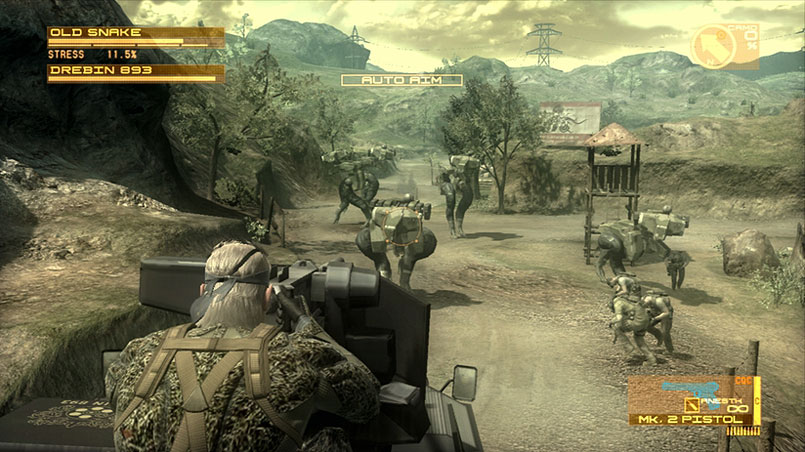
Metal Gear Solid 4: Guns of the Patriots is at its best when its mechanics make the story’s ideas tangible. Battlefield conflicts reward observation, OctoCamo changes how ordinary surfaces are read, and Drebin’s weapon economy places Snake inside the system he is trying to confront. The bosses and return to Shadow Moses give the journey an emotional character that a more open-ended stealth game might not achieve.
Its limitations are just as distinctive. Later chapters reduce some of the freedom established early on, generous equipment access can drain tension from failed infiltrations, and the storytelling demands a remarkable amount of patience. Players seeking sustained stealth experimentation may prefer a less directed game. For those invested in Metal Gear’s characters and willing to accept its uneven rhythm, though, this is a fittingly strange and moving conclusion. Old Snake is still capable of extraordinary things, but what makes his final mission memorable is how much those things now cost him.
Metal Gear Solid 4: Guns of the Patriots Pros & Cons
- Pro: Emotionally ambitious conclusion to Solid Snake’s main storyline and many long-running series relationships
- Pro: Flexible stealth built around OctoCamo, Solid Eye, CQC, non-lethal equipment, battlefield factions, and a large customizable arsenal
- Pro: Active war zones create a distinctive rhythm where Snake can avoid, manipulate, or assist forces already fighting one another
- Pro: Beauty and the Beast encounters, Shadow Moses, music, cinematography, and environmental callbacks create unforgettable moments
- Pro: Emblems, difficulty levels, non-lethal runs, hidden interactions, equipment choices, and efficient routes reward replays
- Con: Extremely long cutscenes and dense continuity make it difficult for players unfamiliar with earlier Metal Gear games
- Con: The five-act structure becomes more linear and cinematic after its strongest battlefield-driven opening chapters
- Con: Some explanations, fan-service callbacks, and character resolutions feel excessive or awkward even by Metal Gear standards
- Con: Original Metal Gear Online is absent from the Master Collection Version
Metal Gear Solid 4: Guns of the Patriots PC System Requirements
OFFICIAL WINDOWS PC REQUIREMENTS:
MINIMUM:
OS: Windows 11, 64-bit
CPU: Intel Core i5-9600K
RAM: 16 GB
GPU: NVIDIA GeForce GTX 1650
DirectX: Version 12
Storage: 25 GB available space for standalone MGS4
Drive: SSD recommended
Additional: 64-bit processor and operating system required
RECOMMENDED:
OS: Windows 11, 64-bit
CPU: Intel Core i5-10500
RAM: 16 GB
GPU: NVIDIA GeForce GTX 970
DirectX: Version 12
Storage: 25 GB available space for standalone MGS4
Drive: SSD required
Additional: 64-bit processor and operating system required
Additional PC Setup and Performance Notes
- Konami’s platform table lists PC output and internal rendering up to 3840×2160, with a maximum frame rate of 60 fps.
- The standalone Steam page lists 25 GB. Steam lists 34 GB for the full Master Collection Vol. 2 package, which also includes Peace Walker and collection bonus content. Leave extra space for downloads and updates.
- The unusual recommended GTX 970 is older but generally faster than the minimum GTX 1650. The rows above reproduce Konami’s listed specifications rather than a simple newer-versus-older GPU progression.
- Windows 11 64-bit is the only officially listed operating system. Windows 10 may work for some players, but it is outside the published specification.
- Valve has rated the standalone MGS4 Steam release Verified for Steam Deck. This rating is distinct from Konami’s desktop hardware requirements and does not promise an identical frame rate or maximum display resolution.
- Konami’s table confirms common 16:9 resolutions up to 4K but does not advertise native 21:9 ultrawide support. Check the in-game options and active Steam Discussions for display-specific reports.
- A controller is the natural choice because MGS4 was designed around gamepad input. If using keyboard and mouse, test movement, aiming, menus, and button prompts before committing to a long session.
- There is no official Steam Workshop or mod toolkit. Unofficial ultrawide, field-of-view and frame-rate modifications have been discussed on Steam; treat them as unsupported, check compatibility with the installed build, and back up files before making changes.
Official Trailer
Note: Konami’s official Master Collection Vol. 2 overview trailer presents MGS4, Peace Walker, Ghost Babel, the Database, digital books, soundtrack, and the collection’s place in the wider Metal Gear saga.
Frequently Asked Questions
Which Metal Gear Solid 4 PC edition should I buy?
Standalone MGS4 includes Old Snake’s single-player campaign, the Database, Screenplay Book, and Master Book. Choose Master Collection Vol. 2 if you also want Peace Walker HD, Metal Gear: Ghost Babel, and Digital Soundtrack Vol. 2; Ghost Babel and the soundtrack are not in the standalone MGS4 purchase.
Can I still unlock the Master Collection Vol. 1 save-data bonus?
Yes. Qualifying Master Collection Vol. 1 save data under the same account and on the same system unlocks Gold Camouflage in MGS4 and a Gold uniform in Peace Walker. Konami states that creating qualifying Vol. 1 save data after beginning Vol. 2 can still count; these rewards are separate from the original preorder-only Cardboard Camouflage and LOVE BOX items.
Does Metal Gear Solid 4 include the original Metal Gear Online?
No. MGS4’s Master Collection Version is single-player only. Peace Walker, available separately or in Vol. 2, has its own online multiplayer for up to six players, without cross-platform play.
Does MGS4 work on Steam Deck?
Yes. Valve rates the standalone Master Collection Version Verified for Steam Deck. That classification does not mean handheld performance always matches the 4K/60 fps maximum listed for the Windows release.
Is Windows 11 required for the native PC version?
Windows 11 64-bit is the only operating system in Steam’s official minimum and recommended requirements. Windows 10 is not an officially listed configuration.
Can MGS4 be played with a controller or keyboard and mouse?
Yes, the Steam version offers controller support and PC input options. A controller is a natural starting point for a game originally designed around the PS3; keyboard-and-mouse players should check the controls and bindings to find a comfortable setup.
Does the PC version support ultrawide displays or more than 60 fps?
Konami lists up to 3840×2160 rendering/output and a maximum 60 fps. Native 21:9 ultrawide and higher frame rates are not part of those officially advertised limits; unofficial modifications are build-dependent and are not guaranteed to work.
Which games should I play before Metal Gear Solid 4?
The clearest story preparation is Metal Gear Solid, Metal Gear Solid 2: Sons of Liberty, and Metal Gear Solid 3: Snake Eater before MGS4. You can start directly with Old Snake’s mission, but many returning characters and emotional resolutions depend on those earlier stories; the included Database can help with the background.
Is Metal Gear Solid 4 an open-world game?
No. The campaign is divided into five acts, moving from relatively open battlefields to more directed stealth, tracking, boss encounters, and cinematic sequences. It is not a continuous open world like Metal Gear Solid V.
How long is Metal Gear Solid 4?
A story-focused first playthrough commonly takes around 15–20 hours, especially when watching the lengthy cutscenes. Higher difficulties, collectibles, no-alert runs, and emblem challenges can add substantial replay time.
Why are the cutscenes so long?
MGS4 uses extended cinematics and conversations to resolve storylines established across earlier Metal Gear games. Those sections are a central part of the campaign, so players seeking almost uninterrupted stealth action should expect frequent narrative pauses.
Can MGS4 be completed without killing enemies?
The campaign supports non-lethal strategies using tranquilizers, CQC, stealth, and carefully chosen boss approaches. A strict no-kill run requires planning around scripted encounters and places where equipment or combat options are restricted.
What is the Big Boss emblem?
The Big Boss emblem is a difficult completion ranking built around strict limits on alerts, kills, continues, healing, and completion time. It rewards players who have already learned routes and enemy behavior rather than those simply finishing the story once.
Still have questions? Visit the Metal Gear Solid Reddit community, the MGS4 Steam Discussions, or Konami’s Master Collection Vol. 2 page.
Sources & References
Key factual and technical information in this guide was checked against relevant official and independent sources, including:
- Steam — MGS4 Master Collection Version — Windows release, standalone contents, system requirements, Steam Deck rating, and overall user reception.
- Steam — Master Collection Vol. 2 — collection inclusions, storage requirement, and save-data rewards.
- Konami — Master Collection Vol. 2 product information — supported platforms, playable titles, digital companion content, and Peace Walker online support.
- Konami — Master Collection Vol. 2 edition announcement — standalone purchasing, original release context, and former preorder bonuses.
- Metacritic — original Metal Gear Solid 4 — historical 94/100 PlayStation 3 critic score; not a score for the PC port.
- Metacritic — Master Collection Version — separate port listing and lack of a corresponding critic Metascore.
Similar Games Like Metal Gear Solid 4: Guns of the Patriots
- Metal Gear Solid 2: Sons of Liberty
- Metal Gear Solid
- Metal Gear Solid V: The Phantom Pain
- Hitman World of Assassination
- Tom Clancy’s Splinter Cell: Chaos Theory
- 007 First Light



Found something worth playing through DecideGame?
DecideGame.com is an independent gaming project run by Editor Zero. If this guide helped you discover a game, solve a problem, or find useful information, you can support DecideGame.com and help keep new and updated game guides coming.
DecideGame — PC Game Guides, Reviews & Setup Help