
📅 Game released: 2002
The Elder Scrolls III: Morrowind is an open-world fantasy RPG where a released prisoner explores Vvardenfell, navigates rival factions, and shapes a character through skills, magic, and discovery. This PC guide compares official Game of the Year Edition download options, explains Tribunal and Bloodmoon, and covers OpenMW installation, mods, controller support, system requirements, and Steam Deck setup.
 By Editor Zero — independently researched, edited, and maintained.
Last updated: 9 November 2026
Last reviewed: 9 November 2026
Table of Contents
- Quick Facts
- Official PC Stores, Download & Installation
- Morrowind Review
- Pros & Cons
- PC System Requirements
- Frequently Asked Questions
- Similar Games
The Elder Scrolls III: Morrowind Quick Facts
- Game: The Elder Scrolls III: Morrowind / Game of the Year Edition (GOTY)
- Developer: Bethesda Game Studios
- Publisher: Bethesda Softworks
- Genre: RPG, Open World, Fantasy
- Release: May 1, 2002 (original Windows PC release); GOTY Edition: 2003
- Platforms: Windows PC, Xbox (original releases)
- Expansions: Tribunal (Mournhold and Clockwork City) and Bloodmoon (Solstheim), both included with GOTY
- Game Pass: PC edition offered through eligible PC Game Pass plans; availability and plan entitlements can change
- DRM-free option: GOG GOTY includes optional offline installers
- Steam Deck: Playable (Valve rating); controller layout or text entry may require adjustment
- Engine: NetImmerse-based Bethesda engine (original); OpenMW is an alternative open-source engine
- Controller support: Original Windows engine has no native modern gamepad support; OpenMW supports controller navigation, and Steam Input can map keyboard/mouse controls
- Modes: Single-player; no official Bethesda co-op or multiplayer
- Community: Steam Discussions, r/Morrowind, OpenMW Forums
- PC modding: Nexus Mods, Tamriel Rebuilt, and engine-specific tools; check compatibility before mixing original-engine and OpenMW mods
- Metacritic score: 89/100 (original PC release)
- IGN score: 9.4/10 (original PC review)
- Steam user reception: Overwhelmingly Positive overall
Official PC Stores, Download & Installation
👇 Compare the official Steam, Epic Games Store, GOG, and Microsoft/Xbox purchase and download options for Morrowind GOTY before installing the original game or OpenMW.
- Official PC editions: Steam, Epic Games Store, GOG, and Microsoft/Xbox sell the Game of the Year Edition; this includes Morrowind plus both expansions, Tribunal and Bloodmoon.
- What the expansions add: Tribunal continues the Nerevarine story in Mournhold and the Clockwork City. Bloodmoon adds Solstheim, the Raven Rock colony, and werewolf gameplay.
- Steam: Provides the complete GOTY package, Steam Cloud, Family Sharing, and community controller layouts. The original Construction Set is not bundled.
- Epic Games Store: Sells the complete GOTY edition with cloud saves. Its listing explicitly excludes the original Construction Set.
- GOG: Provides DRM-free, offline installers without mandatory GOG Galaxy activation. Its Preservation Program listing is verified for Windows 10/11.
- Microsoft/Xbox Store and Game Pass: A separate Windows PC product is sold through Xbox and is shown in Game Pass listings; confirm eligibility and the relevant subscription plan before installing.
- Separate licences: Buying from one storefront does not automatically grant access on the others. Installation folders, cloud saves, and file-management permissions can differ.
- Original engine or OpenMW: Use the original
Morrowind.exewhen a mod needs MWSE, MGE XE, or the Morrowind Code Patch; choose OpenMW for an independently maintained engine with modern display and controller features. - OpenMW installation: First install an authorized copy of Morrowind GOTY. Run the OpenMW Installation Wizard, select the existing installation containing
Morrowind.esm, import settings, and enable the expansion master files in the correct order. - Xbox app file access: For a Microsoft Store or Game Pass installation, the Xbox app may require its advanced installation-management option before OpenMW can access the game files; the OpenMW installation guide explains this route.
- Mod compatibility: Many conventional ESP/ESM and asset mods can work under OpenMW, but MWSE, MGE XE, and the Morrowind Code Patch modify the original engine and do not work in OpenMW. Pick an engine before following a large mod list.
- OpenMW release choice: Use the latest stable version for a normal installation. Release-candidate and development builds are less tested; back up saves before major engine updates.
 Buy Morrowind Game of the Year Edition on Steam
 Buy Morrowind Game of the Year Edition on Epic Games Store
 Buy Morrowind Game of the Year Edition on GOG
 Buy or Play Morrowind GOTY Edition on Microsoft / Xbox Store
 Download the Official OpenMW Engine

The Elder Scrolls III: Morrowind Review
An uncompromising fantasy RPG whose alien culture and systemic freedom reward knowledge more than reflexes.
The Elder Scrolls III: Morrowind begins with a prisoner stepping onto a damp dock in Seyda Neen and receiving little more than release papers, a package, and directions to Balmora. There is no dramatic battle to prove the character is special, no urgent tutorial funnel, and no guarantee that the first cave entered contains an enemy suitable for a new build. Vvardenfell does not reorganize itself around the player’s arrival. It expects the newcomer to learn which weapon they can actually use, why exhaustion makes simple actions fail, how local transport works, and which parts of the island are better left for later.
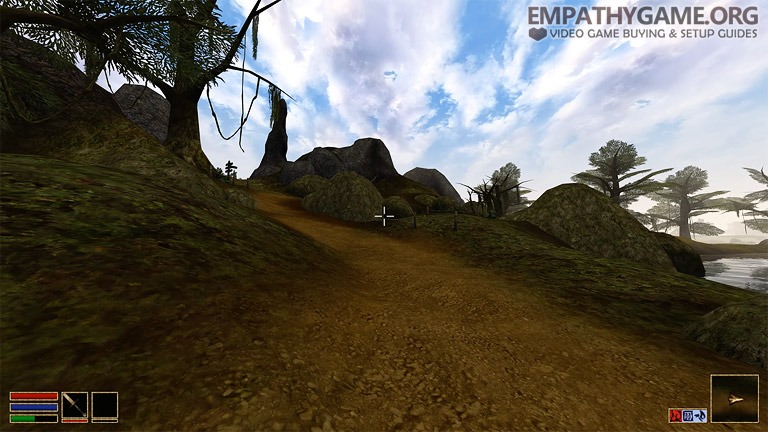
That hostility creates one of the most rewarding transformations in an RPG. Early movement is slow, attacks miss, spells fail, money is scarce, and unfamiliar roads disappear into ash or swamp. Hours later, the same character may cross mountains by levitation, teleport between personal routes, carry enchanted jewelry for emergencies, and manipulate faction politics with knowledge that once seemed impenetrable. The combat never becomes elegant, and the interface remains dense. In exchange, Morrowind provides a world whose cultures, laws, geography, religion, economy, and magic feel connected. Its greatest pleasure is not simply becoming stronger. It is realizing that Vvardenfell has become understandable.
The First Hours Punish a Build That Has No Plan
Character creation quietly determines whether the opening feels demanding or almost dysfunctional. Race, specialization, favored attributes, birthsign, and the ten Major and Minor skills establish what can be attempted reliably. A character with Long Blade as a Major skill may handle an iron longsword reasonably well, while a mage or thief with almost no Long Blade experience can swing the same weapon through an enemy’s model and repeatedly fail the underlying hit roll. The animation shows contact; the character sheet decides whether it mattered.
This is difficult to read without understanding the rules. Weapon skill is the dominant factor, but Agility, Luck, fatigue, attack bonuses, and the target’s ability to evade also contribute. Running from Seyda Neen to a nearby tomb or smugglers’ cave can empty the fatigue bar before the first attack. The player sees a green bar associated with movement, not an obvious warning that accuracy, spellcasting, persuasion, lockpicking, and other actions are about to become less dependable.
A nearby spellcaster can therefore become an early wall rather than routine cave fodder. Retreating, healing, buying a better weapon, or returning after training is often the correct response. Morrowind’s partial level scaling allows dangerous enemies and valuable treasures to exist without waiting for the character to be ready. This creates genuine risk, although it also means a beginner can enter a location with no useful way to judge its difficulty before combat begins.
The complete edition adds another poorly judged spike. On the original PC Game of the Year setup, resting very early can trigger a Dark Brotherhood assassin connected to Tribunal. A character who fled a cave with little health may attempt to sleep and instead wake beside a fast attacker wearing valuable armor. Surviving that encounter can require several minutes of missed swings, retreating, healing, and exploiting space. The equipment becomes an enormous early reward if the assassin falls, but the encounter feels like late-game expansion content intruding on the opening rather than natural progression.
This growth from vulnerable outsider to capable adventurer resembles Gothic 1 Remake, but Morrowind explains its rules less clearly. A poor build can resemble broken combat rather than an inexperienced character using the wrong tools.
Combat Is Statistically Coherent but Visually Unsatisfying
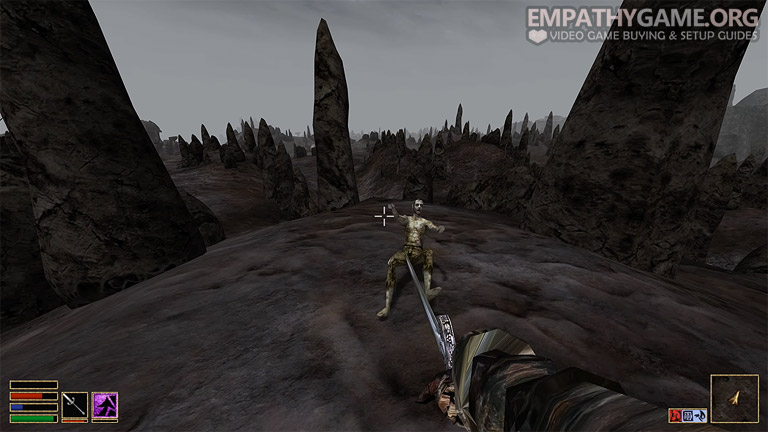
Morrowind’s melee system is easier to respect than to enjoy. Underneath the stiff animations, it behaves consistently: use a weapon supported by a high skill, preserve fatigue, improve Agility, maintain equipment, and hold an attack long enough to deliver meaningful damage. Different weapons favor chopping, slashing, or thrusting, and a spear’s reach can keep a creature outside the safest range for a shorter blade. Once the character’s numbers support the chosen style, attacks connect regularly and enemies that once seemed impossible become manageable.
The weakness is feedback. A modern action game communicates a miss through distance, timing, collision, or a visible defense. Morrowind often shows the weapon crossing the target while playing a miss sound. The result expresses traditional RPG dice rolls through first-person action animation, creating a contradiction the game never resolves. Higher skill reduces the frustration but does not make the swordplay physically convincing.
Fatigue is the most useful practical lesson. Arriving at a fight with an empty bar reduces the reliability of nearly every important action, so sprinting directly into danger is a poor habit. Pausing outside a tomb, walking the final distance, drinking a Restore Fatigue potion, or opening with a ranged attack can matter more than replacing one ordinary sword with another. It is a subtle rule that experienced characters can eventually overcome through high skills and enchantments, but it defines the early game.
Armor progression contains similar hidden logic. Incoming hits are associated with individual equipment slots, and the armor skill connected to the selected piece receives experience. Wearing a mixed set of heavy and medium armor therefore trains both categories, but each generally advances more slowly than it would in a consistent set. The freedom to combine cuirass, pauldrons, gauntlets, greaves, boots, shield, clothing, and robes creates memorable outfits and useful enchantment space, yet the mechanical cost is easy to miss because the interface does not explain how incoming blows distribute that training.
Magic Is Strongest When It Solves Problems Rather Than Deals Damage
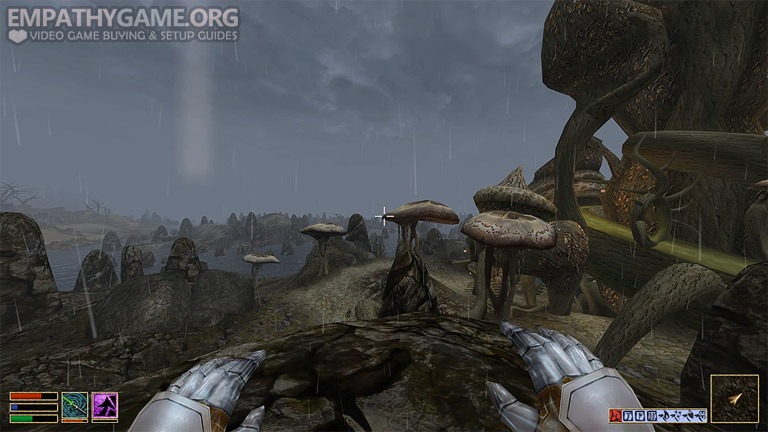
Magic demonstrates Morrowind’s systemic freedom more convincingly than melee combat. A new mage who attempts to behave like an unlimited artillery platform will quickly run dry. Magicka does not normally regenerate in real time, and expensive Destruction spells combine a large resource cost with a meaningful chance of failure when the relevant skill, Willpower, Luck, or fatigue is low. Repeated fireballs demand Restore Magicka potions, resting, absorption, or enchanted items capable of carrying some of the offensive burden.
The system becomes extraordinary when magic is treated as infrastructure. Levitation bypasses walls, reaches hidden ledges, and is required to navigate Telvanni towers whose architecture assumes that important residents can fly. Water Walking turns coastlines into roads. Open replaces lockpicks, Chameleon changes stealth, Resist Magicka protects against hostile effects, and a short Fortify Attribute spell can make another action more reliable at exactly the right moment.
Mark and Recall allow one personal teleport destination. Marking a favored merchant, storage room, remote quest site, or home turns Recall into a route designed by the player. Divine Intervention and Almsivi Intervention then connect wilderness exploration to Imperial shrines and Tribunal temples, often placing the character near boats, silt striders, or Mages Guild transport. Travel ceases to be a collection of separate spells and becomes a network assembled through local knowledge.
Spellmaking adjusts magnitude, duration, range, area, and combined effects, allowing cheap utility spells or solutions no merchant sells. Enchanting moves repeated abilities onto weapons, clothing, and jewelry, while alchemy supplies healing, fatigue restoration, resistances, and Magicka recovery. All three systems can destabilize the economy and balance once their interactions are understood. Morrowind prefers permitting discovery to protecting every encounter from player invention.
Vvardenfell Feels Designed by Its Cultures, Not for Tourists
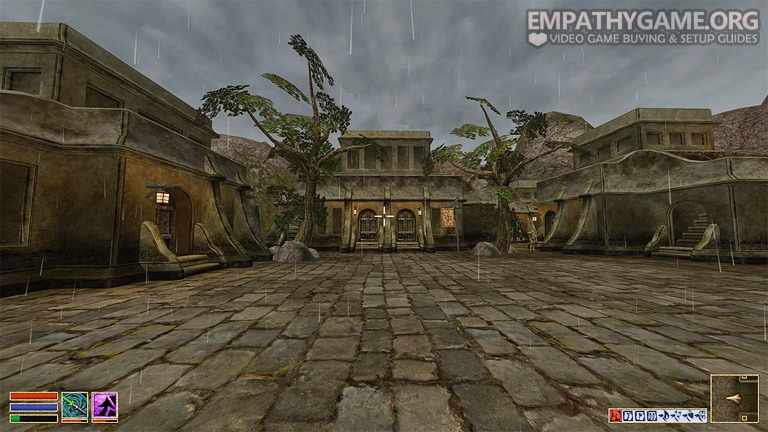
The setting remains Morrowind’s greatest achievement because visual strangeness is supported by cultural and economic logic. Giant mushrooms and insect transport are memorable, but the island feels coherent because settlements, resources, religions, and political groups explain why they exist where they do. Kwama egg mines support nearby communities. Saltrice and marshmerrow plantations rely on enslaved labor. Ebony and raw glass draw wealth and danger toward the volcanic interior. Imperial forts protect colonial interests while Tribunal temples, ancestral tombs, and Ashlander camps express older relationships with the land.
The Great Houses are visible in architecture before their values are explained. Hlaalu towns favor practical trade and Imperial accommodation. Redoran settlements resemble enormous shells and emphasize duty, martial honor, and defense. Telvanni towers grow as organic structures that are deliberately inaccessible to anyone unable to levitate, a perfect physical expression of aristocratic mages who consider ordinary convenience beneath them.
Geography reinforces those identities. Balmora functions as an efficient Hlaalu trade center, Ald’ruhn looks inward toward Redoran tradition, Vivec’s monumental cantons communicate religious authority, and Sadrith Mora primarily serves the powerful wizards who control it. Workers, miners, priests, slaves, and guards suggest systems continuing beyond the current quest, making the island feel larger than its playable dimensions.
The Morag Tong Reveals How Culture Changes Moral Judgment
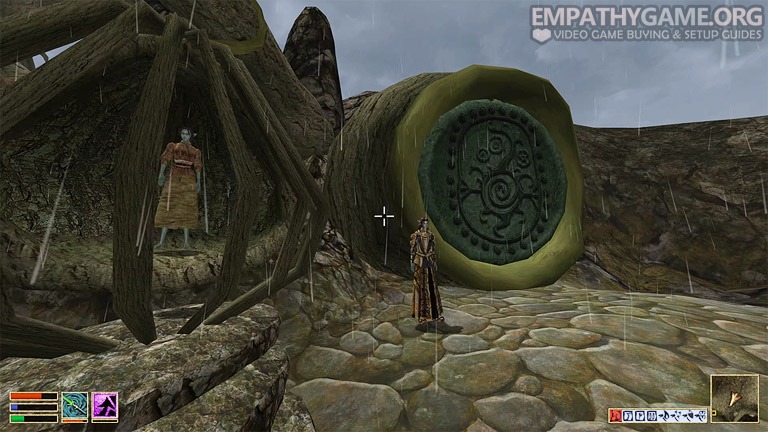
Morrowind’s factions are not merely themed quest lists. Their rules expose competing ideas about law, religion, class, and legitimate violence. The Morag Tong is the clearest example: a Mephala-worshiping organization of assassins whose sanctioned executions are embedded within Dunmer politics. A formal writ can authorize a killing and clear the resulting legal consequences when presented to the authorities.
Mechanically, this turns assassination into a procedure rather than automatic criminality. The target may still resist, witnesses may complicate the act, and unrelated casualties remain crimes, but the central murder is recognized as lawful tradition. The distinction between the Morag Tong and an outlawed murderer is created by institutions, not by a claim that the act itself is harmless.
The arrangement becomes convincing because Dunmer society treats controlled assassination as one way of limiting conflict among powerful Houses. The Empire offers another legal order while benefiting from colonial power and Vvardenfell’s resources. The Tribunal Temple, Ashlanders, Imperial institutions, and mutually exclusive Great Houses similarly ask the character to inhabit a social position rather than unlock parallel reward tracks.
The Main Quest Treats History as an Argument
Caius Cosades initially assigns work that resembles colonial intelligence gathering. The prisoner interviews informants, studies the Nerevarine cult, investigates the Sixth House, and reports what different groups believe. The low-key structure allows the main story to emerge through research rather than presenting Dagoth Ur immediately as a conventional villain waiting at the end of a heroic path.
That patience pays off because almost every central claim is disputed. The Tribunal, Ashlanders, Imperial authorities, dissident priests, surviving witnesses, and ancient texts offer incompatible versions of Indoril Nerevar’s death, the disappearance of the Dwemer, and the legitimacy of the living gods. The player is not simply told the setting’s history; they encounter institutions built around different interpretations of it.
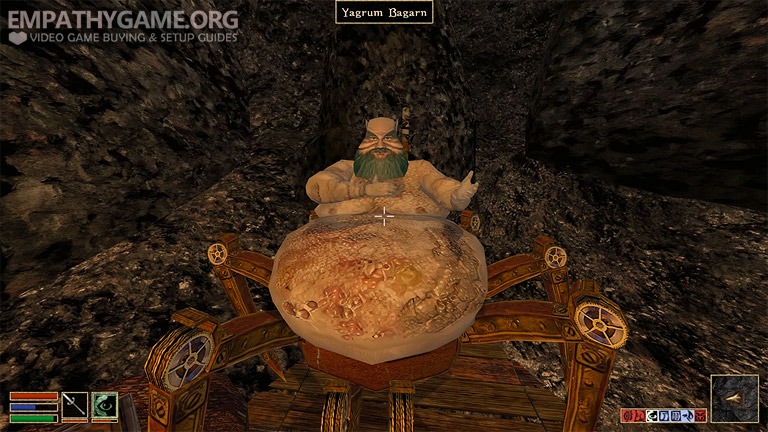
Dagoth Ur belongs to that history. His threat is tied to Red Mountain, the Sixth House, the Tribunal, and the same events that created the prophecy surrounding the protagonist. He is more compelling as a voice from Vvardenfell’s unresolved past than as a sequence of boss encounters. Vivec, Divayth Fyr, Yagrum Bagarn, and the failed Incarnates deepen the central mystery because each knows only part of what happened or has a reason to shape the account.
The cost is presentation. Text topics and repeated responses can make NPCs feel like terminals connected to a shared database, while important ideas disappear beneath rumors and exposition. It is possible to explore for hundreds of hours while barely engaging with books, magic, or the political background. That freedom is impressive, but the game does little to separate essential context from optional encyclopedia material.
Navigation Makes Attention a Character Skill
Quest directions commonly describe roads, junctions, hills, ruins, bridges, foyadas, and nearby landmarks rather than placing an icon on the destination. The player must translate language into movement. A route may involve leaving Balmora by a particular gate, following signs toward another town, turning at a bridge, and searching for a tomb on one side of the road.
Finding the Dwemer Puzzle Box in Arkngthand is a famous early test because reaching the ruin is only the first problem. Inside, industrial chambers, ramps, doors, and vertical spaces must be read without a marker identifying the small object. The box is not hidden at the deepest possible point, which punishes the assumption that every dungeon objective must sit at the end of a linear path.
Directions are not always fair. Some are vague, awkwardly translated into the landscape, or simply inaccurate. The journal’s topic-heavy structure can bury the useful sentence beneath later updates. Getting lost is rewarding when the landmark was present and the route can be reconstructed; it becomes wasted time when the description itself is unreliable.
Travel services prevent the island from becoming an endless walking simulator. Silt striders, boats, Mages Guild guides, Intervention spells, Propylon chambers, and Recall connect different networks rather than providing unrestricted map teleportation. Learning which town links to which destination becomes a form of practical knowledge. A remote expedition may end with Almsivi Intervention to the nearest temple, a short walk to a silt strider, and a final Recall to stored equipment.
Kingdom Come: Deliverance creates similar satisfaction from learning roads and landmarks. Morrowind adds magical and commercial transit, letting familiarity with the world replace convenience supplied by the interface.
Progression Rewards Specialization but Invites Exploitation
Skills improve through use, and ten increases among Major and Minor skills make the character eligible to level after resting. Related skill increases determine the attribute multipliers offered at level-up. This creates a temptation to plan advancement around efficient multipliers, delaying useful skill gains or training miscellaneous abilities before taking the next level.
Perfect management is unnecessary. Morrowind’s world is only partly level-scaled, many treasures and enemies are fixed, and a sensibly specialized character eventually becomes powerful despite imperfect attributes. Efficient leveling is most valuable to someone who enjoys optimization for its own sake; treating it as mandatory can turn natural role-playing into bookkeeping.
The larger onboarding problem is that many systems can be ignored without preventing exploration. A character may complete dozens of quests without enchanting, crafting a spell, joining a Great House, studying lore, or understanding the fatigue calculation. That openness lets people create personal adventures, but it also allows major mechanics to remain invisible for an entire first playthrough.
Training and a second character reveal how different the game can feel. An armored spear user, thief, utility mage, alchemist, or enchanted-item specialist solves the same world through different resources. Great House allegiance changes quests and the eventual stronghold, while faction requirements resist effortless promotion through every hierarchy.
Freedom Includes the Right to Break the Story
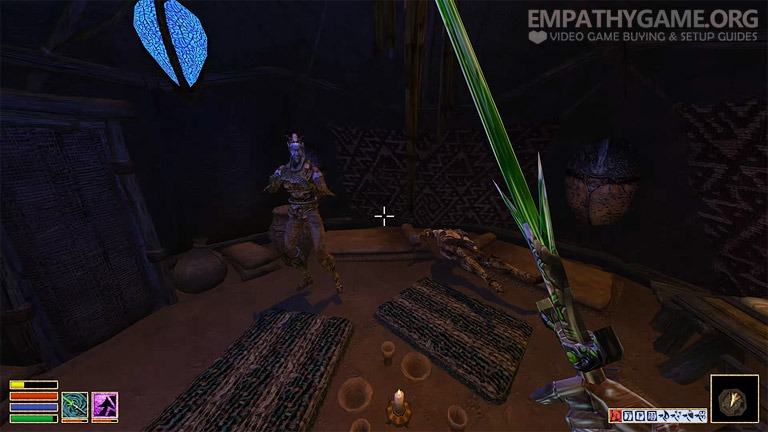
Morrowind does not place universal protection around important NPCs. A shopkeeper, guild leader, quest giver, or person essential to the prophecy can be attacked and killed like almost anyone else. When a critical death breaks the normal main-quest path, the game displays its famous warning that the thread of prophecy has been severed and advises reloading or continuing in the damaged world.
This freedom creates consequences later Elder Scrolls games usually prevent. A player can depopulate a settlement, remove a quest solution, lose a unique object, or damage a faction relationship before understanding its importance. Rotating manual saves are not optional caution; they are part of playing responsibly in a world that does not repair every destructive decision.
The fragility also strengthens role-playing. Characters do not become immortal because a future quest might need them, and doors are not always sealed until the correct objective becomes active. Levitation, high Acrobatics, lock-opening magic, theft, and violence can bypass intended sequences. The world feels persistent because the systems apply beyond carefully isolated mission boundaries.
Replayability Comes From Understanding What Was Missed
A second playthrough is valuable because knowledge changes the opening more dramatically than raw reflex. Choosing skills that support the intended weapon prevents constant misses. Knowing that fatigue affects almost every action changes travel habits. Remembering transport routes shortens journeys, while understanding spellmaking and enchanting makes magic useful long before the character becomes overwhelmingly powerful.
Different Great Houses, faction conflicts, vampire clans, magical specializations, crime, and alternate routes through quests create substantial variation. One character may become a disciplined Redoran warrior and Temple devotee; another can pursue Telvanni power, levitation, and aggressive magical experimentation. The game’s systems are permissive enough that self-imposed identity matters more than collecting every available rank.
The expansions broaden a long campaign but also reveal uneven integration. Tribunal provides concentrated high-level combat and political intrigue, yet its assassin hook can disrupt a new game far too early. Bloodmoon offers a harsher wilderness and different choices on Solstheim, though its enemies are also designed for a developed character. Both are more convincing as later chapters than immediate diversions.
Modding can extend Morrowind almost indefinitely, but its base replayability does not depend on added content. The first journey often leaves entire schools of magic unused, factions untouched, books unread, and regions crossed without understanding their politics. Returning with more knowledge makes the same island feel less opaque without making it less strange.
Final Verdict
The Elder Scrolls III: Morrowind remains extraordinary because Vvardenfell is more than an unusual backdrop. Its mines, plantations, temples, tombs, transport, laws, architecture, factions, and magical practices support cultures that appear to function beyond the player. The Morag Tong’s sanctioned assassinations, the competing accounts of Nerevar, Telvanni towers built for levitation, and the economic pull of Red Mountain all communicate a society with its own internal reasoning.
Reaching that depth demands tolerance for genuine weaknesses. Statistical combat looks worse than it works, fatigue is poorly explained, early movement is slow, text-heavy dialogue obscures important information, and breakable quests make careful saving essential. The Game of the Year content can even ambush an unprepared beginner with an expansion assassin before the main adventure has properly begun. Knowledge eventually destroys much of the balance, but that transformation is also central to the appeal.
Players seeking cinematic storytelling, responsive action combat, or constant objective guidance may find the first hours impossible to enjoy. Those willing to read, specialize, retreat from dangerous encounters, learn transport routes, and experiment with magic will find an RPG that treats understanding as progression. Morrowind does not become welcoming. The player becomes capable of living within it, and few fantasy worlds make that achievement feel more meaningful.
The Elder Scrolls III: Morrowind Pros & Cons
- Pro: Very distinctive Vvardenfell setting, with memorable cultures, religions, architecture, and geography
- Pro: Flexible character creation, factions, custom spellmaking, enchanting, and alchemy
- Pro: Exploration rewards attention to directions, landmarks, dialogue, and local transport networks
- Pro: Open-ended quests and powerful magic support genuinely different character approaches
- Pro: Tribunal, Bloodmoon, and a large modding community extend the game substantially
- Con: Early-game attacks and spells can fail despite convincing on-screen animations
- Con: Slow starting movement and dated, text-heavy menus create a steep onboarding curve
- Con: Fragile quest states and important NPC deaths can disrupt progression
- Con: Original-engine controller, display, and stability limitations require care with PC setups
The Elder Scrolls III: Morrowind PC System Requirements
These are the official published requirements for distinct PC packages, not performance targets for heavily modded installations or OpenMW.
ORIGINAL WINDOWS VERSION — STEAM LEGACY MINIMUM:
OS: Windows 98 / Me / 2000 / XP (historical specification)
CPU: 500 MHz Intel Pentium III, Intel Celeron, or AMD Athlon
RAM: 256 MB
GPU: 32 MB Direct3D-compatible graphics with 32-bit colour support
DirectX: 8.1
Storage: 1 GB available space
Sound: DirectX 8.1-compatible sound card
GOG PRESERVATION PROGRAM — PUBLISHED WINDOWS REQUIREMENTS:
OS: Windows 10 (GOG also verifies Windows 11 compatibility)
CPU: Intel Core 2 Duo or equivalent
GPU: 3D graphics card compatible with DirectX 9.0c
DirectX: 9.0c
Storage: 1 GB available space
The original Steam hardware list is historical. The Steam client itself requires a supported modern Windows installation; modded configurations can require far more memory, storage, and graphics power than the original game.
Additional PC Performance and Setup Notes
- Start clean: Install and launch the GOTY game once before changing engines or adding mods. Confirm
Morrowind.esm,Tribunal.esm, andBloodmoon.esmare installed. - Working 16:9 widescreen setup: The original Windows launcher was built around older display options. For a practical modern 16:9 setup, download the latest stable OpenMW, then use the official Installation Wizard to select a legally installed GOTY copy. Set a 16:9 resolution such as 1920×1080 in the launcher display settings or in-game Video menu; check the image and interface in game before installing graphics mods. Keep a backup of saves and configuration files.
- Original-executable alternative: If an original-engine mod requires it, MGE XE can supply widescreen and distant-land options, but it is not compatible with OpenMW. Follow the mod author’s instructions for the exact game build instead of layering both engines together.
- Original engine vs. OpenMW: Morrowind Code Patch, MGE XE, and MWSE target
Morrowind.exe; do not install them expecting their functionality in OpenMW. Many ordinary content mods can run in either environment, subject to the mod author’s compatibility notes. - Microsoft installation folders: OpenMW’s documentation describes using the Xbox app’s advanced installation-management option when the game data cannot be reached.
- Controller and Steam Deck: The original Windows engine needs mapped keyboard/mouse input for a controller. OpenMW supports controller-driven menus. Steam Deck users may still need the touchscreen, trackpads, or virtual keyboard for text entry.
- Engine updates and saves: Install the stable version from OpenMW Downloads. Release-candidate and development builds are for testing; newer-format saves may not load in older OpenMW releases. Keep rotating save backups before upgrading.
- Mod installation: Use a mod manager or OpenMW’s separate data folders rather than repeatedly overwriting the clean
Data Filesdirectory. Install small batches, check plugin dependencies, and avoid removing scripted mods from active saves without the author’s guidance. - Tamriel Rebuilt: The official installation instructions explain the required Tribunal/Bloodmoon files, Tamriel_Data, and differences between OpenMW and the original engine. Do not assume an old mod list matches the latest public release.
Official Trailer
Note: This official Bethesda trailer introduces Vvardenfell, its strange settlements and landscapes, character freedom, exploration, combat, magic, creatures, factions, and open-ended role-playing, while the written guide adds current PC stores, GOTY content, OpenMW, Steam Deck support, controller options, Windows 11 compatibility, mods, and setup guidance.
Frequently Asked Questions
Should a new player use OpenMW or the original Morrowind engine?
OpenMW is a practical choice for modern resolutions, stability, and controller-driven menus. Choose the original engine when a specific mod depends on MWSE, MGE XE, or Morrowind Code Patch.
Do I need to own Morrowind to use OpenMW?
Yes. OpenMW is a separate, free game engine; it does not include Bethesda’s copyrighted quests, art, audio, or game data. Install a lawfully obtained Morrowind copy before running its installation wizard.
Can I load my original Morrowind save in OpenMW?
Original Morrowind.exe saves and OpenMW saves are not directly interchangeable. Start a new OpenMW game unless you have a separately verified conversion workflow, and keep backups before changing engines.
Do MWSE, MGE XE, and Morrowind Code Patch mods work with OpenMW?
No. Those tools rely on or modify the original Bethesda executable. Many content plugins and texture or mesh replacements work with OpenMW, but individual mods still need compatibility checks.
Can Tamriel Rebuilt be played with OpenMW?
Yes. Tamriel Rebuilt supports both OpenMW and suitable patched original-engine setups. Follow the official Tamriel Rebuilt installation guide for the matching Tamriel_Data version and load order.
Why do sword swings look like hits but cause no damage?
Morrowind resolves weapon attacks through RPG statistics rather than precise animation contact alone. Low weapon skill, depleted fatigue, attributes, and opponent defenses can cause a visible swing to miss; using a trained weapon and fighting with good fatigue helps.
Why does fatigue matter even outside combat?
Fatigue affects more than running: it influences the chances of landing hits, casting spells, and performing several skill checks. Resting or drinking a restore-fatigue potion before an important interaction can make a noticeable difference.
What is a good beginner character build?
Choose a weapon skill as a Major skill, match the weapon you actually equip to that skill, and consider a protective armor skill and Restoration or another reliable support option. Custom classes can work well, but a character that specializes early is easier to use than one with unrelated low combat skills.
Can I change my class or respec my character later?
There is no ordinary built-in class respec. Skills can improve through use and training, but your initial Major/Minor skill classification, race, and birthsign do not become freely editable through normal progression.
Does Morrowind scale enemies to my level?
Only to a limited extent. Some leveled lists vary creatures or loot, but many areas, NPCs, and dangerous encounters remain threatening regardless of your progress. Retreating and returning better prepared is normal.
What should I do when a quest location has no marker?
Read the journal and dialogue for road directions, landmarks, caves, and nearby settlements. Use the local map, road signs, and transport services, then ask nearby NPCs for information instead of assuming a modern objective arrow is missing.
Does Morrowind have fast travel?
Yes, but mainly through a connected world system rather than teleporting freely to every map marker. Silt striders, boats, Mages Guild guides, Mark and Recall, and the Divine/Almsivi Intervention spells provide different routes.
Does Magicka regenerate automatically?
Normally it does not regenerate just by waiting while active, as in later Elder Scrolls games. Resting, potions, enchanted items, and certain special effects help restore it; the Atronach birthsign has additional restrictions on ordinary resting recovery.
Can you join all three Great Houses?
Not through normal unmodified progression. House Hlaalu, Redoran, and Telvanni represent competing political paths; pick one for a standard character. Many other factions can still be joined, although some questlines conflict.
Can killing an important NPC break the main quest?
Yes. Morrowind permits important characters to die, and the game may warn that the thread of prophecy has been severed. Reload an earlier save if you want the intended quest path rather than assuming all essential NPCs are protected.
In what order should I play Morrowind, Tribunal, and Bloodmoon?
The most natural first-time order is the original Vvardenfell story, then Tribunal, then Bloodmoon. Both expansions can be reached in other orders, but their encounters and rewards are generally intended for developed characters.
Why do Dark Brotherhood assassins attack a new character?
Tribunal can trigger assassin encounters after resting, even relatively early in a GOTY playthrough. The attacks are tied to the expansion rather than a random base-game faction bounty; players who find them disruptive sometimes use an appropriate expansion-delay mod.
Does Morrowind run on Windows 11?
The GOG Preservation Program edition is specifically marked Windows 11 verified. The original engine can still need configuration changes, while OpenMW provides an independently maintained modern alternative.
Can I play Morrowind with a controller or on Steam Deck?
Steam rates Morrowind GOTY as Playable on Steam Deck. The original Windows engine lacks native modern controller support, so Steam Input/community layouts help; OpenMW offers stronger controller support but involves separate setup.
Is Morrowind included with PC Game Pass?
A Windows PC edition is listed in the Xbox ecosystem and has appeared in eligible Game Pass plans. Access depends on the subscription tier and regional catalogue; check the live Xbox PC listing before relying on subscription access.
Does Morrowind have official co-op, multiplayer, or Steam achievements?
The official Bethesda game is single-player, and Steam does not list game achievements for this edition. TES3MP is an independent community multiplayer project, not a feature of the official store release.
Still have questions? Check the Morrowind community on Reddit, Steam Discussions, and OpenMW Forums.
Sources & References
Official publisher, storefront, and OpenMW resources used to verify editions, PC requirements, compatibility, installation procedures, and engine information.
- Bethesda — Making Morrowind: Bethesda’s first-release history.
- Steam — Morrowind GOTY: included expansions, legacy Windows requirements, Steam Deck classification, and user reception.
- GOG — Morrowind GOTY: DRM-free ownership, offline installers, Preservation Program compatibility, and Windows requirements.
- Epic Games Store — Morrowind GOTY: official PC package and Construction Set exclusion.
- Xbox — Morrowind GOTY (PC): Windows store listing and subscription availability.
- OpenMW — Official Downloads: latest stable replacement-engine release.
- OpenMW — Install Game Files: setup wizard, owned game data, and PC storefront installation paths.
Similar Games Like The Elder Scrolls III: Morrowind
- The Elder Scrolls IV: Oblivion Remastered
- Gothic 1 Remake
- The Elder Scrolls V: Skyrim
- Fallout: New Vegas
- Kingdom Come: Deliverance
- Fallout 3

Found something worth playing through DecideGame?
DecideGame.com is an independent gaming project run by Editor Zero. If this guide helped you discover a game, solve a problem, or find useful information, you can support DecideGame.com and help keep new and updated game guides coming.
DecideGame — PC Game Guides, Reviews & Setup Help