
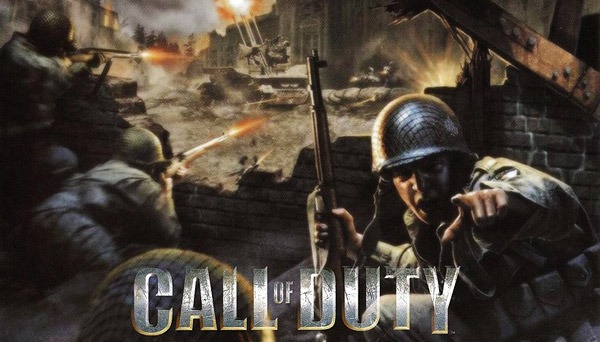
📅 Game released: 2003
Call of Duty (2003) is Infinity Ward’s original World War II first-person shooter, following American, British, and Soviet soldiers through tightly staged battles where squadmates are part of the spectacle. This PC guide compares official Steam and Microsoft Store purchase and download options, the United Offensive expansion and Warchest bundle, original system requirements, multiplayer, Steam Deck support, and practical Windows setup.
 By Editor Zero — independently researched, edited, and maintained.
Last updated: 4 November 2026
Last reviewed: 4 November 2026
Table of Contents
- Quick Facts
- Official PC Stores, Download & Installation
- Call of Duty Review
- Pros & Cons
- PC System Requirements
- Frequently Asked Questions
- Similar Games
Call of Duty (2003) Quick Facts
- Game: Call of Duty / Call of Duty (2003) / Call of Duty 1
- Developer: Infinity Ward
- Publisher: Activision
- Genre: First Person Shooter (FPS), Multiplayer
- Release: October 29, 2003 (Windows PC)
- Platforms: Windows PC, macOS; Call of Duty Classic rerelease: PS3, Xbox 360
- Expansion: Call of Duty: United Offensive (2004), which requires the original game
- Steam bundle: Call of Duty Warchest — Call of Duty (2003), United Offensive, and Call of Duty 2
- Campaign: 24 missions across four interconnected sections with American, British, and Soviet viewpoints
- Multiplayer: Competitive Internet and LAN play through dedicated/community servers; no campaign co-op or split-screen
- Steam Deck: Playable; SteamOS-compatible with control, text-entry, and resolution caveats
- Engine: Modified id Tech 3
- Community: Steam Discussions, Call of Duty Reddit
- PC modding: ModDB hosts maps, campaign changes, weapons, models, textures, tools, and other community modifications
- Metacritic score: 91/100 (original Windows PC release)
- IGN score: 9.3/10 (original Windows PC review)
- GameSpot score: 9/10 (original Windows PC review)
- Steam user reception: Very Positive overall
Official PC Stores, Download & Installation
👇 Compare the official Steam and Microsoft Store options for Call of Duty (2003), United Offensive, and the bundled editions before purchasing, downloading, or installing.
- Steam base game: Call of Duty (2003) is sold separately on Steam as the original 24-mission PC game, with single-player and multiplayer support; buying only this product does not include United Offensive.
- Microsoft Store PC: Microsoft also sells an official Windows PC copy of Call of Duty (2003). This is not an Xbox console edition, and ownership through Microsoft does not grant a Steam license.
- United Offensive: The expansion adds 13 single-player missions across American, British, and Soviet campaigns, alongside new weapons, vehicles, weather effects, artillery support, 11 multiplayer maps, and Domination, Capture the Flag, and Base Assault.
- Expansion ownership: On Steam, United Offensive requires the Steam version of the base game. On Microsoft Store, the expansion requires the Microsoft Store PC version. Do not assume an expansion purchased from one store will attach to the base game from the other.
- Steam Warchest: The Call of Duty Warchest includes the 2003 original, United Offensive, and Call of Duty 2. Compare the bundle with separate purchases, especially during sales.
- Microsoft bundle: The Call of Duty + United Offensive (2003) PC bundle includes the original game and expansion, but not Call of Duty 2.
- PC installation: Install the owned game from your Steam library or through the Microsoft Store/Xbox PC app. When adding United Offensive, install the base game in the same storefront ecosystem before launching the expansion.
- Solo and multiplayer: The single-player campaign is playable independently of an online multiplayer population. Internet multiplayer uses legacy server browsing and community-hosted servers; LAN TCP/IP is also supported, but current server participation varies.
- Game Pass: The verified Microsoft product pages advertise purchases, not a guaranteed PC Game Pass entitlement. Check the live Xbox app for subscription inclusion rather than subscribing on the assumption that the original game is covered.
- Legacy anti-cheat: Older PC multiplayer installations may contain PunkBuster components. Individual servers can use different configurations; avoid unfamiliar anti-cheat installers, cracked executables, CD-key utilities, and unverified download sites.
- Steam Deck: Valve classifies the Steam base game as Playable, not Verified. Expect to adjust controls or resolution, invoke the keyboard manually for some text fields, or use touch input; these are interface caveats rather than demanding hardware requirements.
- Other storefronts: An independently sold DRM-free GOG version was not verified for this guide. Prefer the official Steam or Microsoft PC listings rather than a third-party game-file source.
 Buy Call of Duty (2003) on Steam
Buy Call of Duty: United Offensive on Steam
Buy the Call of Duty Warchest on Steam
 Buy Call of Duty (2003) on Microsoft Store
Buy Call of Duty + United Offensive on Microsoft Store

Call of Duty Review
A squad-driven World War II shooter whose battlefield scale still works, even when its rigid scripts and 2003-era edges are impossible to miss.
The first Call of Duty is easier to understand once everything the series later accumulated is stripped away. There are no perks, killstreak rewards, weapon levels, sliding, regenerating health or blockbuster protagonists carrying an entire war on their shoulders. Infinity Ward’s 2003 debut instead builds its identity around something simpler: the player is one rifle among many. American, British and Soviet soldiers move through battles already in progress, squadmates occupy windows and trenches beside you, artillery lands without asking permission, and objectives usually feel like one small piece of a much larger operation.
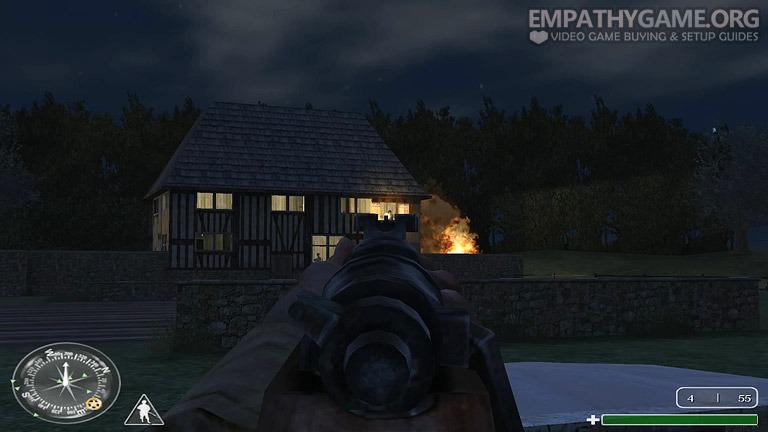
That idea remains the game’s greatest strength. Call of Duty is unmistakably an early-2000s shooter, with narrow routes, obvious scripting and AI that can alternate between surprisingly convincing behaviour and complete battlefield blindness. Yet its fundamental combat language has aged better than its presentation. Aiming down iron sights, carrying only two primary weapons, leaning from cover and treating incoming fire as something to avoid rather than instantly regenerate from still produce a deliberate rhythm. Players willing to accept its rigid mission design will find a concise historical FPS whose best battles remain remarkably effective at making the individual soldier feel small.
The Soldier Matters Less Than the Battle
Call of Duty inherits plenty from the World War II shooters that preceded it, especially Medal of Honor: Allied Assault, but its defining shift is one of perspective. Rather than inventing a single Allied operative responsible for a suspicious number of decisive victories, it moves between Private Martin in the American campaign, Sergeant Evans with the British forces and Alexei Ivanovich Voronin on the Eastern Front. These characters barely exist as personalities. They are silent viewpoints through which different parts of the war are staged.
That sounds like a narrative limitation, and in conventional storytelling it is. There is little character development, almost no personal conflict and no central antagonist holding the campaign together. Captain Price becomes memorable largely because he is one of the few recurring personalities with enough screen presence to distinguish himself from the surrounding soldiers.
Yet the lack of a heroic character arc also serves the game’s strongest theme. Operations continue regardless of who the player character is. Briefings explain what must be captured, destroyed, defended or sabotaged, then the mission drops another soldier into an existing military machine. The campaign is less interested in suggesting that history turns on one exceptional person than in making each protagonist another replaceable participant in a huge industrial war. Later Call of Duty campaigns would become increasingly character-driven and spectacular; this first game often feels more convincing precisely because it refuses to make its protagonists larger than the battles around them.
Gunplay Rewards Cover More Than Momentum
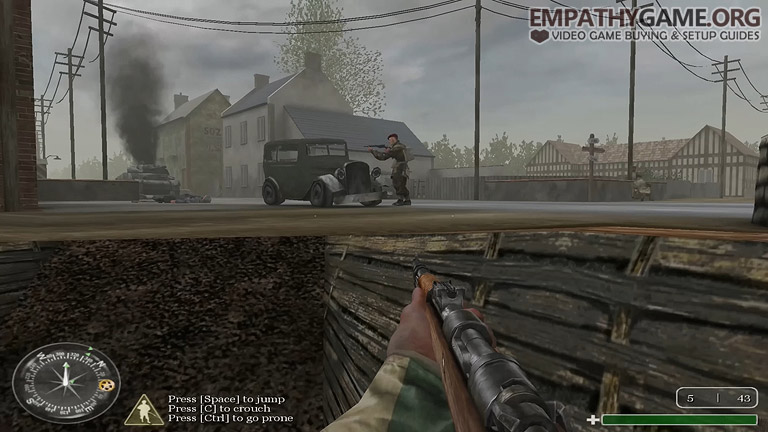
The shooting already contains much of the vocabulary that would become familiar across the series, but it demands a different tempo from modern Call of Duty. Weapons can be fired from the hip or raised to their sights for greater precision. Movement expands the crosshair, aiming reduces mobility, and the absence of sprint means that a badly judged dash across an exposed road cannot be rescued by a sudden burst of speed.
Standing, crouching and going prone therefore have more practical value than they might initially appear to. Crouching provides a useful compromise between movement and exposure, while prone fire becomes valuable when a machine-gun position or distant rifleman has a clear angle over open terrain. Leaning around a doorway or ruined wall is especially important on higher difficulties, where showing an entire character model simply to fire two shots can be an unnecessary risk.
The two-primary-weapon limit reinforces that caution. A sensible combination is often a rifle such as the M1 Garand or Kar98k for open ground paired with a Thompson, MP40 or PPSh-41 for buildings and trenches. That decision matters because weapon swaps are situational rather than cosmetic. Entering a cramped interior with a slow bolt-action rifle is possible, but a submachine gun gives far more room to recover from an enemy appearing several metres away. Conversely, automatic fire across a field wastes ammunition and gives up the precision that the rifles provide.
Health changes the stakes further. Damage does not disappear because the player remained behind a wall for several seconds. On the normal difficulties, health kits restore mistakes, but losing half a health bar near the beginning of a dangerous sequence can still make everything after it more uncomfortable. Veteran is harsher again because health pickups disappear entirely. That turns quick saving from mere convenience into an important part of tackling the campaign: surviving an encounter with minimal damage can matter as much as surviving it at all.
The result is not tactical realism in a simulation sense. Enemies still arrive through scripted encounters, objectives are clearly directed and the player absorbs more punishment than a real infantryman could. But the combination of persistent health, restricted movement and accurate rifle fire makes recklessness expensive enough that cover has genuine value. Modern Call of Duty frequently asks the player to maintain forward momentum. The original is happier to make you crouch behind masonry, identify the dangerous window and expose yourself only long enough to take the shot.
Squad AI Creates Scale Before the Scripts Give It Away
The friendly soldiers surrounding most missions are the feature that gives the game its personality. They are not a controllable tactical squad: there are no formation commands, target orders or elaborate team mechanics. Instead, they occupy space convincingly. Soldiers crouch behind cover, fire through openings, charge positions and sometimes kill enemies without waiting for the player to perform every piece of battlefield housekeeping.
For a 2003 shooter, the smaller behavioural details still add a surprising amount of life. Characters drop prone under fire, adjust around cover and move while a firefight develops. Enemy soldiers are capable of changing position, using grenades and occasionally attacking from an angle that punishes tunnel vision. An opponent does not need sophisticated modern AI to become dangerous when a rifle can remove a large chunk of health and another soldier is already firing from the opposite window.
The illusion has obvious limits. Allies may fail to notice an enemy standing embarrassingly close to them, pathing can become awkward in narrow spaces, and important characters sometimes possess the sort of plot protection that exposes how carefully the encounter is being managed. More fundamentally, squadmates cannot solve the campaign for you. They provide suppression, movement and visual chaos, but the mission usually waits for the player to destroy the gun, plant the explosive or cross the invisible trigger that advances the battle.
That creates a fascinating tension at the centre of Call of Duty. Its battlefields look collective, yet their machinery remains player-dependent. The trick succeeds because there are usually enough soldiers, gunshots and simultaneous movements to hide that machinery until repeated attempts reveal it.
Stalingrad Turns the Core Idea Into the Campaign’s Best Sequence
The Soviet campaign is where Call of Duty’s philosophy becomes most convincing. Alexei’s arrival at Stalingrad deliberately strips away the feeling of being a well-equipped FPS protagonist. The Volga crossing surrounds him with artillery, aircraft, frightened soldiers and orchestral music before he has even established himself as an effective combatant. Once ashore, he begins the assault without being handed a rifle, placing him visually and mechanically among the mass of Soviet troops rather than above them.
The strength of the sequence is not simply spectacle. It establishes vulnerability before asking the player to participate in larger attacks. The battlefield feels as though it would continue killing people whether Alexei were present or not. That makes the eventual acquisition of weapons and movement through the ruined city feel like participation in an existing catastrophe rather than the opening of a power fantasy.
Pavlov’s House later demonstrates how well the campaign can combine spectacle with specific combat problems. The approach begins with snipers controlling the ground ahead, forcing their positions to be identified before the exposed crossing becomes remotely safe. The apartment building then turns into close-range floor-by-floor fighting, followed by the need to use anti-tank rifles against armour and hold the position against a counterattack. The mission repeatedly changes what constitutes the immediate threat without needing a new progression system or scripted superweapon.
It also exposes why squad survival can quietly affect the experience. Friendly soldiers are not merely decorative when several directions must be watched during a defence. A few surviving allies can distract enemies or remove targets that would otherwise compete for the player’s attention. They remain unreliable enough that the player cannot hide indefinitely and expect victory, but their presence changes how crowded encounters breathe.
The later Soviet push westward keeps that sense of collective momentum intact. Tank sections broaden the scale, ruined industrial spaces change sightlines, and the final advance toward Berlin feels like the endpoint of a military campaign rather than the personal duel of a conventional action hero. The Soviet chapters are still scripted corridors beneath the spectacle, but they are the moments when Call of Duty hides those corridors most successfully.
The American and British Missions Win Through Variety

The earlier Allied chapters are less distinctive thematically, yet they contain some of the campaign’s cleanest encounter design. Brecourt Manor places the American squad into trench networks where German artillery positions must be destroyed one after another. It is a good demonstration of the game’s natural weapon rhythm: rifles are useful while approaching exposed positions, grenades clear confined sections, and the trenches quickly compress combat into ranges where an automatic weapon becomes safer.
The British Pegasus Bridge operation produces a different kind of pressure. Capturing the bridge is only the first stage; defending it against a counterattack turns the location into a temporary fortress. Instead of constantly advancing toward the compass marker, the player has to read where the next threat is developing and make use of defensive positions while the battle grows around the squad. The structure is heavily predetermined, but the volume of soldiers and incoming fire makes the defence feel less static than its scripting actually is.
Other British missions move toward sabotage and infiltration, including Eder Dam and the Tirpitz operation, while vehicle and turret sequences break up long stretches of infantry combat. These sections sometimes reduce agency—being driven along a fixed route while operating a mounted weapon is inherently more spectacle than tactics—but the campaign benefits from the change in pace.
The American Normandy material is perhaps the most conventional portion today, partly because the imagery became so familiar across World War II games. What keeps it functional is efficiency. Missions rarely overstay their mechanic, and the campaign moves to another setting or objective before its straightforward corridor fighting becomes exhausting.
Sound Preserves an Atmosphere the Graphics Cannot
Visually, there is no hiding the game’s age. Faces are simple, geometry is angular, distant scenery is sparse by modern standards and many interiors resemble functional combat spaces more than believable buildings. Higher resolutions make the image cleaner but also make some of those limitations more obvious.
The audio has survived far better. Rifles and automatic weapons are easy to distinguish by sound, artillery temporarily overwhelms the mix, soldiers shout across firefights and distant gunfire suggests fighting beyond the playable route. Michael Giacchino’s score is used selectively enough that its arrival can still reshape a sequence, particularly during the Soviet campaign.
This matters because Call of Duty depends on sensory density. A street containing ten friendly soldiers does not feel large purely because ten models are visible; it feels large because several weapons are firing at different distances while aircraft, explosions and shouted orders compete for attention. The graphics establish where the battle is. The sound sells the idea that it extends beyond the walls of the level.
Multiplayer Relies on Weapons and Maps, Not Progress Bars
The multiplayer is almost alien compared with the systems that later became synonymous with Call of Duty. There is no persistent XP ladder feeding unlocks, no Create-a-Class meta and no chain of killstreak rewards changing the match. Players choose their side and weapon, then succeed through shooting, positioning and knowledge of the map.
Deathmatch and Team Deathmatch provide the direct version of that formula, while Search & Destroy and Retrieval make individual deaths more consequential through round-based objectives. Behind Enemy Lines is the stranger idea: a small Allied side attempts to survive against a numerically superior Axis force, with roles changing as kills occur. The original kill cam is a particularly smart addition because it gives the defeated player immediate information about where a shot came from while also discouraging suspicious play.
Maps such as Harbor, Pavlov and Railyard suit a game where rifles can dominate long sightlines but become awkward once someone gets through a doorway or around a rail car. That is why simple community rules such as rifle-only play could produce such durable memories: when progression is removed, the personality of the weapon and geometry of the map become the event.
As a design, it remains a useful reminder that Call of Duty was competitive before the series became an elaborate progression machine.
Final Verdict

Call of Duty is most interesting today not because every part of it has aged gracefully, but because its original priorities are so easy to see. Infinity Ward built a shooter around the sensation of participating in warfare rather than dominating it alone. Friendly soldiers fill the battlefield, persistent health makes incoming fire matter, restricted movement encourages deliberate use of cover, and the strongest missions surround simple objectives with enough activity to make them feel much larger than their actual playable spaces.
The illusion is never perfect. Scripts determine where battles begin and end, AI behaviour can collapse under close inspection, the protagonists barely qualify as characters, and the visual presentation belongs unmistakably to 2003. The American and British campaigns also struggle to match the oppressive identity of the Soviet chapters, where Stalingrad and Pavlov’s House turn the game’s squad-based concept into something more memorable than another collection of World War II shooting galleries.
Players looking for modern mobility, open-ended battlefields, extensive progression or cinematic character drama will probably find the design restrictive. Those interested in older PC shooters, military FPS history or campaigns built around tightly directed encounters have much more to gain. More than two decades later, the first Call of Duty remains a focused demonstration of the idea that launched the series: the battle feels bigger when the player is not presented as the only person capable of fighting it.
Call of Duty (2003) Pros & Cons
- Pro: American, British, and Soviet campaigns make the war feel broader than one protagonist’s mission
- Pro: AI squadmates, artillery, armour, and scripted battles establish a convincing sense of battlefield scale
- Pro: Pegasus Bridge, Stalingrad, and Pavlov’s House remain distinctive, tightly directed missions
- Pro: Iron-sight gunplay, leaning, positional movement, and health pickups make cover meaningful
- Pro: United Offensive adds substantial campaign content and more varied multiplayer modes
- Con: Linear scripted routes limit freedom and can reveal the AI’s weaknesses on repeated attempts
- Con: Veteran difficulty removes health pickups, making mistakes and difficult checkpoints punishing
- Con: Dated presentation and keyboard-first controls are less approachable than modern shooters
- Con: Widescreen, handheld input, and legacy multiplayer may require additional setup
Call of Duty (2003) PC System Requirements
Important: Steam preserves the original 2003 Windows 98/ME/2000/XP game requirements below. Those historical game specifications are not the operating-system requirements of the modern Steam client, which requires Windows 10 or later.
OFFICIAL MINIMUM:
OS: Windows 98 / ME / 2000 / XP (original game requirement)
CPU: Pentium III or Athlon 600 MHz on Windows 98/ME; Pentium III or Athlon 700 MHz on Windows 2000/XP
RAM: 128 MB
GPU: 32 MB hardware T&L-capable 3D accelerator, 100% DirectX 9.0b compatible
DirectX: 9.0b
Storage: 1.4 GB uncompressed free space, plus the original Windows swap-file allowance
Sound: DirectX 9.0b-compatible 16-bit sound card
Input: Windows-compatible keyboard and mouse
Multiplayer: Internet TCP/IP or LAN TCP/IP; original internet requirement: 56 Kbps or faster modem
RECOMMENDED:
Steam does not publish a separate complete recommended CPU/GPU tier for this original PC release. On a modern computer, compatibility and display configuration are more relevant than the hardware demands of the 2003 engine.
Additional PC Performance and Setup Notes
- Modern Windows: Begin with the unmodified Steam or Microsoft Store install on Windows 10/11. The low historical CPU/GPU numbers do not guarantee trouble-free rendering or video playback on every modern graphics driver.
- Original widescreen limitation: The 2003 game does not automatically correct its 4:3 aspect ratio for 16:9 displays. On Steam, open Library > Call of Duty (2003) > Properties > General > Launch Options and enter
+set r_mode -1 +set r_customwidth 1920 +set r_customheight 1080 +set r_customaspect 1.7 +set cg_fov 96for a 1920×1080 starting point. Use your own screen’s width and height; tune FOV for comfort. The original Steam community widescreen guide documents the approach. It changes configuration only; no third-party executable download is necessary. - Manual widescreen alternative: Back up
main/config.cfg(single-player) ormain/config_mp.cfg(multiplayer) in the installed game folder. Setr_modeto-1,r_customwidthandr_customheightto your resolution, andr_customaspectto1.7for 16:9; adjustcg_fovas needed. Restart the game to check the result. Revert the Launch Options or restore the backed-up config if the screen becomes distorted. See PCGamingWiki’s Call of Duty PC configuration notes. Basic aspect settings may not completely correct the original HUD or cinematics. - United Offensive widescreen: The expansion stores separate configurations in its
uofolder (uoconfig.cfgfor solo play anduoconfig_mp.cfgfor multiplayer). The community CoDUO-YAP plugin offers a more complete widescreen/HUD/cinematic solution specifically for United Offensive; its author explicitly says the plugin does not support the untouched original Call of Duty campaign. Read the author’s version and installation instructions before using a community DLL. - Frame rates and input: The modified id Tech 3 engine can behave differently at unusually high frame rates. Start with ordinary settings, and use a reasonable frame-rate cap if movement, audio, or input becomes inconsistent.
- Steam Deck: Valve rates the game Playable. A community controller layout, virtual keyboard, touch input, and a manually chosen display resolution can be necessary; default graphics performance is not the principal limitation.
- Black-screen videos or crashes: Restore default video settings, remove incompatible mods or injected overlays, and verify game files through the owning storefront before experimenting with individual fixes. Problems reported by some Windows 11 players are not universal.
- Mod compatibility: ModDB hosts content for both base Call of Duty and United Offensive. Check whether a mod targets the correct version and make backups before replacing original game files. Avoid obsolete standalone retail patches on an otherwise clean Steam installation.
- Old CD/DVD copies: Original disc DRM and activation methods can be incompatible with current Windows releases. A legitimately owned current storefront copy is typically simpler than trying to bypass legacy disc protection.
Official Trailer
Note: This preserved upload of the original promotional trailer shows the World War II setting, squad action, and Allied campaign perspectives. It is a historical trailer rather than a current Activision-channel upload.
Frequently Asked Questions
How difficult is Call of Duty (2003), and which setting is best for beginners?
Regular is a sensible starting difficulty. The game uses health pickups instead of regenerating health, while Veteran removes the usual health pickups and makes surviving repeated firefights far less forgiving.
Can I save manually during the Call of Duty (2003) campaign?
Yes. The original PC release has manual and quick saving, which is especially helpful before difficult assaults or when retrying a Veteran encounter.
How long does the original Call of Duty campaign take to finish?
A typical first playthrough is around 7–9 hours, depending on difficulty and pace. Higher difficulties or repeated attempts at missions such as Pavlov’s House can lengthen it.
Can you give commands to your AI squadmates?
No. Friendly soldiers advance, suppress enemies, and participate in scripted combat, but they are not a directly controllable tactical squad. The player still completes key objectives.
Is Captain Price in the original Call of Duty the same character as in Modern Warfare?
The original campaign features a British Captain Price during Sergeant Evans’ missions, including Pegasus Bridge. The later Modern Warfare character belongs to a different fictional continuity.
Does Call of Duty (2003) have co-op, split-screen, or LAN multiplayer?
The original 24-mission campaign has no co-op, and the PC game has no split-screen. Competitive multiplayer supports Internet and LAN TCP/IP play between separate computers.
Which multiplayer modes are included in Call of Duty (2003)?
The original includes Deathmatch, Team Deathmatch, Search & Destroy, Retrieval, and Behind Enemy Lines. United Offensive adds Domination, Capture the Flag, and Base Assault.
Does the original Call of Duty multiplayer have weapon unlocks or Prestige?
No. The base game predates persistent weapon-level, perks, killstreak, and Prestige progression. Multiplayer is primarily about map knowledge, weapon choice, aim, and objective play.
Can you still play Call of Duty (2003) multiplayer online?
The PC game supports community-hosted servers, but how many public games are available depends on the version, region, and time. Check the server browser and Steam Discussions before buying primarily for online play.
Can Steam and Microsoft Store owners play multiplayer together?
Cross-store matchmaking or guaranteed server compatibility is not officially documented for these legacy PC releases. Microsoft warns that some Xbox Network features, including cross-platform multiplayer, may be unavailable. For plans with friends, confirm the specific server and version, or buy in the same storefront ecosystem.
Can I play United Offensive without the original Call of Duty?
No. United Offensive requires the base game, and its expansion license must match the storefront version you own. The Steam Warchest and Microsoft’s Call of Duty + United Offensive PC bundle provide different ways to purchase the required content together.
What changes when playing United Offensive instead of the base game?
In addition to 13 new missions and larger battles, United Offensive adds sprinting, deployable machine guns, artillery support, and more vehicle sequences. These mechanics are not automatically added to the original campaign.
Is Call of Duty (2003) included with PC Game Pass?
The checked Microsoft product listing offers a PC purchase, but does not establish a current Game Pass subscription entitlement. Confirm the title directly in the Xbox PC app before relying on a subscription.
Does Call of Duty (2003) work on Windows 11?
It can run on modern Windows PCs, but its original system requirements predate Windows 11, and compatibility is not guaranteed on every configuration. Begin with an official unmodified installation; if problems occur, consult the setup notes above for resolution and clean-file checks.
How do I get proper 16:9 widescreen in Call of Duty (2003)?
The original game’s 4:3 settings do not automatically adapt the aspect ratio. Use the documented Steam Launch Options or main/config.cfg settings in the setup section to set a custom resolution, aspect ratio, and field of view; no separate patch is needed for the basic workaround.
Is Call of Duty (2003) playable on Steam Deck with a controller?
Yes, Valve rates the Steam version Playable rather than Verified. It can require a custom/community controller layout, touch input, manual keyboard access, and resolution adjustments because the original interface was designed around mouse and keyboard.
Does Call of Duty (2003) use PunkBuster, and are mods supported?
PunkBuster is associated with the older PC multiplayer release, although server configurations vary. Community mods and maps are available through sites such as ModDB, but the game has no Steam Workshop integration. Check version requirements and avoid untrusted executable downloads.
Still have questions? Check the Call of Duty community on Reddit, official Activision Support, and Call of Duty (2003) Steam Discussions.
Sources & References
Release details, official PC ownership options, expansion content, legacy system requirements, and current compatibility guidance were checked against these sources:
- Activision: original Call of Duty release announcement — original release date and campaign design
- Steam: Call of Duty (2003) — official PC version, base-game hardware requirements, user reception, and Steam Deck label
- Steam: United Offensive — expansion dependency, campaign additions, and original specifications
- Steam: Call of Duty Warchest — contents of the three-game package
- Microsoft Store: Call of Duty + United Offensive — official Windows PC bundle and included expansion
- PCGamingWiki: Call of Duty — widescreen, FOV, configuration files, and older Windows compatibility
- ModDB: Call of Duty mods — examples and availability of community mod projects
Similar Games Like Call of Duty (2003)

Found something worth playing through DecideGame?
DecideGame.com is an independent gaming project run by Editor Zero. If this guide helped you discover a game, solve a problem, or find useful information, you can support DecideGame.com and help keep new and updated game guides coming.
DecideGame — PC Game Guides, Reviews & Setup Help