
📅 Game released: 2002
Use this updated 2026 James Bond 007: Nightfire PC guide to check official download availability and original-disc ownership, compare the Windows and console releases, review PC system requirements, and find widescreen fixes, multiplayer information, and practical setup guidance for modern Windows systems.
 By Editor Zero — independently researched, edited, and maintained.
Last updated: 19 October 2026
Last reviewed: 19 October 2026
Table of Contents
- Quick Summary
- Quick Facts
- Official PC Stores, Download & Installation
- James Bond 007: Nightfire Review
- Pros & Cons
- PC System Requirements
- Frequently Asked Questions
- Similar Games
James Bond 007: Nightfire Quick Summary
✔ Story-driven first-person spy shooter featuring James Bond, whose investigation of industrialist Raphael Drake and Phoenix International leads from guarded estates and covert facilities to an ambitious threat involving nuclear weapons and an orbital defense system.
✔ The Windows campaign blends firefights, infiltration, gadget-based objectives, security-system avoidance, scripted action sequences, and cinematic Bond storytelling, with missions that sometimes reward stealth over direct confrontation.
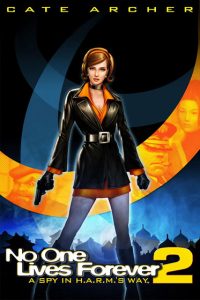
✔ Similar to No One Lives Forever 2: A Spy in H.A.R.M.’s Way through its first-person espionage, distinctive spy gadgets, secret facilities, guarded infiltration routes, and mixture of action and stealth.
✔ The original Windows version was developed by Gearbox Software rather than Eurocom and does not include the console editions’ playable driving missions. Its campaign layout and multiplayer features also differ, making the versions meaningfully different experiences.
✔ No verified modern official PC digital storefront sells Nightfire. The original boxed Windows release is the relevant ownership option, although legacy disc authentication and installer compatibility can complicate use on newer Windows systems.
✔ PC multiplayer supports network matches and computer-controlled bots; the original GameSpy service is discontinued, while community patches and fan-maintained resources provide additional functionality. Widescreen field-of-view correction is also available through an unofficial patch.
James Bond 007: Nightfire Quick Facts
Official PC Store Status, Download & Installation
👇 Use the information below to understand James Bond 007: Nightfire’s official Windows PC availability, original ownership options, and installation limitations before attempting to run the game on a modern computer.
- Official PC availability: James Bond 007: Nightfire received a native Windows PC release, but no verified current purchase listing is available through Steam, GOG, Epic Games Store, Microsoft Store, or the EA App. It should not be confused with newer Bond titles that have separate digital releases.
- Original retail edition: The commercial Windows release was distributed on physical CD-ROM media. A legitimate original boxed copy, with its required installation media and associated product information, is the relevant historical PC ownership option. Used physical copies may be found through independent resellers, but they are not equivalent to a new official publisher-supported digital purchase.
- Digital ownership: No verified modern EA App entitlement or publisher-supported conversion process provides Nightfire to new Windows buyers. Possessing an original disc does not automatically grant access to a downloadable Steam, GOG, or EA App edition.
- Legacy installation: The Windows release was created for Windows 98-era through Windows XP-era computers. Its original installer, DirectX dependencies, and older disc authentication can present compatibility problems on Windows 10 and Windows 11. Install from legitimate original media and preserve the original product information; successful installation does not guarantee successful launching on a newer operating system.
- Original disc protection: Some Windows retail editions use SafeDisc, a legacy disc-based authentication technology that is not supported normally by modern Windows. This is a separate obstacle from the game’s low hardware requirements. Avoid assuming that changing graphics settings alone will resolve an authentication failure.
- PC versus console: Gearbox’s Windows version is a separately developed adaptation, not an identical conversion of Eurocom’s console game. The PC campaign replaces certain console content with different first-person missions and removes the playable driving sequences. Anyone purchasing an older physical copy should confirm which platform’s version it contains.
- Original multiplayer: Windows supports network multiplayer with modes such as Deathmatch, Team Deathmatch, and Capture the Flag, including bot opponents. The original GameSpy server-browser infrastructure has closed. Community-maintained patches may provide alternative server discovery, but these are not official EA online services, and active player availability is not guaranteed.
- Unofficial compatibility tools: The Nightfire Unofficial Patch hosted by PCGamingWiki provides fixes and additional PC settings, including widescreen field-of-view adjustment and mouse-input options. It is community-developed, not an official publisher update. Review its requirements and use it only with a lawfully owned installation.
- Other platform releases: The PS2, Xbox, and GameCube editions are distinct console versions, while the Game Boy Advance release is a separate handheld adaptation. The historical Mac port also belongs to the PowerPC era and is not a modern native macOS release. None of these versions grants a normal Windows digital-store entitlement.

James Bond 007: Nightfire Review
Inventive spy gadgets and lavish Bond atmosphere collide with rigid stealth and uneven shooting.
James Bond 007: Nightfire is at its best when a mission makes being 007 feel different from being an ordinary first-person shooter hero. A locked watchtower suggests a way around castle guards. A pair of unusual glasses reveals security equipment that cannot be seen normally. A carefully timed approach can end with a guard raising his hands rather than exchanging gunfire. Those moments give Gearbox’s Windows version a distinctive, if limited, espionage identity.
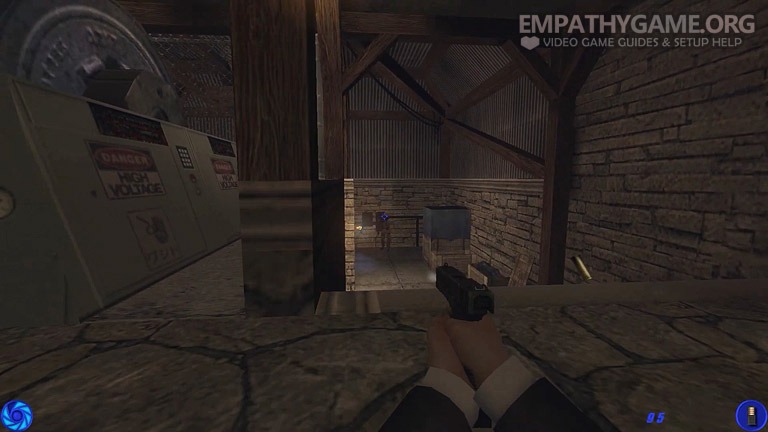
The underlying tension is between two games: a theatrical Bond adventure built around gadgets, disguises and infiltration, and a conventional shooter that regularly turns those possibilities into long corridors of armed opposition. The PC campaign takes a different path from Eurocom’s console versions, replacing their playable driving interludes with more first-person missions. It gains on-foot missions but loses an important change of pace. For players drawn to compact, objective-driven spy adventures, there is enough personality here to justify the trip. Those expecting elegant stealth or consistently satisfying firefights will encounter the seams quickly.
Rendezvous Makes Infiltration Feel Like a Choice
The opening mission, Rendezvous, gives Nightfire its clearest argument for what a Bond shooter should be. Bond parachutes near Raphael Drake’s snowbound Austrian castle with instructions to cross the security perimeter and enter a formal reception. There is an obvious cinematic opportunity: board a delivery truck and ride it through the gate. It can earn a Bond Move, the game’s reward for completing certain objectives with suitable flair, but it is not necessarily the cleanest infiltration. The truck exposes Bond to entrance guards. A less direct route uses the laser watch to open a locked watchtower, an overhead wire to cross the perimeter and a cellphone grapple to reach a balcony.
The choice turns scenery into a tactical question: does the shortcut keep Bond safe, or does the longer route offer better control? Reaching the party changes the pace again. Instead of firing at every person in sight, Bond must preserve his cover, collect gadgets from an undercover waiter and discreetly photograph women attending the reception while searching for a suspect. Surveillance feels more appropriate here than firepower.
Not every later level maintains this balance. Airfield Ambush begins with guarded ground, searchlights and opportunities for quiet movement, then shifts toward sabotage and sniper protection for Zoe Nightshade. The shift is entertaining, although later transitions from investigation to automatic-weapons combat sometimes feel like the designers have simply run out of spy work.
Q’s Gadgets Make Ordinary Rooms Worth Inspecting
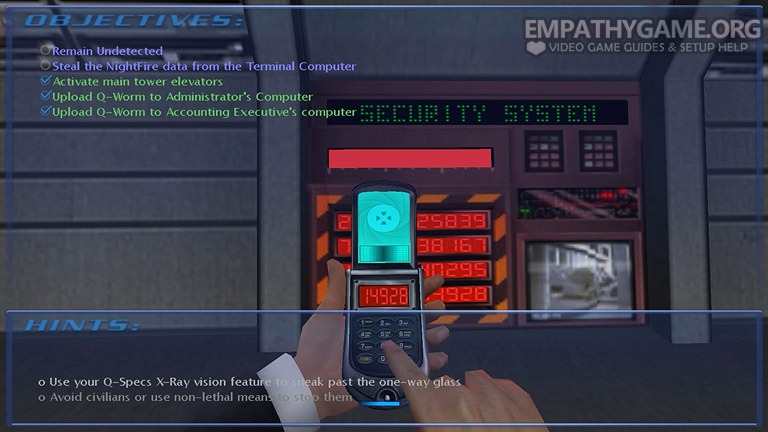
The gadgets do more to establish Nightfire’s identity than its selection of firearms. Q-Specs switch between vision modes to expose threats or information ordinary sight misses. The watch laser cuts designated locks, the grapple turns marked high points into routes, and a disguised dart-firing pen can silence a guard without announcing Bond’s presence. A routine computer can become interesting when an objective requires the Q-Worm.
Phoenix Rising puts that tool kit to particularly good use. Infiltrating the Phoenix office tower means watching cameras, identifying protected computer terminals, installing the Q-Worm and planting surveillance devices while avoiding alarms. Disabling a security system at its control point can be more satisfying than dodging sensors or finding another weapon pickup.
The limitation is their narrow scripting. Most gadgets answer a specific prompt in a specific location. A watch laser does not turn every locked door into a potential shortcut, and a grapple cannot transform any convenient roofline into an escape route. Once the intended interaction is known, discovery gives way to repetition.
There is one revealing exception to the otherwise scripted feel. An unaware ordinary guard can sometimes be confronted from behind with a drawn gun and made to surrender. Bond can then subdue him rather than shoot him; hesitate too long and the situation can turn dangerous again. That human response gives the encounter more character than another predetermined gadget target.
Stealth Rewards Patience, but Punishes the Wrong Mistakes
Much of the campaign encourages caution through cameras, alarm triggers, patrol routes and situations where being noticed can end an objective immediately. Nightfire is effective at producing short stretches of tension: waiting for a guard to turn, slipping behind a piece of cover and deciding whether a dart is worth using before moving toward the next room. The score itself can help with awareness. When enemies detect Bond, the music can accelerate, supplying an alert cue even if the person who spotted him remains outside the camera’s view.
Yet the underlying detection rules are not consistently persuasive. Some guards seem slow to recognise obvious danger, while other encounters shift abruptly from apparent safety to full alert. When a mission requires remaining unseen, failure may mean repeating a prescribed sequence rather than escaping, hiding and regaining control. Stealth can thus feel less forgiving than straightforward combat.
The movement makes that weakness more noticeable. Mouse aiming suits the shooting, but sideways movement can feel loose when trying to edge out from behind a doorway or stop precisely at a drop. Leaning seems designed for careful corner inspection, yet its practical value is restricted when Bond cannot fire from the leaned position. A control meant to support stealth consequently offers less useful protection than expected. Standing back and learning patrol patterns feels safer than improvising under pressure.
Firefights Expose the Limits of the Enemy Design
When the mission becomes a shooter, the weapons at least provide a workable vocabulary. The suppressed Wolfram P2K fits quieter encounters, automatic firearms handle groups of guards, and sniper rifles or explosives become useful when distance and heavier resistance change the threat. A four-firearm carrying limit occasionally forces a meaningful exchange: keeping a specialised weapon may mean surrendering something more versatile. Ammunition and armour matter on higher difficulties, but weapon choice remains fairly shallow.
The larger problem is that enemy behaviour and encounter layout rarely complement each other. An inattentive guard can make a carefully planned approach feel unnecessary; a sudden burst of accurate fire can then turn a supposedly manageable corridor into an abrupt death. Rather than teaching Bond to read an opponent’s tactics, the campaign often teaches the location of a trigger, turret or armed figure waiting around the next corner.
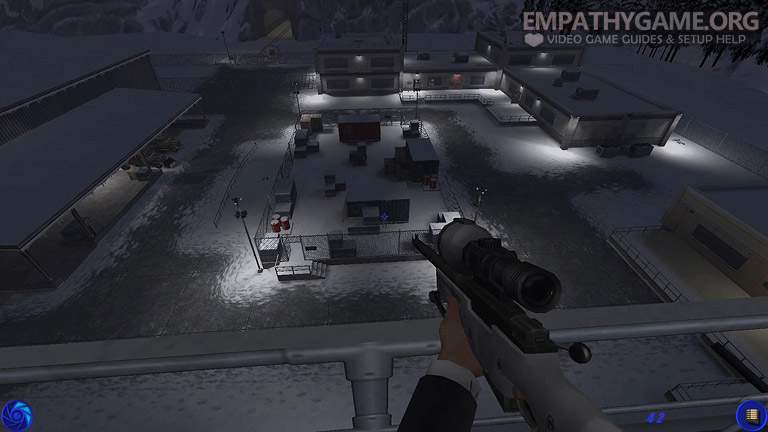
High Treason exposes this tendency most clearly. The escape through the Phoenix tower combines explosive hazards, hard-hitting Phoenix Ronin automated guns, enemies with rocket launchers and a vulnerable elevator sequence. The most punishing moments are not necessarily caused by an intelligent opponent outmanoeuvring Bond. They arise when a dangerous device is difficult to identify before it fires, or when the environment gives little space to respond. The tension feels punitive rather than earned.
The mission often rewards advance knowledge of hazard placement rather than sharper tactics. Lower difficulty can ease the damage without fixing the encounter design.
The Locations Are Lavish, but Not Always Well Connected
There is considerable visual effort behind the journey. Drake’s castle offers snowy approaches and extravagant interiors; the Japanese estate introduces gardens, secluded rooms and shifting sightlines; the Phoenix offices replace aristocratic luxury with glass, corridors and security checkpoints. These contrasts give the nine-mission campaign an international sweep.
The Japanese estate in Uninvited Guests also shows why more space does not automatically create more choice. A large collection of rooms, similar-looking connections and passages that lead nowhere can make the hostage-rescue objectives feel like a search through a building rather than a series of calculated infiltrations. Dead ends and loading transitions make navigation feel more laborious than tactical.
This is where the PC adaptation suffers most beside the broader rhythm of the console game. Replacing vehicle action with additional walking and shooting increases the amount of first-person material, but it does not ensure that every extra corridor is interesting. Nightfire’s best spaces have an understandable purpose: a watchtower creates a route, a security office offers control over alarms, or a high balcony suggests a gadget opportunity. Its weaker spaces merely separate them.
Bond Atmosphere Carries a Familiar, Thinly Developed Plot
The story is unabashedly cinematic. Industrialist Raphael Drake promotes Phoenix International as a benevolent force in nuclear disarmament, while MI6 uncovers evidence of a more dangerous operation. The pursuit moves from polished European hospitality to corporate espionage, isolated installations and escalating international stakes. It is original rather than a film adaptation, but uses all the familiar ingredients: compromised contacts, secret technology and extravagant danger.
The characters are less substantial than their introductions promise. Zoe Nightshade is a useful returning partner, while Dominique Paradis and Alura McCall move Bond between intrigue, banter and assistance. Drake has the grand manner expected of a Bond antagonist, but the narrative does not spend enough time building complicated relationships or making its betrayals particularly surprising. The story mostly serves to deliver Bond from one attractive assignment to the next. Momentum survives; depth does not.
The presentation makes up some of the difference. Pierce Brosnan’s likeness ties this incarnation of 007 to the film era, even though the actor does not supply the voice. Elaborate interiors and recognisable Bond styling do more character work than many conversations. The brassy, suspenseful score is especially valuable because it sets the mood and, through its shifts during detection, occasionally communicates something useful about play. In contrast, compressed-sounding mission dialogue can diminish scenes that are meant to feel sophisticated. Setting and music ultimately sell the fantasy better than exposition.
Bond Moves and Multiplayer Offer Uneven Reasons to Return
The campaign has no skill trees or character builds. Replay instead depends on mastering routes, changing difficulty, finding secrets and recognising Bond Moves: actions that reward a suitably inventive approach. In principle, this is an excellent way to encourage behaviour consistent with the licence. Finding an overlooked grapple route is more satisfying than collecting another token.
In practice, some awards depend as much on objective order as ingenuity. In Uninvited Guests, for example, entering the Library by a special grapple approach must occur before the related hostage has already been rescued if the Bond Move is to register. Discovering the route after completing the rescue may still be clever, but the game no longer acknowledges it. That makes some rewards depend on memorising objective order instead of simply noticing a clever route.
PC multiplayer has its own modest appeal. Free-for-all Combat Training, team matches and Capture the Flag shift attention from scripted objectives to weapon pickups, map familiarity and positioning. Computer-controlled opponents let those spaces function without a human group, though their pathfinding and reactions do not make them especially persuasive rivals. The modes remain basic and combat lacks competitive precision.
Still, the arenas have more personality than their rule sets suggest. Fort Knox, in particular, trades on the appeal of occupying a recognisable classic Bond-film location, while other maps reuse the game’s exotic and industrial imagery. These arenas give basic combat some welcome 007 identity, even if multiplayer remains a secondary attraction.
Final Verdict

James Bond 007: Nightfire is a revealingly uneven attempt to turn a film spy into a first-person action hero. Gearbox understands the surface details of the fantasy: gadgets hidden in everyday objects, expensive interiors, camera-filled facilities, dramatic escapes and the pleasure of taking a route that a straightforward gunman would overlook. Rendezvous and Phoenix Rising show how enjoyable those ideas can be when the mission asks Bond to observe, infiltrate and use his equipment with purpose.
What holds the game back is not simply its age. Its more ambitious mechanics are too closely tied to fixed interactions, and its weaker levels replace meaningful choice with navigation or surprise hazards. Stealth can become an exercise in avoiding a strict failure trigger; shooting can swing from trivial enemies to punishing placement without becoming tactically interesting. The loss of the console editions’ driving sequences also leaves the PC campaign with less variety than its cinematic presentation promises.
There is still an appealing, distinctive shooter here for Bond fans and for anyone who enjoys the compact mission design of early PC espionage games. The surrender mechanic, occasional alternative approaches, collectible Bond Moves and film-inspired multiplayer arenas show flashes of an adventure more imaginative than an ordinary corridor FPS. But players seeking a consistently clever stealth game, a sophisticated firefight system or the broadest version of Nightfire should moderate their expectations. This is a Bond adventure defined by flashes of clever espionage rather than the consistency of its execution.
James Bond 007: Nightfire Pros & Cons
Pros:
✔ Original James Bond storyline with recognizable espionage themes, secret facilities, exotic locations, cinematic cutscenes, and a memorable global threat
✔ Gadgets such as multi-mode glasses, tracking equipment, and specialized weapons add welcome variety to ordinary first-person shooting
✔ Some missions reward alternative approaches, including quiet infiltration, security-system avoidance, and creative objective completion
✔ Keyboard-and-mouse controls suit the Windows version’s conventional first-person shooter structure, while multiplayer bots allow matches without human opponents
✔ Community-made maps, modifications, and compatibility patches provide additional reasons to revisit the older PC release
Cons:
✖ The PC edition omits the driving missions and other distinctive content from the better-received Eurocom console versions
✖ Inconsistent enemy AI, rigid scripting, uneven stealth detection, and a relatively short campaign undermine some of the more ambitious mission designs
✖ Original multiplayer has fewer modes than the console releases and lacks their local split-screen functionality
✖ No verified modern official PC digital purchase route, while legacy disc authentication and display limitations complicate setup on newer computers
James Bond 007: Nightfire PC System Requirements
The requirements below describe the original Gearbox Windows release. They are historical specifications, not official Windows 10 or Windows 11 compatibility guarantees. Older documentation may differ slightly in its listed graphics-memory threshold, so the following uses the detailed Windows requirements recorded by PCGamingWiki.
ORIGINAL WINDOWS PC REQUIREMENTS:
MINIMUM:
OS: Windows 98
CPU: Intel Pentium III 500 MHz or AMD Athlon 500 MHz
RAM: 128 MB
GPU: Direct3D-compatible graphics card with 32 MB VRAM and DirectX 8.1 support
DirectX: DirectX 8.1
Storage: Approximately 675 MB for a minimum installation
Optical Drive: 8x CD-ROM drive
RECOMMENDED:
OS: Windows ME, Windows 2000, or Windows XP
CPU: Intel Pentium III 1 GHz or AMD Athlon 1 GHz
RAM: 256 MB
GPU: DirectX 8.1-compatible graphics card with 64 MB VRAM
DirectX: DirectX 8.1
Storage: Approximately 1.4 GB for a larger installation
Optical Drive: 16x CD-ROM drive
Additional PC Performance and Setup Notes
Modern Windows compatibility: Nightfire’s original hardware requirements are extremely modest by modern standards, but Windows compatibility is the more important concern. The modified GoldSrc engine uses an older Direct3D rendering path, and historical disc authentication may prevent a normal launch. No official Windows 10 or Windows 11 remaster or updated compatibility edition has been verified. Treat community-reported fixes as unofficial rather than guaranteed solutions.
Widescreen and field-of-view fix: The original PC game can display widescreen resolutions, but its uncorrected field of view becomes vertically restricted at wider aspect ratios, while some menus and HUD elements stretch. For proper gameplay field-of-view adjustment, the established community solution is the James Bond 007: Nightfire Unofficial Patch v5.91, developed by click4dylan and contributors and hosted in the PCGamingWiki Community file library.
Widescreen patch installation: With an original Nightfire Windows installation already present, back up the game’s files and save data. Open the linked patch page, select the appropriate package, extract its archive, and run the included Nightfire Patch Setup Wizard. Point the installer to the actual Nightfire installation directory containing the original game, rather than an unrelated folder. The package lists an older Microsoft .NET Framework dependency; use supported Windows components when needed. For non-English retail editions or a minimal installation, the patch page recommends its Lite package.
After installation, launch the game through the patch’s launcher and configure the desired display resolution. The patch automatically adjusts the field of view to suit the chosen aspect ratio, which is preferable to simply stretching the original 4:3 presentation. Some interface elements and prerendered sequences may still retain older aspect-ratio behavior. If the patch does not work correctly with a particular installation, restore the backed-up files rather than repeatedly replacing unrelated game components.
Mouse and controller configuration: The original Windows version uses keyboard-and-mouse controls. The community patch adds options such as disabling mouse acceleration and using raw mouse input. It also includes an XInput controller-support option, although enabling it can alter keyboard movement bindings. Check the patch launcher settings and test controls before beginning a campaign mission.
Performance and frame-rate behavior: The engine was built for early DirectX hardware and does not have modern native graphics features such as DLSS or FSR. PCGamingWiki documents a historical issue with very high frame rates affecting some moving-platform sequences, as well as fixes in the community patch. Begin with conservative frame-rate settings rather than automatically using an unlimited frame rate.
Multiplayer setup: The original PC multiplayer includes bot matches and LAN or network play, but its GameSpy-backed server browser is no longer supported by the original service. Community updates can provide replacement server discovery and other multiplayer fixes. Availability of fan-operated servers varies, and online functionality should not be mistaken for a restored EA-supported service.
Save-file backups: PCGamingWiki identifies the Windows save-data location under %LOCALAPPDATA%\Gearbox Software\Nightfire\bond\SAVE\ for applicable installations. Back up this folder before experimenting with new community patches, modifications, or substantial configuration changes. The associated configuration file may be stored in the neighboring bond directory.
Unofficial mods: Nightfire’s ModDB page documents fan-made projects, including custom content, total-conversion experiments, and modifications to the original PC experience. These are not official Electronic Arts releases. Verify the intended game version and installation instructions before applying any modification.
Video Trailer
Frequently Asked Questions
Is James Bond 007: Nightfire worth playing in 2026?
Yes, particularly if you enjoy classic Bond espionage, creative gadgets, and mission-based first-person shooters. The Windows version has memorable infiltration sequences and bot-supported multiplayer, but its uneven AI, shorter campaign, and missing console driving missions make it a less complete experience than the PS2, Xbox, and GameCube editions.
Is James Bond 007: Nightfire the same game on PC and consoles?
No. Gearbox developed a different Windows campaign with nine missions instead of the console versions’ twelve, replacing several locations and sequences rather than simply removing content. The console editions feature playable driving missions, different level designs, and their own multiplayer systems.
How many missions are in the Nightfire PC campaign?
The Windows version contains nine missions, beginning with Rendezvous and ending with Re-Entry. Other missions include Airfield Ambush, Uninvited Guests, Phoenix Rising, Hidden Agenda, High Treason, Island Getaway, and Zero Minus. Walkthroughs listing Paris Prelude, Alpine Escape, or Equinox refer to the console campaign instead.
Is Nightfire based on an actual James Bond movie?
No. Nightfire tells an original Bond adventure rather than adapting one of the films. Pierce Brosnan’s likeness is used for James Bond, but the story involving Raphael Drake and Phoenix International was created specifically for the game.
What do the Q-Specs glasses do in Nightfire?
Q-Specs provide enhanced vision modes, including night vision, thermal imaging, and X-ray vision for identifying enemies or concealed objects. On the original PC controls, F activates the glasses and V switches between their modes. Their limited battery recharges automatically, so use them when investigating suspicious rooms or dark passages.
How do you photograph the women at Drake’s party in Rendezvous?
Equip the Micro Camera after collecting your Q-gadgets from the undercover waiter, then photograph the women attending the party to identify Mayhew’s bodyguard. Check the mission objectives as you proceed and use the camera rather than an ordinary weapon or your Q-Specs.
Why does Airfield Ambush sometimes fail when enemies spot Bond?
Parts of Airfield Ambush require Bond to remain undetected while disabling searchlights and infiltrating the control tower. Shooting guards or triggering security too early can violate those objectives, even if Bond survives the encounter. Follow the mission’s stealth requirements before switching to direct combat.
How does the grappling hook work in the PC version?
Bond’s cellphone grapple connects to designated grapple points rather than attaching freely to every ceiling or wall. Look for suitable overhead fixtures, move within range, and activate the gadget when the interaction indicator appears. Some grapple routes are optional shortcuts that can count toward a Bond Move.
What are Bond Moves and secrets in Nightfire?
Bond Moves reward distinctive spy-like actions, such as using a gadget creatively or taking an alternative infiltration route. Secrets are hidden discoveries, often involving supplies or unusual areas. The Windows campaign tracks these separately, and certain Bond Moves must be performed before taking a more direct approach to the objective.
Does the PC version have the same gold and platinum medal rewards as consoles?
No. The bronze, silver, gold, and platinum medal reward charts commonly found in Nightfire guides describe the Eurocom console versions. Gearbox’s Windows campaign has its own Bond Moves and secrets, so console-specific medal requirements, unlocks, and mission scores should not be applied to the PC edition.
Which difficulty should beginners choose in Nightfire?
Nightfire offers Operative, Agent, and 00 Agent difficulties. Operative is the most forgiving introduction, Agent provides a more balanced challenge, and 00 Agent is intended for players comfortable with the game’s stealth restrictions and combat encounters. Starting on Operative is reasonable if you mainly want to experience the story.
Can you save manually during a Nightfire PC mission?
Yes. The original Windows version supports manual saving through the pause menu, with F5 assigned to Quick Save and F9 to Quick Load by default. Saving before difficult stealth sections, escort encounters, or extended firefights helps avoid unnecessarily repeating completed objectives.
How many weapons can Bond carry in the PC campaign?
The Windows campaign limits Bond to four carried weapons, making weapon selection important when new firearms become available. A suppressed pistol is useful for infiltration, while a stronger automatic weapon or specialist firearm may be more effective during larger encounters. Drop less useful equipment when a mission requires a different approach.
What multiplayer modes are available in Nightfire on PC?
The original Windows release provides Combat Training, Team Combat Training, and Capture the Flag. These cover free-for-all combat, team-based firefights, and flag objectives on dedicated multiplayer maps. Several additional scenarios frequently mentioned in console guides are not part of the original PC multiplayer mode selection.
Can you play Nightfire multiplayer alone against bots?
Yes. The Windows version supports computer-controlled opponents in multiplayer matches, allowing you to play without finding other human players. The Create Game menu lets you select a map, game type, and bot settings, including their skill level.
Does Nightfire have cooperative campaign multiplayer?
No. The story campaign is designed for one player controlling James Bond. Team Combat Training and Capture the Flag allow players to cooperate competitively against another team, but they do not provide cooperative story missions or shared campaign progression.
Does James Bond 007: Nightfire support split-screen on PC?
No. The native Windows release does not include local split-screen multiplayer. The PS2, Xbox, and GameCube versions support couch multiplayer, but the original PC version requires separate computers for multiplayer between human players.
Can Nightfire multiplayer be played over LAN?
Yes. The Windows version supports local-area-network multiplayer, allowing compatible computers on the same network to host and join matches. Use the Create Game and Join Game menus and select the local-network options. Firewall and network configuration may affect whether a hosted match appears.
Are the original Nightfire PC multiplayer servers still online?
The original GameSpy-powered server-browser service has been discontinued. Community-maintained patches provide alternative multiplayer server discovery and networking improvements, but these are unofficial services rather than restored EA servers. Whether public matches are available depends on fan-operated servers and participating players.
Does Nightfire support cross-play between PC and consoles?
No. The Windows and console editions use different game technology and multiplayer implementations, so they cannot join the same matches. Even when two players own Nightfire on different platforms, their versions do not provide cross-platform matchmaking.
Does Nightfire work on Windows 10 or Windows 11?
The original PC release may work with appropriate compatibility adjustments, but successful operation is not guaranteed. Its legacy disc authentication, older graphics technology, and installer dependencies can cause problems even on powerful computers. The unofficial community patch addresses several gameplay and display issues, but it should not be treated as a guaranteed solution to every installation problem.
Can you buy James Bond 007: Nightfire on Steam or GOG?
No verified official digital purchase listing exists for the original Windows version on either Steam or GOG. Nightfire was commercially released for PC on physical discs, and obtaining an original legitimate retail copy remains the relevant historical ownership option. The lack of a digital listing does not mean the game is officially free.
Still have questions? Check the James Bond Reddit community, Nightfire PC GameFAQs Q&A, or Nightfire ModDB community for additional gameplay help, technical discussions, and community resources.
Sources & References
Key factual and technical information in this guide was checked against relevant historical publisher announcements, professional reviews, and established PC compatibility resources, including:
- Electronic Arts’ Nightfire announcement, reproduced by WorthPlaying — original publisher information on the game’s premise, platform-specific development, and separate Windows and console features.
- PCGamingWiki — James Bond 007: Nightfire — Windows release details, technical specifications, legacy DRM, widescreen limitations, controls, multiplayer networking, and compatibility information.
- PCGamingWiki Community — Nightfire Unofficial Patch — original community patch resource, installation requirements, widescreen corrections, and additional PC settings.
- Metacritic — Nightfire PC Critic Reviews — Windows-specific critical reception and review scores, kept separate from the console editions.
- GameSpot — James Bond 007: NightFire PC Review — contemporary assessment of the Windows campaign, stealth, multiplayer, and missing console content.
- ModDB — James Bond 007: NightFire Mods — documented community-created modifications and continuing fan development.
Similar Games Like 007: Nightfire
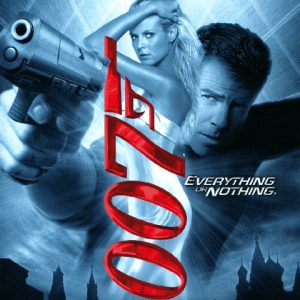
- 007: Everything or Nothing
- 007: Quantum of Solace
- 007: Blood Stone
- No One Lives Forever
- No One Lives Forever 2: A Spy in H.A.R.M.’s Way
- Tom Clancy’s Splinter Cell: Chaos Theory

Found something worth playing through DecideGame?
DecideGame.com is an independent gaming project run by Editor Zero. If this guide helped you discover a game, solve a problem, or find useful information, you can support DecideGame.com and help keep new and updated game guides coming.
DecideGame — PC Game Guides, Reviews & Setup Help