
📅 Game released: 2004
Use this updated 2026 Sonic Heroes PC guide to check its official availability status, understand why no verified digital PC download option is available, and set up a legitimately owned Windows copy with original system requirements, modern compatibility notes, widescreen, controller support, local multiplayer, and community mods.
 By Editor Zero — independently researched, edited, and maintained.
Last updated: 22 September 2026
Last reviewed: 22 September 2026
Table of Contents
- Quick Summary
- Quick Facts
- Official PC Stores, Download & Installation
- Sonic Heroes Review
- Pros & Cons
- PC System Requirements
- Frequently Asked Questions
- Similar Games
Sonic Heroes Quick Summary
✔ Fast 3D action-platformer built around three-character teams that switch instantly between Speed, Fly, and Power formations
✔ Four playable groups—Team Sonic, Team Dark, Team Rose, and Team Chaotix—reuse the same worlds with different difficulty, missions, characters, and progression goals
✔ Similar to Spider-Man: Shattered Dimensions through its colorful linear stages, character-specific abilities, arcade-style combat, platforming, and constantly changing movement challenges
✔ A native Windows PC edition exists, but there is no verified current official digital PC storefront; legitimate original retail copies remain the basis for native PC ownership
✔ Modern Windows systems can require compatibility work because common retail copies use SafeDisc and the original RenderWare/Direct3D 8 PC technology was designed for much older operating systems
✔ Community projects can improve widescreen presentation, controllers, loading behavior, visual consistency, and other weaknesses without changing the game’s core team-based design
Sonic Heroes Quick Facts
Official PC Store Status, Download & Installation
👇 Use the notes below to understand the current official PC availability status for Sonic Heroes and how a legitimately owned original Windows copy fits into a modern PC setup.
- Current store status: No current official Windows PC product page could be verified on Steam, Epic Games Store, GOG, or Microsoft/Xbox Store. GOG lists Sonic Heroes on its Dreamlist rather than as a purchasable store product.
- Original PC ownership: Sega released Sonic Heroes as a native Windows title on physical optical media. Used retail copies can still circulate, but aftermarket copies are not official Sega storefront offers, so check the edition, region, disc condition, and included media carefully.
- SafeDisc compatibility: Common original retail copies use SafeDisc 4 copy protection. That protection is not supported normally by modern Windows versions, so owning the original discs does not guarantee that the retail executable will launch unchanged on Windows 10 or Windows 11.
- Sonic PC Collection: PCGamingWiki documents an official Sonic PC Collection retail release containing a DRM-free Sonic Heroes executable. This is a historical physical release rather than a current digital purchase option, so availability depends on legitimate ownership of that edition.
- Modern Windows: Sonic Heroes uses old RenderWare and Direct3D technology. Community compatibility tools can help with newer operating systems, but avoid disabling important Windows security protections or replacing game executables with untrusted files simply to make an old retail release start.
- Display & controllers: The stock PC version is designed around 4:3 resolutions and DirectInput-era controllers. Community SH Essentials projects can add better widescreen handling, borderless display options, improved loading behavior, modern-controller support, and interface refinements.
- Local multiplayer: Sonic Heroes supports local split-screen two-player modes rather than online multiplayer. There is no cross-play, cross-save service, online account requirement, or modern cloud-save ecosystem attached to the original Windows edition.
- Steam Deck: Because Sonic Heroes has no Steam release, it has no Valve Deck rating or official SteamOS installation path. Treat any manually added legacy-PC setup as an unsupported community configuration rather than official Steam Deck support.
 Visit the Official Sonic Heroes Website

Sonic Heroes Review
Inventive team switching gives 3D Sonic a smart new rhythm, even when loose controls and repeated stages threaten to break it.
Sonic Heroes takes the speed of a 3D Sonic game and turns it into a three-character juggling act. Every team pairs a Speed, Fly, and Power character, and the best stages are built around changing leaders without losing momentum: sprint into a loop, switch to Flight to cross a gap, drop into Power to break through a barrier, then return to Speed before the route opens again. That constant switching is more than a gimmick. It gives familiar rails, springs, enemies, and alternate paths a light puzzle structure while keeping the game recognizably fast.
The idea is strong enough to carry a surprisingly varied campaign, but Sonic Heroes rarely executes it with the same precision it demands from the player. High-speed movement can become slippery near bottomless drops, the camera sometimes chooses poor angles at the worst moment, and combat can interrupt stages that are more enjoyable when they are flowing. Four teams also revisit the same broad set of environments, so the campaign gains mechanical variety without always providing fresh scenery or situations. Players who enjoy expressive arcade platformers and can accept rough edges will find a distinctive Sonic experiment here; those who need exact controls and consistently clean level flow may find the friction harder to forgive.
Team Switching Turns Speed Into Decision-Making
The Speed, Fly, and Power structure works because each role solves a different type of problem. Speed characters handle Homing Attacks, rails, loops, and routes built around momentum. Fly characters lift the other two members across gaps, reach elevated switches, and deal efficiently with airborne enemies. Power characters break heavy objects, absorb more of the combat workload, and provide the force needed for obstacles that stop the faster formations outright. Switching is immediate enough that the game can ask for all three within a few seconds.
Seaside Hill demonstrates the system at its cleanest. Long downhill runs and loops let Speed characters establish momentum, short aerial crossings introduce Flight without stalling the stage, and clusters of robots or blocked paths create obvious moments for Power. The result is a level that teaches through rhythm rather than through long explanations. Later stages complicate that rhythm by asking the player to recognize formation-specific cues while already moving quickly.
The more interesting part is that formations are not only keys for predetermined locks. They can also become tools for controlling risk. On narrow rail sections, switching to Flight before a difficult transition can make recovery feel less desperate than staying in a faster formation. Special Stages create a similar counterintuitive choice: although Speed seems like the obvious option for chasing a Chaos Emerald, Power can feel steadier and easier to position while collecting spheres. Those small decisions give experienced play more texture than simply switching whenever the level places a formation icon in front of the team.
The Best Stages Keep All Three Roles in Motion
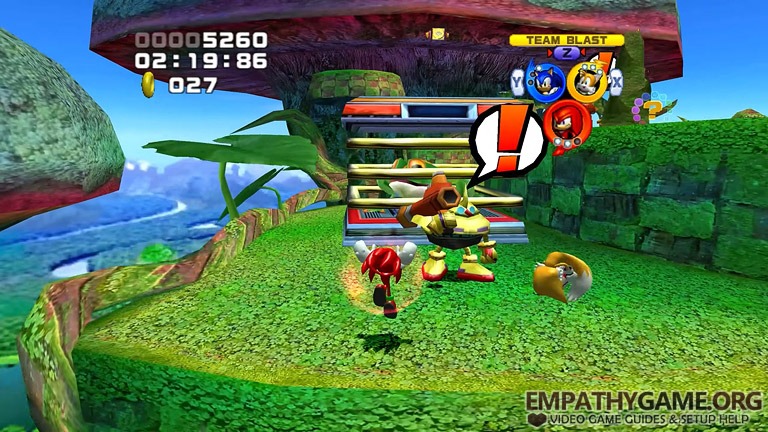
Sonic Heroes is strongest when level design treats formation changes as part of a continuous route rather than as separate mini-challenges. Grand Metropolis and Power Plant mix mechanical hazards, vertical movement, enemy groups, and high-speed stretches without losing their sense of forward direction. Frog Forest uses giant plants and environmental movement to create a softer, more vertical rhythm, while Hang Castle and Mystic Mansion use shifting architecture and gravity tricks to make familiar actions feel less predictable.
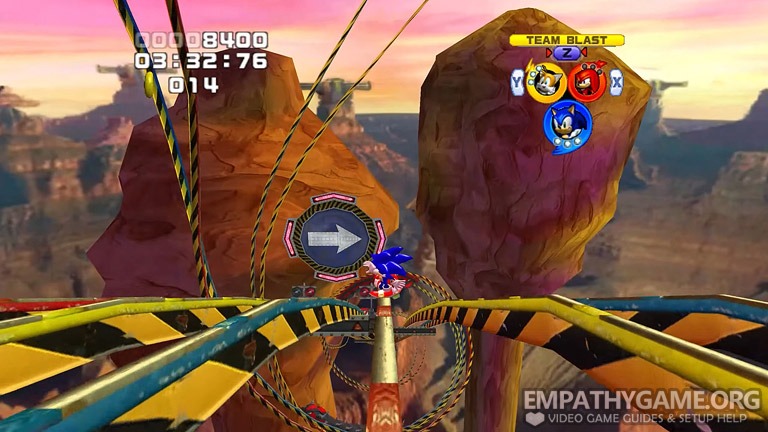
Rail Canyon is one of the clearest examples of the game’s ambition and its danger. Rail switching, gaps, enemies, and sudden changes in elevation create a spectacle that feels appropriately reckless for Sonic, but the stage also exposes how quickly excitement can become uncertainty. A missed input or awkward camera angle can turn a fast section into a fall before there is much chance to understand what went wrong. The level is memorable precisely because it sits on that line between thrilling and unstable.
Casino Park and BINGO Highway are even more divisive. Their pinball tables fit the bright arcade tone and provide a playful change of pace, but they also surrender some direct control at the moment the game is usually asking for rapid decisions. When the ball physics cooperate, the detour feels like a natural extension of Sonic’s momentum. When they do not, progress can feel dependent on bouncing into the right opening rather than executing a route deliberately. Sonic Heroes frequently produces this mixture: imaginative spaces that are easy to remember, paired with mechanics that are not always predictable enough to support them.
Combat Gives Formations Purpose but Often Slows the Game
Enemies help justify the three-role system. Flying targets encourage attacks from Fly characters, shields and heavy robots give Power a clear reason to exist, and Speed attacks are useful for rapidly moving between lighter threats. Power Cores strengthen the three roles during a stage, so a team that has collected several upgrades can dismantle encounters much faster than it could at the starting level.
That temporary progression creates a satisfying sense of acceleration, but the combat itself is less expressive than the movement. Longer encounters often reduce the pace to repeated attacks against enemies with larger health pools or defensive states. This is especially noticeable in later industrial stages, where the level may build momentum through rails or running sections and then ask the player to stop in an arena until a group of robots has been cleared. The problem is not that Sonic Heroes contains combat; it is that fighting works best as punctuation, while some later encounters treat it as the main event.
Team Blast provides an effective release valve. Filling the gauge through rings and combat allows the group to wipe out nearby enemies, and each team gives the move a different after-effect. Team Dark can freeze time for a short period, Team Rose can strengthen and protect its members, and Team Chaotix can turn destroyed enemies into a source of rings. These differences matter because they change when the move is most valuable rather than merely changing the animation. Team Chaotix, for example, can sometimes convert a dense enemy encounter into enough rings to help rebuild the gauge, making aggressive use of Team Blast part of its rhythm.
Loose Controls Make Failure Feel Harsher Than the Level Design Intends
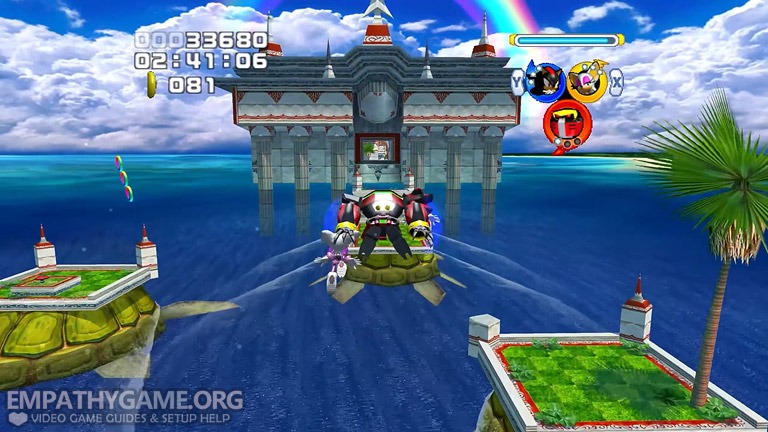
The largest weakness is not difficulty but trust. Sonic Heroes regularly asks for precision at high speed, yet movement can feel too loose for the narrow platforms, rail changes, and bottomless spaces surrounding many routes. Homing Attacks may favor a target the player did not intend, a sharp direction change can produce more movement than expected, and the camera does not always reveal the safest landing point quickly enough.
This matters because the game is at its best when the player commits to momentum. Once a few sudden deaths teach caution, it becomes tempting to slow down before jumps, switches, or rails that visually suggest speed. That creates an uncomfortable contradiction: the stage design celebrates reckless forward motion, while the controls sometimes reward hesitation. Flight formation can partially compensate in dangerous sections, but that is a useful workaround rather than evidence that the underlying movement is consistently precise.
The camera compounds the issue during combat and vertical platforming. It can lag behind turns, become crowded by the three-character formation, or make depth harder to judge when enemies and environmental hazards occupy the same space. None of these problems destroys the central concept, but together they explain why some failures feel arbitrary. Sonic Heroes is often more enjoyable once its roughness becomes familiar, yet familiarity should not be confused with polish.
Four Teams Change More Than Their Difficulty Labels Suggest
The four campaigns reuse the same worlds, but their differences are more meaningful than a simple easy-to-hard ladder. Team Sonic is the most balanced expression of the main formula. Team Rose shortens and softens many stages, making its route a gentler introduction. Team Dark increases enemy pressure and tends to demand more from combat. Team Chaotix changes the structure most dramatically by replacing ordinary goal-running with objectives such as collecting specific items, defeating targets, or completing unusual mission conditions.
Individual characters also prevent the teams from feeling like pure reskins. Amy can hover with her hammer in situations where Sonic or Shadow would approach movement differently, while Espio’s invisibility gives Team Chaotix a genuine stealth tool and changes how some objectives are solved. The distinct Team Blast effects reinforce those identities. These touches are easy to overlook when the shared Speed, Fly, and Power template is introduced, but they become important over a full set of campaigns.
Chaotix is also where the mission system reveals its biggest pacing problem. Searching for objects can be a welcome change from racing toward a Goal Ring, yet later stages are large enough that missing a small number of required items may force substantial backtracking. A route that initially rewards observation can become a slow search through already cleared spaces. The concept is worthwhile because it asks the player to read levels differently, but it works best when objectives complement forward movement rather than requiring exhaustive cleanup.
Story and Presentation Favor Energy Over Drama
The story keeps its ambitions modest. Team Sonic pursues another Eggman threat, Team Dark brings Shadow together with Rouge and Omega, Team Rose searches for missing friends, and Team Chaotix works for a mysterious client. The separate routes repeatedly cross before converging, giving the large cast enough motivation to share locations without turning the campaign into a heavy plot-driven adventure.
That lighter structure suits the game’s arcade pace. Character interactions are broad, quick, and personality-driven rather than subtle, and the repeated stages make more sense when the focus remains on each team’s perspective rather than on four completely different narratives. Team Dark carries the most obvious intrigue because of Shadow’s situation, while Chaotix benefits from the comedy and mystery of its job-based setup.
The presentation is loud in both good and bad ways. Seaside Hill’s blue water and sweeping stone loops, Frog Forest’s giant vegetation, Hang Castle’s impossible architecture, and Final Fortress’s mechanical scale give the game a strong visual identity. The soundtrack matches that confidence with energetic rock and electronic tracks that push stages forward. Voice cues are less successful. Characters constantly call out enemies, switches, formations, and actions, so useful information quickly becomes repeated chatter. The noise fits the game’s personality, but long sessions can make it exhausting.
Replayability Rewards Mastery More Than Novelty
Completing four stories is only one layer of the structure. Challenge missions give each team a recurring second objective pattern: Team Sonic leans toward time pressure, Team Dark toward enemy-clearing demands, Team Rose toward ring collection, and Team Chaotix toward tougher versions of its mission-based objectives. These variations make familiar stages behave differently even when the environment itself is unchanged.
Ranks and Emblems give score-focused players another reason to refine routes, preserve upgrades, and learn where a risky shortcut saves enough time to matter. Special Stage Keys add tension because taking damage can cost access to the Emerald chase, turning otherwise optional enemy encounters or hazardous shortcuts into meaningful decisions. The Special Stages themselves are less precise than the main platforming, but experimenting with formation choice can make them more manageable and adds another small layer of technique.
The weakness is obvious: mastery and repetition are inseparable here. Anyone chasing A Ranks, Chaos Emeralds, extra missions, and later unlocks will revisit the same stage themes many times. For players who enjoy learning routes and turning messy first attempts into cleaner runs, that repetition has purpose. For players primarily motivated by new environments and set pieces, the four-team structure can make the campaign feel stretched. Local competitive modes add another diversion, but the strongest long-term appeal still comes from improving performance in the single-player stages rather than discovering completely new content.
Final Verdict
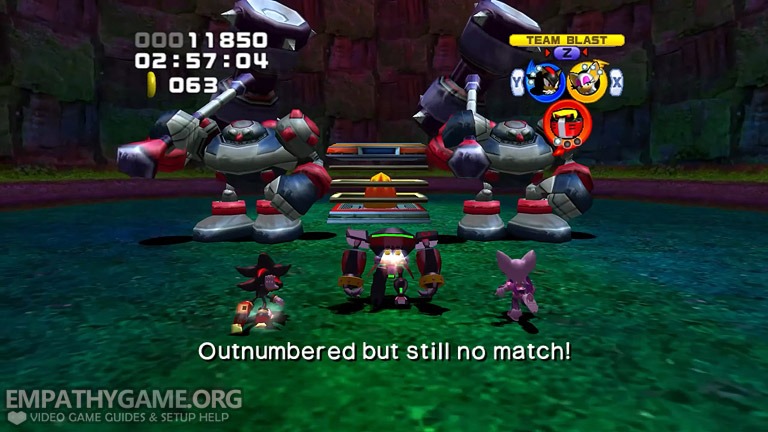
Sonic Heroes succeeds because its central mechanic changes the way a 3D Sonic stage is read. Speed, Fly, and Power are not just three attack styles; they turn movement into a chain of quick decisions about momentum, height, combat, and safety. When a stage such as Seaside Hill, Grand Metropolis, or Frog Forest lets those decisions flow together, the game feels inventive, immediate, and unlike any other entry built around a single playable character.
Its limitations come from execution rather than a lack of ideas. Loose movement, an unreliable camera, heavy combat encounters, noisy voice cues, and repeated environments make the four-campaign structure more tiring than it needs to be. Team Chaotix demonstrates both sides of the design particularly well: its objectives and character-specific abilities create genuinely different play, yet a missed collectible can turn variety into tedious backtracking.
For players who enjoy arcade platformers, route learning, score chasing, and the slightly unruly feel of early 3D Sonic, those imperfections are unlikely to erase the appeal. Sonic Heroes remains a game of strong ideas fighting against inconsistent control, but the formation system gives its best stages enough personality and tactical rhythm to remain memorable long after the roughest moments are forgotten.
Sonic Heroes Pros & Cons
Sonic Heroes PC System Requirements
These are Sega’s surviving official requirements for the original Windows PC release. They describe period hardware and operating systems rather than guaranteed compatibility with a modern Windows computer.
MINIMUM:
OS: Windows 98 SE / Me / 2000 / XP; Sega’s Japanese specification requires Windows 2000 Service Pack 2 or later
CPU: Intel Pentium III 866 MHz or higher
RAM: 128 MB or more
GPU: Direct3D-compatible graphics card with 32 MB VRAM or more
DirectX: DirectX 9.0b
Storage: 800 MB or more available space
Sound Card: DirectSound-compatible sound hardware
RECOMMENDED:
OS: Windows 98 SE / Me / 2000 / XP; Sega’s Japanese specification requires Windows 2000 Service Pack 2 or later
CPU: Intel Pentium 4 1.4 GHz or higher
RAM: 256 MB or more
GPU: Direct3D-compatible graphics card with 64 MB VRAM or more
DirectX: DirectX 9.0b
Storage: 1.5 GB or more available space
Sound Card: DirectSound-compatible sound hardware
Additional PC Performance and Setup Notes
- The official requirements are historical specifications, not a promise that the original retail release will install and launch unchanged on Windows 10 or Windows 11.
- The common two-disc retail version uses SafeDisc 4. Modern Windows no longer provides normal support for the legacy SafeDisc driver, so installation success and game-launch success are separate issues.
- The game renders through Direct3D 8 despite requiring DirectX 9.0b as part of its original software environment. Compatibility wrappers are commonly used by the PC community when addressing display and rendering behavior on newer systems.
- The stock configuration focuses on 4:3 resolutions up to 1280×960. SH Essentials: Graphics and related community projects can provide modern widescreen, borderless-window, interface, and high-aspect-ratio improvements.
- Single-player can run at up to 60 FPS through the original launcher settings, while split-screen multiplayer uses a 30 FPS frame-skipping behavior by default. Community fixes can change the split-screen presentation.
- The original controller implementation is DirectInput-based. Modern Xbox-style XInput controllers can work imperfectly without additional configuration, particularly for camera controls, vibration, hot-plugging, and button behavior.
- Back up the Sonic Heroes save and configuration data before installing mods or changing compatibility tools. Community improvements can depend on specific loaders, dependencies, and mod order.
- Windows 11 systems using newer revisions can expose additional RenderWare compatibility issues, so troubleshoot the rendering/audio layer separately from SafeDisc-related launch problems.
Official Trailer
Note: A suitable original Sega YouTube trailer is not available to embed, so this archival IGN gameplay video is used to show Sonic Heroes’ team switching, high-speed stages, platforming, and combat; the written guide adds the native Windows release status, compatibility, system requirements, controllers, widescreen, and modding information.
Frequently Asked Questions
Is Sonic Heroes worth playing in 2026?
Yes, especially if you enjoy fast 3D platformers with colorful stages, alternate routes, arcade scoring, and an unusual team-switching mechanic. Its slippery movement, repeated stages across four campaigns, and older PC compatibility issues require patience, but the core Speed/Fly/Power system still gives it an identity that few other Sonic games share.
Which team should I play first in Sonic Heroes?
Team Rose is the easiest starting point because its stages are generally shorter, contain fewer demanding encounters, and introduce the mechanics more gently. Team Sonic is a better first choice for experienced Sonic players who want the game’s more typical difficulty and stage length.
What is the difference between Team Sonic, Team Dark, Team Rose, and Team Chaotix?
Team Sonic provides the balanced standard campaign, Team Dark uses tougher layouts and more enemies, and Team Rose offers shorter and easier versions of the stages. Team Chaotix changes the structure most dramatically by replacing simple goal-reaching with objectives such as collecting items, defeating specific enemies, or completing special mission conditions.
How do Speed, Fly, and Power formations work?
Speed characters such as Sonic and Shadow handle fast traversal, rails, Homing Attacks, and speed-specific routes; Fly characters such as Tails and Rouge carry the team across gaps and attack airborne enemies; Power characters such as Knuckles and Omega specialize in combat and breaking heavy obstacles. Switching formations at the right moment is the central mechanic of Sonic Heroes.
How does Team Blast work?
Actions such as collecting Rings and defeating enemies fill the Team Blast Gauge. Once full, Team Blast unleashes a powerful team-specific attack that is especially useful against groups of enemies and during certain boss encounters, after which the gauge must recharge.
What do Level-Ups and Power Cores do?
Blue, yellow, and red Power Cores strengthen the Speed, Fly, and Power characters respectively, with each character able to reach Level 3. Higher levels improve attacks and some movement abilities, but the upgrades are temporary and reset when beginning a new stage or losing a life.
Why does Team Chaotix play differently from the other teams?
Team Chaotix stages are mission-based rather than simply asking you to reach the Goal Ring. Espio, Charmy, and Vector may need to locate objects, destroy targets, rescue something, avoid detection, or satisfy another stage-specific condition, making their campaign more exploration-heavy and sometimes more demanding to replay.
How do Special Stage Keys work in Sonic Heroes?
A Special Stage Key can be found inside an action stage, and you must still be carrying it when you reach the Goal Ring to enter a Special Stage. Taking damage causes the key to be lost, so protecting it is often more important than rushing through the rest of the level.
How do you get the seven Chaos Emeralds?
Chaos Emeralds are earned through the Emerald Challenge versions of the Special Stages. Reach the appropriate Special Stage while carrying a key, collect spheres to build your dash gauge, avoid hazards, and catch the moving Emerald before it reaches the end.
Do I need to collect all seven Chaos Emeralds with the same team?
No. Chaos Emerald progress belongs to the overall save, so different teams can contribute to the complete set. This means you can use whichever team feels easiest for a particular Special Stage rather than earning seven separate sets.
How do you unlock the Final Story in Sonic Heroes?
Complete the stories for all four teams and collect all seven Chaos Emeralds. Once both requirements are satisfied, the Final Story becomes available from the story-selection screen and leads to the game’s true final confrontation.
Can you play as Super Sonic in Sonic Heroes?
Yes, but not as a normal selectable form for standard action stages. Sonic’s super-powered appearance is tied to the Final Story and its climactic battle, which must first be unlocked by finishing all four campaigns and collecting the seven Chaos Emeralds.
What are Emblems used for?
Emblems are completion rewards earned from stages and additional missions, and they gradually unlock more of the local two-player content. There are 120 in total, so collecting them also functions as one of the game’s main long-term completion goals.
What do A Ranks unlock in Sonic Heroes?
A Ranks are the highest stage ranking and are primarily a completion challenge rather than something required to see the main ending. Collecting every Emblem and earning A Ranks across the required missions unlocks Super Hard Mode, which sends Team Sonic through significantly harder versions of the action stages.
Does Sonic Heroes have co-op?
No. The four story campaigns are single-player and do not allow two people to control members of the same team cooperatively.
Does Sonic Heroes have split-screen or local multiplayer?
Yes. The PC version includes local two-player competitive modes in which each player controls a complete three-character team; most use split-screen, while Team Battle places both teams in the same shared arena view. The multiplayer is competitive rather than campaign co-op.
How do you unlock more two-player modes?
Action Race is available first, and another multiplayer mode becomes available for every 20 Emblems collected in single-player play. Continuing toward all 120 Emblems eventually unlocks the full selection of competitive modes, including Battle, Special Stage, Ring Race, Bobsled Race, Quick Race, and Expert Race.
Does Sonic Heroes support online multiplayer, LAN, or crossplay?
No. Its multiplayer was designed for two players on the same system, with no official online matchmaking or LAN mode. Because there is no network multiplayer, crossplay and cross-progression are not applicable.
Is Sonic Heroes available on Steam or another official PC digital store?
No verified current Sega-authorized digital Windows release is available through Steam, Epic Games Store, GOG, or the Microsoft Store. Sonic Heroes did receive a native Windows retail edition, so PC ownership is based on legitimate physical releases rather than a modern official storefront download.
Does Sonic Heroes work on Windows 10 and Windows 11?
The native PC game can work on modern Windows, but it was designed for much older operating systems and should not be expected to run unchanged on every PC. SafeDisc protection on common retail editions is a major compatibility obstacle, while the old Direct3D 8/RenderWare graphics layer can also require modern compatibility work; avoid untrusted replacement executables or DRM-bypass downloads.
Does Sonic Heroes support modern Xbox or PlayStation controllers on PC?
The original PC version uses DirectInput rather than modern XInput conventions. Some Xbox and PlayStation controllers provide basic functionality, but right-stick camera control, vibration, hot-plugging, button mappings, or DualSense input can require established community controller tools such as the SH Essentials controller components.
Does Sonic Heroes support widescreen or ultrawide monitors?
Not properly in the unmodified PC release, which is primarily designed around 4:3 resolutions up to 1280×960. Community projects such as SH Essentials: Graphics and Widescreen Revamp can provide modern widescreen, high-aspect-ratio UI, borderless-window, and related presentation improvements, but these are unofficial modifications rather than Sega-supported features.
Can Sonic Heroes be modded on PC, and what should I back up first?
Yes. Reloaded-II and projects such as SH Essentials and Sonic Heroes: Fixed Edition support widescreen improvements, controller changes, bug fixes, visual adjustments, and other community modifications; follow each project’s compatibility instructions carefully. Before changing the installation, back up the game’s configuration and save data stored under %APPDATA%\Sega\SONICHEROES, including the SONICHEROES_* save files.
Still have questions? Check the Sonic the Hedgehog Reddit community, Sonic Retro forums, or the PCGamingWiki Sonic Heroes page for additional community discussion and PC compatibility help.
Sources & References
Key factual and technical information in this guide was checked against relevant official and community sources, including:
- SEGA — Official Sonic Heroes Website — original Windows release information, supported operating systems, higher-resolution PC presentation, input options, and official game details
- SEGA — Sonic Heroes PC Requirements — official minimum and recommended Windows hardware requirements and original compatibility notes
- PCGamingWiki — Sonic Heroes — retail DRM, modern Windows compatibility, resolutions, frame-rate behavior, controller support, save/configuration locations, and community PC improvements
- MobyGames — Sonic Heroes Releases — regional Windows release history, publishers, physical PC editions, and copy-protection records
- Metacritic — Sonic Heroes PC Critic Reviews — PC Metascore and the archived IGN PC review score used in Quick Facts
- GOG Dreamlist — Sonic Heroes — confirmation that Sonic Heroes is requested through GOG’s Dreamlist rather than offered as a current GOG store product
Similar Games Like Sonic Heroes
- Jet Set Radio Future
- Spider-Man: Shattered Dimensions
- Kingdom Hearts 3
- Harry Potter and the Prisoner of Azkaban
- The Simpsons Game
- The Simpsons: Hit & Run


Found something worth playing through DecideGame?
DecideGame.com is an independent gaming project run by Editor Zero. If this guide helped you discover a game, solve a problem, or find useful information, you can support DecideGame.com and help keep new and updated game guides coming.
DecideGame — PC Game Guides, Reviews & Setup Help