
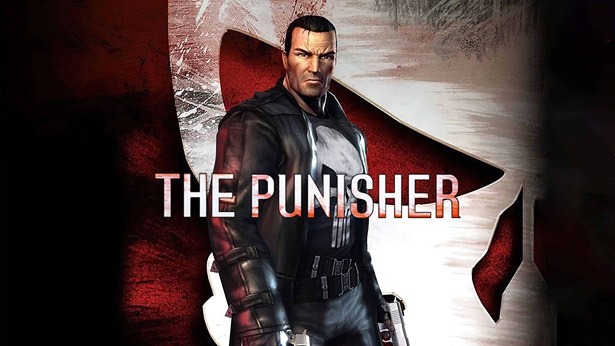
Use this updated 2026 The Punisher PC guide to check official download availability, retail ownership, system requirements, widescreen fixes, mods, and modern Windows setup before returning to Frank Castle’s war on crime.
 By Editor Zero — independently researched, edited, and maintained.
Last updated: 1 October 2026
Last reviewed: 1 October 2026
Table of Contents
- Quick Summary
- Quick Facts
- Official PC Stores, Download & Installation
- The Punisher Review
- Pros & Cons
- PC System Requirements
- Frequently Asked Questions
- Similar Games
The Punisher (2005) Quick Summary
✔ Single-player third-person action shooter following Frank Castle through a violent campaign against organized crime, built around firearms, human shields, interrogations, Quick Kills, and environment-specific interactions
✔ Interrogating captured enemies can reveal information and restore health, while marked Special Interrogation areas turn objects and locations inside each mission into part of Frank’s intimidation toolkit
✔ Similar to Deadpool through its Marvel antihero focus, linear third-person action, firearms, close-range attacks, dark humor, and deliberately excessive comic-book violence
✔ The native Windows version exists, but no current official digital PC storefront was verified; PCGamingWiki lists the original PC edition as a retail release protected by SecuROM 5
✔ The original Direct3D 8.1 PC build predates modern widescreen displays, while community fixes can improve resolution, aspect ratio, field of view, and frame-rate behavior
The Punisher (2005) Quick Facts
Official PC Store Status, Download & Installation
👇 Use the notes below to understand the current official PC availability status for The Punisher and set up a legally owned retail copy without relying on unsafe or unofficial acquisition sources.
- Official PC availability: No current official digital Windows storefront or publisher download page for Volition’s 2005 game was verified. PCGamingWiki lists the Windows edition as a retail release.
- Retail ownership: The native PC version was distributed on physical media. This guide is intended for readers using a legitimately owned copy and does not provide or link to third-party copies of the commercial game.
- GOG status: GOG has a Dreamlist entry where players can vote to bring The Punisher to the store, rather than a current purchasable GOG release.
- Legacy DRM: The retail Windows edition uses SecuROM 5. Because the copy protection and supported operating systems come from the Windows 98/ME/2000/XP era, modern systems can require additional compatibility troubleshooting.
- Modern display setup: The original game uses Direct3D 8.1 and was not designed around today’s widescreen and ultrawide resolutions. The community Widescreen Fixes Pack adds resolution, aspect-ratio, HUD, FOV, video-scaling, and intro-skip adjustments.
- Frame-rate behavior: PCGamingWiki documents aiming and interrogation problems that can be addressed with the ThirteenAG fix and recommends a 60 FPS limit when necessary. Testing at 60 FPS is a sensible starting point before experimenting with higher refresh rates.
- Community modifications: Mods and compatibility fixes are unofficial and version-dependent. Back up configuration and save data before changing executable-adjacent files, wrappers, or graphics fixes.

The Punisher (2005) Review
Brutal interrogations give an ordinary shooter a ruthless identity its gunplay cannot sustain alone.
The Punisher is at its best when a firefight ends with one criminal still breathing. Volition’s third-person shooter has familiar early-2000s foundations—corridors, arena-like rooms, health management, weapon pickups and waves of disposable enemies—but Frank Castle changes what happens inside that structure. A survivor can become a human shield, a source of intelligence, a way to recover health, or the unwilling centrepiece of an environmental interrogation. The result is not a sophisticated tactical shooter, and its artificial intelligence, camera and repeated encounter pattern expose its age. What keeps it distinctive is the way almost every major system asks a very Punisher-like question: is this enemy more useful dead, frightened or dragged to the next hazard?
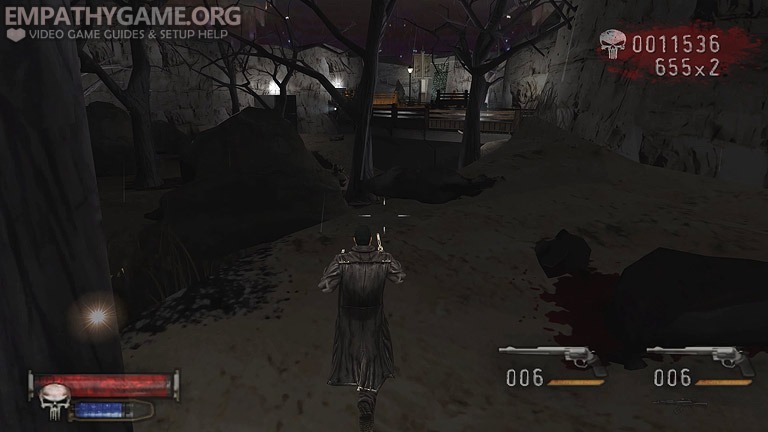
That commitment matters more than technical polish. Plenty of licensed action games can be reduced to a familiar genre template with a recognizable character placed on top. Here, Frank’s methods shape combat, scoring, level design and progression. The game eventually repeats itself, but it rarely forgets who its protagonist is.
Interrogation Is the System That Defines the Game
A typical encounter starts conventionally. Frank enters a room, identifies armed threats, uses pistols, rifles, shotguns or heavier weapons to thin the group, then closes on whoever remains. Grabbing an enemy changes the rhythm immediately. The captive can absorb incoming fire as a human shield, be killed with a Quick Kill, or be interrogated by applying enough pressure to push a fear meter into its breaking zone without going too far. Breaking a criminal restores health, and marked targets can reveal information that changes what happens next in the mission.
This turns health recovery into a behaviour rather than a pickup hunt. Taking damage does not simply send Frank searching for a medkit; it creates an incentive to preserve one enemy long enough to extract something from him. That makes the last few seconds of a gunfight more interesting than the first. Killing everyone efficiently may leave Frank wounded, while deliberately isolating one target can restore him for the next room. Human shields create another tradeoff: they reduce mobility, but they let Frank keep shooting while carrying protection through a dangerous doorway.
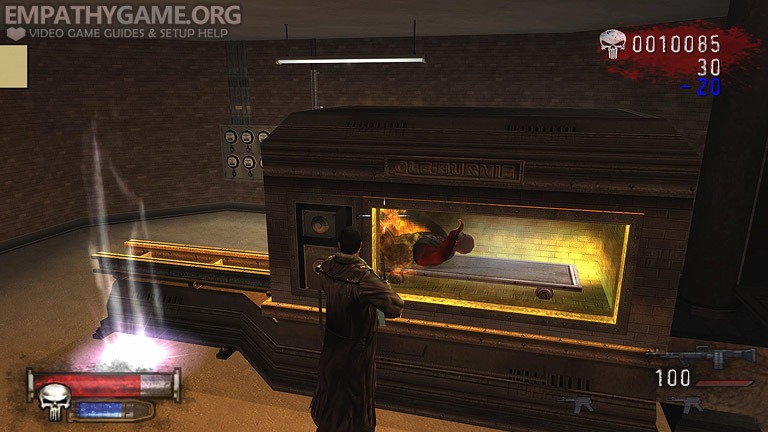
Special Interrogation areas are the system’s most successful extension because they make location matter. The chop shop, funeral home, zoo, Gnucci Estate, docks and industrial facilities do not merely change the wallpaper. Machinery, furnaces, animals, tools and other hazards become intimidation devices, turning a glowing interaction point into a small piece of environmental storytelling. These moments are often grotesque, but mechanically they serve an important purpose: they interrupt the ordinary run-and-gun loop with something specific to the room Frank has entered.
The standard interrogations are less durable. Four basic methods recur frequently, and once their animations and timing become familiar, the process can feel like maintenance between firefights. On PC, the mouse makes the pressure mechanic especially delicate because the player must continually correct the input without accidentally crossing the fatal threshold. That friction matters more than it would in a cosmetic minigame because interrogation is tied to health and information. The mechanic is conceptually strong; its repeated execution is not always graceful.
Gunplay Is Competent, but the Arsenal Does Not Progress Cleanly
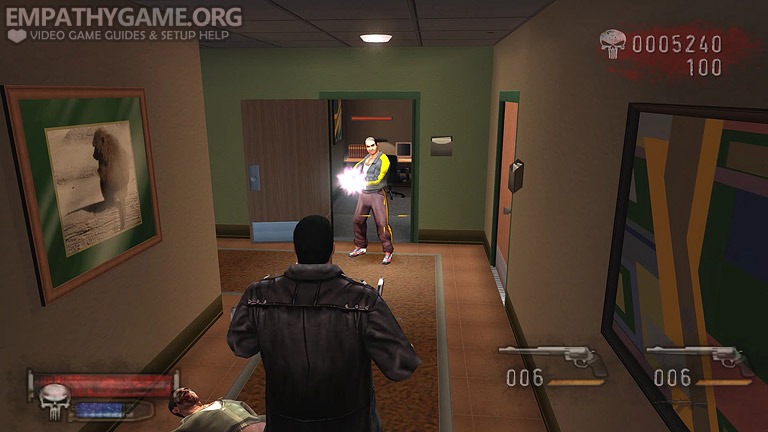
Shooting is solid enough to support the interrogation system without becoming a reason to play on its own. Headshots are effective, dual-wielding gives close-range fights some excess, and the range of pistols, submachine guns, assault rifles, shotguns, grenades and heavier weapons prevents the campaign from relying on a single firearm class. Frank can also enter Slaughter Mode after filling its meter, dropping his guns in favour of knives while becoming much more dangerous at close range and recovering health. It works best as an emergency reversal when a room has become chaotic rather than as a deep combat stance.
Enemy behaviour is the larger limitation. Thugs frequently expose themselves, hold weak positions or attack in numbers without creating convincing pressure through coordination. That makes aggression and accurate headshots more reliable than careful tactical manipulation. Human shields and cover still matter, especially later when incoming damage rises, but the opposition rarely feels clever enough to force the full toolkit. The game gives Frank more interesting options than most enemies deserve.
Weapon progression is also less straightforward than the unlock order suggests. Later guns can offer larger magazines or greater raw damage without necessarily becoming better choices in real encounters. Mid-campaign rifles can remain unusually practical because their hit reactions interrupt enemies and reduce return fire, while the late automatic shotgun trades power for a short effective range that does not suit every late-game space. That creates an unintentionally interesting hierarchy: the newest weapon is not always the one worth keeping.
Upgrades follow the same pattern. Extra armour, accuracy, ammunition capacity and a longer Slaughter Mode are easy to understand, while weapon attachments can alter how certain guns behave. Those additions are not universally better for every play style; a scope, for example, can make a familiar rifle feel less comfortable to aim for someone who preferred its earlier handling. Progression therefore improves Frank statistically while occasionally making equipment choice more subjective than the upgrade menu implies.
The Best Levels Give Frank Room to Hunt
Most missions are linear, but the campaign is more flexible than a simple corridor shooter when its spaces widen. Central Zoo is a good example. Offices lead into rainforest-themed areas, animal exhibits and larger combat spaces, giving the mission a different texture from the enclosed interiors that dominate elsewhere. The Gnucci Estate mixes outdoor approaches, interior routes and contextual hazards, giving Frank more space to control how a fight begins than many of the campaign’s tighter rooms.
In these broader spaces, Frank’s close-range tools can support an almost stealth-like approach. There is no elaborate detection simulation and the game eventually expects gunfire, but careful movement can let Frank isolate targets, use melee or Quick Kills and reduce a group before the encounter becomes loud. That possibility is important because it reveals a more interesting version of the combat system: one where positioning determines which enemy becomes a shield, which target can be removed quietly and which route exposes Frank to the fewest guns.
Unfortunately, many rooms fall back into the same sequence of entering, shooting, grabbing, healing and moving on. Special Interrogations disguise the repetition for a while because each new environment promises another contextual threat, but the underlying mission verbs change less than the scenery. Tight interiors can also work against the camera, particularly when several enemies crowd a doorway or corridor. The game is most enjoyable when the level layout lets Frank choose how to begin violence rather than simply asking him to survive another rectangular room full of gunmen.
Difficulty is similarly uneven. Much of the campaign is approachable once headshots, shields and interrogation healing become routine, then certain encounters sharply increase pressure by forcing Frank to hold a position or absorb sustained waves. Bosses vary for the same reason. The Russian’s apartment fight is memorable because the environment itself becomes the solution, while other bosses lean more heavily on repeated shooting, spawned enemies or a single gimmick. The peaks are not always difficult for the same reasons as the rest of the game.
The Story Understands Frank Better Than It Understands Restraint
The campaign is framed by Frank being questioned at Ryker’s Island by detectives Martin Soap and Molly von Richthofen. Missions unfold as flashbacks explaining how he arrived there, beginning with street criminals and the Gnucci family before expanding into Russian mercenaries, the Yakuza and increasingly comic-book-scale threats. The structure gives the story permission to jump between criminal factions and exaggerated villains without pretending Frank is participating in a carefully paced police procedural.
Garth Ennis and Jimmy Palmiotti’s involvement is felt less through elaborate plotting than through tone. The writing moves between deadpan cruelty, black humour, grotesque criminals and sudden Marvel appearances. Ma Gnucci, the Russian, Kingpin, Bullseye, Black Widow, Nick Fury and Iron Man can enter the story without turning it into a parade of guest stars, because Frank remains emotionally blunt and functionally obsessed with the next target. Thomas Jane’s restrained delivery helps. He rarely sounds impressed by the chaos around him, which suits a character who treats outrageous violence as routine work.
That restraint gives smaller details more weight. Frank’s apartment is not only a mission menu; the armory lets him comment on individual weapons, giving his fixation on firearms a little character outside combat. Joan’s presence and the domestic interruption of the Russian’s attack also create a useful contrast with the larger gang war. These touches do more for Frank than long speeches would. The game is not a deep psychological study, but it understands that his personality is expressed through habits, priorities and clipped reactions.
Scoring Creates a Strange Argument With the Character
Mission performance feeds directly into progression. Interrogations, kills and other actions generate points that can be spent on upgrades, while medal thresholds encourage cleaner, more efficient runs. The interesting contradiction is that the scoring system sometimes rewards behaviour that feels less like Frank Castle than the mechanics around it. Successfully breaking a captive is valuable; executing that captive during the interrogation can cost points. Mechanically, the game is asking for control. Thematically, it has spent the rest of the campaign celebrating ruthlessness.
That tension is weakened further by the rules themselves. A captive can be broken, released so the interrogation reward is secured, then grabbed again and killed afterward. The sequence exposes scoring as a layer sitting on top of the fiction rather than a moral system that convincingly interprets Frank’s actions. It is a small loophole, but a revealing one: the game wants to grade brutality without ever finding a completely consistent way to do so.
Points still make mission performance matter because upgrades are expensive enough to encourage stronger runs. The system also gives repeat visits a purpose beyond nostalgia. Improving accuracy, armour or ammunition capacity can make later missions smoother, while medal chasing asks the player to combine speed, interrogations and damage avoidance more deliberately than a casual first run requires. The downside is that score pressure can make an otherwise expressive combat system feel prescriptive when one mistake destroys a strong multiplier.
Replayability Is Better Than the Linear Campaign Suggests
Frank’s apartment ties the campaign together as a functional hub. The War Zone menu allows completed missions to be revisited, upgrades can be purchased between operations, and the armory gradually becomes a record of the weapons collected along the way. Challenge Mode remixes campaign spaces around specific restrictions or performance goals, while Crime and Punishment stages turn selected areas into arcade-like survival encounters built around escalating waves and score targets.
Those modes give the game more afterlife than its fixed story would otherwise have. Replaying a mission for a better medal can change priorities: a room that was previously survived through cautious cover may become a route to optimize for multiplier preservation, interrogation opportunities and faster kills. Challenges push the systems further by demanding accuracy or specific actions rather than merely increasing enemy health.
Still, replayability depends on tolerance for the same combat grammar. New medals, upgrades, comic covers, concept art and other extras provide goals, but they do not fundamentally transform the campaign. Weak enemy AI and the repetition of standard interrogations become more noticeable once the surprise of the contextual kills has faded. The game rewards mastery, but it does not offer radically different builds or branching missions to make a second run feel like a different campaign.
Final Verdict
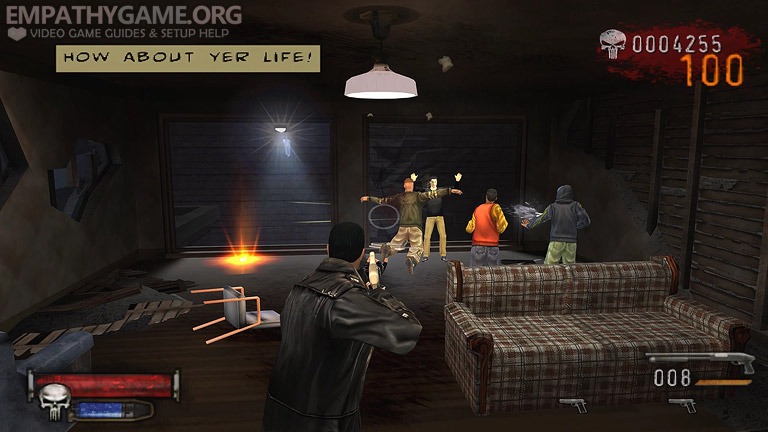
The Punisher is a conventional third-person shooter made memorable by how aggressively it bends convention around Frank Castle. Interrogations affect health, information and scoring; human shields reshape room entry; environmental hotspots turn scenery into threats; Quick Kills and Slaughter Mode keep combat brutally close to the character’s identity. When a level gives those systems enough space, the game becomes more flexible and predatory than its corridor-shooter structure initially suggests.
Its weaknesses are equally clear. Enemy AI rarely matches Frank’s toolkit, PC interrogation controls can be finicky, weapon progression is uneven, some upgrades are more debatable than they appear, and the repeated shoot-grab-interrogate rhythm eventually becomes predictable. The story is more successful as a hard-edged Punisher adaptation than as a complex crime narrative, but Thomas Jane’s performance, the Ennis-and-Palmiotti tone and the Marvel cast give it unusual personality for a licensed shooter.
For players who value precise modern gunplay, sophisticated enemy tactics or constantly changing mission objectives, its age will be difficult to ignore. For anyone interested in a focused single-player action game that genuinely builds its protagonist into the mechanics, it remains distinctive. Volition did not reinvent the third-person shooter; it found a convincing way to make one behave like The Punisher.
The Punisher (2005) Pros & Cons
The Punisher PC System Requirements
OFFICIAL WINDOWS PC REQUIREMENTS:
MINIMUM:
OS: Windows 98 SE / ME / 2000 / XP
CPU: Intel Pentium III 1.0 GHz or AMD Athlon XP 1.0 GHz
RAM: 128 MB
GPU: 64 MB VRAM DirectX 8.1-compatible graphics card with hardware transform and lighting
DirectX: DirectX 8.1
Storage: 2 GB free space
Sound Card: DirectX 8-compatible sound card
RECOMMENDED:
CPU: Intel Pentium 4 2.0 GHz or equivalent
RAM: 256 MB
GPU: Nvidia GeForce 4 or ATI Radeon 8500 equivalent with 128 MB VRAM
DirectX: DirectX 8.1
Additional PC Performance and Setup Notes
These specifications describe the original retail PC release rather than a modern remaster. Modern hardware easily exceeds the original performance requirements, but compatibility is a separate issue because the game is a 32-bit Direct3D 8.1 title designed for early-2000s Windows versions.
For modern displays, the unofficial The Punisher Widescreen Fix can add native widescreen and ultrawide resolutions, correct aspect-ratio scaling, adjust field of view, improve HUD and FMV scaling, and provide a configurable frame-rate limit. PCGamingWiki also notes that Direct3D 8 games on Windows 10 and newer can require a display wrapper for working VSync.
If aiming or interrogation controls behave incorrectly at high frame rates, test the game at a 60 FPS limit before changing other settings. Very high resolutions can also leave some original HUD or menu elements unusually small or overlapping.
Official Trailer
Note: This IGN-hosted trailer shows the original 2005 game’s third-person combat and interrogation-focused action; the written guide above adds Windows availability, ownership, requirements, and modern-PC setup context.
Frequently Asked Questions
Is The Punisher (2005) worth playing in 2026?
Yes, especially for players who want a dark, linear third-person shooter built around Frank Castle’s unusual interrogation, human-shield, Quick Kill, and Slaughter Mode mechanics. Its shooting, AI, controls, and PC compatibility show their age, but the Punisher-specific systems still give it an identity that most licensed action games never attempted.
Is The Punisher (2005) an open-world game?
No. The campaign is built from 16 separate missions selected through Frank’s apartment rather than one freely explorable city. The apartment also serves as a hub for weapons, upgrades, replaying missions, challenges, and unlocked extras.
Is The Punisher (2005) based on the 2004 movie?
Only partly. The game mixes ideas connected to the 2004 film with material from Punisher comics such as Welcome Back, Frank, while Thomas Jane returns to voice Frank Castle; it is not a direct retelling of the movie.
How do interrogations work in The Punisher?
After grabbing an enemy, Frank can enter an interrogation and apply pressure while keeping the intimidation meter around the target’s breaking point. Successfully breaking an enemy can provide information and restore some health, while using too much pressure can kill the captive before the interrogation succeeds.
Do you need to interrogate every enemy?
No. Ordinary enemies often provide generic dialogue, while specially marked enemies can reveal useful information, objectives, routes, or other mission-specific details. Interrogating everyone is therefore unnecessary unless you are chasing score, health, or collectible information.
What is the difference between Special Interrogations and Special Kills?
Special Interrogations place a captive into an environment-specific interrogation involving an object or location in the level, while Special Kill areas are contextual executions. Special Interrogations still use the break mechanic, whereas Special Kills are designed as direct scoring opportunities.
Why do some interrogation executions turn black and white?
That visual treatment is intentional rather than a graphics problem. Violent interrogation sequences were altered with black-and-white effects and camera changes so the retail game could receive a Mature rating instead of the more restrictive Adults Only rating.
Is there an official uncensored version of The Punisher?
There was no normal retail “uncut edition” that restored all of the material altered for the Mature-rated release. Community PC modifications can change effects such as the black-and-white interrogation filter, but those modifications are unofficial.
Does killing someone during an interrogation reduce your score?
Yes. Executing a captive directly during an interrogation can deduct points, even after the enemy has already broken. Players pursuing high mission scores can instead end the interrogation and use another legitimate combat action afterward.
How do Style Points and upgrades work?
Combat actions, Quick Kills, successful interrogations, environmental kills, and sustained combinations contribute to the mission score. Points earned from improved mission performances can be spent at Frank’s apartment on upgrades affecting survivability, weapons, ammunition, and other abilities.
What is Slaughter Mode in The Punisher?
Slaughter Mode is a temporary power state charged by defeating enemies. Frank puts away his firearms, moves much faster, attacks with knives, slowly recovers health, and becomes more resistant to damage until the Slaughter meter is depleted.
What are Challenge and Punishment modes?
Challenge Mode reuses campaign areas with specific restrictions or objectives such as accuracy, time limits, headshots, interrogations, or environmental kills. Punishment Mode is more arcade-like and focuses on surviving waves of enemies while reaching a required score; these bonus modes become available through campaign progress and mission performance.
Can you replay missions in The Punisher?
Yes. The War Zone menu in Frank’s apartment lets you return to unlocked missions, making it possible to improve medals, raise scores, complete challenges, and collect more extras. There is no separate modern-style New Game+ campaign.
What can you unlock after completing missions?
The game contains unlockable weapons, cheats, comic-book covers, concept art, flashbacks, movies, Challenge stages, and Punishment stages. Many are tied to completing missions, earning stronger medals, interrogating particular enemies, or finishing bonus objectives.
How difficult is The Punisher?
The main campaign is generally approachable on its standard difficulties, although later missions can become more demanding. The optional Challenge and Punishment modes can be considerably harder because they often require strict scoring, accuracy, survival, or time conditions.
How long does The Punisher (2005) take to finish?
The campaign contains 16 missions, and a story-focused first playthrough can commonly take around 10–15 hours depending on difficulty and how thoroughly you interrogate enemies or pursue medals. Replaying missions for Gold Medals, Challenges, Punishment Mode, upgrades, and Extras can extend the total substantially.
Does The Punisher have multiplayer or co-op?
No. The Punisher is a single-player game and does not include online multiplayer, campaign co-op, local co-op, split-screen, LAN play, cross-play, or cross-progression.
Does the PC version support Xbox or PlayStation controllers?
The original Windows release was designed around keyboard-and-mouse controls and does not provide modern plug-and-play XInput support comparable to newer PC games. Community controller mappings and input-remapping configurations exist, but they are unofficial and may require additional setup.
Does The Punisher work on Windows 10 and Windows 11?
The native PC version can run on modern Windows systems, but it was designed for much older versions of Windows and compatibility can vary between PCs. Its Direct3D 8.1 renderer and legacy SecuROM 5 retail protection can create additional installation, display, or launch complications, so modern compatibility should not be treated as officially supported.
Does The Punisher support widescreen or ultrawide resolutions?
The original PC release does not provide modern widescreen support in the way newer games do. The established unofficial Widescreen Fix can add modern resolutions and adjust aspect ratio, field of view, HUD scaling, video scaling, and related display behavior.
Does The Punisher work on Steam Deck?
There is no official Steam release and therefore no Valve Steam Deck compatibility rating for The Punisher. Running a legitimately owned legacy PC installation manually is an unofficial setup and may encounter additional input, DRM, display, or compatibility problems.
Can you buy The Punisher (2005) digitally on Steam or GOG?
No verified official digital PC storefront presently sells the 2005 Windows version to new buyers. It is not available as a normal Steam release, while GOG has a Dreamlist request page rather than a purchasable edition, so the original PC release remains primarily a legacy retail product.
Still have questions? Check the Punisher Reddit community, PCGamingWiki technical page, or The Punisher Nexus Mods community for additional help and community discussion.
Sources & References
Key factual and technical information in this guide was checked against relevant official and community sources, including:
- PCGamingWiki — The Punisher (2005) — used to verify the Windows release, CTG engine, retail and SecuROM 5 status, original system requirements, Direct3D 8.1 technology, widescreen support, frame-rate behavior, and modern-PC fixes
- GameSpot — The Punisher Takes It to Retail — used to verify Volition and THQ release information, story-writing credits, interrogation design, and environmental interactions
- GameSpot — The Punisher Review — used to verify gameplay systems, weapons, human shields, Slaughter Mode, campaign structure, PC-specific observations, and the GameSpot review score
- Metacritic — The Punisher PC Critic Reviews — used to verify the PC Metascore and applicable IGN review score
- GOG Dreamlist — The Punisher — used to verify that the game is presently a requested preservation release rather than a purchasable GOG product
- Widescreen Fixes Pack — used to verify the available community widescreen, aspect-ratio, HUD, FOV, and video-scaling improvements for The Punisher
Similar Games Like The Punisher (2005)
- Deadpool
- X-Men Origins: Wolverine
- The Matrix: Path of Neo
- Watch Dogs
- Scarface: The World Is Yours
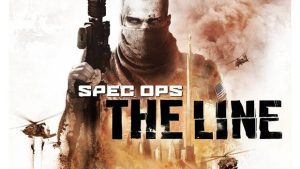
- Spec Ops: The Line


Found something worth playing through DecideGame?
DecideGame.com is an independent gaming project run by Editor Zero. If this guide helped you discover a game, solve a problem, or find useful information, you can support DecideGame.com and help keep new and updated game guides coming.
DecideGame — PC Game Guides, Reviews & Setup Help