
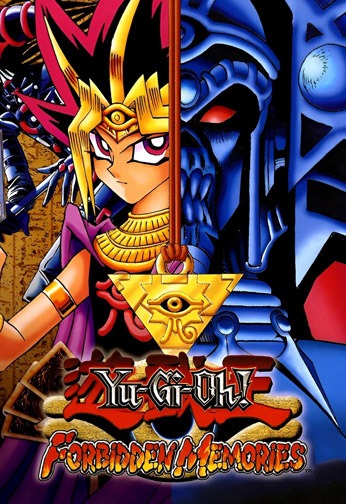
📅 Game released: 1999
Use this updated 2026 Yu-Gi-Oh! Forbidden Memories PC guide to check official download availability, set up the original PlayStation game through DuckStation or RetroArch, understand lawful game backups and PS1 BIOS requirements, and review emulator system requirements, controller settings, graphics, saves, and compatibility.
 By Editor Zero — independently researched, edited, and maintained.
Last updated: 13 October 2026
Last reviewed: 13 October 2026
Table of Contents
- Quick Summary
- Quick Facts
- Official PC Stores, Download & Installation
- Yu-Gi-Oh! Forbidden Memories Review
- Pros & Cons
- PC System Requirements
- Frequently Asked Questions
- Similar Games
Yu-Gi-Oh! Forbidden Memories Quick Summary
✔ Classic PlayStation card-battling strategy game combining an Ancient Egypt storyline, recognizable Yu-Gi-Oh! characters, deck building, monster battles, and collectible cards.
✔ Unlike the modern trading card game, Forbidden Memories uses simplified summoning rules, experimental card fusions, Guardian Star advantages, and fast-paced duels where discovering effective combinations is essential.
✔ Similar to Monster Train 2 through its strategic card battles, deck construction, powerful card combinations, and the satisfaction of discovering stronger ways to overcome increasingly difficult encounters.
✔ The campaign follows an ancient Egyptian prince connected to Yugi’s mysterious past, moving between palace intrigues, rival duelists, and supernatural threats surrounding the Millennium Items.
✔ Konami has not released an official native Windows version. For PC users who own the original PlayStation game, the recommended emulation route is the PS1 release through DuckStation, with RetroArch as an alternative.
✔ Free Duel allows previously encountered opponents to be challenged repeatedly for cards and Starchips, making deck improvement and experimentation central to long-term progression.
Yu-Gi-Oh! Forbidden Memories Quick Facts
Official PC Store Status, Download & Installation
👇 Yu-Gi-Oh! Forbidden Memories has no verified native Windows release or official PC game download. The following guide explains how owners of the original PlayStation game can configure an emulator using a properly obtained game backup and compatible PlayStation firmware.
- Official Windows availability: Konami released Forbidden Memories for the original PlayStation, not as a native PC game. There is no verified official Windows edition available through Steam, Epic Games Store, GOG, Microsoft Store, or a Konami PC launcher. Installing a PlayStation emulator does not create or provide a separate Windows version of the game.
- Recommended emulator — DuckStation: For most Windows users, DuckStation from its developer’s official GitHub releases is the recommended option. It focuses on PlayStation emulation, supports modern controllers, virtual memory cards, save states, internal-resolution scaling, and multiple graphics backends. Its straightforward interface makes it a practical choice for this turn-based card game.
- Alternative emulator — RetroArch: RetroArch can run the original PS1 game through a compatible PlayStation core. The Beetle PSX core prioritizes accurate software rendering, while Beetle PSX HW provides additional hardware-rendering options. RetroArch offers more customization but generally requires more initial configuration than DuckStation.
- Best console version: Emulate the original PS1 game rather than searching for a PS2, PSP, or Xbox edition. The original game was developed for PlayStation. The later PS2 title Yu-Gi-Oh! The Duelists of the Roses is a different game with different mechanics, not a PlayStation 2 port of Forbidden Memories. For English-language play, the North American PS1 edition is a sensible starting point; the Japanese original has different language and regional content considerations.
- Original game ownership: A legitimate secondhand copy of the PlayStation game may be an ownership option where available. A compatible disc drive and suitable dumping software can be used to create a backup from a personally owned disc, subject to applicable laws. The emulator itself does not include the copyrighted game or grant permission to acquire a third-party copy.
- Game-image formats: DuckStation supports several PlayStation disc-image formats, including BIN/CUE and CHD. For a standard CD backup, keep the BIN file and its corresponding CUE file together; normally, the CUE file is selected when importing or opening the game. CHD is also a supported option when properly created from an owned disc image. A standalone ISO file is not always the ideal representation of a PlayStation CD because disc layouts and audio tracks can vary.
- PS1 BIOS requirement: DuckStation requires compatible PlayStation BIOS firmware to emulate the console. The BIOS is proprietary Sony software and is not supplied with DuckStation. Use firmware lawfully extracted from hardware you own. Do not confuse the BIOS with the game image: they are separate components. RetroArch’s Beetle PSX cores also support compatible user-provided BIOS files and document an OpenBIOS fallback, although compatibility can vary.
- DuckStation installation: Download the current Windows installer or portable archive from the official DuckStation release page. Install or extract it, launch the setup wizard, select the appropriate BIOS file obtained from your own console, configure a game directory, and add your legitimately created PS1 disc image. Launch Forbidden Memories from the game list once the emulator recognizes it.
- Controller and graphics configuration: In DuckStation, configure a standard digital PlayStation controller using a keyboard or modern USB/Bluetooth gamepad. Begin with the default graphics settings and original 4:3 aspect ratio. If the game runs correctly, try 2x or 3x internal rendering resolution for cleaner polygonal monster battles. Vulkan or Direct3D may be used on compatible Windows hardware. Avoid forcing widescreen rendering or unusually aggressive enhancement settings when card interfaces or battle animations display incorrectly.
- Memory cards and saves: Use DuckStation’s emulated PlayStation memory-card system for normal in-game saves. Save states offer convenient temporary snapshots but should not replace ordinary memory-card saves, especially before emulator updates or configuration changes. For the original two-player duel and trade features, the game expects distinct saved profiles on PlayStation memory cards; simply connecting two controllers does not replace the required save data.
- Independent file sourcing: This guide does not provide game images, BIOS files, or links to unauthorized copies. Anyone choosing to obtain a game file independently is responsible for checking its origin, security, and legality. Owning a physical copy does not automatically authorize downloading another person’s disc image. Creating a permitted backup from an owned disc is the recommended route where local law allows it.
- Unofficial modifications: Community-made changes can adjust card drops, difficulty, fusion rules, balance, and other game systems. They are not official Konami releases, and patches may require a specific original disc revision. Preserve an unmodified backup and separate save files before experimenting; a patch tested with an older emulator may behave differently with a newer one.
 Download DuckStation PS1 Emulator — Official Developer Releases
Download RetroArch — Official Website
 View the Original Yu-Gi-Oh! PlayStation Game on Konami

Yu-Gi-Oh! Forbidden Memories Review
Brilliantly unpredictable card fusions collide with punishing difficulty and an exhausting reward grind.
Yu-Gi-Oh! Forbidden Memories is at its most enjoyable when an unimpressive handful of cards turns into something that should be impossible. A weak Dragon, an unremarkable Thunder monster and a fortunate fusion chain can produce a creature strong enough to reverse a duel. That moment of discovery is the heart of Konami’s unusual PlayStation card game. It also explains why its rougher decisions remain so frustrating: the game encourages ingenuity, then increasingly asks players to repeat familiar matches until the right cards or opening draw finally appear.
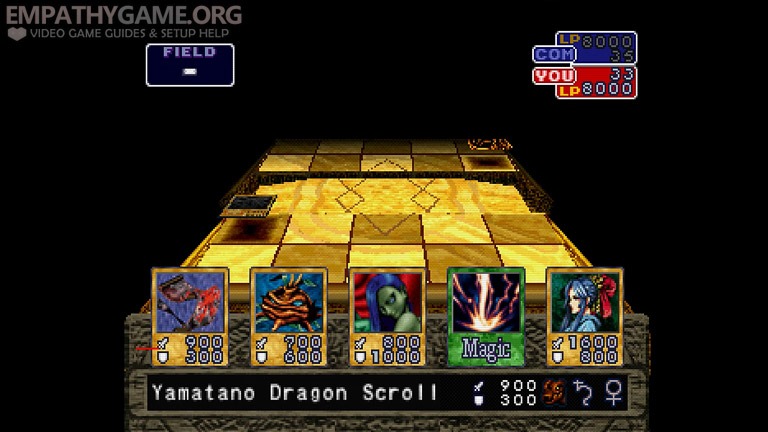
Set between ancient Egypt and the modern world of Yugi and Kaiba, Forbidden Memories follows its own rules rather than those of the trading card game. Monsters need no tributes, familiar effects are often absent, and combining cards matters more than individual abilities. Its simple foundation hides a demanding system. That imbalance appeals to people who enjoy discovering obscure mechanics and building a collection, but frustrates anyone expecting fair, clearly explained competition.
Fusions Turn Weak Cards Into Unexpected Possibilities
Each duel uses a 40-card deck and begins with 8,000 Life Points. The player draws back to a five-card hand and can combine cards before committing a play to the field; no Polymerization is required. The interesting question is often not which monster has the highest printed attack, but what several modest cards can become in the right sequence.
Twin-headed Thunder Dragon captures the appeal. Its 2,800 ATK can be reached through compatible Dragon and Thunder materials, provided the fusion meets the relevant attack-value conditions. A weaker Dragon may first need to combine with another type to make a suitable intermediate monster, which then joins a Thunder card. The same cards placed in a different sequence may produce a weaker result or fail to fuse as intended. Discovering those relationships gives otherwise disposable monsters a purpose and makes remembering a recipe feel like learning a useful trick rather than simply acquiring a better card.
Several ingredients disappear into one result, and a powerful fusion immediately destroyed can leave the player with few options. Trying unfamiliar combinations during difficult matches is both tempting and reckless. With little instruction or convenient catalogue of interactions, experimentation gradually becomes memorization. The system rewards attention but rarely explains why similar attempts behave differently.
Spell combinations expose an even stranger limitation. Two Spellbinding Circles can combine into Shadow Spell, which can then fuse with Dark-piercing Light to create Swords of Revealing Light. But the sequence needs to be assembled together as one hand-fusion action: play the intermediate spell separately and it activates before it can be used again. It is an excellent example of both the system’s creativity and its poor communication. A seemingly logical two-step plan fails not because the ingredients are wrong, but because the game treats the timing of a spell’s appearance as decisive.
Guardian Stars Reward Attention, Not Just Bigger Numbers
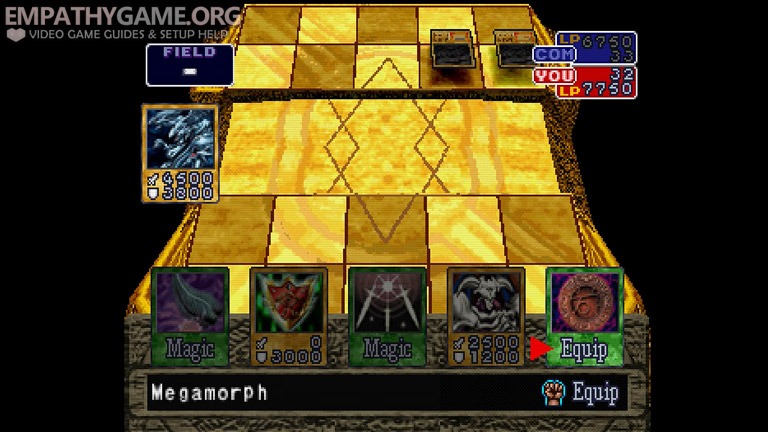
Fusions provide the power, but Guardian Stars provide the smaller tactical reversals. Each monster offers two possible alignments, and choosing one with an advantage over an opponent’s alignment grants a 500-point boost to ATK and DEF during the battle. These are matchups worth learning: a monster with 2,800 ATK can defeat a 3,000-ATK opponent if its alignment holds the advantage.
Terrain and equipment extend those calculations. A field such as Mountain can support compatible monster types, while an equip card can raise a favored creature’s statistics further. A modest fusion with the right field and equip may outperform a stronger card played carelessly. Investing several cards in one monster might secure the board or make the next removal spell devastating.
The problem is that these clever adjustments operate within a very uneven power curve. Guardian Stars can overturn a close fight; they do little when the opponent produces something thousands of attack points beyond what an ordinary hand can answer. Ritual Summoning offers an alternative spectacle, but not usually an efficient solution. To summon a monster such as Gate Guardian, the player needs its designated ritual spell and three particular monsters already on the field. Gathering that precise setup is so restrictive beside normal fusions that rituals become more compelling as collection curiosities than as dependable ways to survive a difficult duel.
Difficulty Escalates Faster Than the Rules Can Teach
The opening is less even-handed than it first appears. A new campaign starts with a randomized deck, and the difference between receiving useful Dragons, Thunder monsters, field spells or an effective equip and receiving an awkward collection can be substantial. Raigeki is particularly valuable when available, because clearing the opposing field can buy time that a weak starter deck otherwise lacks. Restarting for better cards should not be necessary for an approachable opening.
At first, opponents provide space to test unfamiliar combinations. Later, the game makes those lessons feel inadequate. Familiar duelists suddenly arrive with high-attack monsters, damaging spells or combinations the player’s collection may barely be able to answer. The presentation gives little insight into how computer-controlled opponents select cards; when a powerful monster appears almost immediately in one attempt after another, the visible five-card-hand format no longer feels like evidence of equal footing. Even sound positioning and an advantageous Guardian Star cannot compensate for every opening that begins with an enormous strength gap.
The challenge is not entirely arbitrary. Defensive positioning, judicious equips and careful fusion timing can rescue a precarious position. Multiple routes to a strong monster are more reliable than depending on a single rare card. But the game rarely clarifies whether defeat came from poor planning, a weak collection or an opening draw without a workable response.
Ancient Egypt Gives the Duels Personality
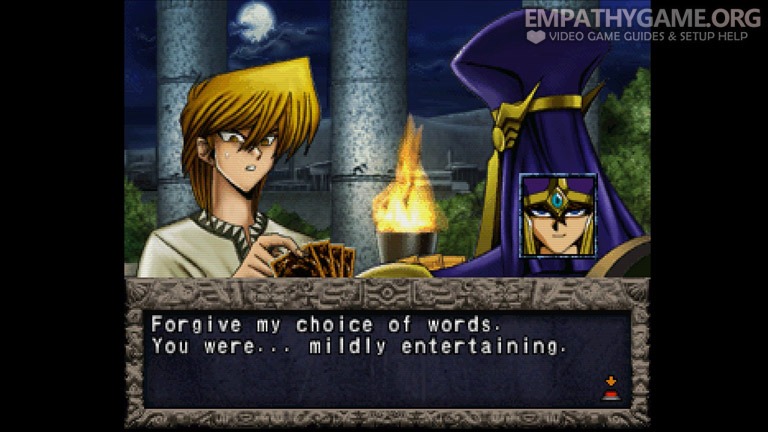
The campaign begins with an Egyptian prince whose interest in dueling conflicts with palace expectations. Teana and Jono provide a friendly introduction before the sorcerer Heishin, political intrigue and the Millennium Items pull the story into darker territory. The shift to modern-day duelists, including Yugi, Kaiba and Pegasus, gives the ancient setting a playful connection to the wider franchise. The structure is more unusual than the script itself, which relies heavily on brief conversations to move from one card battle to the next.
With nearly every dispute settled through a duel, characters serve more as memorable opponents than developed personalities. Expressive portraits and the Egyptian setting lend mystery to encounters, but the brisk dialogue and escalating stakes leave little room for the supporting cast to change. The story is an atmospheric framework, not the main attraction.
Some early dialogue decisions also have consequences the narrative never clearly signals. Optional encounters such as Villager 3 can be missed if the player advances through the opening too quickly, complicating attempts to fill the Free Duel roster. This is an unusually irritating form of obscurity: exploring dialogue should feel like a way to learn about the world, not an invisible test of whether a useful opponent will remain available for later rematches.
Card Rewards Make Progress Satisfying and Slow
Deck building replaces conventional character leveling. Winning a duel awards a card and Starchips, while Free Duel lets the player revisit encountered opponents for further rewards. A new Dragon, useful equip or removal spell can change which opponents the deck can handle. Collection building becomes an equation solved one missing component at a time. Duel Master K, who uses a copy of the player’s own deck, is a particularly interesting opponent because his mirror matches can expose how threatening familiar cards become when played from the other side.
The reward structure is also selective. Fast, aggressive victories generally produce POW rankings, while technically focused play can produce TEC rankings associated with different card pools. This means a player trying to collect monsters is solving a different problem from one seeking particular spells or traps. Pursuing high TEC rewards, however, can demand behavior that runs against winning efficiently.
One approach is to keep an opponent alive long after victory would be possible, use defensive positions and spare traps or equips, and stretch the duel toward a favorable technical finish. Some attempts become elaborate exercises in controlling the opponent’s remaining Life Points and the number of cards left in each deck. That can be satisfying as a resource puzzle, but less so when random rewards require repeating the same prolonged routine.
High-value drops intensify the problem. Chasing a 3,500-ATK Meteor B. Dragon from suitable opponents can seem like the sensible next step toward surviving the campaign, yet repeated successful duels may provide little evidence of progress. The password system appears to offer a more direct alternative, but even unremarkable cards can carry absurd prices of 999,999 Starchips, while each password purchase is limited to one redemption per save. Collecting is an enjoyable motivation when every new card opens a fresh possibility; here, it often becomes an exercise in tolerating repetition for the chance of an upgrade.
The Final Stretch Punishes Inconsistent Decks
The late campaign turns the collection problem into an endurance test. Its concluding run of consecutive duels provides no normal opportunity to save between opponents, so defeating a difficult rival does not guarantee that the progress will survive the next encounter. A deck able to win any single match with a favorable opening may still be poorly suited to the sequence as a whole. One badly timed hand after several victories can force the player back through encounters already cleared.
This is where the distinction between power and consistency becomes unavoidable. A deck containing Twin-headed Thunder Dragons, Meteor B. Dragon, field cards and strong equips may look formidable on paper, but several isolated high-value cards cannot help if they never arrive together. The most useful construction choices are often less glamorous: enough compatible materials to make a strong fusion through different routes, spells that answer immediate threats, and fewer weak cards that stall the hand.
Each duel matters, and mastering the sequence can be gratifying. Yet limited control over draws means failures are not always instructive. The finale can feel less like a test of learned strategy than a demand for an extensively farmed deck and favorable luck.
Presentation and Replay Value Depend on Patience
The duel board is functional and quick to read, particularly when attacks resolve without their optional 3D monster animations. Seeing a familiar creature rendered as a polygonal model has an undeniable old-console charm, but the repeated attack routines are stiff and slow compared with the simple card movements. Character portraits communicate more personality than the arenas, which are largely empty backdrops. The soundtrack’s energetic battle themes help distinguish tense encounters, although their limited variety becomes obvious during extended farming sessions.
Beyond the story, the appeal rests on improving a collection, revisiting difficult opponents and trying unfamiliar fusion paths. The original local dueling and trading features also give card ownership a purpose beyond beating the computer. Yet the dominant strategies tend to favor reliable heavy hitters, equips and removal rather than an endless variety of equally viable decks. Replaying with a different selection can be interesting, but the same slow reward system remains attached to that experiment. Its longevity depends heavily on enjoying collection for its own sake.
Final Verdict
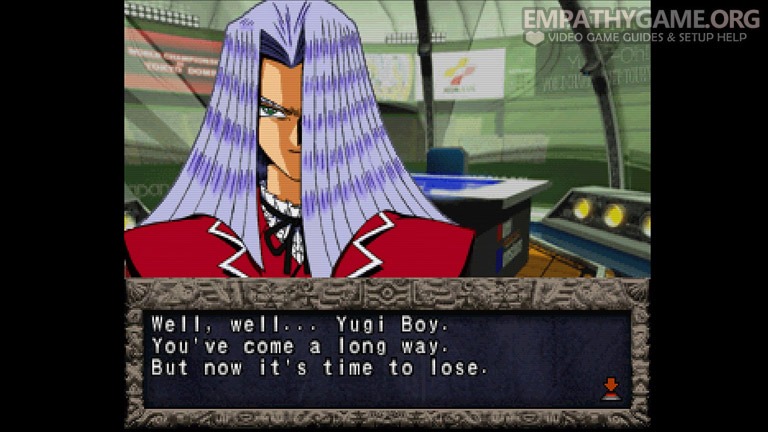
Yu-Gi-Oh! Forbidden Memories succeeds most clearly when it turns the cards themselves into a mystery worth solving. Its fusion rules encourage surprising combinations, Guardian Stars make close matchups interesting, and the Egyptian setting gives its strange version of Duel Monsters a recognizable identity. Finding a way to build Twin-headed Thunder Dragon from an apparently useless hand is still more memorable than playing a familiar strong monster without thought.
The costs are equally distinctive. Rules that should inspire creativity are inadequately explained, randomized rewards make progress uneven, and later opponents demand a level of preparation that the campaign does little to teach. The harsh consecutive-duel finale is the clearest expression of that philosophy: persistence and collection matter as much as tactical judgment. Rituals and passwords suggest choices that most playthroughs can scarcely exploit.
For patient collectors and fans curious about an experimental branch of Yu-Gi-Oh!, those rough edges may be tolerable because the act of discovering combinations provides its own reward. Players who enjoy studying systems, optimizing a narrow set of dependable strategies and gradually overturning intimidating opponents have plenty to explore. Anyone seeking a balanced card battler with transparent rules, flexible deck archetypes or respect for limited playtime is likely to find the grinding hard to forgive. This is an inventive, memorable game whose most interesting ideas deserve a kinder structure than the one surrounding them.
Yu-Gi-Oh! Forbidden Memories Pros & Cons
Yu-Gi-Oh! Forbidden Memories PC System Requirements
Official native Windows PC requirements: Not available. Yu-Gi-Oh! Forbidden Memories was developed for the original PlayStation, and Konami has not published official Windows CPU, GPU, RAM, or storage specifications for this game.
The following information describes the PC hardware and software needed to run the recommended PlayStation emulator. These are DuckStation compatibility guidelines, not official system requirements for a native PC release of Forbidden Memories.
DUCKSTATION — WINDOWS HOST REQUIREMENTS:
OS: Windows 10 version 1809 or newer, or Windows 11; 64-bit Windows for the standard x64 build
CPU: x86-64 processor with SSE4.1 support for the standard DuckStation build; a separate legacy SSE2 build is provided for some older processors
GPU: Graphics hardware supporting OpenGL 3.1, Direct3D 11 Feature Level 10.0, or Vulkan 1.0
RAM: No specific official RAM capacity is published for Forbidden Memories; actual memory use depends on DuckStation, the operating system, and other running applications
Storage: Space for DuckStation, compatible PlayStation BIOS firmware, an owned PS1 game backup, and memory-card/save files; game-image size depends on disc format and compression
Controller: Keyboard or compatible SDL, XInput, or DirectInput gamepad
BIOS: Compatible PS1 BIOS file lawfully obtained from supported PlayStation hardware
Internet: Useful for downloading and updating the emulator; not required for the original offline single-player game after a working setup is complete
RECOMMENDED EMULATOR CONFIGURATION:
Emulator: DuckStation, current stable release
Game Version: Original PS1 release; North American edition for English-language play
Disc Image: Properly created BIN/CUE or CHD backup from an owned PlayStation disc
Graphics Backend: Vulkan or Direct3D on supported Windows hardware; use the backend that displays the game correctly
Rendering Resolution: Begin at native resolution, then test 2x or 3x scaling when desired
Aspect Ratio: Original 4:3 for correct game presentation
Controller Mode: Standard PlayStation digital controller mapping
Saving: Virtual PlayStation memory card, with optional save states and periodic backups
Compatibility: Begin with emulator defaults and adjust enhancements only when needed
Additional PC Performance and Setup Notes
Performance expectations: Forbidden Memories is a turn-based PlayStation game rather than a demanding modern 3D release. Most of its playtime takes place on card-management screens and duel boards, with optional polygonal monster-battle sequences. A reasonably modern Windows PC that meets DuckStation’s requirements should be a practical candidate for emulation, although no game-specific benchmark results are claimed here.
Resolution and interface clarity: Higher internal rendering resolution primarily improves the game’s polygonal graphics. It does not completely redraw the original card artwork, menus, or text. Maintaining the original 4:3 presentation avoids stretching the interface across a widescreen monitor.
Save-data protection: DuckStation supports both virtual memory cards and save states, but these are not interchangeable. A normal memory-card save is generally the safest foundation for long-term progress. Back up your emulator’s save-data directory before major changes, and retain separate unmodified saves when experimenting with game patches.
Two-player setup: The original game’s 2P Duel and Trade features use saved card collections from two distinct memory-card files. Users attempting these modes through emulation should configure the appropriate virtual memory-card slots and independent saved profiles. Compatibility with any particular emulator multiplayer configuration should be checked separately; ordinary online matchmaking is not an original feature.
Regional copies: Original NTSC and PAL PlayStation releases have different regional video standards, and some regional builds may behave differently. Use the game’s proper region settings and compatible firmware where possible. Do not force speed or timing changes simply to match another region without checking whether gameplay, audio, and animations remain correct.
Troubleshooting: If the game fails to boot, first check the disc image, CUE-file references, and BIOS configuration. If menus or 3D battles appear incorrectly, restore default enhancements or try another supported graphics backend. For emulator-specific issues, consult the DuckStation developer documentation or the relevant Libretro PlayStation core documentation.
Video Trailer
Frequently Asked Questions
Is Yu-Gi-Oh! Forbidden Memories worth playing in 2026?
Yes, especially for players who enjoy experimenting with monster fusions, collecting rare cards, and discovering strategies through trial and error. Its unusual rules and Ancient Egypt setting give it a distinct identity, although punishing difficulty spikes and repetitive card farming can frustrate anyone expecting a modern Yu-Gi-Oh! experience.
Does Yu-Gi-Oh! Forbidden Memories follow the normal Yu-Gi-Oh! card game rules?
No. Forbidden Memories uses an early, simplified rule system without normal Tribute Summoning, modern Effect Monster mechanics, or the requirement to use Polymerization for fusions. Players accustomed to the official Trading Card Game will need to learn its separate approach to summoning, combining cards, and managing turns.
Can you summon powerful monsters without sacrificing cards?
Yes. Even powerful monsters such as Blue-Eyes White Dragon can be summoned directly when held in your hand, without tributing weaker monsters. The challenge is obtaining those powerful cards and constructing a deck that can compete against opponents with much stronger collections.
How do card fusions work in Yu-Gi-Oh! Forbidden Memories?
Fusions combine compatible cards into a different monster without requiring Polymerization or ownership of the resulting card. Many combinations depend on monster types, individual card identities, and attack values, so experimenting with Dragons, Thunder monsters, Zombies, Rocks, and other types is an important part of learning the game.
Why do some monster fusion combinations fail?
Not every pair of monsters has a valid fusion result, and some general combinations only work when the materials meet particular attack-value conditions. The order of cards in a multi-card fusion sequence can also change the result. A combination that works with weaker monsters may fail when one material is replaced with a stronger card of the same type.
How do you create Twin-headed Thunder Dragon?
Twin-headed Thunder Dragon has 2800 ATK and is commonly created by combining a suitable Dragon with a Thunder-type monster, provided the combination meets the game’s fusion conditions. For example, Crawling Dragon and Bolt Penguin can produce it. This is one of the most useful fusion targets for strengthening a relatively weak early-game deck.
What are Guardian Stars, and how do they affect duels?
Guardian Stars are battle attributes selected when placing monsters on the field. Each monster offers two choices, and selecting a Star with an advantage over an opponent’s active Star gives your monster a temporary 500-point ATK and DEF advantage during that battle. Choosing correctly can allow a weaker monster to defeat an otherwise stronger enemy.
How do field spells and terrain affect monster strength?
Field spells change the battlefield to environments such as Mountain, Meadow, Forest, Wasteland, Sea, or Dark. Different monsters receive a 500-point increase or decrease in ATK and DEF depending on the terrain. For example, Mountain benefits many Dragon monsters, making terrain selection an important way to strengthen an existing deck.
How do Ritual Cards work in Forbidden Memories?
Ritual Summoning requires a specific Ritual Card and three matching monsters already placed on the field. Activating the Ritual Card sacrifices those monsters and summons the designated result, such as Black Luster Soldier or Blue-Eyes Ultimate Dragon. Unlike ordinary fusions, Rituals use fixed combinations and can be difficult to arrange during competitive duels.
How many cards can you have in your deck?
Your active deck must contain exactly 40 cards, with additional collected cards stored in the Chest. During duels, you normally refill your hand to five cards and play one card or one combination of selected cards per turn. Managing weaker cards through fusions helps cycle through the deck while creating stronger monsters.
What is the best beginner strategy in Forbidden Memories?
Focus on learning reliable fusions before chasing extremely rare individual cards. Dragon, Thunder, Rock, and Zombie combinations can produce monsters stronger than their original materials, while Guardian Star advantages and useful field spells help close the gap against tougher opponents. Replaying manageable duelists in Free Duel is usually more productive than repeatedly attempting an opponent who consistently defeats you.
What is Free Duel, and why is it important?
Free Duel lets you challenge opponents previously encountered in the campaign, with some availability exceptions. Repeated victories can reward additional cards and Starchips, allowing you to improve your deck before continuing the story. It is one of the most important progression systems because many later opponents are difficult to defeat using only the cards gained during mandatory campaign duels.
What do S-POW, A-POW, S-TEC, and A-TEC mean?
These are duel-performance rankings that influence which reward-card pool is used after a victory. POW rankings generally favor aggressive victories and are especially important when farming strong monsters, while TEC rankings reward more technical or prolonged play and can provide access to different spell and trap cards. S and A results use the same reward pool within their respective POW or TEC categories.
How can you earn an A-TEC or S-TEC ranking?
Technical rankings generally require a longer, more controlled duel rather than defeating an opponent immediately. A reliable route to S-TEC is making the opponent exhaust their deck before you do, while carefully managing your own cards and Life Points. Defensive play, spells, and traps can help, but reaching the desired rank takes practice and is less straightforward than earning a strong POW ranking.
Why do rare cards sometimes take hundreds of duels to obtain?
Forbidden Memories uses character-specific reward tables with different probabilities for individual cards and duel ranks. Even when you defeat the correct opponent with the appropriate ranking, the reward is random and a rare monster is never guaranteed after a fixed number of victories. Repeated battles without receiving the desired card are therefore possible even when your farming strategy is correct.
Where can you obtain Meteor B. Dragon?
Meteor B. Dragon, commonly called Meteor Black Dragon, is a powerful 3500 ATK monster associated with farming Jono 2nd and Meadow Mage using A-POW or S-POW victories. Both opponents are popular farming targets, but the card has a low drop probability, so many repeated victories may be necessary. Check that the opponent is available in Free Duel and that you are consistently earning the appropriate ranking.
Can you obtain Blue-Eyes White Dragon in Forbidden Memories?
Yes, but it is exceptionally rare. In the original international release, Seto 3rd can reward Blue-Eyes White Dragon through high POW rankings, although obtaining it may require substantial farming. Its password also carries an extremely high Starchip cost, making ordinary password redemption impractical for most playthroughs.
What are Starchips, and how do you earn them?
Starchips are the currency used to obtain cards through the password system. You earn them by winning duels, with rewards influenced by your performance ranking. They accumulate gradually, so spending them on useful affordable cards is generally more practical than saving for exceptionally expensive monsters.
Why does a valid card password not give you the card?
Entering an eight-digit card password does not automatically award the card: you must also have enough Starchips to pay its listed price. Some powerful cards cost hundreds of thousands of Starchips, making them unrealistic purchases through normal progression. Check the card’s actual cost before assuming that a correct password guarantees immediate access.
Can you collect every card in the original Forbidden Memories?
No, not through ordinary gameplay in the original international versions. Some cards cannot be obtained from normal duelist rewards, fusions, or accessible password purchases, and certain content differs between regional releases. Unofficial modifications can change card availability, but their altered collections should not be confused with the unmodified PlayStation game.
Can you complete all five pieces of Exodia?
The original international versions make completing Exodia exceptionally impractical because some pieces are unavailable as ordinary duel rewards and require extremely expensive password purchases. Collecting the full set through normal farming is therefore not a realistic progression goal. Modified versions may change how Exodia pieces are obtained.
Does Forbidden Memories follow the Yu-Gi-Oh! anime storyline?
It uses familiar characters and themes but tells its own alternative story rather than directly adapting the anime. The campaign moves between Prince Atem’s Ancient Egypt and Yugi’s modern-day tournament, connecting both periods through the Millennium Items and the conflict surrounding Heishin. Familiar characters such as Kaiba, Pegasus, Bakura, and Isis appear in roles adapted to the game’s narrative.
Can you watch the monsters fight in 3D?
Yes. The original PlayStation game includes polygonal monster-battle animations that display creatures attacking one another rather than only showing the duel board. During battle, the Square button is used to access the 3D battle presentation, making it possible to view the monsters in a more cinematic form than the ordinary card interface.
Does Yu-Gi-Oh! Forbidden Memories have local two-player multiplayer?
Yes. The original PlayStation release includes a 2P Duel mode in which two people can battle using their saved card collections. It requires two distinct save files on separate PlayStation memory cards and compatible controller inputs. On PC, reproducing the mode depends on configuring the emulator’s virtual memory-card slots and controllers correctly.
Can you trade cards between two Forbidden Memories save files?
Yes. The original Trade mode allows cards to be exchanged between two different player saves using separate PlayStation memory cards. Cards being traded must be in the Chest rather than the active deck. When using an emulator, keep backups of both virtual memory cards before transferring cards or changing save configurations.
Can you play Forbidden Memories online with friends?
The original game does not include native internet multiplayer, online matchmaking, or official online servers. Its multiplayer features were designed for local PlayStation use. Community projects and some emulator-based arrangements may provide alternative network functionality, but these are unofficial and should not be confused with original Konami online support.
Are unofficial Forbidden Memories PC remakes the same as an official Windows release?
No. Community-developed remakes, recompilation projects, and other fan adaptations are separate from the original Konami PlayStation release. They may introduce changes to graphics, gameplay, multiplayer, or compatibility, but Konami has not released an official native Windows edition of Forbidden Memories. Project availability, ownership requirements, and compatibility must be assessed individually.
Can you modify the original Forbidden Memories game?
Yes, unofficial community modifications exist for features such as card-drop rates, fusion combinations, difficulty, and card availability. These changes can substantially alter progression, especially when rare cards become easier to obtain. Always check the modification’s required game revision, preserve an untouched copy of your legitimately obtained game backup, and protect your existing save files.
Still have questions? Check the Forbidden Memories Reddit community, GameFAQs Forbidden Memories discussions, or DuckStation developer documentation for additional gameplay information, emulator troubleshooting, and community guidance.
Sources & References
Key factual and technical information in this guide was checked against relevant official and established sources, including:
- Konami — Yu-Gi-Oh! Shin Duel Monsters: Sealed Memories — official Japanese product information confirming the original PlayStation release and its December 1999 release date.
- DuckStation — Official Developer Repository — supported platforms, BIOS requirements, disc-image formats, controller compatibility, graphics options, and Windows emulator requirements.
- Libretro Documentation — Beetle PSX HW — alternative PlayStation emulation, BIOS configuration, supported disc formats, graphics renderers, and save support.
- Metacritic — Yu-Gi-Oh! Forbidden Memories — PlayStation release information, aggregated critic reception, and the original game’s 57/100 Metascore.
- GameSpot — Yu-Gi-Oh! Forbidden Memories Review — contemporary review documenting the card-battling systems, fusion mechanics, campaign structure, difficulty, and original PlayStation reception.
- Yu-Gi-Oh! Forbidden Memories Community — established player discussions about card combinations, progression challenges, emulator questions, and unofficial game modifications; community reports are not treated as official compatibility guarantees.
Similar Games Like Yu-Gi-Oh! Forbidden Memories
- Monster Train 2
- The Lord of the Rings: The Third Age
- Baldur’s Gate 3
- Clair Obscur Expedition 33
- The Lord of the Rings: The Battle for Middle-earth II
- Black & White



Found something worth playing through DecideGame?
DecideGame.com is an independent gaming project run by Editor Zero. If this guide helped you discover a game, solve a problem, or find useful information, you can support DecideGame.com and help keep new and updated game guides coming.
DecideGame — PC Game Guides, Reviews & Setup Help