
📅 Game released: 2025
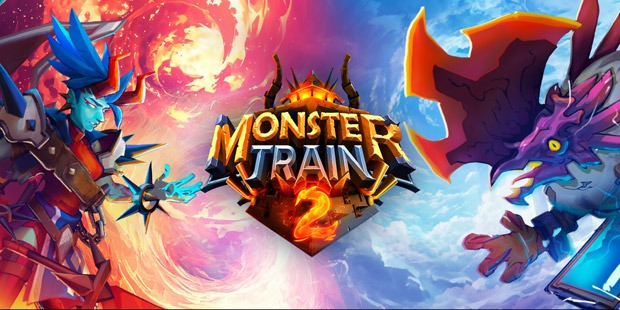
Monster Train 2 is a three-floor roguelike deckbuilder where clan combinations, card upgrades, and Pyre defense shape each run. This PC guide explains official Steam and Microsoft/Xbox download and installation options, The Punished and Destiny of the Railforged DLC, Game Pass, Steam Deck support, and system requirements.
 By Editor Zero — independently researched, edited, and maintained.
Last updated: 13 November 2026
Last reviewed: 13 November 2026
Table of Contents
- Quick Facts
- Official PC Stores, Download & Installation
- Monster Train 2 Review
- Pros & Cons
- PC System Requirements
- Frequently Asked Questions
- Similar Games
Monster Train 2 Quick Facts
- Game: Monster Train 2 / Destiny of the Railforged DLC / The Punished DLC
- Developer: Shiny Shoe
- Publisher: Big Fan Games
- Genre: Card Games, Roguelike Deckbuilder, Strategy, Turn-Based Strategy
- Release: May 21, 2025 (Windows PC and initial console launch)
- Platforms: Windows PC, macOS (Apple silicon), PS5, Xbox Series X|S, Nintendo Switch
- DLC / Expansions: Paid: Destiny of the Railforged (Railforged Clan and Soul Savior) and The Punished (Punished Clan and Monolith); Wurmkin, Lost Arsenal, and Echoes from the Void are free base-game additions
- Cloud Access: Xbox Cloud Gaming with an eligible membership or ownership entitlement; availability depends on plan and region
- Xbox Play Anywhere: Microsoft digital purchase supports compatible Windows PC and Xbox Series X|S devices, with Xbox cloud saves
- Steam Deck: Verified — default controls, legible text, controller icons, and default graphics pass Valve’s checks
- Modes: Single-player, Daily Challenges and leaderboards, Dimensional Challenges, Endless Mode; Soul Savior requires Railforged DLC
- Engine: Unity (detected in Steam build metadata)
- Community: Monster Train Reddit, official Discord, Steam Discussions
- PC modding: Unofficial Nexus Mods; no official Steam Workshop listing
- Metacritic score: 87/100 (PC)
- IGN score: 9/10 (PC review)
- Steam user reception: Overwhelmingly Positive overall
Official PC Stores, Download & Installation
👇 Compare the official Steam and Microsoft/Xbox PC options below before purchasing, downloading, installing, or adding either Monster Train 2 gameplay expansion.
- Official PC stores: Monster Train 2 is sold for Windows PC through Steam and Microsoft/Xbox Store.
- Steam: The Steam version supports Windows PC and macOS on supported Apple-silicon hardware, Steam achievements, Steam Cloud, Family Sharing, full controller support, and Steam Deck Verified play; Intel-based Macs are not supported.
- Microsoft/Xbox: The Microsoft digital version supports Windows PC, Xbox Series X|S, achievements, cloud saves, Xbox Play Anywhere, cloud play where entitled, and supported Windows handheld access.
- Game Pass: Xbox lists the base game with Game Pass Premium, PC Game Pass, and Ultimate. Xbox Cloud Gaming access depends on the plan; Essential requires ownership to stream. Check the listing for regional and catalogue changes. A base-game subscription does not automatically include paid DLC.
- Destiny of the Railforged: This separately purchased gameplay expansion requires the base game and adds the Railforged Clan, Forge-focused mechanics, new enemies and artifacts, and Soul Savior mode.
- The Punished: This separate paid DLC also requires the base game. It adds the Punished Clan, champions Archus and Zariel, self-damage interactions, and a Monolith system built around Tribute, Devotion, and Zeal. It does not include a second Soul Savior-style mode.
- Steam Deluxe bundle: Steam’s Deluxe edition bundle contains the base game, soundtrack, and Digital Compendium. It does not include either paid gameplay DLC, so check bundle contents before purchasing extras.
- Free base-game additions: Wurmkin and the permanent content from Lost Arsenal and Echoes from the Void are included with the base game rather than either paid expansion.
- Launcher setup: Steam handles installation and updates without listing a separate third-party launcher. Microsoft/Xbox players install through the Xbox app or Microsoft Store under the account that owns or accesses the game; install purchased DLC in the same storefront ecosystem as the base game.
- Offline and online features: The core single-player game does not list an always-online requirement. Downloads, cloud synchronization, leaderboards, Daily Challenges, Game Pass licence checks, and cloud play use online services.
- Steam Deck: Valve rates Monster Train 2 as Verified, making the Steam version the clearest official SteamOS handheld option.
 View Destiny of the Railforged DLC on Steam
View The Punished DLC on Steam
 Buy or Play Monster Train 2 on Microsoft / Xbox Store
View Destiny of the Railforged DLC on Microsoft / Xbox Store
View The Punished DLC on Microsoft / Xbox Store

Monster Train 2 Review
A cleverer three-floor deckbuilder where preparation matters as much as the wildest combo.
Monster Train 2 understands a particular pleasure of roguelike deckbuilding: watching a plan that barely worked two battles ago become powerful enough to overwhelm an entire floor. Then it introduces an enemy that makes the plan look foolish. Shiny Shoe’s sequel keeps the original game’s unusual battlefield, a train with three floors between invading enemies and the Pyre, but changes how much control players have before the first wave arrives. Room cards, Equipment, new clans and a more deliberate opening phase give the familiar formula fresh possibilities. The result is more approachable in some important ways without becoming a gentler strategy game. It still rewards the player willing to investigate exactly why a seemingly unbeatable deck fell apart.
The First Turn Changes the Whole Train
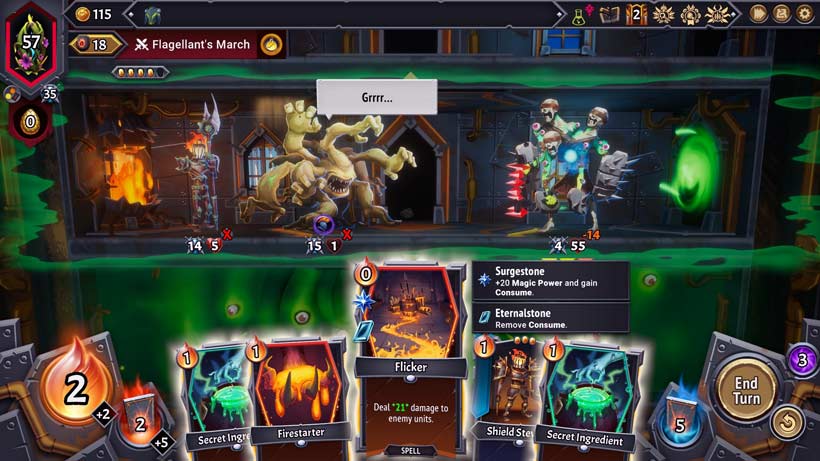
At the center of every battle is a simple vertical problem. Enemies enter the train, fight whatever occupies their floor, and advance toward the Pyre if they survive. Units take up floor capacity, spells consume Ember, and the order in which attackers and defenders resolve their effects matters. A powerful card played in the wrong place can accomplish almost nothing; a modest unit positioned correctly can buy the crucial turn that saves a run. The floor layout makes even routine encounters feel different from a conventional single-board card battle.
The sequel’s Deployment Phase is a larger change than it initially appears. Before the enemies arrive, players get an opportunity to draw and place their banner units. In the original Monster Train, waiting for a vital unit to appear could decide a fight before its strategy had properly begun. Here, setting up several units or even several floors is a more deliberate choice. The opening feels less like hoping the deck cooperates and more like preparing a defense, although the cards available afterward still demand improvisation. This is one of those quality-of-life changes that also creates deeper tactical possibilities.
Where to build that defense remains the difficult part. A middle-floor stronghold may look sensible until enemies with Haste bypass it; bottom-floor defenders can face punishing Corruption effects, while a flying boss can put pressure on an upper position you assumed was safe. Sometimes spreading units across the train is not a concession to a weak deck but the best way to redirect a dangerous encounter. A disposable blocker on another floor can matter more than another attack buff on the main damage dealer. The sequel’s floor design works because there is no universally correct place to put the strongest unit.
That also changes how Pyre health should be understood. Protecting it is the objective, but allowing a manageable enemy through is not automatically a mistake. Spending a little health to preserve an important card or keep a stronger defense intact may be the right calculation. A fragile-Pyre challenge removes much of that freedom, which reveals how often ordinary runs quietly rely on health as a resource rather than a score to keep perfect.
New Cards Turn Good Combinations Into Real Commitments
The clans give Monster Train 2 its identity beyond the train itself. Choosing a primary and allied clan shapes the available units and spells, whether the plan revolves around scaling one defender, spreading buffs, sacrificing units, or clearing enemies through spell damage. Those approaches are not simply different colors of the same deck. They ask different questions about space, timing and where resources should go. The most interesting runs start when a reward suggests a direction that was not obvious from the starting cards.
Room cards and Equipment cards make that process more physical. A Room card modifies an entire floor, giving the location a purpose beyond housing units; Equipment attaches a lasting benefit to an individual fighter. One upgrade may encourage stacking everything behind a tank, while another rewards placing smaller units where a room-wide effect can reach them. Pyre Hearts add yet another choice before departure, influencing the rules and opportunities of a run. These systems give players more freedom to build around what they find, but they also make it easier to create a clever-looking combination that never becomes practical.
A Luna Coven setup built around Conduit and Mageblade illustrates the appeal. Spellcasting can feed the effectiveness of an equipped unit, turning actions that once served mainly as removal or support into part of an offensive engine. A cheaper spell, an appropriate Equipment effect and the right frontline can reinforce each other far more effectively than three individually powerful rewards with no shared purpose. It is satisfying because the result comes from recognizing a connection, not merely increasing a damage number.
Between fights, the decisions are just as important: choose a reward, improve a unit, lower a spell’s cost, duplicate a crucial card, remove a weak starter or take a route with the right shop. Too many attractive additions can dilute a deck until the winning cards arrive a turn too late. Learning when to skip a reward is one of the biggest shifts from collecting strong cards to building a reliable strategy. The temptation to try something reckless is still part of the fun; the skill lies in knowing whether the deck can actually support it.
There is a useful parallel with Baldur’s Gate 3: both reward understanding how positioning, abilities and resource use interact rather than treating a character’s strongest action as the automatic best choice. But Monster Train 2 concentrates that reasoning into much shorter runs. There is little time to grow attached to a plan that the next few encounters have already proved unreliable.
Strong Decks Still Need Answers to Specific Enemies
The sequel is at its best when an enemy exposes the difference between an impressive combo and a complete defense. A deck that steadily increases armor might survive ordinary waves without trouble, yet struggle against the Corruption-focused version of Seraph Aeternus. That boss can double Corruption on the unit it strikes, making damage accumulate faster than a seemingly sturdy frontline can absorb. Simply adding more armor may postpone defeat rather than solve it. Moving the boss with Ascend or Descend effects, preventing attacks, or changing which unit receives the punishment can be more effective than making the same wall thicker.
Other late encounters test a different weakness: speed. High-health, heavily armored enemies can arrive alongside foes that apply Sap or grow more dangerous through Incant. A unit destined to become unstoppable after six turns is not much comfort when the train is already being overrun on turn three. Reliable decks need damage in time to clear a wave, ways to reach protected threats, and enough defense to survive while the engine builds. This pressure makes upgrading cards interesting, though it can also feel abrupt when the game reveals that an otherwise enjoyable strategy scales too slowly.
Fortunately, learning those interactions is less punishing than in many roguelikes. The Undo feature resets the current turn to its beginning, allowing players to reconsider the order of spells, equipment and unit placements rather than lose an entire attempt to a misunderstood interaction. A separate battle restart offers a broader second chance. Neither feature makes a weak deck strong, and players can avoid using them if they prefer stricter consequences. Their real value is educational: the rules are complex enough that being able to test an idea helps players understand what happened instead of merely accepting a confusing loss.
There is still friction in the amount of information a battle can present. Several floors of units, persistent Room effects, equipment bonuses and stacked status effects require close attention. The interface communicates a great deal, but dense late-run boards can become mentally tiring. The sequel improves the ability to experiment while simultaneously giving players more interactions to keep track of.
Replayability Has Variety, but Not Every Challenge Feels Fair
The wider progression structure supplies plenty of reasons to return. Clan pairings, Pyre Hearts, artifacts and route choices make familiar battles develop differently, while increasing Covenant difficulty exposes weak habits that lower levels may have allowed. Daily Challenges and modifiers change the rules around a run, and Endless Mode asks how long an established strategy can survive once enemy pressure keeps escalating. Each mode tests something slightly different, which is more valuable than simply making enemies larger and calling it replayability.
Dimensional Challenges are more divisive because their restrictions can interfere with the freedom that makes normal runs appealing. In Extra Roomy, for example, a spell-oriented starting clan faces penalties to spells and the threat of Permadeath. When the opening rewards include costly spells, fragile units or Rooms with little immediate value, the challenge may feel decided by the starting combination before meaningful deckbuilding begins. It can be enjoyable to solve an awkward preset puzzle, but this is a different sort of satisfaction from discovering an unexpected build through flexible choices.
The Destiny of the Railforged content widens the mechanical range in a more distinctive way. The Railforged clan emphasizes engineering and Forge interactions, while Soul Savior asks players to build around powerful Soul effects over demanding encounters. The early Soul decision carries unusual weight: a benefit that strengthens a frontline immediately, such as Grump, or generates extra gold through repeated spell use, such as Goldie, can help a run stabilize. A more specialized spell-focused effect may be valuable later yet offer little protection at the beginning. This can make Soul Savior exciting for advanced players but initially restrictive for anyone hoping to experiment without a strong foundation.
The Punished adds another kind of decision-making through its two champions, Archus and Zariel. Rather than merely surviving friendly damage, Punished units can turn it into a resource: Punish and Bloodshed reward carefully timed self-inflicted damage, Chained makes enemies share some of that pain, and Tenacious allows certain allies to endure otherwise lethal friendly attacks. The clan’s Monolith asks for an immediate sacrifice of Ember and cards as Tribute in return for persistent Devotion and stronger Zeal on newly summoned units. It creates an interesting contrast with Railforged’s construction-focused strategy: the question is not simply how much damage a floor can deal, but how much pressure its own defenders can safely absorb to strengthen the next fight. Its scope is narrower than Soul Savior, though, because it adds a clan rather than another standalone run mode.
Those harder modes underline the sequel’s main balancing act. It celebrates unexpected combinations, then sometimes asks players to know which combinations are efficient before they have the room to explore them. That tension is productive in the main game, where a failure usually reveals something concrete. In the tougher challenge structures, a bad beginning can feel more like a limitation on choice than an invitation to think differently.
Personality Between Battles
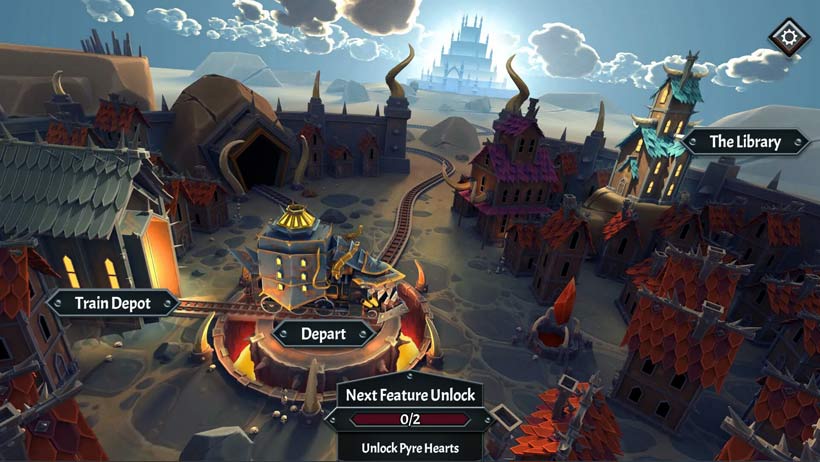
The story provides a reason for the strange alliance aboard the train: angels and demons work together against Titans who have taken control of Heaven. Conversations at the Covenant Outpost and progress tied to Pyre Hearts give returning characters more room than the original’s premise alone required. Yet the writing remains secondary to the systems. The presentation is colorful and eccentric, with creature designs that make different clans recognizable, but the dialogue and character scenes rarely create the same urgency as a battle slipping out of control.
That does not mean the game lacks memorable moments. They simply tend to be mechanical rather than scripted. A barely surviving unit, a spell drawn at the exact moment it becomes useful, or a boss that dismantles a carefully built defense can give a run its own story. The best victories have a clear chain of decisions behind them, including the questionable ones that unexpectedly worked. When a run ends, the possibility of making a completely different set of choices is a stronger invitation to continue than the next narrative conversation.
For players who want tactical combat anchored in a substantial cast and a dramatic journey, Clair Obscur: Expedition 33 offers a different balance of character, timing and carefully staged encounters. Monster Train 2 is less interested in telling one memorable adventure than in letting players build hundreds of small, unpredictable ones.
Final Verdict
Monster Train 2 improves on the original most convincingly where it gives players more deliberate control. Deployment makes multi-floor strategies easier to establish, Room and Equipment cards deepen the relationships between units and spaces, and Undo turns complicated fights into opportunities to learn. Those changes support the wildly satisfying combinations that made the series distinctive without taking away the danger of a bad decision.
It is not equally welcoming in every mode. Late encounters can punish slower strategies harshly, some preset challenges depend too much on an awkward opening, and the growing number of interacting effects may exhaust players who prefer leaner card games. The story is pleasant context rather than a major attraction. For players who enjoy investigating systems, adapting a deck and discovering why one small change transforms a run, though, this is a sequel with genuine substance behind its chaos.
Monster Train 2 Pros & Cons
- Pro: Excellent three-floor roguelike deckbuilding with meaningful tactical positioning
- Pro: Huge replay value from clans, Pyre Hearts, Room and Equipment cards, artifacts, Titans, and challenge modes
- Pro: Destiny of the Railforged adds Forge-focused clan play and the Soul Savior challenge mode
- Pro: The Punished creates fresh risk-reward strategies through self-damage and Monolith progression
- Pro: Steam Deck Verified status, small storage requirements, cloud saves, controller support, and Xbox Play Anywhere make the game flexible across devices
- Pro: Great for players who enjoy escalating difficulty, compact runs, and discovering unusual combinations
- Con: New players may feel overwhelmed by clans, keywords, floor capacity, upgrades, and enemy interactions
- Con: Story and character presentation remain secondary to the mechanics
- Con: Late-run boards can become visually busy, especially on handheld screens
- Con: Paid expansions are separate purchases; The Punished adds a clan but no separate game mode
Monster Train 2 PC System Requirements
OFFICIAL WINDOWS PC REQUIREMENTS:
MINIMUM — 1080p / 60 FPS, Low Quality:
OS: Windows 10 64-bit
CPU: Intel Core i5-4670K / AMD FX-4350
RAM: 8 GB
GPU: GeForce GTX 760 2 GB / Radeon R7 260X 2 GB / Intel UHD Graphics 630
DirectX: Version 11
Storage: 3 GB available space
RECOMMENDED — 1080p / 60 FPS, High Quality:
OS: Windows 11 64-bit
CPU: Intel Core i5-9600 / AMD Ryzen 5 1600
RAM: 16 GB
GPU: GeForce GTX 1080 8 GB / Radeon RX 5700 8 GB
DirectX: Version 12
Storage: 3 GB available space
Additional PC Performance and Setup Notes
- Steam’s official Windows targets are 1080p / 60 FPS at Low Quality for the minimum tier and 1080p / 60 FPS at High Quality for the recommended tier.
- Steam also supports macOS on supported Apple-silicon hardware. The minimum macOS requirement is macOS 14 Sonoma with Apple M2 and 2 GB storage; the recommended tier lists Apple M4 and 2 GB storage. Intel-based Macs are not supported.
- Steam Deck is officially Verified, with default controls, controller icons, text legibility, and default graphics behavior passing Valve’s compatibility checks.
- If the game crashes or fails to launch, verify installation files first, update the operating system and graphics driver where relevant, restart the storefront client, and test without overlays or unofficial mods before reinstalling.
- Community mods are unofficial. Back up important saves and disable incompatible modifications when troubleshooting or using online leaderboard features.
Official Trailer
Note: Big Fan Games’ official launch trailer shows the five new clans, Room and Equipment cards, challenge modes, multi-floor battles, and the sequel’s expanded deckbuilding systems.
Frequently Asked Questions
Does Monster Train 2 have DLC, and which additions are free?
Two gameplay expansions are sold separately: Destiny of the Railforged, which adds the Railforged Clan and Soul Savior mode, and The Punished, which adds another playable clan. Wurmkin, Lost Arsenal, and Echoes from the Void are permanent free base-game additions.
What does The Punished DLC add?
It adds Archus and Zariel as Punished champions, with abilities built around damaging friendly units, applying Chained, and using Tenacious to withstand friendly damage. The Monolith converts Ember and discarded cards into Tribute and persistent Devotion, improving Zeal on summoned units; it is not a separate game mode.
How are Railforged and Soul Savior different?
Railforged is a clan focused on Forge mechanics, Stewards, machines, and Equipment. Soul Savior is a separate run mode from the same DLC in which Souls attach special effects to cards and grow stronger during encounters connected to the Lifemother.
Does the Deluxe edition include both gameplay expansions?
No. Steam’s Deluxe edition bundle contains the base game, soundtrack, and Digital Compendium. Destiny of the Railforged and The Punished must be obtained separately.
Do I need to play the first Monster Train?
No. The sequel teaches its own systems and works as a starting point. Familiarity with the original makes the three-floor structure easier to recognize, but it is not required.
How do Room cards and Equipment cards differ?
Room cards modify the conditions on a particular train floor; Equipment cards improve individual units. The strongest combinations come from choosing equipment and defenders that benefit from a floor’s persistent effects.
What are Pyre Hearts?
Pyre Hearts change aspects of the train’s core and the rules or strategic priorities of a run. Unlocking different Hearts also supports progression at the Covenant Outpost.
Can you undo a turn or restart a battle?
Yes. Undo lets you reconsider actions taken during the current turn, and battle restart provides a broader chance to replay an encounter. Neither replaces the need for a sound deck, but both help clarify complicated card interactions.
Should beginners take every card reward?
No. Skipping a weakly related reward can be better than making your deck larger. Prioritize a clear damage plan, ways to handle protected enemies, and enough defensive support to survive until key cards appear.
Does Monster Train 2 have co-op, PvP, or split-screen?
No traditional co-op, direct PvP, or split-screen mode is listed. It is a single-player game with Daily Challenges, leaderboards, and friend comparisons for asynchronous competition.
Is Monster Train 2 included with Game Pass, and are the DLCs included?
Xbox lists the base game in eligible Game Pass catalogue tiers, including PC Game Pass, Premium, and Ultimate. The paid gameplay expansions are separate purchases; catalogue availability and cloud entitlements can change.
Does Monster Train 2 support Xbox Play Anywhere and cloud saves?
Yes. The Microsoft digital version supports Xbox Play Anywhere and Xbox cloud saves on supported Windows PC and Xbox devices signed into the same Microsoft account. Steam ownership does not unlock the Microsoft edition.
Can Monster Train 2 run on Steam Deck?
Yes. Valve marks the Steam edition Verified for default controls, legible text, suitable controller icons, and default graphics. The turn-based pace suits controller play, although complex later boards still require careful reading.
Does Monster Train 2 support macOS?
Yes, the Steam version supports Apple-silicon Macs. Steam lists macOS 14 Sonoma and Apple M2 as the minimum platform tier; Intel-based Macs are not supported.
Can Monster Train 2 be played offline?
The Steam single-player game does not require a constant connection after normal setup. Downloads, cloud synchronization, leaderboards, online challenges, and subscription or cloud-play features still depend on their services.
Can Monster Train 2 be modded?
Unofficial changes are listed on Nexus Mods, but Steam Workshop is not listed. Back up saves and check version compatibility before adding gameplay modifications.
Still have questions? Check the Monster Train community on Reddit, the Steam Discussions, or the official Monster Train Discord.
Sources & References
Key factual, ownership, and technical information in this guide was checked against these sources:
- Monster Train 2 on Steam — Windows and macOS requirements, features, release, and overall user reception.
- Shiny Shoe — The Punished announcement — the released second DLC, champions, Monolith mechanics, and supported stores.
- Destiny of the Railforged on Steam — Railforged Clan, Soul Savior mode, and base-game ownership requirement.
- Monster Train 2 on Xbox / Microsoft Store — PC entitlement, Xbox Play Anywhere, cloud saves, Game Pass, and add-ons.
- Monster Train 2 Deluxe edition bundle — included soundtrack and Digital Compendium, without the two gameplay expansions.
- SteamDB game configuration — Valve’s Steam Deck Verified criteria and Unity engine detection.
Similar Games Like Monster Train 2
- Yu-Gi-Oh! Forbidden Memories
- Baldur’s Gate 3
- The Lord of the Rings: The Third Age
- Clair Obscur: Expedition 33
- The Lord of the Rings: The Battle for Middle-earth II
- Black & White
Found something worth playing through DecideGame?
DecideGame.com is an independent gaming project run by Editor Zero. If this guide helped you discover a game, solve a problem, or find useful information, you can support DecideGame.com and help keep new and updated game guides coming.
DecideGame — PC Game Guides, Reviews & Setup Help