
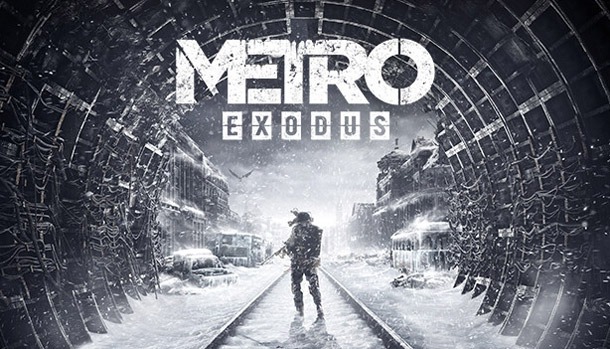
📅 Game released: 2019
Metro Exodus follows Artyom and the Spartan Rangers beyond Moscow on a year-long journey across post-apocalyptic Russia, combining first-person stealth, survival, crafting, and exploration across changing regions. This PC guide compares official Steam, Epic Games Store, GOG, and Microsoft Store download and installation options, explains Gold Edition and both story DLCs, and covers the standard and PC Enhanced Editions, system requirements, Steam Deck, mods, and performance.
 By Editor Zero — independently researched, edited, and maintained.
Last updated: 12 November 2026
Last reviewed: 12 November 2026
Table of Contents
- Quick Facts
- Official PC Stores, Download & Installation
- Metro Exodus Review
- Pros & Cons
- PC System Requirements
- Frequently Asked Questions
- Similar Games
Metro Exodus Quick Facts
- Game: Metro Exodus / Gold Edition / PC Enhanced Edition
- Developer: 4A Games
- Publisher: Deep Silver / PLAION
- Genre: First Person Shooter (FPS), Survival, Post-Apocalyptic, Stealth Action
- Release: February 15, 2019
- Platforms: Windows PC, macOS, Linux/SteamOS, PS4, PS5, Xbox One, Xbox Series X|S
- Story DLC: The Two Colonels and Sam’s Story, available separately or through the Expansion Pass and Gold Edition
- PC Enhanced Edition: Separate Windows client included for eligible PC owners; requires a ray-tracing-capable NVIDIA GeForce RTX or compatible AMD Radeon RX GPU
- Steam Deck: Playable for both Steam versions; the standard client is the more practical handheld starting point
- Engine: 4A Engine
- Modes: Single-player campaign and single-player DLC; no co-op, PvP, or split-screen
- Official Creation Tools: Exodus SDK with the 4A Editor, visual scripting, standalone-content support, documentation, and Mod.io integration
- Community: Official Metro Website, Steam Discussions, Metro Reddit Community
- PC modding: Nexus Mods for Metro Exodus hosts unofficial visual, interface, save, configuration, and gameplay modifications; SDK projects may target only one client
- Metacritic score: 82/100 on PC
- IGN score: 8.5/10
- OpenCritic average: 83/100
- Steam user reception: Very Positive overall
Official PC Stores, Download & Installation
👇 Compare the official Metro Exodus PC stores, editions, Enhanced Edition entitlement, DLC ownership, and installation differences below before purchasing or downloading.
- PC availability: Metro Exodus is officially sold for Windows through Steam, Epic Games Store, GOG, and Microsoft Store / Xbox.
- Standard vs Enhanced: A supported PC purchase includes the standard Windows version and the separately installed PC Enhanced Edition within the same storefront ecosystem. The standard client supports non-ray-tracing GPUs and DirectX 11 or 12, while Enhanced Edition requires Windows, DirectX 12, and ray-tracing-capable hardware.
- Gold Edition: Gold Edition contains the base game and Expansion Pass, covering The Two Colonels and Sam’s Story plus the corresponding Enhanced Edition DLC entitlement for eligible PC ownership.
- Expansion Pass: The Expansion Pass and both story DLCs can also be purchased separately. Check existing ownership before buying the pass after purchasing an individual expansion.
- Steam: Steam supports achievements, Steam Cloud, full controller support, Family Sharing, community discussions, and native standard-version builds for Windows, macOS, and Linux/SteamOS.
- Epic Games Store: Epic provides the standard and Enhanced clients, cloud saves, controller support, DLC, and Exodus SDK access.
- GOG: GOG sells Standard, Gold, and franchise packages as DRM-free Windows releases. GOG Galaxy is optional because offline installers can be downloaded and the single-player game can launch without activation or a continuous connection.
- Microsoft / Xbox Store: The Windows package includes access to Metro Exodus and Metro Exodus Enhanced Edition, with Xbox achievements, HDR, variable refresh rate, PC gamepad support, and listed PC/handheld compatibility. Its standard and Enhanced clients are separately listed in the purchased Windows package.
- Xbox Play Anywhere: The Microsoft listing does not advertise Xbox Play Anywhere for Metro Exodus. Do not assume that a separate Xbox console purchase automatically grants the Windows package.
- Save transfer: Steam, Epic, and GOG standard/Enhanced installs share their respective save locations and can transfer completed chapter saves; Microsoft Store save transfer between the two clients is not officially supported because save data is encrypted separately for each product.
- Separate ecosystems: Steam, Epic, GOG, and Microsoft ownership remain separate. Buying one storefront version does not add the others, and cloud saves should not be treated as cross-store progression.
- Exodus SDK: The official tools require an installed Steam, Epic, or GOG copy of Metro Exodus or PC Enhanced Edition and support personal, non-commercial standalone content plus Mod.io sharing.
- Steam Deck: Valve rates both Steam app listings Playable. The standard client is the more practical starting point because Enhanced Edition requires a fully ray-traced rendering path and is substantially more demanding.

 Buy Metro Exodus on Epic Games Store

 Buy Metro Exodus on Microsoft / Xbox Store
 Visit the Official Metro Website

Metro Exodus Review
A journey across ruined Russia where open horizons never make survival feel safe.
Metro Exodus leaves Moscow’s tunnels without abandoning what made the Metro game series distinctive. Artyom boards the Aurora with Anna, Miller, and the Spartan Rangers, hoping to find a life beyond the underground. The journey spans a year and trades continuous claustrophobia for stretches of dangerous freedom. There is more room to choose a route, but also more opportunity to waste a filter, misjudge a patrol, or walk into something that was hiding in plain sight.
Following Metro 2033 Redux and Metro: Last Light, this is still a directed story, not a post-apocalyptic playground without boundaries. The larger regions matter because they change how Artyom survives, while the Aurora gives the scattered chapters a shared purpose. Each stop also shows another uneasy answer to life after the catastrophe, from religious isolation to exploitation and collective loyalty.
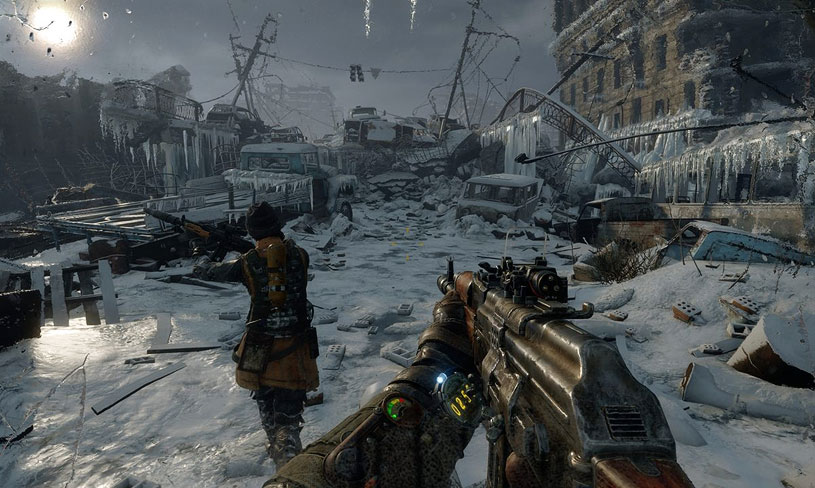
The Aurora Gives the Journey a Human Centre
The train is not simply a way of moving between maps. Crew members repair equipment, play music, argue about their plans, and talk about those left behind. A return to the carriages after a dangerous chapter provides something the combat cannot: the feeling that these people have continued living while Artyom was away.
Anna brings warmth and disagreement to her relationship with Artyom, while Miller’s faith in orders and established authority is tested by what the Rangers discover. The best moments often sit outside mandatory dialogue. Listening to a private fear or an ordinary joke rarely unlocks anything, but it changes how a later crisis lands. The crew feels less like a roster of companions and more like a temporary home. Players who hurry straight to the next objective can miss these changes almost entirely. That is an unusual choice for a story-driven game: some of its best characterization depends on choosing to spend time doing very little.
Artyom’s near-silence is an awkward price for that intimacy. Characters ask him questions, then continue speaking as though he answered. His diary narration gives him a personality between chapters, yet it cannot fill those gaps in face-to-face scenes. Exodus asks the player to care deeply about relationships in which the central participant often seems strangely absent.
Semi-Open Regions Reward Curiosity, but Not Every Detour
Volga, Caspian, and Taiga are separate regions rather than one continuous open world. Volga’s flooded villages mix religious fear, industry, and mutant-infested water. Caspian replaces that cold isolation with dust, exposed roads, vehicles, and a society organized around exploitation. Taiga is greener and more constrained, with wooded routes where restraint often matters more than firepower. Each region has a character that changes the pace of exploration. Boats make Volga’s flooded routes possible but expose Artyom to danger from below, while Caspian’s openness makes distant enemies easier to spot and harder to avoid.
Unlike a map that reveals every activity automatically, Exodus asks the player to look. Binoculars can identify distant points of interest through a focusing cue and add them to Artyom’s map. That modest interaction makes surveying a ruined skyline feel like an act of discovery. A building might hold an equipment upgrade, a diary, a trapped survivor, or nothing worth the ammunition needed to reach it.
There is a limit to this freedom. A camp cleared before its associated mission can still demand another visit once the objective becomes active. That disconnect is noticeable precisely because the game otherwise encourages independent exploration. Taiga creates another tension: its factions and forest setting invite investigation, but the chapter’s tighter route leaves less time to experiment with the crossbow introduced there. The weapon feels interesting just as the world becomes less accommodating.
Compared with Fallout 4, Exodus exchanges a persistent sandbox, settlements, and extensive character progression for carefully bounded regions. Fallout: New Vegas offers deeper dialogue and faction choice. Exodus has fewer branches, but makes the ruined spaces personal through the people living in them and the need to move on.
Survival Systems Turn Distance Into Risk
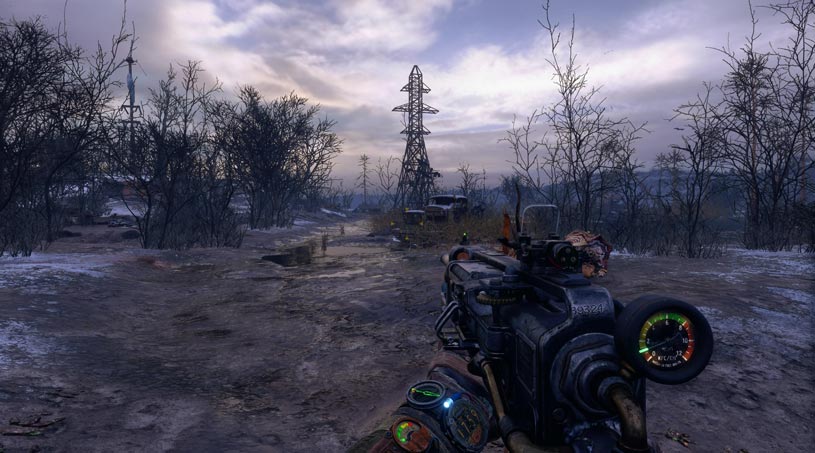
Artyom does not level up through a conventional skill tree. Progress comes from scavenged materials, suit upgrades, useful attachments, and growing familiarity with the terrain. The backpack permits essential crafting in the field, while a workbench is needed for cleaning weapons and larger loadout changes. As a result, a distant objective is never only a question of how far away it is. Equipment condition and the journey home matter too.
Mud, sand, and water gradually foul weapons. A dirty rifle can jam just when several mutants close in, so maintenance has a practical consequence beyond realism. Radiation imposes a different clock through gas-mask filters, and a cracked mask may need an immediate patch. One extra room in a contaminated building can turn an apparently profitable detour into a rushed retreat. A filter runs low, a mutant damages the mask, and the player begins wasting ammunition while searching for the exit. The pressure comes from several ordinary systems colliding rather than from a scripted emergency.
The ammunition economy has more subtle options than simply firing less. Throwing knives can often be recovered, while Tikhar ammunition and crossbow bolts draw on different crafting resources from conventional bullets. Accurate, selective attacks can therefore preserve supplies for encounters where a firefight is unavoidable. It is a satisfying piece of design because learning the value of a tool can matter more than finding another upgrade.
Weapon Customization Rewards Preparation
Stocks, sights, barrels, magazines, and suppressors allow familiar weapons to assume different roles. A Kalash can favor stability at range or quicker close-quarters fighting; the revolver can be configured for stealth or heavier work. The pneumatic Tikhar rewards attention to its pressure, while shotguns become reassuring when mutants rush from close range. No single setup answers every threat, and that is why experimenting with attachments feels more useful than accumulating an arsenal for its own sake.
These choices mean something because the regions pose different problems. Caspian’s long sightlines favor optics, whereas a dark compound invites a quiet approach. Attachments recovered from abandoned weapons can remain useful across chapters, but the game does not always make the process clear. Overlooking a part on a weapon you leave behind can mean losing an option that would have suited the next area. The reward for examining abandoned gear is tangible, although the interface sometimes assumes players understand rules it has barely explained.
Stealth and Morality Are Connected
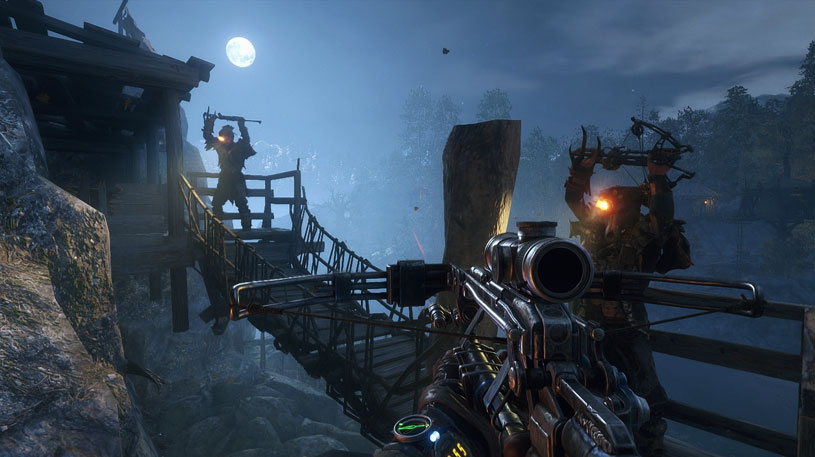
Human encounters permit distractions, suppressed shots, knockouts, alternate routes, and waiting until darkness changes the patrols. Avoiding casualties conserves resources, but it also influences outcomes that Exodus does not track with a visible morality meter. Rescuing captives, sparing surrendering enemies, and recognizing when a frightened faction is not simply a collection of targets can affect companion fates and the ending.
This approach works best when restraint grows naturally from understanding a community. It is less convincing when an armed enemy seems to invite a lethal response, yet the game quietly expects mercy. A player can interpret the same firefight as self-defence and still discover much later that the campaign expected a different choice. Detection is also inconsistent: guards sometimes overlook exposed movement or notice Artyom through clutter. The uncertainty can make careful infiltration feel less reliable than it should, even when the moral consequences encourage exactly that playstyle.
Still, the strongest outcomes feel earned because they reflect conduct across an entire region rather than a final dialogue choice. Metro Exodus asks players to distinguish survival from unnecessary violence without turning every decision into a highlighted menu option.
Weather, Darkness, and Sound Make the World Hostile
Daylight helps with navigation but exposes Artyom across open ground. Darkness hides him from human patrols while making mutants and unfamiliar buildings harder to read. Volga’s fog and rain, Caspian’s dust, Taiga’s filtered forest light, and the radiation of Novosibirsk create different kinds of vulnerability. The scenery changes dramatically, yet none of it feels reliably safe. Even returning along a familiar path can feel different after sunset, when a useful hiding place for a human encounter becomes a dangerous route through mutant territory.
Sound does much of the work. Mask breathing, distant creatures, loose weapon mechanisms, and guards talking behind cover give information before an interface prompt does. Humanimals add another layer of doubt: some blend among bodies or debris before lunging, while thrown rocks mean that simply backing away does not guarantee safety. Even an apparently motionless shape can deserve a second look.
The horror is sometimes more intimate. Small spiders crawling across Artyom’s view after he walks into webs create discomfort without needing a boss fight or a serious threat to his health. That closeness will affect players differently, but it shows how effectively Exodus uses the first-person perspective. Dying Light produces a faster version of night-time pressure through parkour and infected pursuits; Metro relies more on hesitation, limited supplies, and not knowing what is nearby.
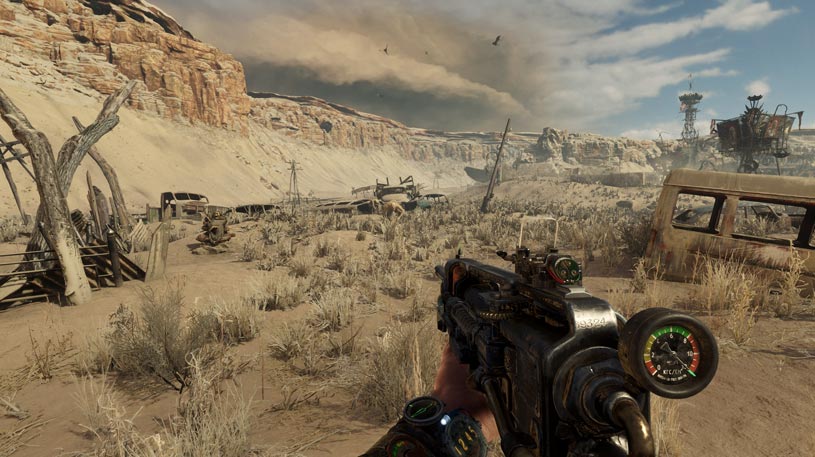
The Two Colonels and Sam’s Story Extend the Journey Differently
The Two Colonels returns underground with Colonel Khlebnikov in Novosibirsk. Its flamethrower changes combat, but the greater force comes from following ordinary duties and family ties inside a society approaching collapse. The narrow spaces and tragic context make it a focused counterweight to the main campaign, best appreciated after Artyom’s journey. It also shows that Metro’s older corridor-based tension still works; openness is an addition to the series, not a replacement for everything that came before.
Sam’s Story takes the opposite direction. Sam explores Vladivostok while hoping to reach the United States, with more open routes, equipment, and choices. He also speaks during exploration, sometimes reacting to objects or slipping into English. Those brief remarks give him a presence that Artyom often lacks; an ordinary comment can establish character more naturally than another long conversation directed at a silent protagonist. The expansions complement rather than imitate each other.
The Journey Has Rough Edges
Exodus does not always balance its ambitions. Some drives cross empty ground between worthwhile locations, vehicles can catch on terrain, and Volga boat journeys lose tension when mutant interruptions become routine. Movement animations occasionally leave Artyom committed to an action for longer than expected. The game’s better moments encourage thoughtful preparation, but these interruptions can make the controls feel like another unpredictable opponent.
Its travel has a particular appeal for anyone who enjoys the relationship between distance and uncertainty. Death Stranding 2: On the Beach works with very different mechanics, yet both games can make reaching a destination feel more consequential than simply clearing the objective waiting there.
Replayability Comes From Consequence, Not Endless Content
New Game Plus modifiers, Ranger Hardcore, missed attachments, alternate approaches, and different moral outcomes give a second journey purpose. Ranger Hardcore also changes the meaning of exploration through restrictive checkpoints. Dying after a long scavenging detour may mean gathering everything again, so caution extends to climbing and movement as well as combat. The resulting tension can be absorbing or needlessly punishing, depending on what a player wants from difficulty. A failed jump that erases a careful scavenging trip feels different from losing a hard-earned firefight, and the mode does not always distinguish between those frustrations.
There is no endless post-story free roam. Once the Aurora departs a region, ordinary exploration there is finished. Days Gone offers a more persistent world of motorcycle travel and infected hordes; Exodus gains urgency from knowing that a missed place or a decision may stay missed. Its branching is limited, but the consequences for companions make replaying with greater restraint worthwhile.
Final Verdict
Metro Exodus finds a convincing middle ground between the tunnels of its predecessors and the freedom of a larger adventure. Scavenging, weather, weapon upkeep, stealth, and moral consequences all give exploration a cost. The Aurora supplies the emotional reason to accept that cost, turning quiet conversations and the crew’s changing relationships into something as important as a successful firefight.
It remains uneven. Unpredictable detection, occasional backtracking, cumbersome movement, and a protagonist who rarely answers his friends can interrupt the immersion the game works so hard to establish. Taiga’s reduced freedom is another reminder that bigger environments alone do not guarantee better design.
For players who want a focused post-apocalyptic story with room for mistakes, discovery, and personal restraint, those compromises are worth considering rather than dismissing. Metro Exodus does not turn survival into comfort just because there is sky overhead. It allows the series to breathe while keeping each departure, and each return to the train, meaningful.
Metro Exodus Pros & Cons
- Pro: The Aurora crew, changing seasons, and region-specific societies create a memorable year-long post-apocalyptic journey
- Pro: Semi-open regions balance exploration with directed storytelling instead of relying on repetitive map-clearing activities
- Pro: Scavenging, crafting, weapon condition, attachments, gas-mask filters, darkness, and weather keep survival connected to ordinary movement
- Pro: Stealth, mercy, rescues, optional conversations, and regional choices can change companion outcomes and the ending
- Pro: Gold Edition adds two worthwhile story expansions, while PC Enhanced Edition remains a striking showcase for fully ray-traced lighting
- Con: Human AI, stealth detection, vehicle handling, and some animations remain inconsistent
- Con: Artyom’s silence weakens conversations built around his relationships and decisions
- Con: Important morality rules, missable regional content, and version-specific installation details are not always explained clearly
- Con: PC Enhanced Edition requires ray-tracing hardware, a separate installation, and substantially more performance than the standard client
Metro Exodus PC System Requirements
Important: Metro Exodus has separate standard and PC Enhanced Edition clients. The standard version supports conventional rendering and non-ray-tracing GPUs. PC Enhanced Edition uses a fully ray-traced lighting pipeline, requires Windows 10 20H2 or newer in its published specification, DirectX 12, and a compatible NVIDIA RTX or AMD Radeon RX ray-tracing GPU.
STANDARD VERSION — MINIMUM
OS: Windows 7, Windows 8, or Windows 10, 64-bit
CPU: Intel Core i5-4440 or equivalent
RAM: 8 GB
GPU: NVIDIA GeForce GTX 670 / GTX 1050 / AMD Radeon HD 7870
DirectX: Version 11
Storage: 59 GB available space
Sound Card: DirectX-compatible sound card
STANDARD VERSION — RECOMMENDED
OS: Windows 10, 64-bit
CPU: Intel Core i7-4770K or equivalent
RAM: 8 GB
GPU: NVIDIA GeForce GTX 1070 / RTX 2060 / AMD Radeon RX Vega 56
DirectX: Version 12
Storage: 59 GB available space
Sound Card: DirectX-compatible sound card
PC ENHANCED EDITION — MINIMUM / 1080p NORMAL AT 45 FPS
Ray-Tracing Preset: Normal
OS: Windows 10 version 20H2 or newer, 64-bit
CPU: Four CPU cores with Hyper-Threading or equivalent eight-thread support
RAM: 8 GB
GPU: NVIDIA GeForce RTX 2060
DirectX: Version 12
Additional: Ray-tracing-capable GPU required; the ray-traced lighting path cannot be disabled
PC ENHANCED EDITION — RECOMMENDED / 1080p HIGH AT 60 FPS
Ray-Tracing Preset: High
OS: Windows 10 version 20H2 or newer, 64-bit
CPU: Eight CPU cores
RAM: 8 GB
GPU: NVIDIA GeForce RTX 2070 / RTX 3060 / AMD Radeon RX 6700 XT
DirectX: Version 12
Additional: Published target used Shading Rate 1 with DLSS disabled
PC ENHANCED EDITION — HIGH / 1440p AT 60 FPS
Graphics Preset: Ultra
Ray-Tracing Preset: High
OS: Windows 10 version 20H2 or newer, 64-bit
CPU: Eight CPU cores
RAM: 16 GB
GPU: NVIDIA GeForce RTX 3070 / AMD Radeon RX 6800 XT
DirectX: Version 12
Additional: Published target used Shading Rate 1 with DLSS disabled
PC ENHANCED EDITION — ULTRA / 4K AT 30 FPS
Graphics Preset: Ultra
Ray-Tracing Preset: High
OS: Windows 10 version 20H2 or newer, 64-bit
CPU: Eight CPU cores
RAM: 16 GB
GPU: NVIDIA GeForce RTX 3080 / AMD Radeon RX 6900 XT
DirectX: Version 12
Additional: Published target used Shading Rate 1 with DLSS disabled
PC ENHANCED EDITION — RT EXTREME / 4K AT 60 FPS
Graphics Preset: Extreme
Ray-Tracing Preset: Ultra
OS: Windows 10 version 20H2 or newer, 64-bit
CPU: Eight CPU cores
RAM: 16 GB
GPU: NVIDIA GeForce RTX 3090
DirectX: Version 12
Additional: Published target used Shading Rate 1 with DLSS disabled
Additional PC Performance and Setup Notes
- The current Steam client requires Windows 10 or newer. The standard game’s older Windows 7/8 requirement remains historical storefront information rather than a recommendation for a new Steam installation.
- 4A Games later listed approximate installed sizes of 70.1 GB for the standard game, 77.95 GB with all DLC, and 79.6 GB for PC Enhanced Edition when publishing Exodus SDK requirements. Keep additional free space for updates, caches, saves, and the SDK.
- Standard Metro Exodus can use DirectX 11 or DirectX 12. DirectX 11 can be a useful stability test when DX12 crashes or stutters, but it cannot be selected in PC Enhanced Edition.
- PC Enhanced Edition adds fully ray-traced global illumination, ray-traced emissive lighting, advanced ray-traced reflections, improved denoising, DLSS 2.0 on compatible NVIDIA hardware, variable-rate shading, and an FOV option.
- Run the built-in benchmark and judge frame pacing as well as average FPS. Lower ray-tracing quality, general quality, HairWorks, tessellation, and resolution before assuming the installation is defective.
- Update graphics drivers, verify files, disable conflicting overlays, remove unstable overclocks, and test without mods when either client crashes, freezes, displays corrupted lighting, or fails to load a save.
- Do not copy configuration files or modifications blindly between standard and Enhanced Edition. Their rendering pipelines, executable paths, and compatible tools can differ.
- Back up local and cloud saves before changing store clients, installing community saves, testing New Game Plus modifications, or using Exodus SDK projects.
- Steam Deck is rated Playable rather than Verified. Valve says the default controller configuration works, text is legible, and default graphics perform well, but warnings appear and external controllers may require manual controller-order selection.
- PC Enhanced Edition also has a Playable compatibility listing, but the standard version remains the more sensible handheld starting point because its rendering path is less demanding and does not require ray tracing.
Official Trailer
Note: This official Metro launch trailer presents Artyom, Anna, Miller, the Aurora, post-apocalyptic Russia, semi-open exploration, stealth, mutants, weapons, weather, and the crew’s search for life beyond Moscow.
Frequently Asked Questions
Should I play Metro 2033 Redux and Last Light before Exodus?
Playing them first is recommended but not essential. The earlier stories establish Artyom, Anna, Miller, the Rangers, and the history that gives leaving Moscow greater emotional weight.
Which Metro Exodus edition includes both story expansions?
Gold Edition includes the base game and Expansion Pass, which contains The Two Colonels and Sam’s Story. Standard Edition includes the main campaign; you can buy the expansions separately if needed.
What is the difference between the standard and PC Enhanced Editions?
The standard version works with conventional graphics cards and supports DirectX 11 or 12 on Windows. The separate PC Enhanced Edition requires a ray-tracing-capable GPU and DirectX 12, with fully ray-traced lighting and improved reflections. It is not a patch that replaces the standard game.
Is PC Enhanced Edition included with existing PC purchases?
Yes. Owners of the supported PC version receive the Enhanced client through the same storefront. The DLC and Expansion Pass also provide their corresponding Enhanced versions, but licenses do not transfer between different stores.
Do I need to install both Metro Exodus PC versions?
No. Install the one you intend to play. Use the standard client if your hardware lacks ray tracing or you want the most practical native Linux, macOS, or Steam Deck route.
Can I transfer saves between standard and Enhanced Edition?
Steam, Epic, and GOG support carrying over completed chapter saves, although mid-chapter progress does not transfer in the same way. Official transfer between the Microsoft Store clients is not supported, so treat their saves separately.
How do The Two Colonels and Sam’s Story differ?
The Two Colonels is a shorter, mostly linear story set around Novosibirsk and Colonel Khlebnikov. Sam’s Story is a broader semi-open adventure around Vladivostok, with additional exploration and decisions.
When should I play the Metro Exodus DLC?
Finish the main campaign first to avoid story spoilers. The Two Colonels makes the most sense immediately afterward, followed by Sam’s Story as a longer epilogue.
Is Metro Exodus a fully open-world game, and can I revisit regions?
No. Volga, Caspian, and Taiga are separate large regions connected by linear chapters and Aurora journeys. Once the story moves on, you generally cannot return to explore an earlier region in the same playthrough.
How long does Metro Exodus take to finish?
The main campaign commonly takes roughly 15–25 hours, depending on exploration and difficulty. Thorough scavenging, repeat attempts, alternate outcomes, and both expansions can extend the total substantially.
Does Metro Exodus have multiple endings?
Yes. The campaign’s outcome is influenced by important crew members’ fates and the way Artyom treats people across the regions, not just by one final choice.
How can I work toward the good ending?
Protect and assist civilians and prisoners, avoid killing surrendering or frightened humans, pay attention to regional factions, and favor non-lethal solutions where appropriate. Some enemies are genuinely hostile, so the morality system is not a rule against every kill.
Does Metro Exodus have co-op or multiplayer?
No. The main campaign and both story expansions are single-player only, without online co-op, competitive multiplayer, or split-screen.
Can Metro Exodus be played offline?
The single-player game can be played offline after any required store setup. GOG offers a DRM-free version with standalone offline installers; store-based achievements, cloud synchronization, and downloads may still need internet access.
Is Metro Exodus Steam Deck Verified?
No. Valve classifies both the standard Steam listing and the PC Enhanced Edition as Playable, not Verified. The standard version is the more practical starting point for handheld performance.
Should I select DirectX 11 or 12 on Windows?
The standard version can use either; DirectX 11 is worth trying if DirectX 12 causes persistent instability. The Enhanced Edition requires DirectX 12 and ray-tracing hardware.
What should I check if Metro Exodus crashes or stutters?
Start with up-to-date GPU drivers, file verification, and a test without overlays, unstable overclocks, or unofficial modifications. If using the standard client, compare its DirectX 11 and 12 modes before changing numerous settings at once.
Does Metro Exodus support controllers, ultrawide displays, and FOV adjustment?
Controller support is official. PC Enhanced Edition includes an FOV option; ultrawide presentation can differ between normal gameplay, menus, and cutscenes. Treat unofficial FOV or interface adjustments as version-specific modifications.
What is Exodus SDK?
It is 4A Games’ official creation toolkit for owners of Metro Exodus or PC Enhanced Edition on Steam, Epic, or GOG. It includes the 4A Editor, visual scripting tools, documentation, and Mod.io integration for personal, non-commercial projects.
Still have questions? Check the official Metro Exodus support centre, Metro Exodus Steam Discussions, or Metro community on Reddit.
Sources & References
Key factual and technical information in this guide was checked against relevant official and technical sources, including:
- Steam — Metro Exodus — Enhanced Edition entitlement, Steam features, native desktop builds, standard system requirements, Steam Deck status, and current overall user reception
- Epic Games Store — Metro Exodus — standard and Enhanced ownership, DLC entitlement, cloud saves, controller support, and single-player features
- GOG — Metro Exodus — DRM-free offline installation, edition contents, store features, and OpenCritic reception data
- Microsoft / Xbox — Metro Exodus (Windows) — Windows package contents, Enhanced Edition access, cloud saves, achievements, HDR, variable refresh rate, and PC/handheld capabilities
- PLAION — Metro Exodus System Requirements and PCGamingWiki — Metro Exodus Enhanced Edition — standard and Enhanced PC hardware requirements, DirectX requirements, client differences, and save behavior
- Metacritic — Metro Exodus PC Reviews — PC Metascore and release-date cross-check used in Quick Facts
Similar Games Like Metro Exodus



Found something worth playing through DecideGame?
DecideGame.com is an independent gaming project run by Editor Zero. If this guide helped you discover a game, solve a problem, or find useful information, you can support DecideGame.com and help keep new and updated game guides coming.
DecideGame — PC Game Guides, Reviews & Setup Help