
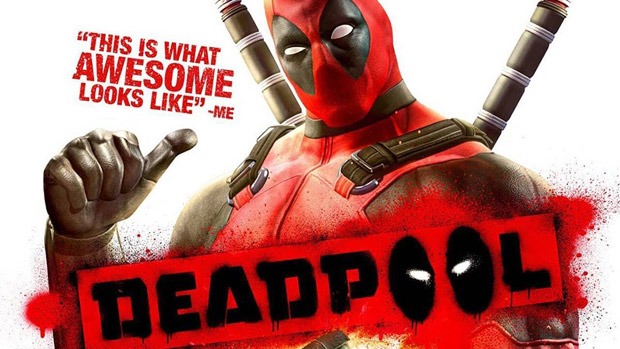
📅 Game released: 2013
Deadpool (2013) is a single-player superhero action game mixing katana combos, firearms, teleport counters, and fourth-wall comedy. This PC guide explains official download access for existing Steam owners, the game’s purchase status, Merc with a Map Pack DLC, system requirements, controller compatibility, Steam Deck support, and practical Windows setup.
 By Editor Zero — independently researched, edited, and maintained.
Last updated: 7 November 2026
Last reviewed: 7 November 2026
Table of Contents
- Quick Facts
- Official PC Stores, Download & Installation
- Deadpool Review
- Pros & Cons
- PC System Requirements
- Frequently Asked Questions
- Similar Games
Deadpool Quick Facts
- Game: Deadpool (2013)
- Developer: High Moon Studios
- Publisher: Activision
- Genre: Action-Adventure, Brawler / Beat ’em Up, Third-Person Shooter, Superhero
- Release: June 25, 2013 (including Windows PC)
- DLC: Merc with a Map Pack adds two Challenge Mode arenas and two map-specific alternate costumes; no normal new Steam purchase is offered
- Platforms: Windows PC, PS3, Xbox 360, PS4, Xbox One
- Steam Deck: Unsupported (Valve rating for the existing Steam release)
- Engine: Unreal Engine 3
- Modes: Single-player campaign and Challenge Mode; no co-op or PvP
- Community: Activision Deadpool Support, Steam Discussions
- PC modding: Nexus Mods for Deadpool hosts unofficial visual, costume, controller-prompt, and other modifications; no official mod tools or Steam Workshop
- Metacritic score: 63/100 (Windows PC)
- IGN score: 6/10 (PC review)
- Steam user reception: Very Positive overall in surviving Steam review data; the game is no longer sold to new Steam buyers
Official PC Store Status, Download & Installation
👇 Use the notes below to understand Deadpool’s official PC availability, download the game through an existing Steam license, and avoid unsafe or unofficial acquisition options.
- Steam store status: Deadpool was retired from new Steam sales and no longer has a normal purchasable PC storefront listing.
- Existing Steam owners: If Deadpool is already attached to your Steam account, use your Steam Library to download or reinstall the Windows version instead of searching for third-party game files.
- No replacement PC store: No verified current Windows purchase release is available through Epic Games Store, GOG, or Microsoft/Xbox PC; GOG lists Deadpool only as a requested Dreamlist title.
- Steam requirement: Activision’s official PC documentation states that Steam must be installed and running for the game to work and is required to install the game.
- Activation and offline play: An internet connection is required for activation. After legitimate installation and activation, Steam can be placed into offline mode for the single-player game.
- Merc with a Map Pack: This legacy DLC adds the GRT Plaza and Inside the Tower Challenge Mode maps plus D-Pooly and Uncanny X-Force costumes. It is not a normal current Steam purchase for new owners.
- Old keys and retail copies: Historical Steam packages and retail activation records still exist, but availability on resale sites or key marketplaces does not make those sellers official; this guide does not recommend unofficial acquisition sources.
- Local saves: Steam Cloud is not listed as a supported feature for the PC release, so back up local save data before reinstalling Windows, changing PCs, or experimenting with mods.
- Steam Deck: The surviving Steam compatibility record rates Deadpool Unsupported, even though community compatibility layers may sometimes launch older Windows games.
- Mod compatibility: PC modifications are community-created rather than officially supported. Keep clean game files and save backups before replacing textures, models, controller prompts, or configuration files.
 Open Deadpool on Steam Support
 Visit the Official Deadpool Support Page

Deadpool Review
Deadpool’s fourth-wall chaos and flexible melee-and-gun combat are memorable, even when repetitive arenas struggle to keep pace with the jokes.
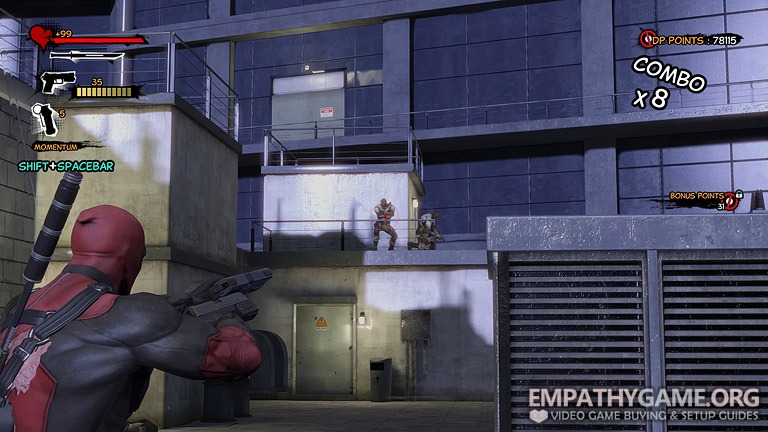
Deadpool succeeds first as a character piece and second as an action game. High Moon Studios builds a linear third-person campaign around Wade Wilson’s katanas, firearms, teleport counters, regenerating health, Momentum attacks and an upgrade economy that rewards active fighting. Switching from a sword combo into gunfire gives ordinary encounters a loose arcade rhythm, but the game’s identity comes from how aggressively Wade interferes with the production around him. He argues with the developers, responds to voices represented through coloured caption boxes, mocks objectives and level design, and addresses the player as if everyone has been dragged into his joke.
That personality covers a lot of mechanical simplicity, but not all of it. The weapons are more useful than the modest arsenal first suggests, and the campaign occasionally breaks its formula with perspective shifts, absurd set pieces and brief stealth or platforming diversions. Yet too many chapters return to the same solution: another enclosed combat space and another wave of enemies. Deadpool fans who enjoy crude humour, Marvel cameos and deliberate spectacle are the audience most likely to forgive that imbalance.
Combat Works Best When Melee and Gunplay Stay Connected
The combat system is simple, but it has a better rhythm than pure button-mashing suggests. Light and heavy attacks drive melee strings, while ranged weapons can be folded into the same encounter without forcing a complete change of pace. Deadpool begins with katanas and pistols before gaining faster sais, slower heavy hammers, shotguns, a pulse rifle and other firearms. Grenades, mines and bear traps round out the toolkit, although direct aggression is usually quicker than careful trap placement.
Different tools solve different kinds of pressure. The hammers trade speed for heavier hits, while the sais favour rapid attacks. A shotgun suits enemies crowding Deadpool at close range, whereas the rifle gives him a cleaner answer to threats that are awkward to reach through a mob. This is where the arsenal earns more credit than the level design: weapon roles are clear enough to encourage switching, even though many encounters do not demand especially creative combinations.
Teleporting is the system that makes the fighting feel like Deadpool rather than a generic brawler with guns. The same defensive input handles evasion and contextual counters, allowing Wade to disappear from an incoming strike and reappear nearby. It can rescue a collapsing combo, but becomes less dependable when several enemies attack from different angles. Counter prompts compete for attention, the camera may lose the threat that matters most, and a move that feels effortless in a small fight becomes harder to read inside a crowded arena.
His healing factor changes the risk calculation too. Health regenerates after Deadpool avoids damage for a short period, so breaking line of fire and creating space can be smarter than continuing a flashy combo while surrounded. That rhythm—attack aggressively, disengage briefly, then re-enter—fits the character surprisingly well.
Upgrades Add Expression Without Changing the Rules
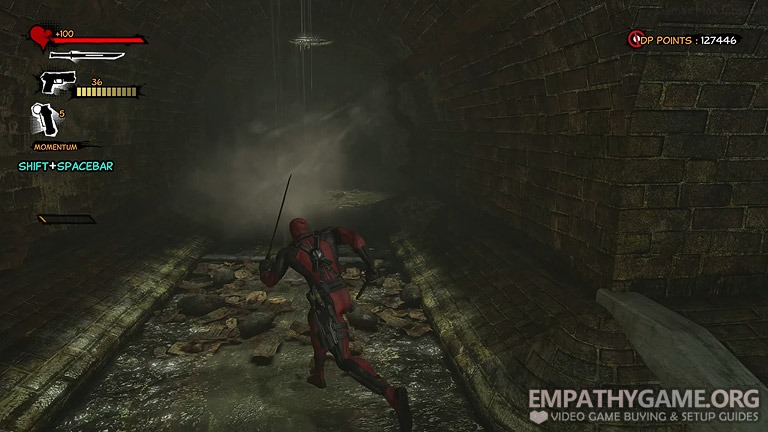
Combat feeds into progression through DP Points, which buy new attacks, weapon improvements, ammunition capacity, character bonuses and Momentum abilities. Because upgrades arrive steadily, the early and middle campaign keeps introducing reasons to experiment. A weapon that initially feels secondary can become more attractive once its follow-up attacks or damage upgrades are unlocked, and switching between melee and firearms gives the system more breadth than the basic controls imply.
Momentum attacks provide the clearest burst of power. Sustained offence fills meters that can be spent on stronger special moves, making a long combo valuable for more than its score. In a manageable group, this creates a satisfying loop: build Momentum with ordinary attacks, reposition with teleport, then spend a special move before the crowd closes in.
The limitation is that progression mostly improves efficiency. Deadpool never develops into radically different builds, and upgraded weapons do not transform the underlying melee-shoot-teleport rhythm. The extra moves make combat more expressive, but they cannot solve the repetition that appears once the encounter structure stops surprising the player.
The Campaign Is Best When It Breaks Its Own Formula
The most memorable stretches are often the ones that refuse to behave like normal levels. The opening apartment lets Wade waste time with mundane objects before the mission properly begins, establishing immediately that player interaction itself can be part of the comedy. Later, the sewer chase in “Taking a Chance” briefly veers into deliberately old-fashioned rooms and platforming before returning to conventional action. These diversions matter because they interrupt the expectation that every corridor exists only to connect two combat arenas.
Genosha gives the campaign its strongest comic-book backdrop, with ruined structures, Sentinel debris and X-Men cameos providing more personality than the office interiors and tunnels that dominate earlier stretches. “Landed in Prison” pushes the absurdity further: Deadpool wakes from a crash badly mangled, movement is briefly reversed while he retrieves a missing arm, and the chapter eventually hands control to Rogue after she absorbs his powers. None of these ideas becomes a major system, but that is partly why they work. The game can throw away a joke after a few minutes because Wade’s unpredictability matters more than mechanical consistency.
Even tiny interactions can outlast the surrounding mission. Repeatedly slapping an unconscious Wolverine has almost no mechanical significance, yet it works because the player participates in the punchline rather than merely watching it. The white and yellow caption voices do something similar: their interruptions, combined with Wade commenting on the player’s behaviour, make the fourth wall feel integrated into play instead of confined to cutscenes.
Encounter Design Cannot Match the Arsenal
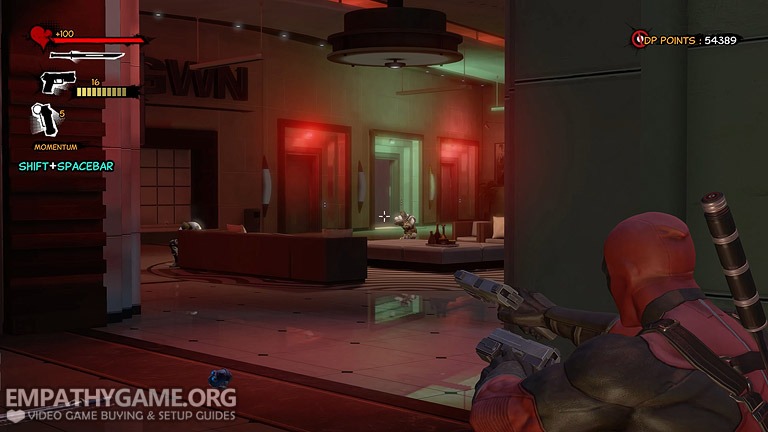
The campaign’s central problem is not a total lack of combat options; it is that the levels often ask too little of them. Many fights place melee enemies in front while ranged attackers chip away from the edges. Early on, that mixture encourages useful target prioritisation: teleport past the front line, remove the gunner, then return to the heavier threat. Later, the same structure returns with more bodies and more damage filling the screen.
That exposes the camera and counter system at exactly the wrong time. Deadpool is most enjoyable when the player can see a threat, choose a weapon and react deliberately. When enemies, explosions and off-camera gunfire overlap, success depends less on expressive combos and more on surviving the clutter. The final stretch makes this especially obvious by leaning heavily on waves of Sinister’s clones. Difficulty rises, but the tactical question does not deepen at the same rate.
Enemy roles still create some useful variety. Heavy opponents, ranged threats and disruptive specialists can make certain weapons more practical than others, supporting weapon switching when a fight mixes close and distant threats. The repetition is broader: similar encounter patterns return often enough that the solution becomes familiar before the campaign ends. Stealth executions, traps and brief platforming sections offer relief, but not enough to reshape the core loop.
The Joke Machine Is Both the Story’s Strength and Its Limit
The plot begins with Deadpool effectively forcing his way into his own videogame production, then turns a mercenary job involving media executive Chance White into a larger confrontation with Mister Sinister. Cable, Wolverine, Rogue and Domino move through the story, but most function as comparatively serious characters trapped inside Wade’s version of events.
Nolan North carries that structure. Deadpool talks to himself, the player and the people supposedly making the game, treating even exposition as something to sabotage. The writing is strongest when the joke depends on the medium—budget complaints, objective conventions, abrupt genre changes—rather than only on sex, gore or random absurdity. Those moments give the campaign a distinct voice even when its plot is little more than an excuse to keep moving.
There is a trade-off. This portrayal pushes Deadpool heavily toward the loud, childish and impulsive side of the character. Cable sometimes has to simplify serious stakes until Wade pays attention, and the campaign rarely gives his wounded or self-aware side enough room to complicate the comedy. Players familiar with darker Deadpool stories may therefore find him narrower here than the character can be elsewhere. The humour is also relentless: some jokes land through North’s timing, while others feel like period-specific shock comedy. What matters is that the game commits completely to its chosen version of Wade.
Presentation Has Personality Where the Levels Do Not
Visually, Deadpool is more functional than striking. Character animation, comic effects and exaggerated violence support the tone, but many interiors, tunnels and combat spaces are sparse and lightly interactive. Outside breakable objects and scripted gags, the environment rarely behaves like a playground. Exploration therefore feels thin: there are pickups and small detours, but little reason to study a room once its immediate joke or fight is finished.
Genosha helps with larger comic-book imagery and wrecked Sentinel scenery, yet the game is easier to remember as a collection of moments than as a sequence of great levels. A visual gag, cameo or absurd transition sticks; the arena connecting them often does not. The camera is the presentation weakness with the greatest gameplay consequence, because losing visual control during a crowded teleport-heavy fight can hide the very attack the counter system expects the player to read.
Replayability Depends on How Much You Enjoy the Combat
Completed chapters can be revisited with purchased upgrades retained, so a second run has the immediate appeal of using a developed arsenal from the start. Higher difficulties make positioning, regeneration and ranged target priority more important, but the campaign remains structurally fixed: there are no branching paths, alternate builds or substantial exploration systems waiting to reveal a different version of the adventure.
Challenge Mode is the clearer test of lasting combat appeal. Its arenas strip away most narrative interruptions and focus on surviving fights, building scores and clearing tougher challenge tiers. Completing Gold difficulty on a map unlocks Infinite difficulty, giving players who enjoy optimising combos and Momentum use a reason to continue. For anyone mainly interested in the jokes and cameos, though, removing the campaign’s comic interruptions can expose the mechanics’ limits faster rather than extend their appeal.
Final Verdict
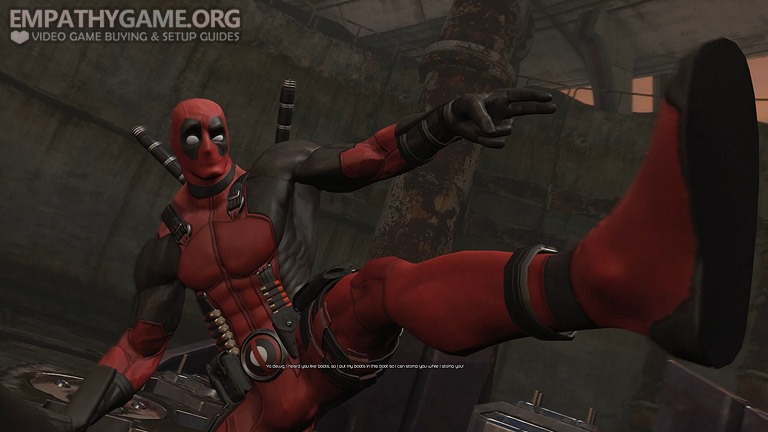
Deadpool is memorable because Wade Wilson refuses to behave like a polite protagonist waiting for the videogame around him to finish. He interrupts exposition, argues with his own voices, mocks the developers, bothers the X-Men and turns throwaway interactions into jokes that can be more memorable than the missions containing them. Nolan North gives that chaos enough energy to carry stretches that would otherwise feel like an ordinary licensed brawler.
The action is better than a “mindless button-masher” label suggests. Katanas, hammers, sais, pistols, shotguns and the rifle occupy useful roles; teleporting gives defence a character-specific identity; regeneration rewards tactical disengagement; and Momentum attacks make sustained offence worthwhile. The problem is that the campaign does not build enough interesting situations around those tools. Arena repetition, crowd-heavy difficulty spikes, a troublesome camera, light exploration and shallow platforming eventually reveal how modest the underlying structure is.
Players looking for deep character-action combat, intricate levels or meaningful build experimentation will find the systems too thin. Deadpool fans who value fourth-wall humour, Marvel cameos and an action game willing to sabotage its own conventions every few minutes are much better served. It is mechanically flawed but unmistakably itself, and that personality is the main reason its best moments still stand out.
Deadpool Pros & Cons
- Pro: Nolan North’s energetic Deadpool performance and constant fourth-wall jokes give the campaign far more personality than its straightforward structure suggests
- Pro: Guns, katanas, heavy melee weapons, teleport counters, executions, upgrades, and combo chaining create an accessible mixture of shooting and brawling
- Pro: Challenge Mode provides score-driven combat arenas and additional replay value after finishing the relatively compact campaign
- Pro: Lightweight original PC requirements make the game technically approachable on modest hardware, provided modern compatibility issues are handled
- Pro: Existing Steam owners retain a legitimate route to download and reinstall their purchased PC copy despite the game’s removal from new sale
- Con: Deadpool is delisted, leaving new PC players without a normal official digital purchase option
- Con: Enemy variety, encounter design, platforming, and environmental structure become repetitive over the course of the campaign
- Con: The PC release has a dated graphics menu, limited native controller flexibility, frame-rate quirks, and awkward ultrawide/high-resolution behavior
- Con: Steam Deck remains officially Unsupported, and there has been no modern PC remaster or comprehensive compatibility refresh
Deadpool PC System Requirements
Activision still publishes the original official minimum Windows requirements for Deadpool. A separate official recommended specification is not provided, so no unofficial recommended tier has been substituted below.
OFFICIAL MINIMUM:
OS: Windows XP / Windows Vista / Windows 7 / Windows 8
CPU: Intel Core 2 Duo E8200 @ 2.66 GHz or AMD Phenom X3 8750 or better
RAM: 2 GB
GPU: NVIDIA GeForce 8800 GT series with 512 MB RAM or ATI Radeon HD 4850 with 512 MB RAM or better
DirectX: DirectX 9.0c or later
Storage: 16 GB free space
Internet: Internet connection required for activation
Additional: Steam must be installed and running; offline mode is supported after setup
RECOMMENDED:
Activision does not publish a separate official recommended PC specification for Deadpool in its surviving support documentation.
Additional PC Performance and Setup Notes
- The official specifications predate Windows 10 and Windows 11, so they should not be interpreted as an official compatibility certification for newer operating systems.
- The PC version provides relatively basic graphics presets rather than the extensive graphics menu expected from a modern PC release.
- Community PC documentation reports a default frame-rate ceiling around 59 FPS. Higher-frame-rate workarounds exist, but excessively high frame rates can interfere with scripted interactions, so preserving stable gameplay is more important than forcing an unlimited frame rate.
- Native controller support is oriented around XInput-compatible controllers. PlayStation-style button prompts and other controller changes generally depend on unofficial community modifications.
- Standard widescreen works normally, while ultrawide, multi-monitor, and some very high-resolution setups can require community configuration changes to correct field of view, HUD placement, or texture behavior.
- Local Windows saves are normally stored under
%USERPROFILE%\Documents\My Games\Deadpool\SaveData\. Back up this folder before reinstalling, moving to another PC, or adding modifications. - When troubleshooting startup problems, first verify the legitimate Steam installation, reinstall required legacy DirectX or Visual C++ components when appropriate, and test with mods or third-party overlays disabled.
Official Trailer
Note: Marvel Entertainment’s official launch trailer highlights Deadpool’s guns, sword combat, fourth-wall humor, X-Men appearances, explosions, and deliberately chaotic presentation, while this written guide focuses on the delisted PC release, legitimate Steam download access, requirements, compatibility, mods, and setup.
Frequently Asked Questions
Can you still buy Deadpool on PC?
Not through a normal official Windows storefront. The Steam release has been retired from sale, and no verified replacement PC release is available through GOG, Epic Games Store, or the Microsoft Store.
Can existing Steam owners still download Deadpool?
Yes. If your Steam account already has a legitimate license for Deadpool, open your Steam Library and reinstall it there. The game’s removal from new sale does not automatically remove existing entitlements. If it is missing from your library, check the relevant account and contact Steam Support.
Does Deadpool require an internet connection to play?
An internet connection is required for the original Steam installation and activation process. Activision states that Steam can then be placed into Offline Mode, so the single-player campaign does not require a continuous internet connection after normal setup.
Is Deadpool open world?
No. Deadpool is a linear third-person action game built around individual chapters, combat arenas, platforming sections, scripted sequences, and occasional exploration for pickups rather than a freely explorable open world.
Does Deadpool have multiplayer, co-op, or split-screen?
No. The game is designed for one player and does not include campaign co-op, online multiplayer, local co-op, or split-screen. Challenge Mode is also a single-player score-focused mode rather than multiplayer.
What difficulty settings does Deadpool have?
The campaign offers Genetically Superior as the easier option, Veteran as the standard difficulty, and Ultra-Violence! as the hardest choice. Veteran is a sensible first playthrough for players familiar with third-person action games, while Ultra-Violence! makes enemy damage and crowded encounters considerably less forgiving.
How does Deadpool’s healing factor work?
Deadpool automatically regenerates health after avoiding damage for a short period. When health becomes low, breaking line of fire, evading attacks, or teleporting away can create enough breathing room for regeneration to begin.
How do DP Points and upgrades work?
DP Points function as the game’s upgrade currency and are earned through combat and collected throughout stages. They can be spent on Deadpool himself, weapons, additional attacks, ammunition capacity, Momentum abilities, and other combat improvements, so maintaining strong combos helps progression as well as your score.
Can you replay chapters and keep your upgrades?
Yes. Chapter replay allows you to return to completed stages while retaining purchased upgrades, which makes it useful for harder difficulty runs, achievements, missed challenges, and earning more DP Points. It effectively provides much of the practical benefit of New Game Plus even though the menu does not present a separate traditional New Game+ mode.
How does Challenge Mode work in Deadpool?
Challenge Mode places Deadpool in combat arenas built around surviving enemy waves and earning increasingly difficult ratings. Completing the Gold challenge for a map unlocks its Infinite difficulty, which Activision identifies as the mode used for continuing score-focused play.
Why will the Catacombs of Genosha Challenge not unlock?
Activision documents a progression issue when the ending of the preceding Death, Baby chapter is skipped too quickly or inputs are repeatedly pressed during its final scene. Replay that chapter and allow the entire ending cutscene to finish normally, then check the Challenge menu again.
Does Deadpool support controllers on PC?
Yes, although Steam’s surviving metadata describes the game as having Partial Controller Support rather than modern full controller integration. XInput-style Xbox controllers are the most natural fit for the original PC release; other controller types may depend more heavily on Steam Input or community configuration.
Does Deadpool work on Windows 10 and Windows 11?
Activision’s official requirements cover Windows XP through Windows 8, not Windows 10 or Windows 11. The original Windows build may work on newer systems, but it is not officially certified there. Problems can vary by driver, runtime, display setup, and controller; start from a clean Steam installation before trying community workarounds.
Can Deadpool run above 60 FPS on PC?
The PC release normally operates around a 59–60 FPS ceiling. Community configuration can raise that limit, but PCGamingWiki documents gameplay interactions and softlocks that can occur at unusually high frame rates, so a stable 60 FPS configuration is the safer choice for a normal playthrough.
Does Deadpool work on Steam Deck?
Valve rates the historical Steam release as Unsupported on Steam Deck. That rating does not mean every community Proton configuration must fail, but it is not an official Verified or Playable recommendation. A Steam license is required to access your purchased copy.
What does the Merc with a Map Pack DLC add?
Merc with a Map Pack adds the GRT Plaza and Inside the Tower Challenge Mode arenas and the D-Pooly and Uncanny X-Force costumes, which are associated with the DLC challenge maps. It is not a new story expansion and is no longer a normal Steam purchase for new owners.
Still have questions? Check the Deadpool Steam Discussions or Activision’s official Deadpool support page for further troubleshooting and player discussion.
Sources & References
Key official, technical, store-status, and review facts in this guide were checked against the following sources:
- Activision — Deadpool Minimum System Requirements — original PC specifications, Steam requirement, activation, and offline mode.
- SteamDB — Deadpool (App 224060) — Steam release metadata, delisting, surviving reviews, controller features, and Steam Deck rating.
- PCGamingWiki — Deadpool — save data, display behavior, frame-rate limitations, and community PC workarounds.
- Steam — Merc with a Map Pack Announcement — the original official DLC description and Challenge Mode additions.
- Metacritic — Deadpool PC Critic Reviews — PC Metascore and the original IGN review score.
- GOG Dreamlist — Deadpool — confirmation that its GOG page is a community request, not a purchasable PC release.
Similar Games Like Deadpool
- X-Men Origins: Wolverine
- God of War II
- Metal Gear Rising: Revengeance
- Spider-Man: Web of Shadows
- The Punisher (2005)
- Prototype



Found something worth playing through DecideGame?
DecideGame.com is an independent gaming project run by Editor Zero. If this guide helped you discover a game, solve a problem, or find useful information, you can support DecideGame.com and help keep new and updated game guides coming.
DecideGame — PC Game Guides, Reviews & Setup Help