
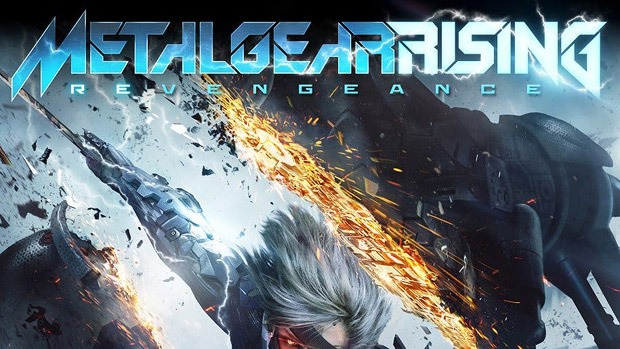
📅 Game released: 2013
Metal Gear Rising: Revengeance replaces Metal Gear’s usual stealth-first approach with Raiden’s fast, parry-driven cyborg sword combat, precise Blade Mode cuts, and spectacular boss battles. This PC guide compares official Steam and GOG purchase and download options, explains the included Jetstream and Blade Wolf DLC, and covers system requirements, Steam Deck support, mods, and practical display setup.
 By Editor Zero — independently researched, edited, and maintained.
Last updated: 3 November 2026
Last reviewed: 3 November 2026
Table of Contents
- Quick Facts
- Official PC Stores, Download & Installation
- Metal Gear Rising: Revengeance Review
- Pros & Cons
- PC System Requirements
- Frequently Asked Questions
- Similar Games
Metal Gear Rising: Revengeance Quick Facts
- Game: Metal Gear Rising: Revengeance / MGR:R / MGRR
- Developer: PlatinumGames, in collaboration with Kojima Productions
- Publisher: Konami
- Genre: Hack and Slash, Brawler / Beat ’em Up, Action-Adventure, Sci-Fi
- Release: February 19, 2013 (PS3/Xbox 360, North America); Windows PC: January 9, 2014
- Platforms: PS3, Xbox 360, Windows PC, macOS (legacy port), Android (NVIDIA SHIELD version)
- PC bonus content: Jetstream, Blade Wolf, VR Missions, and Raiden costume/body DLC included
- Modes: Single-player campaign, additional character chapters, VR challenges; no co-op or PvP
- Steam Deck: Verified by Valve
- Engine: PlatinumGames’ proprietary engine (commonly identified as Platinum Engine)
- Community: Steam Discussions, Metal Gear Solid subreddit
- PC modding: Unofficial community mods at Nexus Mods; no official mod tools or Steam Workshop
- Metacritic score: 83/100 (Windows PC)
- IGN score: 8.5/10 (PC review)
- OpenCritic average: 84/100
- Steam user reception: Overwhelmingly Positive overall
Official PC Stores, Download & Installation
👇 Compare the official Steam and GOG Windows PC editions before purchasing or downloading Metal Gear Rising: Revengeance; both include the main story and the previously released DLC.
- Steam edition: The official Windows game is sold on Steam. Purchase it on the store, then use your Steam Library to download and install it. Steam lists achievements, Steam Cloud, Family Sharing, and full controller support.
- GOG edition: GOG sells an official DRM-free Windows edition. After purchasing, install through the optional GOG Galaxy client or download the official game installer from your GOG account. GOG states that no activation or online connection is required to play.
- All DLC included: Both Windows editions include the Jetstream and Blade Wolf character story chapters plus VR Missions. There is no need to buy these three packs separately to obtain the complete PC content.
- Raiden bonus bodies: The PC release also includes White Armor, Inferno Armor, Commando Armor, Raiden’s MGS4 body, and the Cyborg Ninja outfit. These are customization additions, not separate campaigns.
- Extra PC menus: The PC release includes menu access to replay cutscenes and codec conversations, select individual boss fights from the chapter menu, adjust graphics options, and change the Zangeki cut setting. These are part of the PC release rather than a separately sold upgrade.
- Storefront and ownership: Steam and GOG sell separate licenses; buying one does not add the other to your library. For offline ownership and an installer independent of the Steam client, GOG is the more straightforward choice; Steam is preferable for its integrated cloud saves and Steam Deck ecosystem.
- Availability by country: The game has country-specific purchase restrictions. GOG has confirmed regional restrictions comparable to Steam’s, so check the product page in your own region rather than assuming every country can buy the same edition.
- Steam Deck: Valve labels the Steam version Verified, indicating the standard controller layout, text, and default presentation meet its Deck criteria. On an external controller, users may need to change the active controller in Steam Deck’s Quick Access menu.
- Legacy ports: The title also appeared on macOS and NVIDIA SHIELD Android hardware, but those historical releases should not be mistaken for a modern Mac or ordinary Android edition. The Windows listings above are the relevant PC purchase choices for this guide.
- Community modifications: The Windows game has unofficial texture, model, interface, and gameplay mods at Nexus Mods. Check each mod’s game-version and storefront compatibility and keep backups before changing game files; mods are not required for the base campaign.
 Buy Metal Gear Rising: Revengeance on Steam
 Buy Metal Gear Rising: Revengeance on GOG
 View Metal Gear Rising: Revengeance on PlatinumGames

Metal Gear Rising: Revengeance Review
A ferocious sword-fighting spinoff that rewards understanding aggression, not just unleashing it.
Metal Gear Rising: Revengeance asks Raiden to solve problems that a traditional Metal Gear protagonist would rather avoid. Armed with a high-frequency sword, he charges into fights against cyborg soldiers and towering machines, deflecting attacks and cutting enemies apart with remarkable precision. But PlatinumGames does something more interesting than simply making Metal Gear louder and faster. It builds a combat system in which defending, attacking and recovering health are connected. The same enemy threatening Raiden can become the resource that keeps him alive.
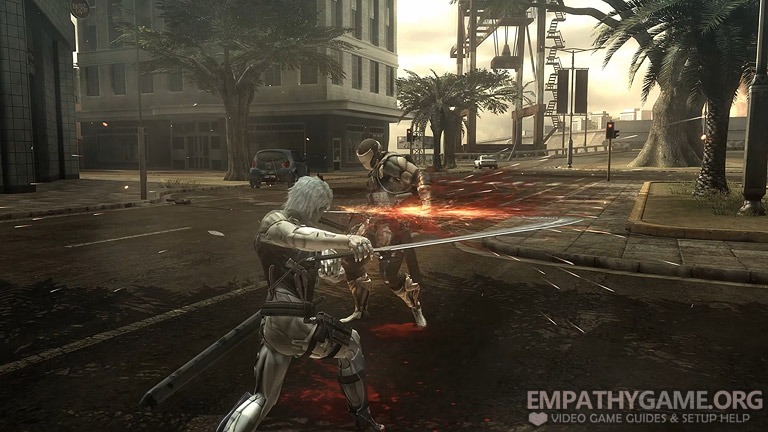
That idea gives Rising its momentum and much of its difficulty. The swordplay can feel awkward before the directional parry makes sense, and the camera occasionally works against the precision that combat demands. The campaign also moves through surprisingly ordinary corridors between its extraordinary bosses. Yet the deeper mechanics reward attention in a way the initial spectacle does not fully reveal. Learning when to interrupt an attack, preserve a combo or take a calculated risk is where this spinoff starts to feel like a complete action game rather than a collection of spectacular finishers.
Combat Turns Defense Into an Opening
Raiden’s basic moves are straightforward enough. Light and heavy attacks form combinations, Ninja Run carries him over obstacles and toward distant targets, and Blade Mode allows the direction of a sword cut to be controlled. The surprise is the defensive system. Instead of comfortably holding a guard button, Raiden blocks by directing an attack toward an incoming strike. Get the direction and timing right, and a threatening exchange can turn into a damaging counterattack.
This demands a different kind of attention from ordinary hack-and-slash combat. Simply attacking until an enemy staggers will work against some opponents, but it becomes unreliable when cyborgs attack from several sides or a heavier unit starts a series of blows. Raiden needs to remain aggressive without becoming careless. A normal parry buys breathing room; a perfect counter can end the danger almost immediately. Neither is very useful if the player has stopped watching the enemy in order to concentrate on a long button sequence. Certain grabs and other attacks also call for evasion rather than a conventional parry, so even good defensive timing is not a universal answer.
Blade Mode makes the relationship between risk and reward unusually clear. Weaken or stagger an enemy, slow the action and guide the blade through a vulnerable point. A successful Zandatsu extraction restores Raiden’s health and Fuel Cell energy. Instead of stepping away from combat to recover, he earns that recovery by finishing an enemy precisely. It is a satisfying idea because the outcome depends on what happened before the cut. Stronger targets must first be brought into a vulnerable state, and rushing the final angle can waste the opportunity. The execution is spectacular, but its real value is how it prepares Raiden for the next encounter.
The Most Interesting Techniques Are Barely Explained
For a game that asks so much of its defensive controls, Rising is not especially patient about teaching them. Directional parrying can feel unresponsive until the input becomes familiar, particularly when a player keeps holding a movement direction instead of deliberately pressing toward the new attack. Defensive Offense, an evasive strike that makes grabs and other troublesome moves easier to handle, is purchased rather than available at the beginning. That leaves an unfortunate gap between what the combat system can do and what a newcomer is likely to understand it can do.
The difference becomes more obvious when animation timing enters the picture. Briefly activating Blade Mode can cancel the recovery of many moves, allowing Raiden to interrupt a slow finish and respond to a new threat. Dodge offset can preserve progress through a heavy combo when an evasion is inserted between attacks. These are relatively small input details, but their consequences are substantial. A long combination no longer has to mean standing still and accepting whatever happens next. With practice, Raiden can commit to an attack, avoid retaliation and continue the sequence.
This is also where the game’s uneven sense of fairness becomes easier to identify. A difficult parry feels earned when the enemy’s motion is visible and the controls respond as expected. It is much less convincing when a Mastiff rushes across the screen in a confined arena and the camera loses the threat. Lock-on can create its own complications, especially with mouse and keyboard, if a shifting target or viewpoint makes the intended defensive direction harder to judge. The issue does not affect every control setup equally, but it matters in a game where a single change in orientation can turn a good reaction into a missed defense.
Boss Battles Give the Mechanics Their Personality
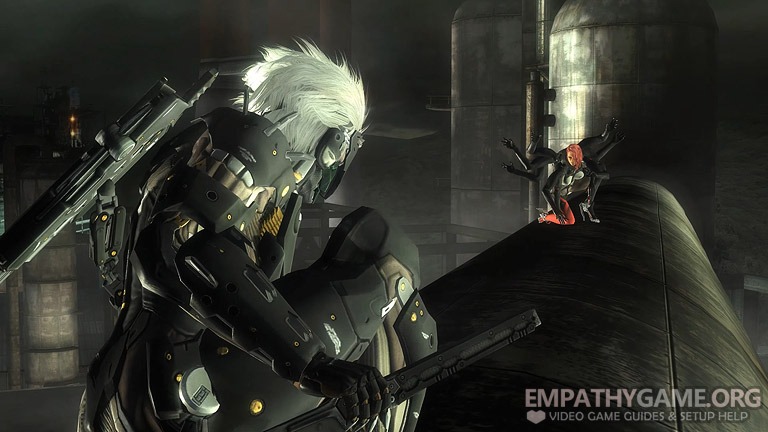
The bosses are where Rising most clearly understands its own design. Mistral uses sweeping attacks and supporting Dwarf Gekkos to divide attention, making it dangerous to focus entirely on the main opponent. Monsoon’s detachable body and magnetic assaults create a different problem, pushing the player to recognize patterns and manage the space around Raiden rather than rely on constant pressure. Their personalities are expressed through how they fight as much as through their dialogue. That makes learning each encounter more interesting than simply finding an opening to deal damage.
Fights against enormous Metal Gear machinery approach the same idea from the opposite direction. Here the pleasure comes from scale: Raiden confronts something far larger than himself and, through precise attacks and Blade Mode cuts, takes it apart. Those moments fit the cyborg ninja perfectly, although quick-time prompts sometimes do the dramatic work that direct sword control could have handled. The strongest bosses make learned techniques feel extraordinary. The weaker stretches simply show extraordinary things happening. Regular cyborg encounters do not always provide enough fresh challenges between these peaks, and familiar attack-parry-execute routines eventually begin to repeat.
A Personal Conflict Inside an Overheated Political Story
The story takes place after Metal Gear Solid 4, with Raiden working for Maverick Security Consulting before becoming entangled with Desperado Enforcement and a scheme involving children exploited for warfare. That premise reaches into his own past as a child soldier. For all the exaggerated combat, Rising has a personal question at its center: how does someone who was shaped by violence decide what to do with the ability to inflict so much more of it?
The game does not always explore that question with the same control it brings to its best fights. The antagonists offer competing arguments about violence, power and freedom, but those ideas often arrive in long, confrontational speeches. Jetstream Sam stands out partly because he needs less effort to establish himself. His almost casual confidence challenges Raiden’s intensity before either character has to explain much. Other villains are compelling presences, though their combat styles frequently leave a clearer impression than their philosophical arguments.
Rising still remembers the peculiar humor of its parent series. Optional Codec conversations with Boris, Kevin, Courtney and Doktor create room for personality between the serious military discussions. Those exchanges are especially welcome because much of the scenery is comparatively restrained. Industrial complexes, gray facilities and city streets are functional places to stage fights, but few are as memorable as the cyborgs moving through them.
The soundtrack does more to shape the atmosphere than the environments alone. Its electronic rhythms, heavy guitars and character-specific vocals suit a game that moves from calculated parries to outrageous acts of strength. More importantly, the music often develops with the encounter. Instrumental passages establish the pressure, then prominent vocals emerge as a boss fight escalates. The change can make a difficult final phase feel like a dramatic turning point rather than merely another portion of the same health bar. It is one of Rising’s most effective ways of making the player’s actions and the presentation feel connected.
Linear Stages Leave Some of the Best Ideas Underused
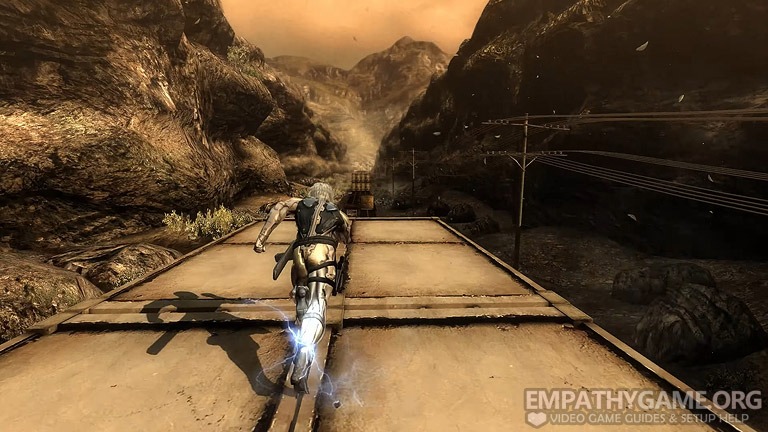
Outside those confrontations, the campaign follows a much narrower path. Raiden sprints through urban streets, rooftops, sewers and military interiors, usually moving from one fight to the next with only modest opportunities to explore. Ninja Run keeps travel lively, letting him clear obstacles without stopping to negotiate every piece of scenery. The movement is enjoyable, but the places themselves rarely give it much to discover. They feel more like routes into combat than environments designed around Raiden’s unusual abilities.
Stealth shows the problem from another angle. Raiden can perform quiet takedowns, hide and even use the familiar cardboard box, so the series’ older identity has not vanished. But avoiding an encounter can also mean avoiding the fighting that awards Battle Points and develops the skills the rest of the game rewards. Stealth offers an occasional change of pace rather than an equally substantial alternative. That is not necessarily wrong for a sword-focused action game; it simply makes the remaining infiltration mechanics feel less purposeful than the combat built around them.
There is a similar disconnect in Blade Mode’s environmental possibilities. Precise cutting feels wonderfully flexible when dismantling an enemy, yet only selected scenery reacts and the stages seldom build substantial puzzles or route choices around the ability. The blade feels exceptional; the environments seldom react like spaces built around its possibilities. More thoughtful level design could have made the time between bosses as distinctive as the fights themselves.
Upgrades Create Power, but Not Always Better Combat
Battle Points can be spent on new moves, weapon improvements and larger health or Fuel Cell reserves. New techniques are often the most interesting rewards because they change what Raiden can actually attempt. Defensive Offense, for example, opens up answers to attacks that otherwise seem difficult to escape. More health and damage make the campaign forgiving in a different way, but they also expose a tension between making progress and preserving the challenge that gives the moveset its purpose.
Secondary weapons offer more variety than their awkward switching suggests. Mistral’s polearm is useful against groups of Dwarf Gekkos; a charged tactical Sai can keep an individual threat such as a GRAD stunned; and the slow Pincer Blades can punish armored enemies when a safe opening appears. These differences become easier to appreciate in VR Missions, where restricted arenas and particular enemy combinations make specialization worthwhile. In the main campaign, a well-upgraded sword can often solve the same problems with less interruption. Stopping to change equipment discourages the kind of spontaneous experimentation that the combat otherwise seems built to support.
There is an unexpected downside to becoming too strong. When regular enemies fall after only a few hits, elaborate combos and careful Fuel Cell management start to matter less. Choosing new moves while deliberately limiting statistical upgrades can make even Normal or Hard encounters more involved, because opponents remain alive long enough to demand proper responses. It is not how everyone will want to play, and the game never requires such restrictions. Still, it reveals something important about Rising: the most satisfying reward is often better control over Raiden, not simply a larger damage number.
Replayability Is About Precision, Not a Different Story
Rising does not hide an expansive second adventure behind its credits. Repeated chapters retain the same basic routes, encounters and narrative. What changes is the standard the player brings to them. Cleaner counters, faster executions, improved combat ranks and more deliberate use of the available moves can make a familiar encounter feel surprisingly different. Collectible left arms, hidden items and VR terminals also encourage a closer look at levels that were easy to rush through the first time.
Even ranking a chapter completely has a route-finding element. Not every ranked battle sits on the obvious forward path; some require a detour or a return to a previous area. Heading back toward the collapsed bridge in R-01, for example, can reveal another encounter. This gives completionists more to investigate than their performance in the visible fights, although it can be frustrating to play beautifully and still miss a full ranking because a battle was never triggered.
The two highest difficulties also deserve to be distinguished rather than treated as consecutive steps on one ladder. Very Hard can sustain dangerous, extended exchanges. Revengeance raises the consequences of being hit much further while rewarding an exact counter-parry with tremendous damage. An attack that could be survived before may become decisive, yet perfect defense can end a threatening fight more quickly. The result is an unusually sharp risk-and-reward balance. Players who enjoy flawless reactions may appreciate it; those who prefer longer, improvised duels may actually find Very Hard the richer setting.
The Jetstream and Blade Wolf chapters are worthwhile because they change how the familiar mechanics are approached. Sam relies more heavily on charged attacks, evasive mobility and a taunt that exposes enemies to greater damage while making their retaliation more dangerous. Blocking a taunted foe can still result in chip damage, so carrying Raiden’s defensive habits directly into Sam’s campaign is a mistake. His style favors creating an opening and committing to one powerful strike. Blade Wolf provides a more unusual, stealth-conscious change of pace. Neither chapter transforms Rising’s structure, but both offer something more meaningful than simply replaying Raiden with another appearance.
Final Verdict
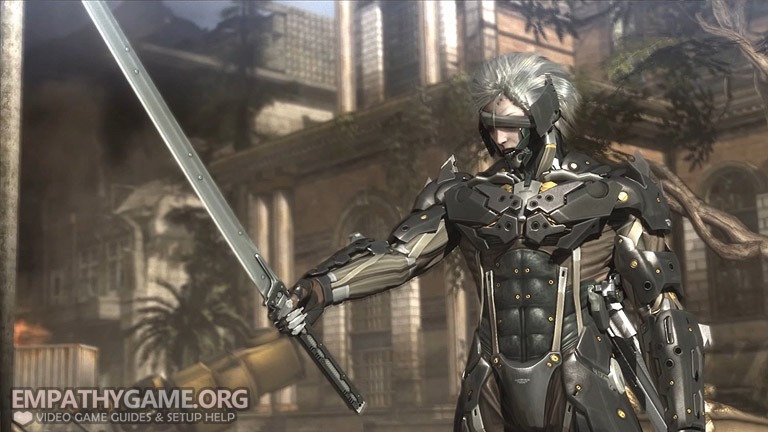
Metal Gear Rising: Revengeance succeeds because the spectacle has a system beneath it. Directional parrying creates openings, Blade Mode turns precision into a tangible advantage, and Zandatsu makes an aggressive finisher part of Raiden’s survival. Animation cancelling and combo-preserving evasions add an extra layer for anyone willing to learn them. The strongest bosses draw out that depth while the soundtrack makes their changing momentum part of the drama.
The same care is not present everywhere. Important controls are explained poorly, the camera can interfere with demanding defensive inputs, and linear levels rarely find much use for Raiden’s remarkable cutting abilities outside combat. Secondary weapons have situational value but are inconvenient to switch, while upgrades can make ordinary enemies too fragile to challenge the full moveset. The story raises compelling questions about violence and identity without always developing them persuasively.
Anyone looking for the careful infiltration, exploratory freedom or substantial campaign length associated with other Metal Gear entries may find this spinoff restrictive. For players who enjoy focused action and the process of turning difficult encounters into controlled, precise exchanges, those limitations are easier to accept. Rising is most rewarding when a fight that once felt chaotic becomes readable. At that point, Raiden’s aggression is no longer just an impressive animation. It is a skill the player has learned to direct.
Metal Gear Rising: Revengeance Pros & Cons
- Pro: Blade Mode lets precise sword cuts feed directly into Zandatsu energy recovery and combat momentum.
- Pro: Demanding directional parries, distinct bosses, and energetic music give the short campaign a strong identity.
- Pro: Steam and GOG both include Jetstream, Blade Wolf, VR Missions, and Raiden customization content.
- Pro: Steam Deck Verified status, controller support, and GOG’s DRM-free edition provide flexible PC options.
- Con: The main campaign is comparatively short, and some story and stealth sections interrupt the action’s rhythm.
- Con: Directional parrying is poorly explained at first, while the camera can struggle during crowded fights.
- Con: Built-in PC resolution choices top out at 1080p, and the original port has display and save-path quirks.
- Con: Players seeking traditional Metal Gear infiltration will find relatively little stealth-focused play.
Metal Gear Rising: Revengeance PC System Requirements
These are the officially published Windows PC requirements for the original Steam release. They describe the game’s older hardware targets, not a guarantee of identical behavior on every modern Windows configuration. GOG’s official listing instead specifies Windows 10, with the same principal CPU, memory, graphics, and storage requirements.
MINIMUM — OFFICIAL STEAM SPECIFICATIONS:
OS: Windows XP, Vista, 7 or 8 (original Steam listing); GOG lists Windows 10
CPU: Intel Core i5-2400
RAM: 2 GB
GPU: NVIDIA GeForce GTS 450
DirectX: Version 9.0c
Storage: 25 GB available space
Sound: DirectX-compatible sound card
RECOMMENDED — OFFICIAL STEAM SPECIFICATIONS:
OS: Windows XP, Vista, 7 or 8 (original Steam listing); GOG lists Windows 10
CPU: Intel Core i7-3770
RAM: 4 GB
GPU: NVIDIA GeForce GTX 650
DirectX: Version 9.0c
Storage: 25 GB available space
Sound: DirectX-compatible sound card
Additional PC Performance and Setup Notes
Display resolution and frame rate: The original Windows options support ordinary 16:9 widescreen, including 1920 × 1080, but do not offer native 1440p, 4K, or 21:9 choices. Standard gameplay targets approximately 60 FPS, while cinematics and some menus run at lower rates. Higher refresh-rate displays do not automatically unlock higher gameplay frame rates.
Optional higher-resolution adjustment: For a display above 1080p, the community-made MGROverride by Darioff (creator-credited Nexus Mods page) can replace the game’s 800 × 600 mode with a custom resolution. Back up the original game executable first, run the patcher, select the installed game’s executable, enter your desired resolution, and choose Patch. Then select 800 × 600 in the game’s graphics menu to activate the custom size. This is an unofficial executable modification: the HUD may display incorrectly, and resolution overrides do not themselves provide correct ultrawide aspect-ratio support. Keep the backup to restore the original game.
Save files and modern PCs: Community technical documentation identifies a fixed Windows save location under C:\Users\YOUR-NAME\Documents\MGR\SaveData\. If progress is missing or Steam Cloud does not restore it as expected, check whether the Windows Documents folder has been redirected away from the C: drive. See the PCGamingWiki technical page for documented save-path and display workarounds. Back up saved data before moving folders or modifying configuration files.
Recommended input: A gamepad is the most straightforward starting point for directional parries, movement, and Blade Mode. Keyboard and mouse support exists on PC, but the control method is a preference rather than a separate requirement.
Official Trailer
Note: This original launch trailer shows Raiden’s cyborg sword combat and cinematic boss encounters. The written guide adds official Windows store comparisons, the included DLC details, and PC-specific setup advice.
Frequently Asked Questions
How do you parry attacks in Metal Gear Rising: Revengeance?
Press Light Attack while flicking the movement stick toward the attacking enemy. On the default PC keyboard controls, press the appropriate WASD direction and left mouse button almost simultaneously. Release and repeat the directional input for each strike in a combo; simply holding the direction will not parry successive hits. A precisely timed parry also triggers a powerful counterattack.
How do you dodge unblockable attacks?
Attacks signaled by a yellow flash cannot be parried normally. Purchase the Defensive Offense skill from the Customize menu to unlock a directional dodge that also deals minor damage. Ninja Run can help create distance, but Defensive Offense is particularly useful against aggressive bosses and enemies with unblockable attacks.
Why can’t I cut certain enemies in Blade Mode?
Heavily armored enemies must first be weakened with normal attacks until the blue Augment Mode indicator shows they can be severed. Blade Mode also requires sufficient Fuel Cell energy for its slow-motion cutting effect. During the opening prologue, Raiden’s limited abilities prevent him from performing the full Blade Mode and Zandatsu techniques.
How do you recover health using Zandatsu?
Weaken an enemy until Blade Mode can expose its vulnerable area, then slice through the highlighted red square and press the prompted action button to extract its repair unit. A successful Zandatsu restores Raiden’s health and Fuel Cell energy. Recovery items provide another healing method when an enemy cannot be finished this way.
Which upgrades should beginners buy first?
Defensive Offense is an excellent early purchase because it adds an evasive option alongside parrying. Upgrading LIFE and Fuel Cells also improves survivability and Blade Mode flexibility. Spend Battle Points (BP) through the Customize menu, accessible between chapters or through the Codec during gameplay.
Does Metal Gear Rising: Revengeance have an easier mode for beginners?
Yes. Easy difficulty offers Easy Assist, which automatically determines the direction needed for parrying. This makes the combat more approachable while learning attack patterns, Blade Mode, and movement. Normal difficulty is a reasonable starting point for players already comfortable with fast character-action games.
What is the difference between Blade Mode and Ripper Mode?
Blade Mode gives Raiden direct control over the direction of his sword cuts and can slow time when enough Fuel Cell energy is available. Ripper Mode is a separate combat enhancement unlocked through story progression that increases his offensive power at the cost of consuming Fuel Cell energy. Both are useful, but Ripper Mode does not replace precise Blade Mode cutting.
How do you unlock VR Missions, and do they require a VR headset?
No VR headset is required. VR Missions are conventional challenge stages displayed on a screen, featuring combat, movement, stealth, and other objectives. Tutorial missions are available through the VR Missions menu, while additional challenges become accessible by finding and activating data terminals throughout the campaign.
How do you access the Jetstream Sam and Blade Wolf DLC on PC?
The additional character campaigns are included with the Windows version, but their selection options may remain locked until the main story has been completed. After completing the campaign, open the Story menu and select the relevant DLC chapter, represented by red chapter tiles in Chapter Select. These are separate playable stories rather than optional missions inside Raiden’s campaign.
Can you play as Jetstream Sam or Blade Wolf in Raiden’s main campaign?
No. Jetstream Sam and Blade Wolf are playable in their own DLC chapters, each with distinct movement and combat mechanics. Sam emphasizes charged sword strikes and aggressive dueling, while Blade Wolf has specialized hunting attacks and stealth-oriented abilities. Raiden remains the playable protagonist of the main story.
Does Metal Gear Rising: Revengeance have New Game Plus?
It effectively does, although the system is not labeled as a conventional New Game Plus mode. Use Story > Chapter to replay completed stages while retaining previously earned upgrades and collectibles. Avoid selecting New Game on an existing save when you want to preserve progression, because it can reset that progress. Some abilities are temporarily restricted during the prologue even when upgrades have been retained.
Can you replay boss fights without completing entire chapters?
Yes. The PC edition includes a boss-selection option within the Chapter menu, allowing previously encountered bosses to be challenged separately. If the option is missing after finishing the main story, completing the Jetstream and Blade Wolf DLC campaigns can unlock the additional boss-selection entries.
Do you need to play Metal Gear Solid 4 before Metal Gear Rising: Revengeance?
No. Revengeance follows Raiden several years after the events of Metal Gear Solid 4, but its central conflict and characters are introduced sufficiently for newcomers to follow the main story. Playing earlier Metal Gear titles adds context to Raiden’s history, his cyborg transformation, and returning references, but is not essential.
Is Metal Gear Rising: Revengeance open world or linear?
It is primarily a linear, chapter-based action game rather than an open-world adventure like Metal Gear Solid V. Some environments allow optional exploration, collectibles, and stealth approaches, but the campaign generally follows a fixed sequence of encounters and objectives.
How long does it take to complete Metal Gear Rising: Revengeance?
The main story usually takes approximately 6–8 hours, depending on difficulty and familiarity with the combat system. Playing the Jetstream and Blade Wolf chapters, completing VR Missions, collecting hidden items, and pursuing higher combat ranks can extend the experience substantially.
Does Metal Gear Rising: Revengeance support multiplayer, co-op, or split-screen?
No. The game is entirely single-player, including its main campaign, additional character chapters, and VR Missions. There is no online co-op, local split-screen, LAN multiplayer, or competitive PvP mode.
Does Metal Gear Rising: Revengeance work on Steam Deck?
Yes. Valve rates the Steam version as Verified, meaning its default controller configuration, interface readability, and performance meet Steam Deck verification requirements. The rating specifically applies to the Steam edition; installing the separate GOG version requires its own setup and is not covered by that verification.
Still have questions? Check the Metal Gear Rising Reddit community or Steam Discussions for additional gameplay advice, troubleshooting, and community help.
Sources & References
Key factual and technical information in this guide was checked against relevant official and community sources, including:
- Konami — Metal Gear Rising: Revengeance — official product identity, platform history, and single-player format
- PlatinumGames — Metal Gear Rising: Revengeance — developer collaboration, original release chronology, and Blade Mode mechanics
- Steam — Metal Gear Rising: Revengeance — PC release, included DLC, system requirements, Steam features, Deck rating, and user reception
- GOG — Metal Gear Rising: Revengeance — DRM-free ownership, included content, Windows requirements, and additional review-score references
- Metacritic — PC critic reviews — the Windows version’s 83/100 aggregated critic score
- PCGamingWiki — Metal Gear Rising: Revengeance — community-documented resolution limits, frame-rate behavior, and save-file considerations
Similar Games Like Metal Gear Rising: Revengeance
- Transformers: Devastation
- God of War II
- Stellar Blade
- X-Men Origins: Wolverine
- Sekiro: Shadows Die Twice
- Deadpool




Found something worth playing through DecideGame?
DecideGame.com is an independent gaming project run by Editor Zero. If this guide helped you discover a game, solve a problem, or find useful information, you can support DecideGame.com and help keep new and updated game guides coming.
DecideGame — PC Game Guides, Reviews & Setup Help