
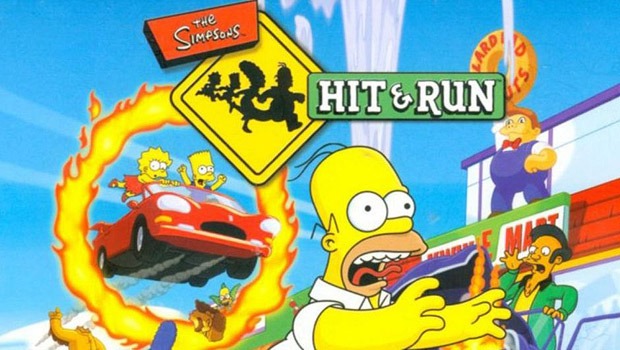
Use this updated 2026 The Simpsons: Hit & Run PC guide to understand its retail-only legal availability, install an owned Windows copy, check the original system requirements, and improve modern Windows play with widescreen, controller, frame-rate, compatibility, and modding guidance.
 By Editor Zero — independently researched, edited, and maintained.
Last updated: 21 September 2026
Last reviewed: 21 September 2026
Table of Contents
- Quick Summary
- Quick Facts
- Official PC Stores, Download & Installation
- The Simpsons: Hit & Run Review
- Pros & Cons
- PC System Requirements
- Frequently Asked Questions
- Similar Games
The Simpsons: Hit & Run Quick Summary
✔ Open-world action-adventure and driving game set across Springfield, with Homer, Bart, Lisa, Marge, and Apu uncovering a conspiracy involving surveillance cameras, mysterious vans, Buzz Cola, and aliens
✔ Seven story levels mix timed driving missions, vehicle chases, street races, destruction objectives, on-foot platforming, hidden gags, collectible cards, costumes, and unlockable vehicles
✔ Similar to GTA Vice City through mission-based open-world driving and on-foot exploration, but replaces firearms and mature crime themes with Simpsons comedy, cartoon chaos, and collectible hunting
✔ The original Windows edition is not available through a verified modern official digital storefront, making legitimate retail ownership and existing PC installations especially important
✔ Existing PC owners can use the community-maintained Lucas’ Simpsons Hit & Run Mod Launcher for modern resolutions, XInput controllers, borderless play, Direct3D 9, frame-rate control, bug fixes, and mod support
✔ The campaign is primarily single-player, while collecting all seven cards within a level unlocks tracks for a separate local bonus racing minigame supporting up to four players
The Simpsons: Hit & Run Quick Facts
Official PC Store Status, Download & Installation
👇 Use the notes below to understand the current official PC availability status for The Simpsons: Hit & Run and avoid unsafe or unofficial acquisition options.
- Digital store status: No verified current official Windows purchase page is available through Steam, Epic Games Store, GOG, Microsoft Store, EA App, or another major PC storefront. GOG currently provides a Dreamlist voting page rather than a purchasable release.
- Original PC release: The legitimate Windows edition was distributed on CD-ROM. Existing owners can install from their original PC media; secondhand physical copies may also exist, but third-party resale marketplaces are not treated here as official storefronts.
- Disc installation: The original manual instructs users to insert the Hit & Run CD-ROM, launch the installation screen through Autoplay or run
setup.exe, and follow the installer prompts. DirectX 8.1 was bundled for systems that required it. - Retail DRM: The Windows release uses SecuROM 4. Because this is legacy copy protection from the Windows 98/XP era, disc authentication and installation behavior can be less predictable on modern Windows systems. This guide does not recommend modified executables or DRM-bypass files.
- Modern Windows: For an existing legitimate installation, the community-maintained Lucas’ Simpsons Hit & Run Mod Launcher is the most established compatibility tool. Its first-time setup asks the user to select the installed
Simpsons.exefile. - Display & controls: The Mod Launcher adds support for modern resolutions and aspect ratios, borderless windowed mode, Direct3D 9, MSAA, XInput controllers, controller improvements, and other optional quality-of-life features.
- Frame-rate behavior: The original game logic was designed around approximately 60 FPS. Running substantially above or below that target can affect vehicle physics, character movement, enemy behavior, and some missions, so a 60 FPS limit is the safest default.
- Mod compatibility: Donut Team’s launcher loads community mods without permanently replacing the original game files in normal use. Keep an unmodified installation and save backup before adding major campaign, gameplay, vehicle, or graphics modifications.

The Simpsons: Hit & Run Review
A wonderfully faithful Springfield driving adventure whose clever shortcuts and vehicle choices outlast its repetitive mission design.
The Simpsons: Hit & Run works because Springfield is not merely scenery between objectives. Radical Entertainment turns the television show’s familiar streets into a compact driving playground where shortcuts, landmarks and collectible routes gradually become as important as raw speed. Its structure borrows heavily from early open-world action games, but the result has a distinct identity: there are no firearms or criminal empire systems, only cartoon vandalism, vehicle chases, platforming, races and increasingly absurd errands performed by Homer, Bart, Lisa, Marge and Apu.
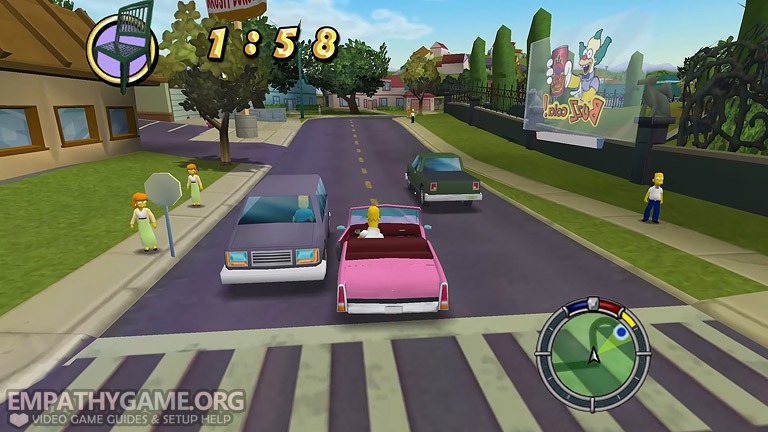
The appeal is immediate. Cars are easy to throw around corners, the town is dense with visual jokes, and almost every route rewards curiosity. The weakness is just as obvious once the campaign settles into its rhythm. Too many missions recycle the same timed collection, pursuit, destruction and racing templates, and later stages often make those familiar objectives harder by tightening the clock rather than changing the problem. Players who enjoy arcade driving, route mastery and completion hunting will get far more from Springfield than anyone expecting the freedom or systemic depth of a modern open-world game.
Springfield Is the Game’s Best Mechanic
The campaign is divided into seven levels built from three main Springfield districts, revisiting them with different characters, traffic patterns, missions and atmosphere. On paper, that sounds like heavy reuse. In practice, the repetition works better than it should because the districts are designed as spaces to learn rather than backdrops to cross once. A route that initially feels like a straightforward road network gradually reveals alleys, ramps, lawns, parking lots and breakable shortcuts that shave valuable seconds from later missions.
That knowledge matters. The difference between barely missing a checkpoint and finishing comfortably is often not a faster car but remembering that a Krusty glass panel hides a direct line through a block, or that a side road bypasses an awkward intersection. Timed objectives therefore turn map familiarity into a form of progression. There is no skill tree improving cornering; the player improves by understanding Springfield itself.
The world also supports slower exploration. Collector Cards sit on rooftops and awkward ledges, Wasp Cameras occupy side routes, and environmental gags reward poking into places that story missions ignore. On-foot movement is basic—jumping, double-jumping, kicking and climbing simple geometry—but it gives the levels vertical texture and prevents the experience from becoming a pure racing game. The camera and platforming lack the precision of dedicated action-platformers, yet the short detours work because they usually lead to a recognizable joke, hidden vehicle or collectible rather than empty space.
Arcade Driving Has More Depth Than the Stat Bars Suggest
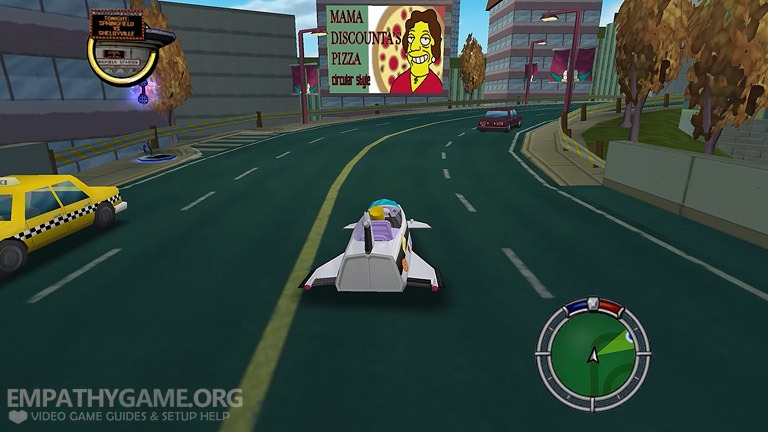
Driving is loose, forgiving and deliberately exaggerated. Cars slide easily, recover quickly and can absorb collisions that would end a realistic race. The important distinction is not simulation detail but suitability. A tough bus or truck can be useful when a mission asks for repeated ramming, while a lighter sports car makes checkpoint races and long timed deliveries easier. In Lisa’s “Operation Hellfish,” for example, the required School Bus turns a sequence of black-sedan chases into a demolition problem: weight and durability matter more than graceful cornering.
The phone-booth ratings help communicate these differences, but they should be read as broad hints rather than exact measurements. Vehicles with identical displayed speed ratings can perform differently in practice, so experimentation is more useful than simply choosing whichever set of stars looks highest. That uncertainty actually suits the game’s garage. A newly unlocked car can feel meaningfully different even when its menu statistics imply only a small change.
Handling technique can also change the apparent value of a vehicle. The Rocket Car is exceptionally fast but fragile and awkward to turn, which makes it look like a novelty at first. Once the handbrake becomes part of cornering, its poor turning circle is easier to manage, while wrench pickups around the map can offset some of its low durability. Speed, route choice and repair opportunities can therefore matter more than a neat balance of four stat bars.
The Hit & Run meter adds another layer without making the game punitive. Smashing scenery, hitting pedestrians and wrecking traffic eventually attracts police cars, and being caught costs coins. The system is simple, but it creates small decisions during missions: taking a shortcut through destructible scenery may save time while also raising police pressure, and an already damaged vehicle can turn that extra pursuit into a real problem.
Mission Variety Peaks Early, Then the Timers Take Over
The campaign’s central limitation is not a shortage of activities but how often they are recombined without changing their underlying demands. Missions ask the player to race a rival, tail or escape a vehicle, destroy a target, collect dropped items, deliver cargo or reach a destination before time expires. Early on, those templates feel varied because the districts, characters and jokes are fresh. By the middle of the game, the structure is easy to predict.
“Ketchup Logic” illustrates both sides of the design. Marge drives Cletus’s pickup around the suburban district collecting a long chain of ketchup packets, with jumps and shortcuts forcing careful alignment rather than simple straight-line speed. The mission then adds an escape from a pursuing sedan. It is more involved than a basic checkpoint race, yet its challenge still comes from combining familiar collection, driving and evasion tasks under time pressure.
The final stretch pushes this philosophy much harder. The late “Alien Auto-topsy” missions demand fast cross-map routes with fragile nuclear waste, forced vehicles, pursuit sequences and strict time limits. By then, knowing the cemetery, trailer park, fire-engine and school shortcuts is effectively mandatory. That creates a satisfying exam for players who have learned the map, but it also exposes how heavily the difficulty depends on repetition and memorization. A collision that would be funny during free exploration can become irritating when it invalidates a nearly perfect timed run.
There is at least an unusual safety valve. After repeated failures, most story missions can present a Skip option, allowing the campaign to continue without turning one difficult objective into a permanent wall. Previously played missions remain accessible through mission select, so a skipped challenge can be revisited later with better cars and stronger route knowledge. The exception around the final missions preserves some late-game pressure, but the broader system is surprisingly considerate for a game otherwise fond of strict timers.
Characters and Comedy Carry a Deliberately Silly Mystery
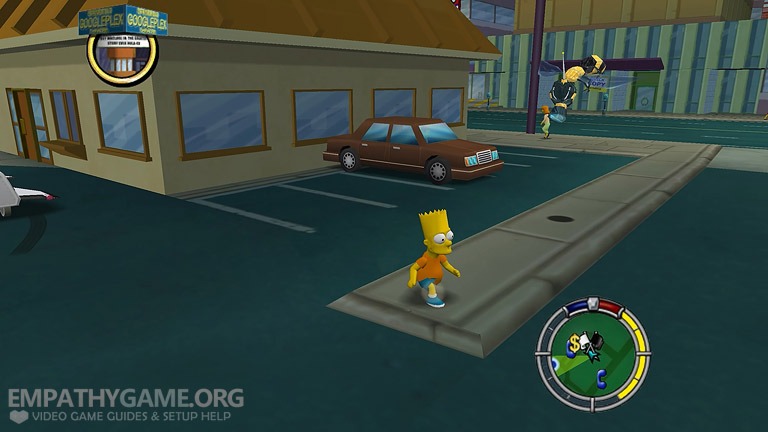
The story begins with surveillance cameras, black vans, robotic wasps and Buzz Cola, then escalates through the kind of conspiracy that only makes sense in Springfield. Homer, Bart, Lisa, Marge and Apu take turns investigating, giving the campaign a natural excuse to shift districts and perspectives without pretending that one character needs to do everything.
The plot is functional rather than emotionally ambitious, and that is the right choice. Its job is to connect errands, chases and references while maintaining the show’s absurd logic. The more important narrative achievement is how well the locations and voices create the feeling of moving through an interactive episode. Springfield Elementary, the Kwik-E-Mart, Burns’ mansion, the harbor and familiar residential streets are not isolated cameos; they form recognizable routes that become part of play.
The returning cast gives even thin objectives personality, although repeated one-liners can wear out their welcome after several failures. The game is at its funniest when dialogue, environment and mission design line up—for example, when a ridiculous vehicle choice or mundane errand becomes the basis of an elaborate timed chase. It is less effective when a joke has to carry another mechanically familiar collect-and-return sequence.
Completion Is Rewarding Until the Coin Economy Tightens
Progression revolves around collection rather than character statistics. Coins buy costumes and vehicles, Street Races unlock cars, Bonus Missions award additional vehicles, and each level tracks cards, Wasp Cameras and other completion goals. The structure gives exploration a clear purpose because almost every detour advances a visible checklist or expands the garage.
Collector Cards are especially well judged. Seven are hidden in each level, often positioned to encourage rooftop exploration or awkward jumps, and completing a set unlocks a track for the separate Bonus Game. Finding all 49 also contributes to a larger completion reward. The cards make the same districts worth revisiting for reasons other than another story mission.
The economy is less elegant for a full-completion run. Many generous coin sources—loose trails, Buzz Cola objects and Wasp Cameras—are effectively finite, while buying every costume and vehicle demands far more spending than a normal story playthrough. A player who purchases everything can eventually reach a point where ordinary exploration no longer supplies enough money efficiently, making repeatable Wager Races or deliberate vehicle destruction more attractive. That grind does not meaningfully hurt a standard campaign, but it gives the final stretch toward 100% a more mechanical feel than the earlier collectible hunt.
Small Extras Add More Replay Value Than the Story Itself
Replayability comes less from narrative choice than from mastery and completion. Replaying a level with a faster car changes the rhythm of missions that once felt tight, while memorized shortcuts can transform a frustrating route into an easy one. Street Races, Bonus Missions, hidden vehicles and the pursuit of 100% all give the campaign reasons to revisit familiar districts.
The Bonus Game is a modest but charming extra. Collecting every card in a level unlocks a local racing track, and the mode supports up to four players. Its overhead presentation can initially make it look more limited than the main driving game, but the camera can be switched to other perspectives, including chase-style views. It never becomes a substitute for a full multiplayer mode, yet it gives the card hunt a tangible reward beyond a percentage counter.
What does not change is the mission logic. There are no branching routes through the story, alternate builds or radically different character abilities, so a second campaign is primarily about driving better, collecting more efficiently and appreciating details missed the first time. For players who enjoy shaving seconds from routes or finishing checklists, that is enough; anyone looking for substantially different play styles will find the replay ceiling much lower.
Presentation Still Works Because the Art Direction Is Specific
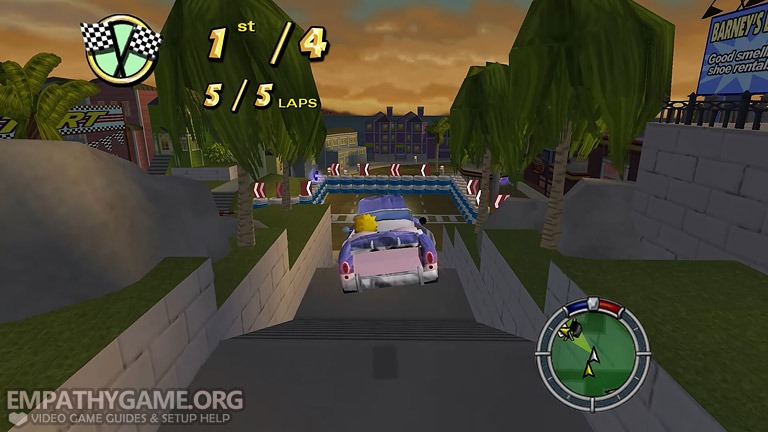
Visually, the game is unmistakably from an earlier 3D era: character animation is stiff, environments use simple geometry, and on-foot movement lacks modern fluidity. Yet the art direction survives those limitations because it prioritizes silhouette, color and recognizable Springfield architecture over realism. The result remains readable at speed. Important streets, buildings and shortcuts are easy to identify after a few laps, which directly supports the route-learning at the heart of the game.
Sound matters just as much. Familiar character voices, exaggerated collision effects and music tailored to different areas make the world feel authored rather than generically licensed. The repetition is again the trade-off: hearing the same character reaction during repeated mission failures can become more irritating than funny. Even so, the presentation rarely feels anonymous, and that specificity is a major reason the game has more personality than many licensed titles built around stronger technology.
Final Verdict
The Simpsons: Hit & Run succeeds because it understands that the fantasy is not simply driving a car with Homer Simpson behind the wheel; it is learning Springfield until its streets feel familiar. Shortcuts become knowledge, vehicle choice changes how missions are approached, and collectibles turn rooftops, alleys and landmarks into useful spaces rather than decoration. The result is a compact action-driving game with an unusually strong sense of place.
Its age shows most clearly in structure rather than graphics. Too many missions recycle collection, pursuit, racing and destruction objectives, later timers can turn comic chaos into repetition, and the on-foot sections never develop beyond simple platforming. Completionists also face a less graceful final phase once finite coin sources dry up and repeatable money-making activities become the practical route toward buying everything.
Even with those limits, the game’s strongest qualities reinforce one another. Faithful locations make exploration worthwhile, forgiving handling makes experimentation easy, and the escalating reliance on shortcuts rewards players who have paid attention to the map. It is best suited to Simpsons fans, arcade-driving players and completionists who enjoy mastering compact spaces. Those expecting a deep open-world sandbox may find it narrow, but as a focused tour of Springfield built around driving, collecting and cartoon destruction, it remains remarkably distinctive.
The Simpsons: Hit & Run Pros & Cons
The Simpsons: Hit & Run PC System Requirements
These are the original official Windows PC requirements from the game’s manual. They describe the hardware and operating systems supported at release, not modern Windows certification.
MINIMUM:
OS: Microsoft Windows 98 / ME / 2000 / XP
CPU: Intel Pentium III 700 MHz or AMD Athlon processor
RAM: 192 MB
GPU: 100% DirectX-compliant 3D video card with 32 MB VRAM and T&L support
DirectX: DirectX 8.1
Storage: 1.5 GB of uncompressed hard disk space for game files
Optical Drive: Quad-speed CD-ROM drive
Sound Card: DirectX 8.1 or higher compatible sound card and drivers
Input: Microsoft-compatible mouse and keyboard
RECOMMENDED:
OS: Microsoft Windows 98 / ME / 2000 / XP
CPU: Intel Pentium III 1 GHz or AMD Athlon processor
RAM: 256 MB
GPU: 100% DirectX-compliant 3D video card with 32 MB VRAM and T&L support
DirectX: DirectX 8.1
Storage: 1.9 GB of uncompressed hard disk space for game files
Sound Card: DirectX 8.1 or higher compatible sound card and drivers
Controller: Windows-compatible 12-button dual-stick analog gamepad, joystick, or steering wheel optional
Additional PC Performance and Setup Notes
- The original requirements are extremely light by modern hardware standards; compatibility with contemporary Windows versions is a more important concern than CPU, GPU, or memory performance.
- PCGamingWiki recommends Lucas’ Simpsons Hit & Run Mod Launcher for modern systems because it provides compatibility fixes, bug fixes, modern aspect ratios and resolutions, Direct3D 9, MSAA, XInput, and additional customization.
- Keep the game near 60 FPS. Very high or very low frame rates can alter physics, enemy behavior, jumping, collisions, and timed mission behavior.
- The original game exposes only a limited set of resolutions. The Mod Launcher’s aspect-ratio support can use modern widescreen, ultrawide, multi-monitor, and 4K resolutions reported by the graphics hardware.
- XInput support through the Mod Launcher is useful for modern Xbox-style controllers; the original game primarily targets older DirectInput-era peripherals.
- The Mod Launcher does not contain The Simpsons: Hit & Run itself. It requires an existing installation and asks the user to select the game’s
Simpsons.exefile. - PC save files are stored with the installed game files. Back them up before experimenting with major mods, compatibility tools, or installation changes.
Official Trailer
Note: The trailer shows the original Springfield environments, characters, driving, on-foot action, vehicles, and cartoon humor, while this written guide adds present-day PC availability, installation, compatibility, requirements, controller, and modding guidance.
Frequently Asked Questions
Is The Simpsons: Hit & Run worth playing in 2026?
Yes. Its compact version of Springfield, Simpsons humor, arcade driving, collectibles, unlockable vehicles, and varied characters still give it a distinctive identity that few licensed games have matched. The biggest drawback for PC players is that there is no verified modern digital release, and an original Windows installation benefits greatly from community compatibility tools.
Is The Simpsons: Hit & Run basically a Simpsons version of GTA?
There are clear similarities, especially the open areas, vehicle stealing, driving missions, police-style pursuit meter, and ability to explore on foot. Hit & Run is much lighter and more structured, however, with cartoon combat, no firearms, smaller maps, level-based progression, collectibles, platforming, and a strong focus on driving.
Is The Simpsons: Hit & Run fully open world?
Not in the seamless modern sense. The campaign contains seven levels built around several large Springfield areas that are revisited with different playable characters, missions, traffic, visual details, and story conditions rather than one uninterrupted city map.
Which characters are playable in The Simpsons: Hit & Run?
The campaign lets you control Homer, Bart, Lisa, Marge, and Apu. Homer appears in Levels 1 and 7, Bart in Levels 2 and 5, Lisa in Level 3, Marge in Level 4, and Apu in Level 6.
Why do the later missions in The Simpsons: Hit & Run feel so difficult?
Later levels combine stricter timers with longer driving routes, repeated trips across the map, traffic interference, vehicle damage, collection objectives, and police pressure. Learning shortcuts and choosing a fast but durable vehicle usually matters more than simply driving aggressively.
How does the Hit & Run meter work?
Damaging vehicles, hitting pedestrians, and destroying parts of Springfield raises the meter around the radar. Once it fills, police cars pursue you, and getting caught costs coins; avoiding further destruction allows the meter to fall again.
What are coins used for in The Simpsons: Hit & Run?
Coins buy vehicles and character outfits, including some purchases required for story progression. They can be collected around each level, earned from destructible objects and Wasp Cameras, and won through wager races, so spending everything on optional unlocks early can make later required purchases more inconvenient.
What do Collector Cards unlock?
Each level contains seven Collector Cards, and finding all seven unlocks that level’s track for the Bonus Game. Collecting all 49 cards also lets you unlock the hidden Itchy & Scratchy bonus movie through the Android’s Dungeon and Aztec Theatre sequence.
What are Wasp Cameras, and do I need to destroy them?
Wasp Cameras are hostile surveillance devices hidden throughout Springfield that reward coins when destroyed. There are 20 in each level, and destroying every one contributes to 100% completion.
What do Street Races unlock?
Each level contains three standard Street Races. Winning all three in that level rewards an additional vehicle, making races useful for both completion and expanding the cars available through phone booths.
What do Bonus Missions unlock?
There is one optional Bonus Mission in each level, usually started by helping a familiar Simpsons character. Completing it rewards a vehicle that can then be selected through the game’s vehicle system.
What is required for 100% completion?
Full completion requires clearing the story and Bonus Missions, winning the races, collecting the cards, destroying the Wasp Cameras, discovering the level gags, and obtaining the required vehicle and costume collections. Because several categories are tracked separately for every level, a nearly complete save can still be missing one small activity or purchase.
Does The Simpsons: Hit & Run have multiplayer or co-op?
The original campaign is single-player and does not support campaign co-op. Its built-in multiplayer feature is the separate Bonus Game, which is a local racing minigame rather than cooperative story play.
Does The Simpsons: Hit & Run support split-screen or local multiplayer?
Yes, through the Bonus Game rather than the main campaign. It supports local racing for up to four players, with tracks unlocked by collecting all seven Collector Cards in individual campaign levels.
Does The Simpsons: Hit & Run have official online multiplayer?
No. The original game never included official online multiplayer, but Donut Team provides an unofficial community multiplayer system and self-hostable server software for PC users of Lucas’ Mod Launcher. This should be treated as a community modification rather than an original or publisher-supported feature.
Can you still buy The Simpsons: Hit & Run digitally on PC?
There is no verified modern official Windows storefront selling the game through Steam, GOG, Epic Games Store, Microsoft Store, or another major PC platform. Existing owners can continue using a legitimate original Windows installation, but the game should not be confused with unofficial copies offered by third-party download sites.
Is The Simpsons: Hit & Run available on Steam?
No. There is no official Steam release, Steam store page, Steam achievements, Steam Cloud integration, or Steam Workshop support for the original game.
Does The Simpsons: Hit & Run work on Windows 10 and Windows 11?
The original PC release predates both operating systems and was never officially designed for them, so results can vary, especially because of its legacy installer and SecuROM protection. For an existing legitimate installation, Lucas’ Simpsons Hit & Run Mod Launcher is widely used to improve compatibility and add modern rendering, resolution, input, and bug-fix options.
Does Lucas’ Simpsons Hit & Run Mod Launcher include the game?
No. Donut Team explicitly states that the launcher does not contain The Simpsons: Hit & Run; during setup it asks you to point it to an existing installation and select the game’s Simpsons.exe file.
Can I use an Xbox controller with The Simpsons: Hit & Run on PC?
Yes, although modern controller support is much better through Lucas’ Mod Launcher than through the original DirectInput-era configuration. Its XInput feature supports modern Xbox-style gamepads, rumble, hot-plugging, and compatibility with Steam’s controller system when the launcher is added as a non-Steam game.
Can The Simpsons: Hit & Run run above 60 FPS?
It can technically render at other frame rates, but the safest target is around 60 FPS because parts of the game’s physics, movement, AI, collisions, and mission behavior are frame-rate sensitive. Lucas’ Mod Launcher includes a frame limiter that makes maintaining an appropriate cap easier on modern hardware.
Does The Simpsons: Hit & Run support widescreen, ultrawide, or 4K?
The original PC version was not designed around today’s display formats, but Lucas’ Mod Launcher adds modern resolution and aspect-ratio support. That makes widescreen, ultrawide, and high-resolution displays much more practical without permanently replacing the original game files.
Does The Simpsons: Hit & Run work on Steam Deck?
There is no official Steam version, native Linux release, or Valve Steam Deck compatibility rating. Community users have managed to run legitimate PC installations through Linux compatibility layers and Lucas’ Mod Launcher, but this requires unofficial setup and should not be treated as supported plug-and-play Deck compatibility.
Can The Simpsons: Hit & Run be modded?
Yes. Lucas’ Mod Launcher supports community-created campaigns, characters, vehicles, maps, visual changes, gameplay modifications, fixes, and other additions, with many projects distributed through Donut Team’s Mod Bakery. Follow each mod’s instructions, avoid combining known conflicting mods, and keep backups of saves and a clean installation before making major changes.
Does The Simpsons: Hit & Run have Steam Workshop or official mod tools?
No Steam Workshop exists because the game has no Steam release, and Radical Entertainment did not ship a modern official modding toolkit. The established PC modding ecosystem instead revolves around community tools such as Lucas’ Mod Launcher and Lucas’ Pure3D Editor.
Still have questions? Check the The Simpsons: Hit & Run Reddit community, Donut Team Hit & Run forum, or Donut Team Mod Launcher documentation for additional help and community discussion.
Sources & References
Key factual and technical information in this guide was checked against relevant archival, technical, and community sources, including:
- PCGamingWiki — The Simpsons: Hit & Run — Windows release data, retail availability, SecuROM information, Pure3D engine identification, system requirements, save locations, frame-rate behavior, modern-resolution support, controller notes, and compatibility guidance
- Donut Team — Lucas’ Simpsons Hit & Run Mod Launcher documentation — modern compatibility features, widescreen and resolution support, Direct3D 9, XInput, bug fixes, mod support, and confirmation that the launcher does not include the game
- Donut Team — Mod Launcher Setup Guide — first-time launcher configuration and selection of an existing The Simpsons: Hit & Run installation
- MobyGames — The Simpsons: Hit & Run Windows Releases — original PC release dates, regional releases, developer, and publisher information
- GOG Dreamlist — The Simpsons: Hit & Run — current GOG preservation request status rather than an active purchasable GOG release
- GameSpot — The Simpsons: Hit & Run PC Review — contemporary PC-release context and historical critical reception
Similar Games Like The Simpsons: Hit & Run


Found something worth playing through DecideGame?
DecideGame.com is an independent gaming project run by Editor Zero. If this guide helped you discover a game, solve a problem, or find useful information, you can support DecideGame.com and help keep new and updated game guides coming.
DecideGame — PC Game Guides, Reviews & Setup Help