
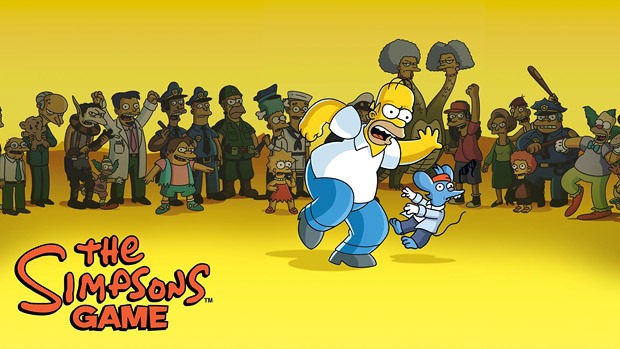
📅 Game released: 2007
Use this updated 2026 The Simpsons Game PC guide to check official download availability, compare PCSX2 and RPCS3 emulation for owned console copies, explore the unofficial Xbox 360 recompilation, review emulator system requirements, and learn about controller setup, graphics compatibility, local co-op, and the differences between console versions.
 By Editor Zero — independently researched, edited, and maintained.
Last updated: 14 October 2026
Last reviewed: 14 October 2026
Table of Contents
- Quick Summary
- Quick Facts
- Official PC Stores, Download & Installation
- The Simpsons Game Review
- Pros & Cons
- PC System Requirements
- Frequently Asked Questions
- Similar Games
The Simpsons Game Quick Summary
✔ Cartoon-style action-adventure platformer in which Homer, Bart, Lisa, and Marge discover that they are characters inside a video game and gain special powers to confront increasingly absurd threats to Springfield and their virtual world.
✔ The main console adventure combines 3D platforming, light combat, character-specific abilities, cooperative environmental puzzles, collectibles, and 16 story episodes filled with references to television, gaming culture, and other popular franchises.
✔ Similar to The Simpsons: Hit & Run through its recognizable Springfield locations, authentic television-series humor, familiar characters, and interactive recreation of the Simpsons universe, although this game emphasizes platforming and structured episodes rather than driving and open-world missions.
✔ Electronic Arts never published a native Windows PC edition. Playing an owned PS2 copy through PCSX2 is a practical starting point, while RPCS3 supports the PS3 version with its more detailed environments and presentation.
✔ The Xbox 360 and PS3 editions generally provide the most elaborate console presentation, while PS2, Wii, and PSP have differences in level design and abilities. The Nintendo DS edition is a substantially different, primarily side-scrolling game with touchscreen features and separate multiplayer mini-games.
✔ The game supports local cooperative play on its main home-console editions, while its distinctive appeal comes from the television cast’s voice performances, original comedy, video-game parodies, and the family’s contrasting abilities.
The Simpsons Game Quick Facts
Official PC Store Status, Download & Installation
👇 The Simpsons Game has no official Windows PC edition or standard PC store download. Use the information below to understand its ownership status and the differences between legitimate emulation options for console copies you own.
- Native Windows status: Electronic Arts did not release The Simpsons Game as a Windows PC product. There is no verified official PC purchase or installation through Steam, Epic Games Store, GOG, EA App, or Microsoft Store. An unofficial executable or community project should not be mistaken for a publisher-authorized PC edition.
- Original ownership: The game was distributed on physical console and handheld media. Original secondhand copies may be found through ordinary resale channels, but acquiring a console disc does not grant access to a native Windows edition or automatically establish permission to make backups in every jurisdiction. Follow the applicable laws governing media ownership and copying.
- Recommended PCSX2 route: For readers who own the PlayStation 2 version and have access to a PS2 BIOS dumped from their own console, PCSX2 is a practical starting point. Its game-specific compatibility documentation identifies the North American PS2 release as Playable on Windows, although documented graphics issues mean results can vary by configuration.
- Owned PS2 disc: PCSX2’s official disc-dumping documentation explains how to create a backup from an original PlayStation 2 disc using a suitable PC optical drive. The emulator also requires a PS2 BIOS obtained from your own console using its official BIOS-dumping guide. Neither component is supplied with this article.
- PCSX2 installation: Install PCSX2 from its official website, complete the initial configuration with your own PS2 BIOS, and add the folder containing the backup of your game disc. Select the game from the library, configure a controller, and begin with the emulator’s default rendering settings before experimenting with higher internal resolutions.
- PlayStation 3 alternative: RPCS3 offers a way to run the PS3 version on compatible PC hardware. Its official compatibility database lists The Simpsons Game as Playable. RPCS3 requires a properly prepared game backup from a copy you own and the necessary PlayStation 3 system firmware. Follow the project’s Quickstart documentation for supported setup and disc-dumping methods.
- PS3 versus PS2: The PS3 edition has more elaborate graphics, environments, and presentation, while PCSX2 generally offers a more approachable configuration and lower hardware demands. These console versions are not perfectly identical: certain abilities, encounters, environmental details, and level arrangements differ. Select the emulator corresponding to the edition you actually own.
- Other console versions: Owners of the Wii edition can investigate Dolphin, although Wii-specific motion controls may require additional mapping. The PSP edition can be used with PPSSPP after preparing an owned UMD backup using the emulator’s official documentation. These versions should not be assumed to match the PS3 or Xbox 360 versions in content, presentation, or controls.
- Unofficial Xbox 360 recompilation: The independent The Simpsons Game Recompiled project translates Xbox 360 game code for Windows and Linux. Its developers describe playable builds that require an original Xbox 360 game backup and do not include copyrighted game assets. This is experimental community software, not an Electronic Arts PC port; bugs, performance limitations, and unsigned-program security warnings remain relevant considerations.
- Controllers and saves: A standard modern gamepad is recommended for console-style movement, camera control, and character abilities. Configure separate controller profiles when using local co-op. Emulator memory cards, save files, and save states should be backed up before major configuration changes. Saves from different console versions and emulators are not automatically interchangeable.
 Download PCSX2 from the Official Emulator Website
Download RPCS3 from the Official Emulator Website

The Simpsons Game Review
The jokes understand video games better than the platforming does.
The Simpsons Game is at its funniest when it turns the habits of video games into the family’s next problem. Homer dreams his way through a land built from chocolate, Bart discovers a mysterious instruction manual, and before long the Simpsons are fighting aliens, mocking fantasy adventures, and wandering through the machinery that supposedly produces games. The writing delivers on that self-aware premise. A joke about recycled enemies, however, remains attached to a fight against recycled enemies.
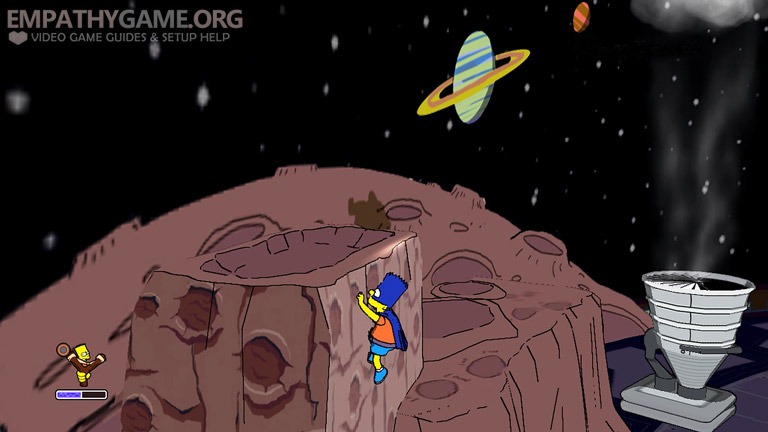
Across the main 3D console adventure, two family members tackle each episode through a mixture of combat, jumping, switches, and character-specific powers. There is real pleasure in seeing a puzzle solved through the family’s absurd abilities, particularly with another person controlling the second character. Yet the stages regularly substitute a required interaction for an interesting decision, while loose camera behaviour makes apparently simple jumps harder than intended. Its scenarios, performances, and visual jokes consistently outshine its mechanics. Simpsons devotees and fans of gaming satire have the strongest reason to forgive that imbalance.
Character Switching Gives Simple Puzzles an Identity
The basic rhythm is to move through a stage, fight a few enemies, identify an obstacle, and bring the appropriate Simpson into position. Most episodes assign two family members, so solo play involves switching between them while the other follows. That gives each character a distinct job. Bart excels at routes above ground level: he shoots distant switches with his slingshot, grapples between hooks, and uses his Bartman cape to glide across gaps. Homer approaches the same world with considerably less grace. As Homerball, he rolls, charges, and crashes through objects; as Gummi Homer, he fires projectiles at enemies and targets.
Lisa and Marge change the pace more noticeably. Lisa summons the Hand of Buddha at designated points to pick up scenery, reposition platforms, and manipulate threats from a distance. Her abilities make a room feel briefly like a construction puzzle rather than another corridor. Marge’s megaphone turns nearby citizens into a controllable mob that can clear barriers or put objects together; Maggie then provides a smaller-scale solution by slipping through vents inaccessible to everyone else. These powers suit the characters without complicated rules.
Lisa the Tree Hugger illustrates the design at its best: Lisa rearranges parts of the environment while Bart can reach elevated paths and disable targets with his slingshot. Success depends on recognising how one family member’s action creates an opportunity for the other. These sequences are satisfying because the pairing briefly matters. Yet the Hand of Buddha only works at designated positions, and many obstacles announce which power is needed. Once the intended sequence is spotted, there is seldom an alternative worth exploring.
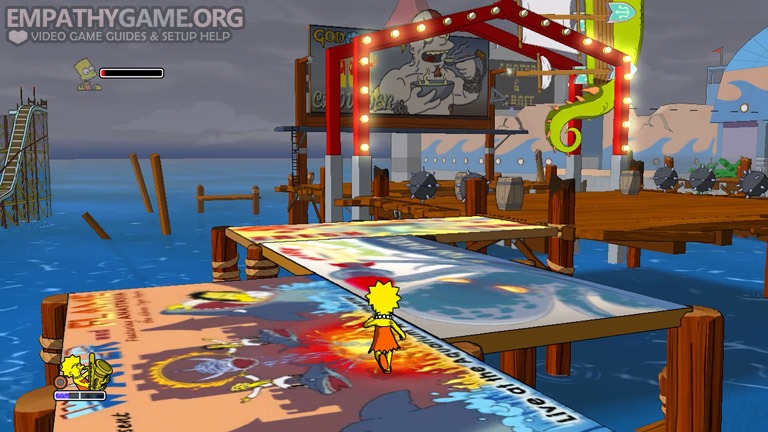
The cues can also be misleading. In The Day of the Dolphin, for instance, solving the King Snorky encounter involves arranging jellyfish and using Bart’s ranged attack as part of the environmental setup. Knowing that Lisa can lift objects does not necessarily reveal which exhibit or target matters next. Objectives can be vague about the route or final interaction, turning a potentially clever cooperative puzzle into a search for the one usable detail. One room spells out its solution while another obscures a mechanical task.
Combat and Jumping Rarely Match the Imagination
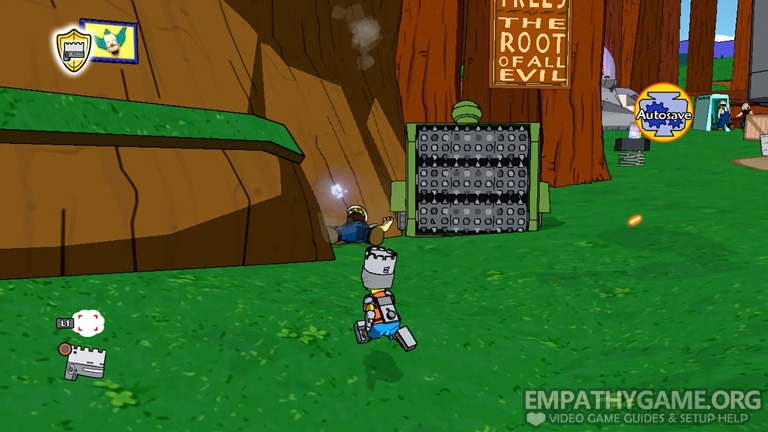
Fighting is the weakest recurring activity. Basic attacks and special powers give the cast a little personality, but ordinary encounters rarely demand much positioning or tactical change. Enemies arrive in amusing costumes, from miniature Krustys to characters borrowed from other genres, yet their behaviour is less varied than their appearance. Some block for long stretches, extending fights without adding challenge. Others keep returning until the player locates and disables a spawning source. In those moments, dispatching opponents is less interesting than working out how to stop the interruption.
The computer-controlled companion adds another uneven layer. On some stretches, an AI partner can follow across difficult jumps once the player has successfully reached the other side, sparing a second round of precise platforming. That is a useful concession to the two-character structure. During combat, though, leaving the second Simpson exposed can make the same companion feel surprisingly fragile. Switching may become more about protecting a partner than combining abilities. The system handles traversal more gracefully than danger.
Platforming is more frustrating because it sits between the player and the better material. Bart’s grapples and cape should make vertical movement lively, and Homer’s rolling charge has a satisfying slapstick idea behind it. In practice, imprecise landings, uneven collision behaviour, and a camera that struggles around walls or narrow ledges interrupt the rhythm. Missing a jump often feels like a disagreement with the viewpoint rather than a failure to read the obstacle. Repeated interruptions drain energy from jokes that deserve a brisker pace.
The Parody Episodes Are the Real Attraction
The sixteen-episode structure gives the writers an excuse to change subject before any single gag wears out. Medal of Homer turns a wartime shooter into Simpsons comedy; NeverQuest borrows the language of fantasy role-playing; and Big Super Happy Fun Fun Game exaggerates familiar Japanese game imagery. Environments and jokes change more dramatically than the controls. That mismatch is the game’s central compromise: each new setting promises a different sort of adventure, then frequently asks for another fight, jump, or obvious mechanism.
Shadow of the Colossal Donut comes closest to making the joke inseparable from the activity. Its enormous Lard Lad statue is not simply an enemy with a health bar. Bart and Homer must deal with a moving landmark, identify its exposed weak points, and reach the mechanisms that bring it down. The absurdity of scaling a murderous doughnut mascot gives familiar boss-stage actions a visual and comic payoff. When a level’s theme dictates the actions, the adventure feels more considered.
Much of the humour comes from the game openly cataloguing its own clichés. Comic Book Guy identifies design conventions such as invisible walls and recycled enemies as the family encounters them. This is funny partly because the title does not pretend to be above its targets. Still, recognising an overused idea does not automatically improve the section built around it. A repetitive encounter can be a deliberate joke and a repetitive encounter at the same time. Self-criticism gives it personality, not better pacing.
Springfield Is Better as a Place to Recognise Than a Sandbox
The story’s movement from Bart’s mysterious manual to superhero mischief, alien invasion, and the inner workings of the game industry is deliberately unruly. Its connective logic matters less than its ability to set up an outrageous new sketch. Homer remains governed by his appetite, Bart enjoys the costume more than the responsibility, Lisa tries to make sense of the nonsense, and Marge turns moral indignation into a literal crowd-management tool. Familiar performances make these reactions more memorable than the escalating plot.
On PlayStation 3 and Xbox 360, Springfield offers a welcome change from the self-contained episodes. Moe’s Tavern, the Kwik-E-Mart, the Android’s Dungeon, and other familiar sites are enjoyable to recognise, and several interiors give the town a more intimate quality than a street map alone would provide. Encounters with residents and incidental dialogue make exploring worthwhile even when there is no immediate objective. It feels like walking around a sitcom rather than watching it.
The limitations are just as noticeable. The hub is compact, travel is on foot, and there is no driving-based freedom to make moving between landmarks an activity in its own right. Exploration largely means visiting recognisable places and searching for collectibles, not discovering interlocking systems or unexpected missions. Springfield is charming as a collection of rooms, faces, and jokes—not as a substantial open world. Its strongest reward is recognition rather than unrestricted play.
Co-Op Strengthens the Family Dynamic, but Narrows the View
Local two-player co-op gives the paired-character design its most natural expression. Instead of swapping to Bart after Lisa has placed a platform, one person can prepare the route while the other moves into position. Certain puzzles benefit from simultaneous attention or tightly coordinated actions, creating small moments of teamwork that feel more purposeful than alternating control in single-player. Because the roles and goals are usually understandable, a less experienced partner can contribute through communication and observation rather than needing to master complex combat.
Split-screen narrows an already imperfect view, making jumps harder when both players must judge distance within restricted camera space. The appeal of sharing a joke or discovering a route together is therefore offset by failed landings and occasional confusion about where the second character should stand. Co-op is a design strength, but one that magnifies the weak camera.
Completionism Makes the Satire Uncomfortably Literal
Character-specific collectibles and episode revisits extend the adventure after the story ends. Duff bottle caps, Krusty coupons, and Malibu Stacy items send players back through stages and across Springfield, while new costumes and other rewards provide fan-oriented incentives. The quantity is not trivial. Hunting down every last icon can turn a game that mocks collect-a-thon conventions into a sizable collect-a-thon itself. For someone who enjoys checking off every corner of a level, there is ample cleanup to do; for someone following the comedy, that same task can feel like stretching the material long after the punch line has landed.
Time challenges provide a more interesting kind of replay in the Xbox 360 and PS3 versions. They are not always a simple matter of finishing an unchanged stage faster. The Bargain Bin challenge introduces resistance absent from the equivalent stretch of the story, so the player must manage enemies while reaching the objective. In Enter the Cheatrix, protecting Bart from attacks can matter more than shaving seconds from the route. These variations reward a different balance of caution and speed, even though the basic movement and fighting systems remain the same. They make revisits more compelling than collecting alone.
The Nintendo DS release deserves a clear distinction rather than being judged as a reduced version of this 3D adventure. Its largely 2D stages use a different rhythm: one Simpson may create a way forward, then the other still has to travel through much of the same territory. Frequent checkpoints soften failed attempts, but they do not remove the repeated traversal. Touch-screen interactions and separate handheld features alter the experience further. The central joke and family identity survive, yet the observations about Springfield exploration, 3D camera problems, and console co-op do not carry over unchanged.
Presentation Gives the Comedy Room to Work
The cel-shaded art holds up because it aims for the television show’s shapes and expressions instead of realism. Character silhouettes remain immediately legible, familiar locations are recognisable at a glance, and the stronger console versions have enough environmental detail to support the broader genre spoofs. Animation can be stiff when jumping or fighting, but the cutscenes frequently capture the timing of an actual episode. The contrast between lavish parody and misplaced character reactions is especially effective.
The voice cast does much of the work that the mechanics cannot. Homer’s misplaced enthusiasm, Marge’s outrage, Bart’s irreverence, and Lisa’s exasperation lend continuity to a plot that deliberately jumps between premises. Music likewise shifts to suit wartime action, fantasy questing, and other borrowed genres without losing the cartoon’s playfulness. The performances can make even another routine fight worth enduring. The presentation is not merely decorative; it is the thread keeping a mechanically uneven adventure entertaining.
Final Verdict
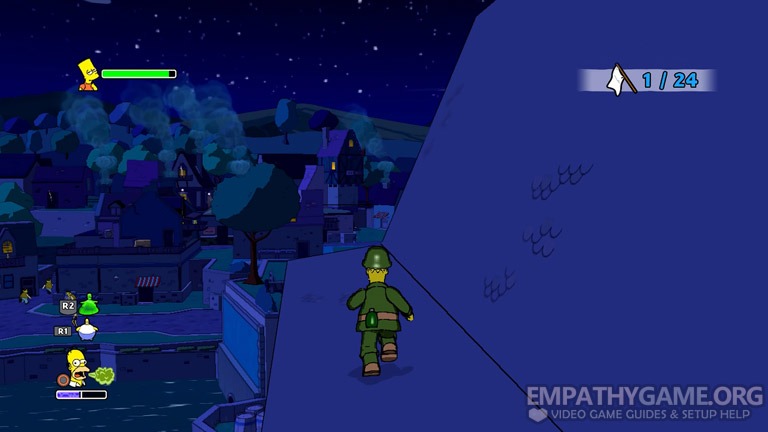
The Simpsons Game succeeds most convincingly as an interactive comedy about the medium that contains it. Its video-game parodies are specific, its characters sound and behave like the Simpsons, and its best environmental puzzles find genuinely funny uses for family members who should have no business being superheroes. Local co-op also gives those abilities a social purpose: solving a problem together is more satisfying than watching one character wait for the other to finish.
The weaker parts are equally hard to ignore. Straightforward combat sometimes drags because of defensive enemies and repeated spawns; platforming asks for precision that the camera and collision handling do not consistently support. Some puzzle instructions are too vague, while other solutions are so prescribed that there is little discovery involved. Springfield rewards familiarity and curiosity more than freedom, and the optional hunts can exhaust even a good joke.
That makes the recommendation unusually specific. Fans who want an original Simpsons production, enjoy spotting references to older games, or have a partner willing to tolerate some rough edges will find plenty of character here. Anyone looking primarily for tight 3D platforming, expressive combat, or a deep Springfield sandbox should lower their expectations. The adventure often understands exactly why its gameplay is clichéd; it is less adept at escaping those clichés. Fortunately, its sharp comic identity makes the uneven journey memorable on terms few licensed games manage.
The Simpsons Game Pros & Cons
The Simpsons Game PC System Requirements
There are no official native Windows PC system requirements for The Simpsons Game. Electronic Arts never published a Windows edition. The specifications below are requirements published by the PCSX2 emulator project, not official requirements for the game itself.
PCSX2 Emulator System Requirements
MINIMUM — PCSX2 Emulator:
OS: Windows 10 64-bit, supported releases
CPU: x86-64 processor with SSE4.1 support, approximately 1,500 or higher PassMark single-thread score, and two physical cores with simultaneous multithreading
RAM: 8 GB
GPU: Graphics hardware supporting Vulkan 1.1, Direct3D 11 Feature Level 10.0, or supported OpenGL 3.3 functionality; approximately 600 or higher PassMark G3D Mark score
Additional Notes: Requires a BIOS dump from a PS2 console you own, suitable original game media or an appropriately created backup, and enough storage for the emulator, game data, and saves
MODERATE — PCSX2 Emulator:
OS: Windows 11 64-bit
CPU: x86-64 processor with AVX2 support, approximately 2,000 or higher PassMark single-thread score, and four physical cores
RAM: 16 GB
GPU: Vulkan 1.3 or Direct3D 12-capable GPU, approximately 6,000 or higher PassMark G3D Mark score, and 4 GB VRAM
Additional Notes: This emulator performance tier provides greater headroom for rendering improvements but does not guarantee specific frame rates or full compatibility for every PlayStation 2 game
Source: PCSX2 Official System Requirements. These are general emulator specifications; The Simpsons Game performance was not independently benchmarked by DecideGame.com.
Additional PC Performance and Setup Notes
PCSX2 graphics compatibility: The PCSX2 game wiki documents missing or misaligned cartoon outlines when upscaling, along with older reports of audio noise and rendering problems. Some documented workarounds refer to older emulator interfaces, so begin with the current default configuration rather than applying outdated plugin instructions. If characters or scenery look incorrect, compare native-resolution and software-rendering behavior before changing advanced graphics options.
PCSX2 resolution scaling: Higher internal resolutions can produce sharper edges and cleaner environments, but they do not replace original textures or correct every graphical effect. Start near native resolution, confirm that scenes and outlines render correctly, then increase scaling according to the GPU’s available performance.
RPCS3 performance: PlayStation 3 emulation generally depends more heavily on CPU capabilities than PlayStation 2 emulation. A compatibility-list entry marked Playable means the game has met RPCS3’s compatibility criteria in submitted testing, not that every PC configuration will provide identical results. Consult RPCS3’s official setup guidance for hardware recommendations and required software.
Unofficial recompilation requirements: The independent Xbox 360 recompilation project documents a 64-bit x86 CPU, an AVX2-capable processor for its standard build, appropriate Vulkan or Direct3D graphics support, and approximately 5 GB of installation space for owned game data. Separate builds and renderer options may have different requirements. These are community-project specifications, not publisher-certified Windows requirements.
Controller configuration: The Simpsons Game was designed around console controllers. Map movement, camera, jump, attack, character-switching, and special-ability inputs before beginning a long session. For local cooperative play, check that each controller is assigned to a separate emulated player input and that the selected console version supports the intended mode.
Save files and stability: Use normal in-game saving as the primary progress method where possible, with emulator save states as a supplement. Preserve backups of memory cards or game saves before changing emulator builds, experimenting with community patches, or importing files from another installation. State compatibility and performance conclusions cautiously because emulator behavior can change with hardware, drivers, and software revisions.
Official Trailer
Note: Electronic Arts’ original E3 trailer introduces the Simpson family’s superhero abilities, cartoon-style presentation, and irreverent video-game humor. The written guide provides the additional PC availability, emulation, ownership, and setup information that the original promotional video does not cover.
Frequently Asked Questions
Is The Simpsons Game worth playing in 2026?
Yes. The Simpsons Game remains an entertaining choice for fans of the television series, particularly because of its original comedy, recognizable voice cast, inventive video-game parodies, and cooperative platforming. Its awkward camera, occasionally frustrating jumping mechanics, and repetitive combat show their age, but the humor and distinctive episode designs make it worthwhile for players who enjoy older licensed adventures.
Is The Simpsons Game the same as The Simpsons: Hit & Run?
No. The Simpsons Game is a separate adventure focused on platforming, combat, character abilities, and missions that parody other video games. The Simpsons: Hit & Run emphasizes driving, vehicle-based missions, and exploration, making the two games quite different despite sharing Springfield and its familiar characters.
Is there an official PC version of The Simpsons Game?
No. Electronic Arts never released a native Windows version of The Simpsons Game. PC players can investigate compatible console emulators for copies they own, while the independent Xbox 360 recompilation project offers an experimental Windows implementation that requires original game data and is not an official EA release.
Can you freely explore Springfield in The Simpsons Game?
Yes, but only in the PlayStation 3 and Xbox 360 versions. These editions feature an explorable Springfield hub with recognizable locations, character interactions, collectibles, and access to story episodes. The PS2, PSP, and Wii versions have more restricted hubs, and even the larger Springfield is not a driving-focused open world like The Simpsons: Hit & Run.
Which version of The Simpsons Game is the best to play?
The Xbox 360 and PlayStation 3 editions are generally the strongest choices for their more detailed presentation and freely explorable Springfield. On PC, the PS3 edition through RPCS3 is appealing if your hardware can handle it, while the PS2 edition through PCSX2 offers a less demanding alternative. The best choice also depends on which original console version you own.
How is the Nintendo DS version of The Simpsons Game different?
The Nintendo DS edition is a substantially different game built around side-scrolling action, touchscreen interactions, and a shorter 12-episode campaign. It also features Pet Homer, a touchscreen activity, and four multiplayer mini-games through DS Download Play. It should not be treated as a portable copy of the PS3 or Xbox 360 adventure.
Can The Simpsons Game be played on PS5 or Xbox Series X|S?
The original game has no native release for these consoles, and its Xbox 360 edition is not included in Microsoft’s supported backward-compatibility catalogue. A PS3 or PS2 disc also cannot be played directly on a standard PS5. Original compatible hardware or PC emulation of an appropriately owned console copy remains the more practical approach.
How many episodes are in The Simpsons Game?
The main home-console adventure contains 16 story episodes arranged across four acts, including The Land of Chocolate, Bartman Begins, NeverQuest, Medal of Homer, and Grand Theft Scratchy. Episodes introduce different combinations of characters, enemies, settings, and abilities as the story progresses. The Nintendo DS version follows a different 12-episode structure.
Can you switch between all four Simpsons characters whenever you want?
Not during every episode. Most missions provide a predetermined pair of Simpsons characters, and a solo player switches between them to use the abilities required for puzzles and combat. The opening tutorial focuses on Homer, while the final episode gives the family a broader role.
Is Maggie Simpson playable in The Simpsons Game?
Yes, although Maggie is not a conventional standalone playable character like Homer, Bart, Lisa, or Marge. During certain Marge sections, she can enter small passages and ventilation spaces to reach switches or mechanisms that the other family members cannot access.
How does Lisa’s Hand of Buddha ability work?
Lisa activates the Hand of Buddha at designated Buddha statues, allowing her to manipulate nearby objects from a special overhead viewpoint. It is useful for moving obstacles, building routes, and attacking enemies with environmental objects. If the ability is unavailable, check whether Lisa is standing at the appropriate activation point rather than trying to use it anywhere in the level.
Why do enemies keep appearing in some episodes?
Certain encounters contain enemy-spawning objects or entrances that continually produce opponents until disabled. For example, some missions use doors, portable toilets, or other themed structures as spawn points. Look for destructible sources or nearby switches before spending too much time fighting individual enemies.
What are video-game clichés in The Simpsons Game?
Video-game clichés are collectible jokes that recognize familiar gaming conventions, including double jumps, explosive barrels, pressure plates, and repeated enemies. Comic Book Guy comments on these discoveries, turning ordinary mechanics into part of the game’s satire. Finding them is an optional completion activity rather than a requirement for finishing the story.
What do the character collectibles unlock?
Each main family member has themed collectibles, including Homer’s Duff bottle caps, Bart’s Krusty coupons, Lisa’s Malibu Stacy items, and Marge’s hairspray cans. Completing collectible sets earns trophies displayed around the Simpsons’ house and contributes to character-related completion rewards, including enhanced abilities. These rewards encourage exploration beyond the main objectives.
Can you replay episodes to collect items you missed?
Yes. Completed episodes can be revisited, so missing a collectible during the first run does not normally mean restarting the entire campaign. This is especially useful after learning additional character abilities or becoming more familiar with an episode’s platforming routes.
What are Time Challenges in The Simpsons Game?
Time Challenges are optional timed objectives associated with completed story episodes. They ask players to perform specific tasks quickly, such as defeating enemies, collecting objects, or navigating a section under a time limit. They provide additional replay value beyond finding collectibles and finishing the campaign.
How long does it take to finish The Simpsons Game?
The main home-console campaign typically takes around 7–9 hours, depending on familiarity with the puzzles and platforming. Exploring Springfield, collecting optional items, and completing Time Challenges can extend playtime to roughly 12–17 hours or more. The Nintendo DS edition has a different structure, so its completion time may vary.
Does The Simpsons Game have New Game Plus?
No conventional New Game Plus mode is included. Instead, the game allows completed episodes to be replayed for collectibles, trophies, and time-based challenges. This makes it possible to continue working toward completion without restarting the entire story.
Does The Simpsons Game support two-player split-screen co-op?
Yes. The main home-console versions support local two-player cooperative gameplay, with each person controlling one of the characters assigned to an episode. The game divides the view when necessary so both players can move and perform their tasks independently, making it particularly suitable for couch co-op.
How do you start two-player co-op in The Simpsons Game?
Connect a second controller and have the second player press Start during an episode that supports two characters. The opening Land of Chocolate tutorial is Homer-only, so a second player cannot join that episode normally. Once the game reaches missions such as Bartman Begins, local cooperative play becomes available.
Does The Simpsons Game have online co-op or LAN multiplayer?
No. The main console adventure was designed around local cooperative play rather than online matchmaking or LAN sessions. Although the Nintendo DS edition includes separate local wireless mini-games, these should not be confused with online cooperative campaign support.
Can you play The Simpsons Game in local co-op using a PC emulator?
Yes, potentially. PCSX2 and RPCS3 support multiple controller inputs, allowing the original console game’s local cooperative mode to function when both emulated controllers are configured correctly. Each player needs their own mapped controller inputs, and performance or compatibility may vary depending on the emulator and PC hardware.
Do you need an internet connection to play The Simpsons Game?
No. The original console campaign and local cooperative gameplay were designed for offline play. PC emulators may require internet access initially to obtain official emulator software, documentation, or necessary system components, but the game itself does not rely on online multiplayer servers.
Still have questions? Check the Simpsons gaming community on Reddit for discussions about older Simpsons titles, the PCSX2 Forums for PS2 emulation and compatibility help, or the RPCS3 community for PlayStation 3 emulation questions.
Sources & References
Key factual and technical information in this guide was checked against relevant official and community sources, including:
- Nintendo — The Simpsons Game — official Nintendo DS product information confirming its separate gameplay features, platform release, stylus interactions, and multiplayer mini-games.
- MobyGames — The Simpsons Game — original release history, credited developers, platform information, gameplay structure, and engine technology used across console versions.
- Metacritic — The Simpsons Game — historical critical reception, review scores, and platform-specific differences in aggregate ratings.
- PCSX2 — Official System Requirements — current minimum and higher-performance hardware guidance for PlayStation 2 emulation on supported desktop operating systems.
- PCSX2 Wiki — The Simpsons Game — game-specific PS2 compatibility reports, rendering issues, audio observations, and historical configuration testing.
- RPCS3 — Official Game Compatibility List — PlayStation 3 compatibility classification for The Simpsons Game and the distinction between playable and more limited emulator compatibility states.
- The Simpsons Game Recompiled — GitHub — independent project’s own documentation on Windows/Linux support, original-game ownership requirements, rendering technology, limitations, and unofficial development status.
Similar Games Like The Simpsons Game
- The Simpsons: Hit & Run
- Sonic Heroes
- Spider-Man: Shattered Dimensions
- Harry Potter and the Prisoner of Azkaban
- Marvel: Ultimate Alliance
- Kingdom Hearts 3

Found something worth playing through DecideGame?
DecideGame.com is an independent gaming project run by Editor Zero. If this guide helped you discover a game, solve a problem, or find useful information, you can support DecideGame.com and help keep new and updated game guides coming.
DecideGame — PC Game Guides, Reviews & Setup Help