
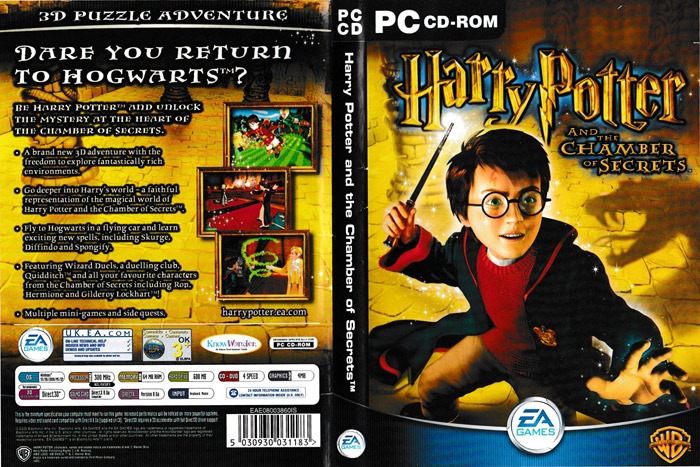
📅 Game released: 2002
Use this updated 2026 Harry Potter and the Chamber of Secrets PC guide to check official download status, understand original-disc ownership and Windows 10/11 setup limits, review system requirements, and find practical compatibility, widescreen, and modding guidance for the 2002 KnowWonder version.
 By Editor Zero — independently researched, edited, and maintained.
Last updated: 6 October 2026
Last reviewed: 6 October 2026
Table of Contents
- Quick Summary
- Quick Facts
- Official PC Stores, Download & Installation
- Harry Potter and the Chamber of Secrets Review
- Pros & Cons
- PC System Requirements
- Frequently Asked Questions
- Similar Games
Harry Potter and the Chamber of Secrets Quick Summary
✔ Colorful third-person action-adventure and 3D platformer following Harry’s second year at Hogwarts through exploration, spell lessons, platforming challenges, combat, secrets, and story missions
✔ Rictusempra, Skurge, Diffindo, and Spongify expand Harry’s abilities through dedicated challenges before becoming useful for enemies, puzzles, environmental obstacles, and hidden areas around Hogwarts
✔ Similar to Hogwarts Legacy through its Hogwarts setting, spellcasting, magical secrets, school atmosphere, collectibles, and freedom to explore parts of the castle between objectives
✔ The KnowWonder Windows game is its own version and should not be confused with the mechanically different PS2, Xbox, GameCube, PS1, or handheld releases carrying the same name
✔ No normal official digital Windows purchase listing is available through the major PC storefronts checked, making original retail ownership and modern compatibility the main PC setup concerns
✔ The original disc release was designed for early Windows systems and uses SafeDisc, while modern widescreen, rendering, and frame-rate behavior may require careful community compatibility adjustments
Harry Potter and the Chamber of Secrets Quick Facts
Official PC Store Status, Download & Installation
👇 Use the notes below to understand Harry Potter and the Chamber of Secrets’ official PC availability, original-disc ownership, and installation limitations without relying on unofficial game-file sources.
- Official digital availability: No active official digital PC purchase page was verified for the 2002 Windows version through the major storefronts checked. This guide therefore does not present a Steam, GOG, EA App, Epic Games Store, or Microsoft Store purchase button.
- Original Windows release: The native PC version was distributed as a Windows CD-ROM published by Electronic Arts. Owners of an original retail copy should keep the physical media, documentation, and any accompanying product information together when maintaining an older installation.
- Steam: The game does not have a normal Steam store app, Steam achievements, Steam Cloud, Steam Workshop integration, or an official Steam Deck compatibility rating.
- GOG: GOG lists Harry Potter and the Chamber of Secrets through its Dreamlist request system rather than as a purchasable game, so the Dreamlist page should not be mistaken for a downloadable GOG release.
- SafeDisc protection: The original retail Windows version uses SafeDisc-era copy protection. The required legacy protection mechanism does not operate normally on Windows 10 or Windows 11, so possessing and installing the original disc does not by itself guarantee that the game will launch on a current Windows installation.
- Modern Windows setup: The game was designed for Windows 95 through Windows XP-era systems. Modern players may encounter old DirectX rendering, display, frame-rate, or launch compatibility problems even when the hardware is vastly faster than the original requirements.
- Community modifications: Widescreen fixes, renderer wrappers, localization files, and other community-made adjustments exist, but they are unofficial. Keep backups of original configuration and game files before modifying an installation, and obtain community tools only from established project or modding pages.

Harry Potter and the Chamber of Secrets Review
A warm, secret-packed Hogwarts adventure whose exploration outshines its simple combat.
Harry Potter and the Chamber of Secrets works best when it gives the player permission to ignore the obvious route. KnowWonder’s PC version turns Harry’s second year into a compact 3D action-platformer built around spell lessons, obstacle-course challenges, hidden rooms, collectible Wizard Cards, Quidditch, dueling, and repeated trips through Hogwarts. None of those systems is especially deep on its own. What gives the game its character is how often they point back toward the castle itself. A portrait that looked decorative can hide a passage. A ledge that seemed unreachable may become useful after learning Spongify. A corridor passed several times can still contain a card, a bean chest, or a secret that has not yet been discovered.
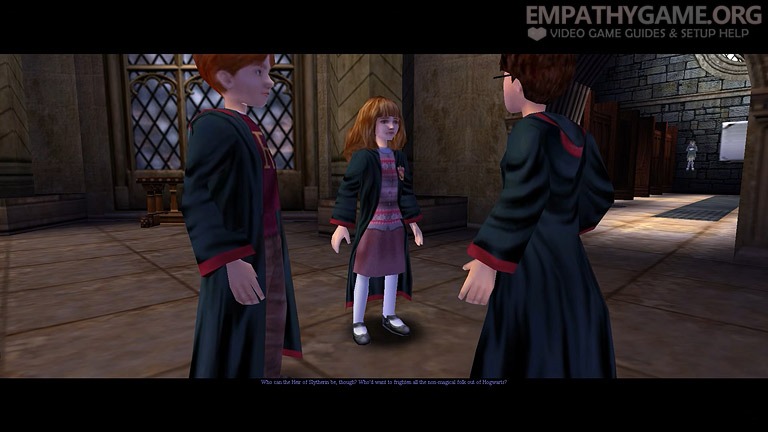
That emphasis makes the PC version feel less like a sequence of movie scenes and more like a child-friendly collectathon built inside Hogwarts. Combat is basic, the story moves quickly, and several encounters rely on obvious spell solutions, but curiosity is rewarded so consistently that simply wandering between classes becomes part of the appeal. It is an approachable game, yet not an empty one: the pleasure comes from gradually understanding how its castle is put together.
Hogwarts Is the Real Reward
The strongest part of Chamber of Secrets is its structure between missions. Hogwarts functions as a hub rather than a fully open world, with classrooms, staircases, dungeons, corridors, courtyards, the grounds, trading students, Quidditch access, and hidden routes connecting the school day. Story objectives usually make the next destination clear, but the game repeatedly gives reasons not to hurry there. Decorative objects can react to Flipendo, portraits and cracked surfaces can hide secrets, Lumos can reveal temporary paths, and later spells make previously suspicious obstacles worth reconsidering.
This is where the ability-gated design earns its keep. Skurge removes ectoplasm, Diffindo cuts ropes, vines, and webs, while Spongify turns marked surfaces into launch points. These are simple interactions, yet they change how familiar rooms are read. Instead of merely collecting a new attack, Harry acquires another way to interrogate the environment. Returning through the school therefore has a mild Metroidvania quality without becoming a maze of hard progression locks.
The game also does more than hide items and expect the player to remember everything. The start screen tracks how many secrets exist in the current area and how many have already been discovered, which turns completion into a manageable search rather than blind wall-hugging. Some bean chests can even refill as the school day advances, so revisiting earlier spaces can replenish currency as well as reveal newly reachable rewards. Those details make backtracking feel intentional instead of merely repetitive.
Hogwarts is not architecturally convincing in a realistic sense, but that is part of the charm. Rooms seem designed around the fantasy that every wall could conceal something. Staircases, statues, portraits, moving platforms, strange switches, and impossible side chambers make the school feel playful rather than practical. The result captures a particular early-2000s vision of Hogwarts: smaller and more artificial than later interpretations, but unusually dense with secrets.
Spell Challenges Turn Lessons Into Platforming
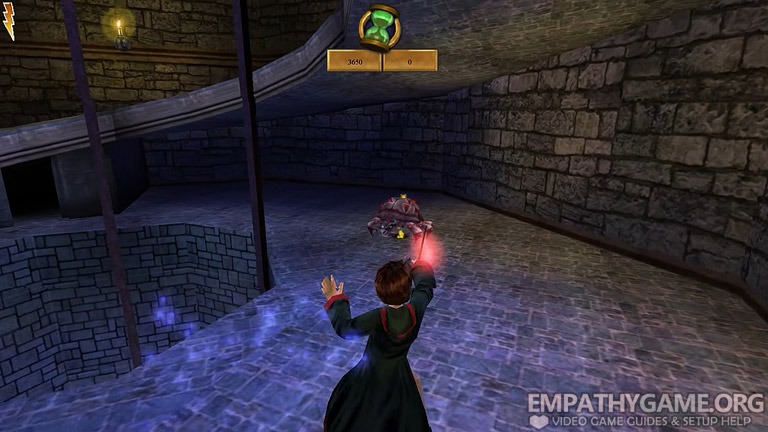
The central progression loop alternates between learning magic and proving that Harry can use it. Rictusempra, Skurge, Diffindo, and Spongify each receive dedicated challenge spaces built around the new spell. These courses combine moving platforms, enemy encounters, switches, hazards, secret rooms, and optional Challenge Stars before ending at a Completion Star. Because a new ability is immediately tied to traversal and puzzle-solving, the lesson has a clearer purpose than simply adding another icon to Harry’s spell set.
The classroom sequence itself is forgiving. Spell learning uses three performance stages tied to House Points, but perfect execution is not required to keep the spell. Passing the first stage is enough to progress with the new magic; better performance mainly improves the House Points reward. That is a smart fit for the game’s audience. The lessons still provide something to master, yet a missed input does not turn a children’s action-adventure into a progression wall.
Platforming is similarly approachable, although the PC controls are more flexible than they first appear. Harry can jump manually, and he will grab suitable ledges when he reaches them. Keyboard movement is binary—running or stopped—so there is less fine movement control than an analog stick would provide. Spellcasting also changes depending on the input method: mouse controls allow Harry to keep moving while aiming and charging magic, whereas keyboard casting can repurpose the movement keys for aiming and leave him stationary. That distinction matters whenever positioning and spell timing overlap.
The challenge rooms are at their best when several learned spells interact in quick succession. A route might ask Harry to clear ectoplasm, move an enemy onto a pressure plate, reveal a hidden path, cut a rope, then use Spongify to reach the next ledge. The ingredients are simple, but combining them gives the obstacle courses a satisfying rhythm. Repetition appears when rooms fall back on the same small pool of creatures, switches, and hazards, yet the steady arrival of new spells usually keeps the campaign moving.
Combat and Dueling Rarely Demand Much
Combat is the weakest major system because most enemies are closer to moving puzzle pieces than tactical threats. The game usually teaches a direct relationship between creature and response, then asks the player to repeat it. Fire Crabs, gnomes, imps, snails, pixies, plants, and other hazards add visual variety, but the encounters seldom require much improvisation once their counter is understood. Bosses and chase sequences create occasional spikes in spectacle, yet the general difficulty remains low.
That simplicity is not necessarily misplaced. Chamber of Secrets is designed to be readable, and enemy encounters rarely interrupt exploration for long. The problem is that spellcasting has more verbs than combat has reasons to use them creatively. Environmental puzzles often make a new spell feel meaningful; a fight more often confirms that the correct spell has been selected.
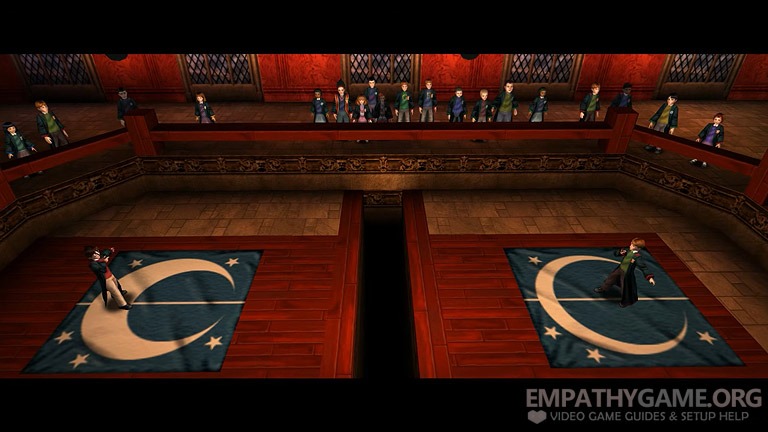
The Dueling Club illustrates the imbalance even more clearly. Its rules appear to create a small three-spell mind game: Rictusempra deals damage, Mimblewimble interferes with an opponent’s next cast, and Expelliarmus reflects incoming magic. In practice, Expelliarmus can dominate the exchange. Waiting for the opponent to cast and repeatedly returning spells is a low-risk strategy that reduces much of the duel ladder to a counter loop. Wagering Bertie Bott’s Every Flavour Beans gives the activity a useful economic purpose, but the mechanical decision-making is thinner than the spell list suggests.
Stealth is equally limited, though less damaging because the game uses it sparingly. Sneaking does not become a systemic Hogwarts-wide playstyle. Instead, specific linear nighttime sequences ask Harry to avoid Filch and Mrs Norris while navigating predetermined routes and obstacles. These sections change the pace and suit the fiction of breaking curfew, but they are set pieces rather than a flexible detection system. The game is strongest when it accepts that exploration and platforming—not combat or stealth—are its real foundations.
Beans, Cards, and House Points Give Curiosity a Purpose
The collectible economy ties many of the game’s smaller activities together. Bertie Bott’s Every Flavour Beans function as currency rather than disposable score objects. Students trade useful items and Wizard Cards for them, the Dueling Club puts beans at stake, and Quidditch upgrades give another reason to keep collecting. Because beans spill from chests, scenery, hidden rooms, and repeat visits, searching Hogwarts has a practical reward beyond increasing a completion percentage.
Famous Witches and Wizards Cards provide the clearer long-term goal. There are 101 to find, divided into Bronze, Silver, and Gold sets. Bronze milestones increase Harry’s maximum health, while collecting all 40 Silver Cards opens the Gold Wizard Card Challenge. That structure gives secrets a progression consequence: a hidden chest can improve survivability, advance a larger collection goal, or move the player closer to a final optional challenge rather than existing only as a decorative pickup.
House Points add another layer to the school fantasy. Lessons, spell challenges, and Quidditch contribute to Gryffindor’s standing, and successful performance can lead to timed access to the Bonus Bean Room. None of these systems is complicated, but together they create a useful feedback loop. Learning spells improves exploration, exploration produces beans and cards, beans fund optional purchases and duels, and school activities feed back into House Points.
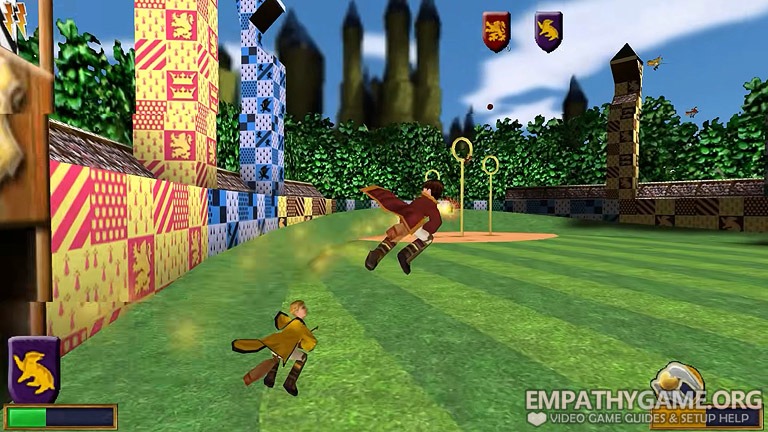
Quidditch works best as a change of pace rather than a deep sports game. It breaks up the repeated rhythm of corridors and spell challenges, contributes to the House competition, and connects with the bean economy through purchasable equipment. Like dueling, it is more valuable for the variety it adds to the school year than for mechanical complexity on its own.
This is also where replay value comes from. The campaign does not offer branching story choices or radically different builds, so a second run is unlikely to transform the core experience. Completionists have much more to do: missed secrets, card sets, challenge performance, Quidditch, dueling, and areas that become more productive after progression. The game rewards thoroughness more than experimentation.
The Story Moves Quickly, but the School Carries the Atmosphere
The narrative follows the broad shape of Harry’s second year: Dobby’s warnings, the return to Hogwarts, Gilderoy Lockhart’s classes, attacks on Muggle-born students, suspicion surrounding the Chamber, and Harry’s investigation with Ron and Hermione. The adaptation moves briskly and often treats characters as guides to the next activity. Dumbledore, Snape, McGonagall, Sprout, Lockhart, and other familiar figures help establish the school-day rhythm, but the game rarely pauses long enough to develop them beyond their immediate role.
That compression makes the central mystery less powerful than the setting around it. Chamber of Secrets does not need long dialogue scenes to make Hogwarts appealing because the school is constantly communicating through spaces and routines. A trip to class can pass trading students, moving staircases, portraits, locked passages, and rooms that will matter later. Nighttime sequences alter familiar routes through darkness and the threat of being caught. Quidditch moves the focus outside, while dungeons and challenge rooms give individual lessons their own visual identity.
The presentation is unmistakably of its era. Character faces and animation are stiff, environmental geometry is simple, and repeated assets are easy to notice. Yet the stylized art direction prevents the game from becoming sterile. Warm interiors, exaggerated magical architecture, colorful spell effects, and distinctive classroom spaces create a storybook quality that suits the lightweight tone. The music and ambient sound are especially important, lending quiet exploration, classes, danger, and Quidditch their own moods even when the underlying mechanics remain modest.
That atmosphere explains much of the game’s durability as a memory. It is not a comprehensive simulation of school life, and its story is too compressed to carry the experience alone. What it does capture is the fantasy of being turned loose in a secret-filled Hogwarts where the next ordinary-looking wall might respond to a spell.
Final Verdict
Harry Potter and the Chamber of Secrets succeeds less through mechanical depth than through the way its systems reinforce curiosity. Spell challenges teach abilities that matter outside the classroom, Hogwarts keeps presenting new reasons to inspect familiar spaces, and the combination of beans, Wizard Cards, House Points, Quidditch, and hidden rooms gives exploration a steady stream of small rewards. The secret counter and refilling bean chests make completion friendlier than it first appears, while manual jumping and different spellcasting inputs give the PC controls more flexibility than a purely automatic platformer would suggest.
Its limitations are just as clear. Combat is predictable, dueling can collapse into repeated Expelliarmus counters, stealth is restricted to scripted sequences, and the story moves too quickly to give many characters much dramatic weight. Players looking for demanding action, systemic stealth, or sophisticated puzzles will find the design shallow. Players who enjoy collectathons, gentle platforming, ability-gated exploration, and the particular atmosphere of early Harry Potter games are much better served.
The reason this version stands out is simple: Hogwarts is not merely scenery between story beats. It is the game’s main toy box. The castle continually turns curiosity into progress, and that makes a modest licensed platformer feel more inviting than its basic combat and dated presentation should allow.
Harry Potter and the Chamber of Secrets Pros & Cons
Harry Potter and the Chamber of Secrets PC System Requirements
Note: The specifications below are the original retail-era Windows PC requirements. They describe the hardware expected by the 2002 game and should not be interpreted as a guarantee of compatibility with a modern version of Windows.
ORIGINAL WINDOWS PC REQUIREMENTS:
MINIMUM:
OS: Windows 95, Windows 98, Windows ME, Windows 2000, or Windows XP
CPU: 350 MHz Intel Pentium II or comparable processor
RAM: 64 MB; 128 MB for Windows 2000 or Windows XP
GPU: 4 MB for software rendering or 16 MB Direct3D hardware accelerator compatible with DirectX 8.0a
DirectX: DirectX 8.0a or later
Storage: Approximately 600 MB free hard-drive space, with additional space required for the Windows swap file
Optical Drive: 4x CD-ROM drive
Sound Card: DirectX 8.0a-compatible sound card
RECOMMENDED:
OS: Windows 95, Windows 98, Windows ME, Windows 2000, or Windows XP
CPU: 500 MHz Intel Pentium III or comparable processor
RAM: 128 MB; 256 MB for Windows 2000 or Windows XP
GPU: 16 MB Direct3D hardware accelerator compatible with DirectX 8.0a
DirectX: DirectX 8.0a or later
Storage: Approximately 600 MB free hard-drive space, with additional space required for the Windows swap file
Optical Drive: 8x CD-ROM drive
Sound Card: DirectX 8.0a-compatible sound card
Additional PC Performance and Setup Notes
- Windows 10 and 11: Raw CPU and GPU performance is not the limiting factor on a modern PC. The more important obstacle is the original SafeDisc protection, which is incompatible with normal current Windows operation.
- Widescreen: The original game predates modern widescreen standards. Community widescreen methods can provide better aspect-ratio support, while forcing unsupported resolutions without the appropriate adjustment can crop or misalign parts of the interface.
- Frame rate: Running this old engine at unrestricted frame rates can cause timing problems, including abnormally fast cutscenes or physics behavior. A 60 FPS or 60 Hz limit is a practical compatibility starting point.
- Old DirectX rendering: Compatibility wrappers such as dgVoodoo2 or DDrawCompat are commonly used by the PC community to improve rendering behavior in older Windows games. These are third-party tools rather than official Electronic Arts updates.
- Backups: Keep copies of original configuration and save files before applying widescreen, renderer, localization, or other community modifications so changes can be reversed easily.
Video Trailer
Frequently Asked Questions
Is Harry Potter and the Chamber of Secrets worth playing in 2026?
Yes, especially for players who enjoy early-2000s 3D platformers, Hogwarts exploration, hidden secrets, collectibles, and simple spell-based puzzles. Its biggest obstacle is not the underlying game but getting the original PC release running comfortably on a modern Windows system.
Is the PC version of Harry Potter and the Chamber of Secrets the same as the PS2, Xbox, or GameCube versions?
No. The 2002 KnowWonder PC version is a substantially different game with its own level layouts, Hogwarts design, spell challenges, collectibles, progression, and controls. Guides or videos made for the PS2, Xbox, GameCube, PS1, or handheld releases should not automatically be assumed to apply to the PC game.
Do I need to play Harry Potter and the Philosopher’s Stone before Chamber of Secrets?
No. Chamber of Secrets explains its own controls, spells, characters, and objectives, so it works as a standalone adventure. Playing the earlier KnowWonder PC game first mainly adds continuity because Chamber of Secrets builds on its style of platforming, spellcasting, secrets, and Hogwarts exploration.
Is Harry Potter and the Chamber of Secrets an open-world game?
Not in the modern seamless open-world sense. Hogwarts acts as a relatively open hub where Harry can explore corridors, staircases, grounds, classrooms, traders, secrets, Quidditch, and dueling between more linear story quests and spell challenges.
Can you keep exploring Hogwarts after finishing the story?
Yes. After completing the main story, Harry can continue exploring Hogwarts, enter the Dueling Club, play Quidditch, revisit spell challenges, collect remaining items, and work toward fuller completion instead of being locked permanently at the ending.
What spells can Harry use in the PC version?
Harry begins with Flipendo, Alohomora, and Lumos, then learns Rictusempra, Skurge, Diffindo, and Spongify through the story. These spells do more than attack enemies: they reveal secrets, remove obstacles, activate mechanisms, cut ropes and webs, expose hidden paths, and launch Harry from Spongify surfaces.
How do spell challenges work?
Each major new spell is followed by a dedicated platforming and puzzle challenge built around that ability. Harry must reach the Completion Star before time expires, while optional Challenge Stars add time and improve the House Points reward.
Can spell challenges be replayed?
Yes. The major spell challenges can be entered again, which is useful for finding missed secrets, improving times, collecting items, or earning additional House Points. They also remain available after the main story.
How do House Points work in Chamber of Secrets?
Harry earns House Points from activities such as spell lessons, spell challenges, and Quidditch performance. Weekly House Point ceremonies compare Gryffindor with the other houses, and leading the standings gives Harry timed access to the Bonus Bean Room, with a larger lead generally allowing more time inside.
What are Bertie Bott’s Every Flavour Beans used for?
Beans function as the game’s main currency. Students around Hogwarts trade items such as Wizard Cards, potion ingredients, Quidditch Armor, and the Nimbus 2001 for beans, while the Dueling Club also requires Harry to stake beans before a duel.
How do Famous Witches and Wizards Cards work?
The PC game contains 101 cards: 50 Bronze, 40 Silver, and 11 Gold. Every ten Bronze Cards permanently increases Harry’s health, while every ten Silver Cards supplies one of the four keys needed to unlock the Gold Wizard Card Challenge; all 40 Silver Cards are therefore required to reach the 11 Gold Cards.
Does Harry Potter and the Chamber of Secrets have playable Quidditch?
Yes. Quidditch is a playable side activity rather than only a cutscene, and matches contribute to House Points. Beans can also be exchanged for Quidditch Armor and a Nimbus 2001, giving collectors another reason to participate in trading and exploration.
How does the Dueling Club work?
After the story introduces the club, Harry can challenge students near the Great Hall and wager Bertie Bott’s Beans. Duels use Rictusempra for direct damage, Mimblewimble to interfere with an opponent’s next spell, and Expelliarmus to reflect incoming magic.
How does saving work in the PC version?
Save Books act as checkpoints: touching one records Harry’s current progress, health, and items, and fainting normally returns him to the latest saved state. Important cutscenes and completed objectives can also create progress checkpoints, so the game does not rely exclusively on manual Save Books.
Does Harry Potter and the Chamber of Secrets have multiplayer or co-op?
No. The KnowWonder PC version is a single-player game with no campaign co-op, split-screen, LAN mode, or online multiplayer. Quidditch and wizard dueling are both played against computer-controlled opponents.
Does the PC version support controllers?
Yes, the original PC game includes controller/joystick support and configurable bindings, although its input system predates modern Xbox-style controller standards. Contemporary controllers can require additional configuration, and the launcher itself may still need mouse input, so keyboard and mouse remains the simplest baseline setup.
Does Harry Potter and the Chamber of Secrets work on Windows 10 and Windows 11?
The game itself can run on modern hardware, but the original retail release uses SafeDisc protection that modern Windows versions do not normally support. Compatibility therefore depends on the particular installation and community compatibility solution being used, and owning the original CD does not by itself guarantee a trouble-free launch.
Does Chamber of Secrets support widescreen and high frame rates?
The original PC release was designed around older display standards, so modern widescreen resolutions are not handled perfectly without community improvements. Very high unrestricted frame rates can also cause timing, physics, or cutscene problems, making a sensible frame-rate limit such as 60 FPS a safer starting point for an older installation.
Can Harry Potter and the Chamber of Secrets be modded?
Yes, but modding is unofficial and relatively small compared with modern PC games. Community projects include localization work, visual or widescreen improvements, compatibility-focused engine work, and expanded/restored-content projects; there are no official mod tools or Steam Workshop support, so back up configuration and save files before experimenting.
Can you still buy or download Harry Potter and the Chamber of Secrets officially on PC?
No active official digital Windows purchase listing was verified through the major PC storefronts. GOG’s page for the game is a Dreamlist preservation request rather than a purchasable release, so players should not mistake it for an available GOG download.
How long does Harry Potter and the Chamber of Secrets take to finish?
A normal PC playthrough varies considerably with exploration, but roughly 8–20 hours is a reasonable range, with user-reported data centering around the mid-teens. Searching for secrets, collecting all 101 Wizard Cards, replaying challenges, dueling, trading, and completing optional Quidditch activities can extend the playtime substantially.
Still have questions? Check the Harry Potter Game Reddit community, PCGamingWiki Chamber of Secrets page, or GOG Dreamlist community page for additional technical help, preservation information, and community discussion.
Sources & References
Key factual and technical information in this guide was checked against relevant official and community sources, including:
- PCGamingWiki — Harry Potter and the Chamber of Secrets — used to verify SafeDisc compatibility, legacy Windows behavior, widescreen limitations, frame-rate concerns, renderer workarounds, and historical PC specifications
- GOG Dreamlist — Harry Potter and the Chamber of Secrets — used to verify that the game is requested through GOG Dreamlist rather than offered as a normal GOG purchase
- Metacritic — Harry Potter and the Chamber of Secrets for PC — used to verify the PC Metascore and applicable IGN review score
- MobyGames — Harry Potter and the Chamber of Secrets release information — used to cross-check the Windows release, developer, publisher, and historical PC release details
- GameSpot — Harry Potter and the Chamber of Secrets PC impressions — used to verify contemporary PC gameplay details, spell challenges, platforming design, and the Unreal-powered technology behind the Windows version
Similar Games Like Harry Potter and the Chamber of Secrets
- Harry Potter and the Philosopher’s Stone
- Harry Potter and the Prisoner of Azkaban
- Hogwarts Legacy
- The Simpsons Game
- Kingdom Hearts 3
- Tomb Raider I-III Remastered






Found something worth playing through DecideGame?
DecideGame.com is an independent gaming project run by Editor Zero. If this guide helped you discover a game, solve a problem, or find useful information, you can support DecideGame.com and help keep new and updated game guides coming.
DecideGame — PC Game Guides, Reviews & Setup Help