
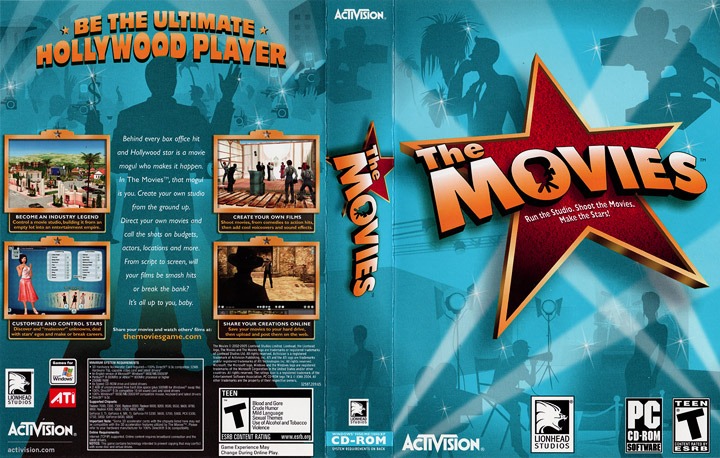
📅 Game released: 2005
Use this updated 2026 The Movies PC guide to check official download availability, understand the Stunts & Effects expansion and historical editions, review original system requirements, and find Windows 10/11 compatibility, installation, modding, and troubleshooting guidance for an owned copy of Lionhead’s Hollywood studio simulator.
 By Editor Zero — independently researched, edited, and maintained.
Last updated: 11 October 2026
Last reviewed: 11 October 2026
Table of Contents
- Quick Summary
- Quick Facts
- Official PC Stores, Download & Installation
- The Movies Review
- Pros & Cons
- PC System Requirements
- Frequently Asked Questions
- Similar Games
The Movies Quick Summary
✔ Hollywood business-management simulator from Lionhead Studios in which players build a film studio, hire actors and directors, manage production, compete for awards, and guide their company through changing eras of cinema.
✔ Combines traditional tycoon gameplay with an interactive moviemaking system featuring scripted scenes, actors, sets, costumes, editing, soundtrack selection, and films that can be watched or exported.
✔ Similar to Black & White through its Lionhead Studios design philosophy, indirect character management, evolving simulated environments, and freedom to experiment with systems rather than follow a linear campaign.
✔ The Stunts & Effects expansion adds stunt performers, new filming equipment, special effects, additional sets, and a more flexible camera system for creating elaborate productions.
✔ The original PC release is no longer offered for new purchases through its former Steam listing, and no replacement official digital storefront has been verified. Existing owners may have retail installation media or historical Steam-library access.
✔ Original retail DRM and older rendering technology complicate Windows 10/11 use. The game has a documented community of modders and technical contributors, but modern compatibility requires more care than the original hardware specifications suggest.
The Movies Quick Facts
Official PC Store Status, Download & Installation
👇 Use the notes below to understand The Movies’ official PC availability, historical ownership options, expansion requirements, and Windows compatibility before attempting to install or run a copy you already own.
- Official PC availability: The Movies was originally distributed for Windows PC through physical retail editions and subsequently through Steam. Its historical Steam release is no longer available for new purchases, and no current official purchase listing has been verified on GOG, Epic Games Store, Microsoft Store, or another mainstream PC storefront. An ordinary official digital purchase is therefore not available through the verified options.
- Existing Steam ownership: The original Steam application is associated with app ID 7900. Players who previously purchased and retained the game in their Steam library may be able to download it again through their account. Check the Steam Library directly; historical ownership does not mean the game can be purchased by a new account.
- Retail ownership: Original boxed releases contain installation media and historically required a product key supplied with the package. If purchasing a genuine secondhand copy, verify that the discs and original key are present, while understanding that a complete package does not guarantee compatibility with modern Windows.
- Premiere Edition: The original special retail edition included additional star costumes and bonus materials, including soundtrack content, concept artwork, moviemaking guidance, and promotional videos. It is not a replacement for the Stunts & Effects expansion and should not be confused with a complete-content edition.
- Stunts & Effects: The Windows expansion requires an existing installation of The Movies. It introduces specialist stunt performers, stunt-training facilities, additional sets, costumes, visual effects, weather effects, enhanced camera positioning, and improved filmmaking tools. The expansion’s original installer also incorporates the game’s earlier official update.
- Superstar Edition: This later Mac package bundles the base game and Stunts & Effects, along with bonus soundtrack content. It is a historical Mac release, not an officially modernized Windows edition. Its availability, installation requirements, and compatibility should not be assumed to match those of the original Windows package.
- Legacy copy protection: Original Windows retail editions used SafeDisc protection. Windows 10 and Windows 11 do not support the older SafeDisc driver used by these releases, so the game may fail to launch even when its files install correctly. Windows compatibility mode alone does not resolve that fundamental protection issue. Avoid disabling Windows security protections or installing obsolete, vulnerable DRM drivers as a casual workaround.
- Basic installation: For a legitimately owned retail copy, use the original installation media and follow its setup instructions, including the supplied product-key procedure when required. The original installer was designed for Windows 98 SE, ME, 2000, and XP, and may prompt for DirectX 9.0c and Windows Media components. These historical components and installers should not be assumed to work automatically on a contemporary system.
- Offline operation: Studio management and local movie creation are fundamentally single-player activities. The original game did not require an internet connection for ordinary offline studio play, although historical activation or installation requirements depend on the specific release. The former official online film-sharing and related web services should not be treated as available.
- Modern compatibility: PCGamingWiki documents several separate technical problems, including original DRM incompatibility, certain new-game crashes, legacy audio issues, and limitations affecting widescreen presentation. Community fixes may address particular rendering or memory problems, but they do not constitute an officially supported modern Windows version and should not be confused with authorized DRM solutions.
- Mods and save protection: Community-created sets, costumes, props, textures, and interface or rendering modifications can expand filmmaking options. These additions are unofficial and may depend on the base game, expansion, language edition, and existing installed modifications. Back up your personal saves and game files before changing the installation, and inspect community software carefully before running it.
Official documentation for existing owners: Although no suitable official PC purchase button is available, Valve continues to host historical documentation associated with the game’s Steam applications. These manuals explain the original installation, product-key, gameplay, and expansion procedures.
 Read the Original The Movies Manual (Steam-hosted PDF)
Read the Official Stunts & Effects Expansion Manual (Steam-hosted PDF)

The Movies Review
A charming Hollywood simulator whose creative ambitions collide with relentless studio micromanagement.
The Movies asks for two very different kinds of imagination. As a studio boss, you must keep film crews working, famous actors content, and rival companies out of the awards spotlight. As a filmmaker, you can assemble scenes into your own shorts, adjust performances, and decide whether a romance needs a tender ending or an absurd brawl. Lionhead Studios makes both jobs inviting, then steadily reveals how difficult it is to do them at the same time.
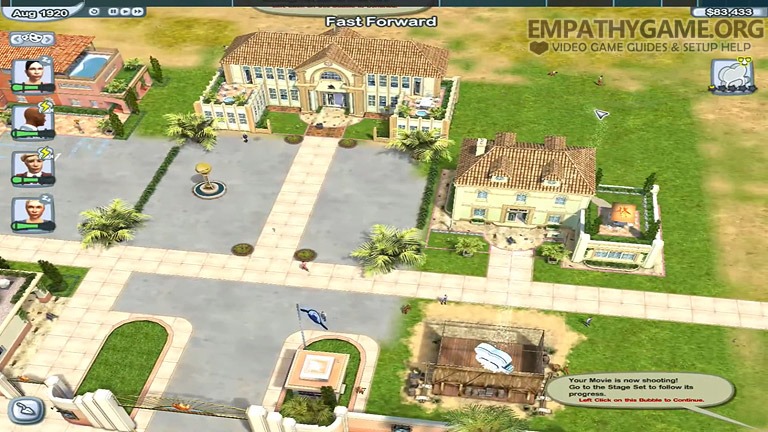
Watching an unknown recruit star in a production filmed on your own lot gives tycoon statistics a tangible result. Yet success often demands more attention to celebrity moods, staff queues, landscaping, and budgets than to storytelling. This tension defines an approachable creative tool inside an amusing but exhausting management simulation. It best suits players who appreciate both logistical puzzles and artistic experimentation.
A Working Studio Is More Than a Collection of Sets
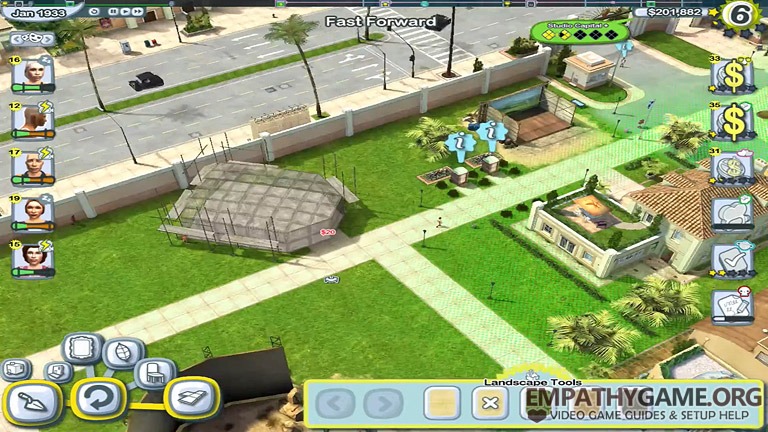
The campaign opens in the 1920s with an empty studio lot and little more than the ambition to become Hollywood’s leading name. You hire builders, scriptwriters, stars, directors, and crews while constructing the facilities they need. A script moves from the Script Office to casting, enters production when its performers and crew are ready, and eventually reaches the Production Office for release. Every picture depends on a working production chain.
Keeping several films in motion is where the business becomes interesting. One director may be free while the actors assigned to the next script are recovering from their previous shoot. Two productions can compete for a set, and a larger script demands more extras and experienced crew members than a modest early picture. More staff cannot fix an unhappy cast. The strongest planning involves staggering productions, so one team rehearses or rests while another is shooting.
The lot itself adds a second layer of management. Buildings need sensible paths and maintenance, janitors must keep the grounds presentable, and greenery and decorative objects contribute to studio prestige. An impressive backlot performs badly without upkeep. As the decades pass, protecting that rating means regularly revisiting the physical studio rather than treating landscaping as a one-off cosmetic task. Tending ornaments during a major production hardly feels glamorous.
Stars Are Characters, Employees, and Ongoing Problems
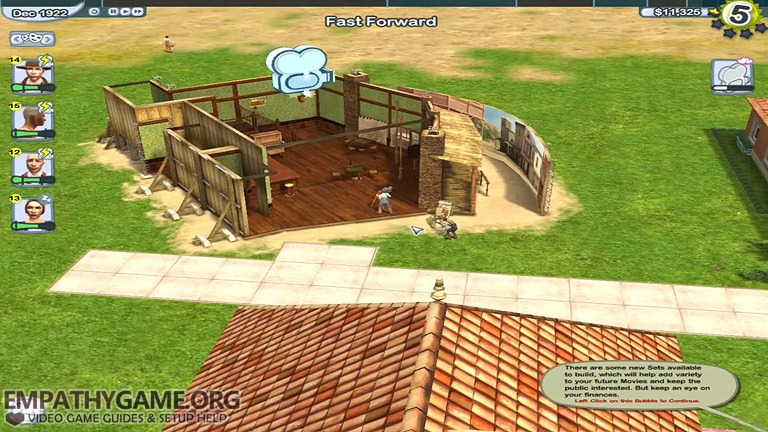
Actors and directors are more than interchangeable skill ratings. Their genre experience matters, as do their relationships, stress, appearance, salaries, and demands for appropriate trailers. Overwork can damage a performance; too much idle time can also cause problems. Fame brings bigger demands, while improving one performer’s trailer can make a colleague jealous. Hollywood ego becomes an actual production cost.
There are satisfying ways to plan around those demands. An actor with spare time can rehearse on a suitable set rather than wait for another script: putting a horror specialist on a cellar set, for instance, develops the experience relevant to future horror productions. Directors can train too, turning idle sets into useful career-development spaces.
Supporting staff matter as well. Extras gain experience, and a capable extra can eventually be promoted into an acting or directing role when a larger production needs more leads or an established star retires. Keeping a reserve of developing talent is therefore useful, especially once elaborate scripts strain the available cast. Extras need not remain permanent scenery.
Unfortunately, the simulation demands constant intervention. Moving a star between rehearsal, filming, leisure, and the facilities needed to repair their mood becomes repetitive when several careers overlap. Information bubbles explain what is wrong, but acknowledging a complaint and physically resolving it are separate chores. A celebrity complaining about a trailer becomes less funny after repeatedly interrupting a shoot.
The Advanced Movie Maker Is the Real Creative Attraction
Ordinary films can be commissioned and produced with little directorial input. The Custom Script Office and Advanced Movie Maker reveal the more unusual game hiding underneath. Instead of accepting a generated sequence, you choose sets and scenes, assign performers to individual roles, alter costumes and hand-held props, and build a film from a catalogue of recognizable cinematic situations. It directs predefined performances rather than freely animated actors.
Crucially, choosing a scene does not always mean accepting one fixed outcome. Sliders can change the intensity of a fight or the emotional direction of an encounter; in some confrontations, they can even change which character wins. Casting changes the feel of identical actions. A dinner scene can become flirtatious, awkward, or comically disastrous depending on the available variation and how it is followed. These choices give prefabricated scenes personality.
Post Production extends that authorship. Scenes can be rearranged or trimmed, music and sound effects can shape the mood, and recorded voices or subtitles can replace the characters’ nonsense dialogue. The results are often funniest when two incompatible-looking scenes somehow form a coherent joke. Continuity, shot order, and music can also support a coherent short story. Few management games leave behind an artifact as personal as a film that can be watched outside the ordinary business screens.
The trade-off is clear once a specific idea calls for an action the library does not contain. Characters cannot simply walk wherever a director imagines, carry every object into every scene, or perform entirely invented gestures. Matching props and physical positions across cuts can become an exercise in compromise. Accessible tools still leave the scene library defining what is possible.
Hollywood Success Is Governed by Numbers, Not Storytelling
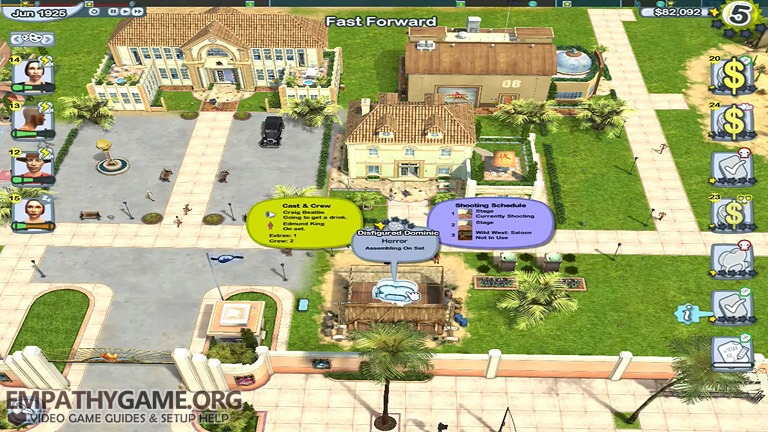
The commercial side asks a different question from the creative editor: not whether a sequence is touching or funny, but whether the production satisfies a measurable set of requirements. Script quality, genre fit, star experience, relationships, set condition, and the people working behind the scenes influence the result. Expensive stars cannot compensate for every weakness. Success demands more than fame.
Publicity introduces a useful release strategy. Sending a script through the Publicity Office can build awareness before filming is complete, while the marketing budget selected at release should match the picture’s prospects. A promising production can justify a stronger promotional push; spending heavily to promote a weak one is not automatically wise. Release feedback offers direction for the next project.
But the game cannot meaningfully judge whether an improvised love story has a clever twist or whether a deliberately awkward cut lands as comedy. Its ratings understand production qualities and certain scene choices, not the emotional intelligence behind them. Spending an hour perfecting a homemade film may feel deeply worthwhile as a creative exercise while producing little extra advantage in the studio rankings. The business game and the filmmaking sandbox share the same sets and performers, yet reward different things. That separation is both the game’s defining curiosity and its largest missed opportunity.
Cinema History Shapes the Studio’s Personality
Moving through the decades changes more than the architecture and costumes. Silent pictures give way to sound and color, new techniques become available, and the audience’s appetite for action, comedy, horror, romance, or science fiction rises and falls. Historical events appear along the timeline and influence genre popularity. Wars, economic upheaval, and the excitement surrounding space exploration can therefore become factors in deciding what kind of picture to commission next.
This is one of the game’s smartest connections between theme and mechanics. A studio that keeps producing the same successful genre may discover that its audience has shifted. Following a trend can make financial sense, while developing performers with complementary genre experience gives the business a way to adapt. The simplified history gives changing tastes a credible context.
The presentation is affectionate rather than realistic. Exaggerated animations, gibberish performances, bustling sets, period-flavored announcements, and award ceremonies make the backlot feel like a comic miniature of the industry. There is no conventional protagonist. Instead, the story emerges from an unknown performer becoming a star, falling out with colleagues, winning recognition, and eventually making room for a new generation.
Research Makes Progress Exciting, Then Weakens the Competition
Research gives each decade a forward pull. Advancing filmmaking technology and gaining access to additional sets, costumes, and facilities make the studio feel increasingly capable. Movie Mogul ranks provide specific goals beyond profit, unlocking special rewards when their requirements are met. The five-yearly Lionhead Motion Picture Awards grant temporary advantages, making prestige more valuable than money alone.
The drawback is an uneven difficulty curve. In the earlier decades, limited staff, basic sets, and modest technology force meaningful choices about where money and time go. Sustained research investment can then move a studio well ahead of rival companies, reducing the pressure to improve once a successful production routine is established. More technology produces better films, but it can also remove the competitive tension that made acquiring those advantages satisfying.
Progression becomes more compelling than the competition itself. A late-game studio may be immensely productive and full of expensive facilities, yet its greatest challenges often come from keeping that machinery staffed, attractive, and free of avoidable delays rather than outsmarting the competition.
Accessible Controls Become Less Comfortable at Scale
Drag-and-drop interaction is immediately understandable. Picking up a script, employee, or performer and moving them to a recognizable building makes complex production tasks feel physical. The camera can sweep across the lot as an actor walks toward a set and workers gather to film, so management rarely feels like manipulating only spreadsheets.
That simplicity wears thin as repetitive actions accumulate. The interface includes shortcuts, but not always the conventions a PC strategy player expects: P pauses time, while the space bar recenters the camera on the studio entrance. Limited control customization and repeated dragging make it harder to settle into the quick, keyboard-driven rhythm of newer management games. The cartoonish graphics have aged more gracefully than the workflow, which frequently asks for several interactions to accomplish an uncomplicated decision.
Sandbox and Stunts & Effects Reward a Different Kind of Replay
New Game is suited to players who want the entire journey from fledgling studio to established Hollywood institution. Sandbox is much better when the objective is a finished movie rather than a higher ranking. Its options can supply extra money, instant construction, calmer celebrities, and faster production, allowing creative experiments without as much administrative interference. Some options require campaign progress, so Sandbox is not unrestricted from the outset.
StarMaker adds personal investment by letting filmmakers create recognizable custom performers. The Stunts & Effects expansion is more substantial for directing: stunt performers, training facilities, dramatic effects, and additional scenes broaden what a production can show. FreeCam allows more deliberate camera positions and movement, so a scene can be staged with greater visual intention. Stunts also bring injuries, physical condition, and training into studio management. The expansion strengthens the filmmaking half considerably, although its new personnel demands can intensify the very micromanagement that some players hope to escape.
This division determines replay value. A second tycoon campaign faces much the same long-term efficiency problem once research and finances are under control. Creating another short film, trying a new genre, or experimenting with the expanded camera and scene library can be far more compelling because the goal comes from the player’s imagination rather than a ranking table.
Final Verdict
The Movies has a rare talent for making the business of art feel both ridiculous and absorbing. Actors develop careers, sets become familiar workplaces, genre trends complicate production plans, and successful films produce something more memorable than a profit figure. The best moments force difficult choices between developing talent and meeting production demands.
Yet the more successful the operation becomes, the more the player is asked to maintain it. Landscaping, celebrity grievances, awkward controls, and staff supervision can crowd out the filmmaking that makes the game distinctive. The research system also undermines some of the later economic challenge, while the film editor’s impressive flexibility remains bounded by predefined animations. The commercial simulation cannot truly appreciate storytelling.
For management fans who enjoy nurturing careers and solving production bottlenecks, those frustrations may be part of the Hollywood comedy. For creative players, Sandbox and Stunts & Effects provide a more direct route to the game’s most enduring idea: assembling a film and making it your own. Anyone looking for either a frictionless tycoon or unrestricted film animation will find compromises. As a meeting point between those two ambitions, however, The Movies remains unusually imaginative—and difficult to replace.
The Movies Pros & Cons
The Movies PC System Requirements
The specifications below describe the original 2005 Windows release, not a modern remaster. They reflect hardware and operating systems contemporary with its initial publication. Meeting them on a modern computer does not guarantee that the game will install or run successfully on Windows 10 or Windows 11.
ORIGINAL WINDOWS PC REQUIREMENTS:
MINIMUM:
OS: Windows 98 SE, Windows ME, Windows 2000, or Windows XP
CPU: Intel Pentium III 800 MHz or AMD Athlon 800 MHz processor, or higher
RAM: 256 MB
GPU: DirectX 9.0c-compatible graphics card with at least 32 MB video memory and hardware Transform & Lighting support
GPU Examples: NVIDIA GeForce 3 series or ATI Radeon 7000 series and supported later models
DirectX: DirectX 9.0c
Storage: 2.4 GB of available disk space, plus approximately 500 MB for the original Windows swap-file requirement
Optical Drive: 8x CD-ROM drive or appropriate DVD-ROM drive, depending on the retail edition
Sound Card: DirectX 9.0c-compatible 16-bit sound card
Display: 800 × 600 resolution
Controls: Keyboard and mouse
Additional Notes: The original installation references Windows Media Player 9 codecs for its movie-related functionality.
RECOMMENDED / HISTORICAL GUIDANCE:
RAM: 512 MB (historical recommended specification documented by PCGamingWiki)
CPU / GPU: A complete independently verified manufacturer-recommended tier was not available from the consulted original manuals and documentation. Higher-performance hardware than the minimum was advisable for larger studios and more complex productions, but no unsupported CPU or graphics target is presented here as official.
Additional PC Performance and Setup Notes
- Windows 10/11: The principal barrier is legacy software compatibility rather than insufficient modern CPU, RAM, or GPU performance. The retail SafeDisc driver is unsupported, and graphical, audio, or memory-related problems may remain even where the game can be launched.
- Widescreen displays: The game’s original presentation predates modern widescreen and ultrawide expectations. PCGamingWiki documents manual resolution configuration and community widescreen corrections, including fixes intended to address camera field of view and interface positioning.
- Memory-related crashes: Some installations can encounter crashes when starting a new game or during extended use. PCGamingWiki documents a Large Address Aware approach for specific memory-related issues; it is an unofficial technical modification, not an official Lionhead compatibility update.
- Legacy audio: Older RenderWare titles may encounter sound-system compatibility issues on newer Windows releases. Modern audio wrappers or other community-developed workarounds can sometimes help, but their suitability depends on the actual installed version and the specific error.
- Save-game backups: PCGamingWiki documents the traditional Windows save directory as
%USERPROFILE%\Documents\The Movies\Saved Games\. Verify the location on your own installation, particularly if using a historical Steam release, a customized Documents folder, or Windows compatibility settings. Preserve backups before changing versions or installing mods. - Mod compatibility: Fan-made sets, props, costumes, and technical improvements can depend on particular game files or expansion features. Test modifications individually and retain original copies of files they replace.
For game-specific troubleshooting and documented community corrections, consult the PCGamingWiki technical page for The Movies. Treat unofficial modifications as community-maintained solutions and do not assume every reported fix works with every installation.
Video Trailer
Frequently Asked Questions
Is The Movies worth playing in 2026?
Yes. The Movies remains an unusually creative studio-management game because it lets you produce, direct, edit, and watch films made by characters whose careers you manage. Its dated interface, demanding celebrity management, and modern Windows compatibility problems are significant drawbacks, but players who enjoy tycoon games and experimenting with filmmaking tools will find plenty of distinctive ideas.
Can you still buy The Movies on Steam or GOG?
The original game was sold on Steam but is no longer available for new purchases, and GOG does not offer a verified commercial release. Previous Steam owners may retain access through their libraries, while genuine secondhand retail copies are another ownership possibility. GOG’s Dreamlist also provides a place for players to express interest in an official rerelease.
Does The Movies work on Windows 10 and Windows 11?
Compatibility is inconsistent. Original retail editions used SafeDisc copy protection, which modern Windows versions do not support, and even installations that launch can experience graphics, audio, or memory-related problems. PCGamingWiki documents version-dependent compatibility issues, but there is no officially supported modern Windows rerelease.
What is the difference between New Game and Sandbox mode in The Movies?
New Game starts your Hollywood studio in 1920 and challenges you to compete against rival companies while developing technology, talent, and facilities. Sandbox lets you customize the starting decade, budget, construction speed, celebrity behavior, and filmmaking process, making it better suited to experimentation without normal awards competition.
Why can’t I select every decade in The Movies Sandbox mode?
Sandbox initially restricts the decades you can select based on your progress in New Game mode. The original rules allow starting decades up to 30 years beyond the period you have reached in the main game. Progressing through the studio-management campaign gradually makes more historical settings available.
How do you make your first movie in The Movies?
Build a Stage School to recruit actors and a director, establish a Script Office, and hire a scriptwriter. Once the script is ready, move it to the Casting Office, assign the required performers, and make sure a film crew and the necessary set are available. After shooting, take the completed film to the Production Office to release it.
Can you write your own movies instead of using generated scripts?
Yes. The Custom Script Office unlocks the Advanced Movie Maker, where you can select sets, arrange scenes, assign actors, and customize costumes, props, lighting, and other details. You can follow a genre-based story template or use Freeform to create your own sequence, although individual scenes still rely on the game’s predefined animations.
Does the popularity of movie genres change in The Movies?
Yes. Action, comedy, horror, romance, and science fiction rise and fall in popularity as the historical timeline advances. Watch the genre information on the timeline before planning productions, since matching audience trends can improve a film’s commercial prospects. A strong movie can still succeed outside the most fashionable genre.
How do you make higher-rated movies in The Movies?
Improve script quality, maintain your filming sets, use experienced actors and crews, and cast performers who suit the film’s genre. Actor mood, relationships, production variety, and the quality of the finished production also matter. Spending more on a movie does not automatically produce better reviews if the cast or studio is poorly managed.
How do you improve an actor’s genre experience in The Movies?
Assign the actor to films in the genre you want them to learn or have them rehearse on a suitable studio set between productions. Experience improves through repeated practice and performances, making the actor more effective in that genre. Rehearsal is particularly useful when a star has free time but you do not want to produce another movie immediately.
How do you keep actors and directors happy in The Movies?
Balance their workload with opportunities to rest, maintain suitable salaries and trailers, and provide entertainment, social interaction, and other benefits as their fame increases. Check each star’s information bubbles to identify the actual cause of dissatisfaction. Famous stars can become jealous of better-paid colleagues or more luxurious trailers, so generous treatment of one performer may create problems elsewhere.
Do relationships between actors affect movie quality?
Yes. Actors and directors who get along can produce better on-screen performances, and the director’s relationship with the cast is particularly important. Let stars socialize together regularly, then use facilities such as restaurants or bars as their relationships develop. Forcing incompatible or unhappy stars into frequent interactions is not necessarily productive.
Why do actors develop addictions in The Movies?
Overworked or unhappy stars can turn to drinking or excessive eating as their stress increases, affecting their appearance, mood, and performances. Reducing excessive workloads and addressing their needs helps prevent these problems. Once a suitable rehabilitation facility becomes available, affected stars can receive treatment.
Can actors retire or leave your studio permanently?
Yes. Actors and directors age throughout their careers and eventually retire, meaning experienced performers cannot remain available indefinitely. Seriously unhappy stars may also abandon your company before retirement. Recruiting and developing younger talent helps prevent a sudden shortage of experienced performers.
How do you improve your studio ranking in The Movies?
Studio ranking considers your finances, released movie quality, celebrity ratings, and the prestige of your studio lot. Maintain buildings, keep the grounds clean, connect facilities with sensible paths, and improve landscaping alongside your film production. You can inspect rankings and their contributing factors through the Charts screen.
What should you research first in The Movies?
Prioritize research according to what is limiting your studio. Movie-Making research develops technologies such as sound, color, and CGI; Mainstream and Cult Packs unlock additional sets and costumes; and Stars & Studio research improves facilities and celebrity care. A balanced strategy keeps filmmaking technology advancing without neglecting the staff and infrastructure needed to use it.
How do the Lionhead Motion Picture Awards work?
Award ceremonies take place every five in-game years and recognize achievements involving films, stars, and studio management. Winning an award activates a bonus that lasts until the next ceremony, when you must win it again to retain the benefit. Advancing through the separate Movie Mogul ranks can also unlock special facilities and sets for use in New Game and Sandbox.
Can you create custom actors in The Movies?
Yes. The included StarMaker tool allows you to design characters with customized facial features, hairstyles, physiques, personalities, and skills. After saving a character, you can recruit that creation through the Import Star room at the Stage School. This provides more control over your cast than relying entirely on randomly generated applicants.
When do stunt performers become available in Stunts & Effects?
Stunt performers and their related facilities become available from 1960 in the normal New Game progression. The expansion also includes a Quick Start option that begins in 1960 with access to its new stunt-related content. Quick Start is convenient for exploring the expansion, although its Gold and Platinum Lifetime Achievements are unavailable in that mode.
Should actors perform their own stunts or use stunt doubles?
Both approaches have advantages. A star performing a successful stunt can earn a stronger stunt rating, but injuries can reduce their condition, mood, and future performance. Trained stunt doubles reduce that risk, although their physical resemblance to the lead actor affects the film’s stunt rating.
How does FreeCam work in The Movies: Stunts & Effects?
FreeCam allows you to position the camera independently within compatible scenes instead of relying only on preset shots. You can define starting and ending camera positions, adjust their field of view, and create camera movement between those positions. It offers substantially more shot composition freedom, although the underlying character animations remain predefined.
Can you add your own voices, music, and subtitles to movies?
Yes. The Post Production tools support recorded dialogue, imported audio, music, sound effects, and subtitles. You can assign dialogue to particular actors for automatic lip synchronization and reposition audio along the editing timeline. These tools make it possible to create narrated films or character conversations without relying on the game’s original vocal sounds.
Can you export movies from The Movies as video files?
Yes. The original Post Production system can render completed movies to Windows Media Video (.wmv) files with several quality settings. Exported films can be stored locally and edited or converted using other compatible video software. Successful rendering on a modern computer may depend on whether the game’s legacy Windows Media components work correctly.
Can you still upload films to the original The Movies website?
No. The original official movie-sharing and online community infrastructure is no longer operating as it did when the game launched. Local film creation, editing, and exporting remain separate functions, so players with a working installation can still create videos and share the resulting files through other suitable platforms.
Does The Movies have multiplayer, co-op, or LAN play?
No. The Movies is fundamentally a single-player studio-management and filmmaking game without a playable cooperative campaign, split-screen mode, or LAN studio management. Its historical internet features involved sharing and viewing user-created films rather than managing a movie studio together in real time.
Can original The Movies save files be used with Stunts & Effects?
Yes. The Stunts & Effects expansion supports loading saved games from the original release, letting players continue an existing studio with the expansion installed. However, saves created or subsequently saved through Stunts & Effects cannot be loaded back into the unexpanded original game. Back up your original saves before converting an established studio.
Still have questions? Check the The Movies Steam Discussions or the TheMovies3D community forums for help with filmmaking, studio management, compatibility, and community modifications.
Sources & References
Key factual and technical information in this guide was checked against relevant official and established sources, including:
- Activision — Original The Movies Retail Announcement — confirms the November 2005 launch, developer, publisher, original product positioning, and Premiere Edition bonus content.
- The Movies — Original Official Game Manual — original installation instructions, product-key requirements, studio management systems, Sandbox options, filmmaking features, and historical support information.
- The Movies: Stunts & Effects — Official Expansion Manual — verifies expansion installation requirements and the additions to stunt production, filmmaking, camera controls, and effects.
- PCGamingWiki — The Movies — documents the RenderWare engine, historical release information, Steam availability, original DRM, technical limitations, save locations, graphics configuration, and modern-PC compatibility issues.
- SteamDB — The Movies Historical Steam Application — verifies the original Steam application identity, historical release metadata, developer and publisher information, and the game’s retained Steam record.
- TheMovies3D — Historical System Requirements — preserves period-era Windows minimum specifications and supported graphics hardware information.
- Metacritic — The Movies — provides the original Windows release’s aggregated critical reception and identifiable contemporary reviews.
Similar Games Like The Movies
- Black & White
- Medieval Dynasty
- The Lord of the Rings: The Battle for Middle-earth II
- The Lord of the Rings: The Battle for Middle-earth
- Mount & Blade II: Bannerlord
- GTA 5




Found something worth playing through DecideGame?
DecideGame.com is an independent gaming project run by Editor Zero. If this guide helped you discover a game, solve a problem, or find useful information, you can support DecideGame.com and help keep new and updated game guides coming.
DecideGame — PC Game Guides, Reviews & Setup Help