
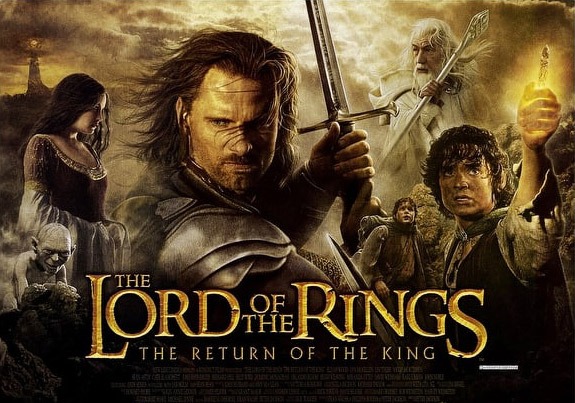
📅 Game released: 2003
This updated 2026 PC guide for The Lord of the Rings: The Return of the King checks official download status, retail-disc ownership, system requirements, Windows compatibility, local co-op, controller support, and practical setup for the original 2003 release.
 By Editor Zero — independently researched, edited, and maintained.
Last updated: 3 October 2026
Last reviewed: 3 October 2026
Table of Contents
- Quick Summary
- Quick Facts
- Official PC Stores, Download & Installation
- The Lord of the Rings: The Return of the King Review
- Pros & Cons
- PC System Requirements
- Frequently Asked Questions
- Similar Games
The Lord of the Rings: The Return of the King Quick Summary
✔ Cinematic third-person action game based on Peter Jackson’s film trilogy, sending Gandalf, Aragorn, Legolas, Gimli, Frodo, Sam, and unlockable heroes through the final battles against Sauron’s forces
✔ Combat centers on cutting through large enemy groups, building combos, earning mission ratings, improving characters, using ranged attacks, and interacting with battlefield objects across three story paths
✔ Similar to The Lord of the Rings: Conquest through its Middle-earth setting, playable heroes, large battles, familiar film locations, and direct action-focused interpretation of the War of the Ring
✔ A native Windows PC version exists, but no current official digital PC storefront could be verified; the original release survives primarily as physical CD-ROM and DVD-ROM editions
✔ The Windows version supports two-player local co-op on one PC, but it does not include the PlayStation 2 version’s online co-op functionality
✔ Modern-PC setup requires extra attention because the retail release uses legacy SafeDisc protection and was designed for Windows 98, 2000, Me, and XP-era hardware
The Lord of the Rings: The Return of the King Quick Facts
Official PC Availability, Download & Installation
👇 Check the PC availability and installation notes below before buying an original retail copy or attempting to install a Windows disc you already own.
- Digital availability: No current official digital Windows storefront for The Lord of the Rings: The Return of the King could be verified. PCGamingWiki lists the PC edition as a retail release, while GOG currently places the game on its Dreamlist rather than in its purchasable catalogue.
- Original Windows editions: The PC version was sold on both CD-ROM and DVD-ROM. The DVD-ROM edition contains additional bonus material, but the underlying game remains the same 2003 Windows release.
- Physical ownership: Original PC copies may still appear through second-hand marketplaces and used-game sellers. These are secondary-market purchases rather than a new official EA digital sale, so check the exact region, disc condition, included media, manual, and any original product-key requirements before buying.
- Installation media: Install the Windows version from legitimate retail media you own. This guide does not provide or link to third-party game images, unofficial full-game archives, repacks, cracks, or other copyrighted game-file sources.
- SafeDisc DRM: The Windows retail release uses SafeDisc 3. Windows 10 and Windows 11 do not support the legacy SafeDisc driver used by this version, while Vista through Windows 8.1 can also be affected when Microsoft’s KB3086255 security update is installed.
- Modern Windows warning: Successfully installing the original disc does not guarantee that the protected executable will launch on a modern Windows installation. Community compatibility documentation can help explain display and input problems, but this page does not provide DRM-bypass executables or instructions for weakening Windows security.
- Local co-op: Windows supports two-player cooperative play on one PC. A controller is required for local multiplayer, making a gamepad plus keyboard/mouse the most practical two-player arrangement.
- Online multiplayer: The native PC edition does not include online co-op. The original PlayStation 2 version had online functionality, but that feature should not be confused with the Windows release.
- Controller behavior: The PC version supports controllers, although its original input implementation has limitations including unavailable right-stick and D-pad functions. Community controller configurations and fixes may improve modern-gamepad usability but are unofficial.
- Community fixes: PCGamingWiki documents unofficial options for higher resolutions, widescreen aspect ratios, windowed or borderless display, frame-rate control, field of view, and other quality-of-life improvements. Back up game files before modifying an installation and obtain community tools only from sources you trust.

The Lord of the Rings: The Return of the King Review
A compact Middle-earth brawler where crowd control, scoring, and spectacle give simple combat surprising bite.
The Lord of the Rings: The Return of the King is at its best when the screen looks almost too busy to control. Orcs press from several directions, archers fire from the edges, siege machinery demands attention, and the safest route is often straight through the crowd. Rather than rebuild Middle-earth as an explorable world, EA Redwood Shores compresses the trilogy’s final stretch into short, aggressive action stages where positioning, combo efficiency, upgrades, and battlefield objectives matter more than wandering.
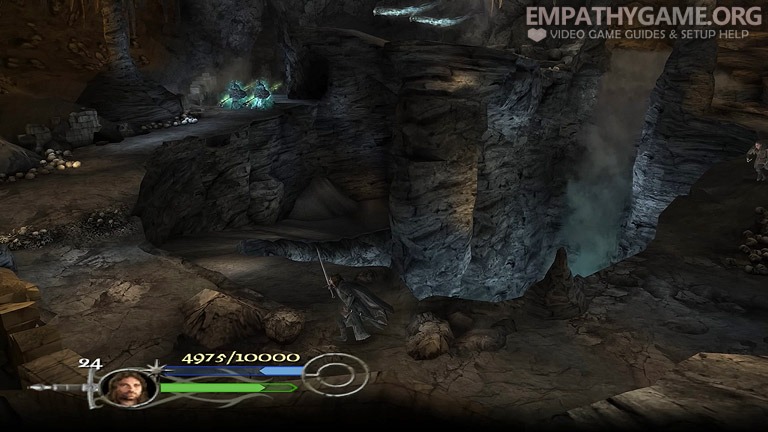
The design is deliberately accessible, but it is not quite the button-masher it first appears to be. Speed attacks, fierce strikes, parries, ranged weapons, killing moves, special abilities, and unlockable combinations all feed a performance system that rewards clean, varied kills. Repetition and a rigid camera keep the game rooted in its era, yet the strongest missions still turn familiar film scenes into readable arcade challenges rather than passive recreations.
Crowds Turn Simple Combat Into a Scoring Puzzle
Fast attacks handle exposed enemies, fierce strikes break shields, parries create openings, ranged attacks thin groups, and killing moves finish foes already on the ground. What gives those basics more structure is the rating meter. Efficient kills raise performance through Fair, Good, Excellent, and eventually Perfect. Perfect Mode briefly makes attacks more destructive and increases the experience value of kills, so aggression is tied directly to progression rather than existing only for spectacle.
The more interesting detail is that longer combinations do not have to stay locked onto one enemy. A sequence can be steered through a crowd, letting one attack string begin on one Orc and finish on another. That changes moves such as Orc Hewer from flashy single-target sequences into crowd-management tools. Gandalf and Legolas benefit especially from broad horizontal attacks that can catch several enemies when bodies bunch together. Starting a useful sequence during Perfect Mode lets good positioning produce several high-value kills instead of one elaborate overkill.
Character identity becomes clearer as upgrades accumulate. Gandalf’s high-level light projectile can pass through multiple enemies and set survivors aflame, making enemy alignment important in dense battles such as the Black Gate or Palantir challenges. Legolas interacts with the scoring system differently: his speed, ranged pressure, and upgrades that help sustain Perfect Mode make him particularly effective when chasing high mission ratings. The roster is less interesting when reduced to damage and animation speed; it becomes more convincing when one hero can control a packed lane while another is built around maintaining scoring momentum.
None of this completely solves repetition. Many encounters still ask the player to clear another group before a gate opens or an objective advances, and several dependable early combinations remain effective for most of the campaign. The wider move list therefore creates more expression than necessity. Players who enjoy improving ratings have reasons to master it; players interested only in finishing the story can lean on a much smaller toolkit.
The Best Missions Let the Battlefield Fight Back
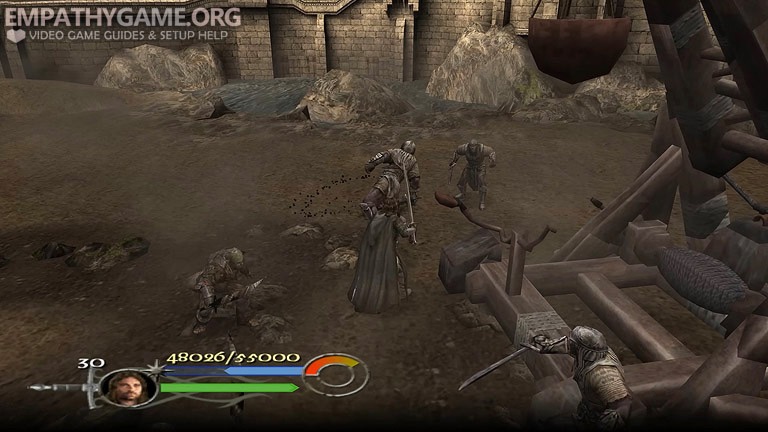
The three campaign routes provide variety mainly through level structure. Gandalf’s Path of the Wizard favors large defensive battles, Aragorn, Legolas, and Gimli take on the broader battlefield set pieces of the Path of the King, and Sam and Frodo move through tighter spaces on the Path of the Hobbits. It is a smart way to preserve the film’s parallel storylines while giving each branch a different scale.
Minas Tirith shows the game at its most effective. Knocking down siege ladders while watching an overrun meter forces attention away from whichever enemy is directly in front of Gandalf. Pelennor Fields similarly works because movement between threats is part of the challenge. Bosses such as the King of the Dead and Shelob then provide punctuation between crowd-heavy stages, even if their mechanics remain comparatively straightforward.
Sam’s route is more interesting than its linear shape suggests because environmental hazards can replace direct melee. Cirith Ungol rewards noticing traps and interactive objects that can eliminate groups more efficiently than standing in the center of every fight. Elsewhere, catapults, spears, collapsible objects, siege equipment, and other battlefield interactions keep the best stages from feeling like sealed combat rooms. They are not deep systemic tools, but they make the scenery participate in the action.
The weaker missions are the ones that stop creating those secondary pressures. When the only meaningful task is to empty another section of enemies, familiar attack patterns and limited enemy behavior become obvious. The short campaign helps, but not every battle earns its scale.
Progression Rewards Good Play but Can Punish a Weak First Run
Experience earned after missions buys new combos, stronger ranged attacks, health improvements, special abilities, and other upgrades. Better combat ratings increase the reward, giving the arcade scoring system a practical purpose: a cleaner mission can make the next one easier. Fellowship upgrades add a useful shared layer because certain abilities can be purchased across the roster, although each hero still needs the appropriate level before benefiting from them.
The less elegant part appears before the campaign is finished. Replay freedom is more restrictive during the first run than it becomes afterward, so an underleveled hero cannot always be sent back through cleared content with the same freedom available in the postgame. Other eligible characters may revisit some missions, and co-op can create additional leveling opportunities, but weak early ratings or poor spending decisions can still make later stages harsher than the simple upgrade screen suggests.
That limitation also explains why Perfect Mode, Bane-style counters, efficient crowd combos, and character-specific strengths matter beyond completionist scoring. They accelerate the growth needed for tougher late-game encounters. The progression model is modest, but it is tightly connected to how well the combat is performed.
The Camera Is Both a Director and an Obstacle
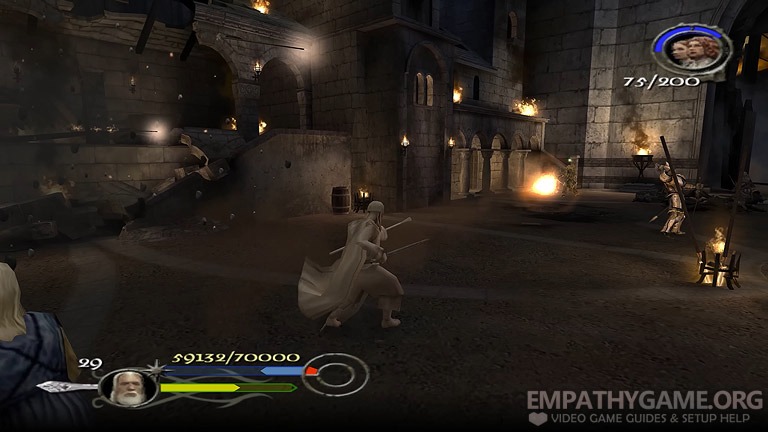
The fixed and automatically moving camera often succeeds aesthetically. It frames Minas Tirith, the Paths of the Dead, and large battlefields like compact film sets, preserving a cinematic sense of scale without asking the player to manage the viewpoint constantly. In straightforward encounters, that keeps attention on the action and lets the scenery carry more drama than the relatively simple geometry otherwise could.
Problems appear when the camera changes sides during movement. On narrow paths, stairs, or climbing sequences, a rotation can alter the relationship between directional input and the screen quickly enough that a held direction no longer feels consistent. The issue is therefore more than poor visibility; it can interfere with movement itself. Dense fights also leave enemies attacking from awkward edges while the player has limited ability to reframe the scene.
Co-op magnifies the limitation because both heroes share one view. Separating too far can push one character toward the edge and make enemy spacing harder to judge, so the camera effectively encourages both players to move as a pair. It is manageable, but it is one of the clearest places where the game’s age affects control rather than merely presentation.
Co-op Gives Repeated Battles Better Energy
Two-player co-op fits the design because the campaign already revolves around crowd pressure and simultaneous objectives. One player can hold a cluster of enemies while the other handles archers, a siege objective, or a dangerous target. Cooperative encounters are tougher rather than simply dropping two heroes into unchanged single-player balance, so the additional body does not remove all urgency.
The shared camera prevents the mode from becoming completely free-form, but coordinated players can divide attention in ways that single-player cannot. That changes the texture of repeated enemy waves: a familiar fight becomes more enjoyable when two people are competing for efficient kills, rescuing each other from pressure, or improvising around the same objective. For a short arcade-style campaign, that social energy is one of the strongest reasons to replay it.
Film Presentation Does More Work Than the Storytelling
The adaptation assumes the audience already understands the trilogy. Film footage flows into game scenes, recognizable actors provide voice work, and Howard Shore’s music gives even simple objectives a sense of consequence. Minas Tirith, Pelennor Fields, Cirith Ungol, and the Paths of the Dead are compressed heavily, yet each retains enough visual and musical identity to feel attached to a particular part of the film rather than to an interchangeable fantasy arena.
The three-path structure is effective because it preserves simultaneous crises without forcing Gandalf, Aragorn, and Sam into one artificial sequence. What it does not provide is much room for character development. Scenes move quickly from recognizable moment to recognizable moment, and emotional weight usually comes from knowledge of the films rather than relationships developed inside the game. As an adaptation of spectacle this works; as a self-contained retelling it is thin.
Postgame Challenges Reward Mastery More Than Variety
Finishing the campaign opens the game substantially. Completed stages can be revisited with characters who were not originally assigned to them, additional heroes expand the roster, and the Palantir challenges provide a harder use for upgraded characters. Replaying a familiar mission with a different hero can expose how attack reach, ranged power, and special abilities affect the same encounter, even when the objective itself does not change.
The Palantir of Sauron is the strongest test because its later waves mix threats instead of relying only on larger numbers. Champions, archers, and trolls create competing priorities: durable melee enemies restrict movement while ranged attackers punish standing still, and the largest targets make careless positioning dangerous. Broad crowd attacks, piercing projectiles, Perfect Mode, and defensive special abilities all feel more justified when several enemy types apply pressure at once.
There is still a clear ceiling to replayability. The campaign does not branch narratively, exploration is minimal, and the core verbs remain the same whichever hero is chosen. Replay value comes from improving ratings, leveling different characters, co-op, postgame character freedom, and mastering harder enemy combinations. If the combat loop clicks, those are meaningful reasons to continue; if it already feels repetitive by the ending, the bonus content will not transform it into a different game.
Final Verdict
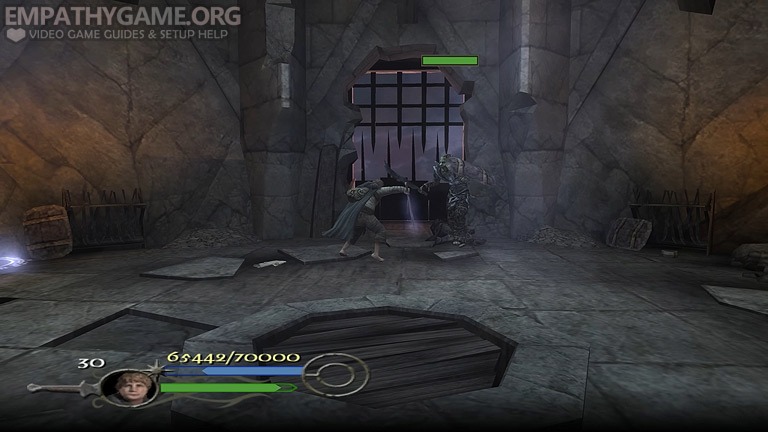
The Lord of the Rings: The Return of the King succeeds because it concentrates on one fantasy: being surrounded and fighting forward. Its combat is approachable enough to understand immediately, yet redirected combos, crowd positioning, performance ratings, Perfect Mode, upgrades, and character strengths give efficient play more structure than the basic controls imply. The strongest missions add battlefield objectives and environmental hazards so victory depends on reading the space, not only on emptying health bars.
Its limitations are equally clear. Repeated waves expose the modest depth of the enemy roster, first-run progression can make weak leveling decisions unnecessarily restrictive, and the fixed camera occasionally interferes with movement as well as visibility. The story relies heavily on familiarity with the films, while postgame replay changes characters and challenge more than mission structure.
For players who want a concise hack-and-slash game rather than an open-world Middle-earth adventure, those boundaries are part of the appeal. The campaign moves quickly, co-op gives familiar battles a livelier rhythm, and the scoring system rewards anyone willing to look beyond basic attack mashing. It remains a focused movie adaptation whose best ideas come from turning cinematic scale into playable pressure.
The Lord of the Rings: The Return of the King Pros & Cons
The Lord of the Rings: The Return of the King PC System Requirements
These are the original retail Windows PC requirements published for the 2003 release. They describe period hardware requirements and should not be interpreted as a guarantee of compatibility with modern versions of Windows.
MINIMUM:
OS: Windows 98, Windows Me, Windows 2000, or Windows XP
CPU: Intel Pentium III 700 MHz or equivalent
RAM: 128 MB; 256 MB for Windows XP
GPU: NVIDIA GeForce 2 with 32 MB VRAM
DirectX: DirectX 8.0
Storage: 2 GB free disk space
Optical Drive: 8x CD-ROM or DVD-ROM drive
RECOMMENDED:
CPU: Intel Pentium 4 1.5 GHz or faster
RAM: 256 MB; 512 MB for Windows XP
GPU: NVIDIA GeForce 3 or GeForce 4 with 64 MB VRAM
Additional PC Performance & Setup Notes
The extremely low hardware requirements reflect the game’s age rather than easy modern compatibility. The Windows release uses Direct3D 8 and was designed around operating systems and graphics drivers from the early 2000s. A modern PC has more than enough processing performance, but legacy DRM, display behavior, controller handling, and old graphics APIs can be more important than raw CPU or GPU power.
The most significant obstacle for an original retail installation is SafeDisc 3. Windows 10 and Windows 11 no longer support the legacy SafeDisc driver required by this release, so installing from an owned disc and actually launching the protected game are separate compatibility questions. DecideGame.com does not recommend restoring vulnerable legacy DRM drivers or downloading modified game executables from unverified sources.
PCGamingWiki documents unofficial community fixes for higher resolutions and aspect ratios, frame-rate control, adjustable field of view, windowed and borderless modes, and modern controller behavior. These modifications are not supported by Electronic Arts, can depend on the exact executable or regional release, and should be applied only after backing up the original installation.
For local co-op, the Windows version supports two players on the same machine and requires a controller. A gamepad for one player alongside keyboard and mouse for the other is therefore the most practical native-PC arrangement.
Video Trailer
Frequently Asked Questions
Is The Lord of the Rings: The Return of the King worth playing in 2026?
Yes, especially for players who enjoy straightforward hack-and-slash combat, cinematic Middle-earth battles, character progression, and local co-op. Its biggest limitations are the fixed-camera design and awkward modern-PC compatibility, but the underlying action remains unusually energetic for a movie tie-in from its era.
Do I need to watch The Return of the King movie before playing the game?
It is strongly recommended if you want to avoid story spoilers. The game closely follows major events and locations from Peter Jackson’s film and includes footage and story material connected directly to the movie.
How is the campaign structured?
The campaign is divided into the Path of the Wizard, Path of the King, and Path of the Hobbits. Gandalf follows the Wizard route, Aragorn, Legolas, and Gimli share the King route, while Sam and Frodo cover the Hobbit side of the story; progress across the paths eventually converges toward the final missions.
Can I switch between the three story paths?
Yes. After the opening at Helm’s Deep, you can move between available missions on the three paths rather than completing one entire route before touching another. Individual missions within each path still unlock in sequence.
Which characters are playable?
The main campaign features Gandalf, Aragorn, Legolas, Gimli, Sam, and Frodo in story-specific roles. Completing the main story expands the roster and allows much freer character selection when replaying missions.
How do I unlock Faramir, Merry, and Pippin?
Completing the final Crack of Doom mission unlocks Faramir, Merry, and Pippin as additional playable heroes. They are mainly valuable for postgame replays, bonus stages, and experimenting with different characters outside the normal story structure.
Can I replay missions with different characters?
Yes. After completing the main campaign, the normal story restrictions are removed and previously completed missions can be replayed using characters who normally would not appear there. This creates deliberately non-canonical combinations such as taking Gandalf or another hero into a mission originally designed for a different path.
How does character progression work?
Defeating enemies earns experience, while efficient combat and higher performance ratings increase the amount earned. Characters level up and use accumulated experience between missions to purchase new combos, stronger attacks, health improvements, and other abilities.
What are Fellowship upgrades?
Fellowship upgrades are more expensive versions of certain upgrades that become available across multiple playable characters rather than benefiting only the hero who purchases them. They are particularly useful when alternating between the three campaign paths because lower-level characters can inherit abilities once they reach the required level.
What is Perfect Mode?
Perfect Mode is a temporary combat state that increases the experience earned from defeated enemies. Building strong attack chains without being hit can trigger it, and certain successful counter or Bane-style moves can also put the character directly into Perfect Mode.
Do Aragorn, Legolas, Gimli, Gandalf, and the Hobbits play differently?
They share the same basic attack structure but have meaningful differences in speed, damage, ranged ability, animations, and special powers. Gandalf can use a protective damaging barrier, Sam and Frodo can temporarily conceal themselves, while Aragorn, Legolas, and Gimli have abilities focused more heavily on combat momentum.
Which character is easiest for beginners?
There is no single required choice, but Aragorn is a balanced introduction to the melee system, while Gandalf’s strong attacks and defensive special ability can make him forgiving in large battles. Legolas is particularly useful when ranged attacks matter, whereas Gimli trades some speed and reach for heavier close-range power.
Does the game have difficulty settings?
Yes. Easy, Normal, and Hard settings are available. Normal can already be demanding because several missions combine large enemy groups with timers, escort objectives, defensive tasks, or long stretches between checkpoints.
Does every mission have checkpoints?
No. Some missions contain checkpoints that let you restart from partway through the level, while others send you back to the beginning after failure. This is one reason certain encounters can feel considerably tougher than their individual combat sections suggest.
Is the PC co-op split-screen?
No. Two players share the same camera and gameplay area rather than receiving separate split-screen views. That means both players need to stay reasonably close together as they advance through a level.
How does two-player co-op work on PC?
The Windows version supports two players locally on the same computer. A practical setup is one player using keyboard and mouse and the other using a gamepad, and the co-op difficulty is adjusted to account for having two human-controlled heroes.
Does the PC version have online co-op or LAN multiplayer?
No. The original Windows release has local co-op but no native online or LAN mode. The online co-op feature associated with the original PlayStation 2 version was not included in the PC edition.
Can the entire game be completed solo?
Yes. Co-op is optional, and the full campaign can be completed in single-player. Computer-controlled allies appear during many battles, but a second human player is never required to finish the story.
What are the Palantir of Saruman and Palantir of Sauron?
They are difficult postgame combat challenges built around surviving repeated waves of enemies. The Palantir of Saruman becomes available after completing the main story, while the Palantir of Sauron additionally requires Gandalf, Sam, and at least one Path of the King hero—Aragorn, Legolas, or Gimli—to reach level 10.
How do I reach 100% completion?
Finishing the Crack of Doom completes the main story, but it does not represent every optional challenge. Full completion also requires clearing the Palantir bonus stages, including meeting the character-level requirements needed to unlock the Palantir of Sauron.
Does The Return of the King have New Game Plus?
Not as a formally named New Game+ mode. Instead, completing the campaign opens broader mission replay, unrestricted character combinations, additional characters, bonus stages, and continued character leveling, which serves a similar postgame purpose.
How long does The Return of the King take to finish?
A first campaign playthrough is generally a relatively short action-game experience, roughly around a weekend or about 8–12 hours depending on difficulty and retries. Leveling several characters, completing the Palantir stages, replaying missions, and pursuing unlockable extras can extend that considerably.
Can you manually control the camera?
No. The game relies mainly on predetermined and automatically moving camera angles rather than modern free camera control. Most encounters remain readable, but cramped areas and two-player co-op can occasionally make positioning harder when characters move too far apart.
Does the game include bonus material from the films?
Yes. Progression unlocks extras such as cast interviews, production material, concept art, and other DVD-style bonuses tied to particular missions and achievements. These extras are separate from normal character upgrades and combat progression.
Does the original PC version work normally on Windows 10 or Windows 11?
Not reliably without compatibility considerations. The retail Windows release uses legacy SafeDisc protection that modern Windows versions do not support normally, so installing an owned disc and successfully launching the game are separate issues; avoid unofficial replacement executables or DRM-bypass downloads when troubleshooting.
Still have questions? Check the PCGamingWiki Return of the King page for PC-specific technical information or the Lord of the Rings Reddit community for additional game discussion.
Sources & References
Key factual and technical information in this guide was checked against relevant official, archival, and community sources, including:
- PCGamingWiki — The Lord of the Rings: The Return of the King — used to verify Windows release information, retail availability, SafeDisc DRM, local co-op, controller behavior, graphics technology, system requirements, and documented compatibility fixes
- GOG Dreamlist — The Lord of the Rings: The Return of the King — used to verify that the game is being requested for preservation on GOG rather than offered there as a normal purchasable release
- SoftClub — The Lord of the Rings: The Return of the King PC — used to verify preserved original Windows system requirements and historical PC product information
- MobyGames — Release History — used to cross-check Windows development credits, porting credits, regional release history, and original platform information
- GameSpot — The Lord of the Rings: The Return of the King Review — used to verify the Windows local co-op arrangement, lack of native PC online play, and period gameplay context
- ModDB — The Lord of the Rings: The Return of the King — used to check the current state of unofficial community modification and RTX Remix projects
Similar Games Like The Lord of the Rings: The Return of the King
- The Lord of the Rings: Conquest
- God of War II
- Middle-Earth: Shadow of Mordor
- X-Men Origins: Wolverine
- Black Myth: Wukong
- Dragon’s Dogma: Dark Arisen
Found something worth playing through DecideGame?
DecideGame.com is an independent gaming project run by Editor Zero. If this guide helped you discover a game, solve a problem, or find useful information, you can support DecideGame.com and help keep new and updated game guides coming.
DecideGame — PC Game Guides, Reviews & Setup Help