
📅 Game released: 2015
Rise of the Tomb Raider sends Lara Croft into Siberian ruins, where puzzle tombs, stealth, survival combat, and exploration meet across connected wilderness hubs. This PC guide compares official 20 Year Celebration purchase and download options, DLC and co-op differences, system requirements, Steam Deck support, Blood Ties VR, and practical installation advice.
 By Editor Zero — independently researched, edited, and maintained.
Last updated: 10 November 2026
Last reviewed: 10 November 2026
Table of Contents
- Quick Facts
- Official PC Stores, Download & Installation
- Rise of the Tomb Raider Review
- Pros & Cons
- PC System Requirements
- Frequently Asked Questions
- Similar Games
Rise of the Tomb Raider Quick Facts
- Game: Rise of the Tomb Raider / Rise of the Tomb Raider: 20 Year Celebration
- Developer: Crystal Dynamics with Eidos-Montréal; Windows PC development by Nixxes; macOS/Linux ports by Feral Interactive
- Publisher: Crystal Dynamics (current Windows PC storefront publisher; originally Square Enix; Feral Interactive publishes macOS/Linux editions)
- Genre: Action-Adventure, Puzzle-Solving, Third-Person Shooter, Stealth Action
- Release: November 10, 2015 (Xbox One/Xbox 360); Windows PC: January 28, 2016; 20 Year Celebration: October 2016
- Platforms: Windows PC, macOS, Linux, PS4, Xbox One, Xbox 360, Nintendo Switch 2
- Modes: Single-player campaign and bonus modes; two-player online Co-Op Endurance on supported editions
- Steam Deck: Playable; occasional manual keyboard input and a compatibility warning may appear
- VR: SteamVR support for the Blood Ties Croft Manor story chapter only; the main campaign is not a VR game
- Engine: Foundation Engine (Crystal Dynamics technology)
- Community: Steam Discussions, Reddit Tomb Raider
- PC modding: Nexus Mods (unofficial mods)
- Metacritic score: 86/100 (PC)
- IGN score: 9.3/10 (original game review)
- OpenCritic average: 85/100 (20 Year Celebration; displayed on Epic Games Store)
- Steam user reception: Very Positive overall
Official PC Stores, Download & Installation
👇 Compare official PC stores below to purchase, download, and install Rise of the Tomb Raider.
- Windows availability: Official PC purchases are offered through Steam, Epic Games Store, GOG, and the Microsoft/Xbox Store. Storefront ownership, saves, and features are separate.
- 20 Year Celebration: The complete edition includes the base campaign and Season Pass content: Baba Yaga, Cold Darkness Awakened, Blood Ties, Lara’s Nightmare, Endurance additions, outfits, weapons, Expedition cards, and Extreme Survivor difficulty. Check existing entitlements before buying overlapping DLC.
- Steam: Offers achievements, Steam Cloud, controller support, community features, and the 20 Year Celebration package, including SteamVR support for Blood Ties.
- Epic Games Store: Sells 20 Year Celebration with cloud saves, controller support, and listed multiplayer functionality.
- GOG DRM-free: Offers a DRM-free offline installer without requiring GOG Galaxy. Its Preservation Program build adapts cards, leaderboards, Expeditions, and Croft Manor functionality for offline play and has been checked for Windows 10/11.
- GOG co-op limitation: Co-Op Endurance is not available on GOG. If two-player survival is a priority, compare supported Steam, Epic, and Microsoft editions before purchasing; the main story is single-player on every storefront.
- Microsoft/Xbox version: Microsoft’s Windows PC listing sells the base game and offers DLC separately, including the Season Pass and 20 Year Celebration Pack. Do not assume that its base purchase includes the complete 20 Year Celebration bundle offered elsewhere. Xbox achievements, cloud saves, and Game DVR belong to this separate Microsoft ecosystem.
- Game Pass: Rise of the Tomb Raider left the Game Pass catalog and is not confirmed as an included subscription title for this audit. Buy a copy through an official store if you want ownership; check the live Xbox catalog before depending on subscription or cloud access.
- Steam Deck: Valve rates Rise of the Tomb Raider Playable, not Verified. The default controller layout and graphics settings are supported, but text input and a compatibility notice can require attention.
- VR scope: SteamVR support covers the Blood Ties chapter within the 20 Year Celebration content, not the complete action-adventure campaign. Check headset/runtime compatibility before buying specifically for VR.

 Buy This Game on Epic Games Store

 Buy This Game on Microsoft / Xbox Store

Rise of the Tomb Raider Review
A bigger, more curious sequel that finally lets Lara lead the expedition.
Rise of the Tomb Raider finds a convincing balance between the survivor introduced in Tomb Raider (2013) and the explorer Lara Croft is supposed to become. The earlier game placed her in a disaster she could barely escape. Here, she chooses to follow a mystery that others dismiss, knowing the risks. Her confidence changes the feel of the adventure. Danger still comes through collapsing ruins, enemy ambushes, and desperate climbs, but curiosity is no longer something the player squeezes in between emergencies. It is part of Lara’s reason for being there.
That distinction matters more than the sequel’s increased scale. The campaign can be loud and relentlessly cinematic, yet its best moments often involve noticing a passage that seemed inaccessible, studying an ancient mechanism, or returning to a familiar area with a new understanding of its layout. Rise is most satisfying when action and discovery support each other, rather than competing for attention.
A Wilderness Built for Curiosity
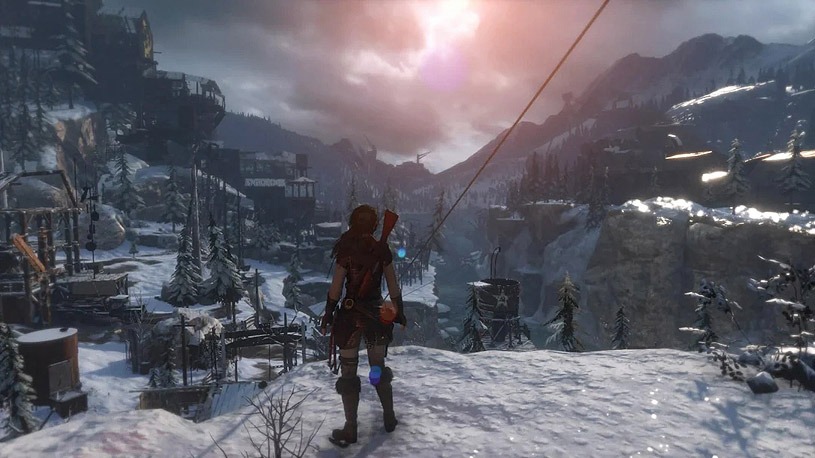
Siberia gives the expedition a strong sense of place. Soviet installations sit among frozen forests, caves lead toward Byzantine ruins, and the Geothermal Valley provides an unexpected contrast to the snow. Details such as abandoned machinery, half-buried structures, and weathered murals suggest different histories occupying the same landscape. The lost city of Kitezh becomes more interesting because the surrounding world has already taught Lara, and the player, to look beneath its surface.
This is not an open world in the usual sense. Linear story sequences connect several semi-open hubs filled with challenge tombs, crypts, side missions, documents, relics, and survival caches. That structure gives exploration room to breathe without losing the campaign’s direction. The map may encourage systematic cleanup, but the more enjoyable detours begin with a clue in the environment: a rope-wrapped barrier, a patch of climbable ice, or a dark opening just beyond the obvious path.
Traversal feels physical even when the underlying platforming is forgiving. Lara drives her axes into ice, scrambles across stone, swings on ropes, dives through flooded passages, and creates new routes with arrows. Returning with climbing arrows, a combat knife, or the rebreather makes earlier spaces worth examining again. A wall that once stopped progress may become the entrance to a completely different part of a hub. That is a better reason to revisit an area than simply collecting the last few map icons.
There is also a less comfortable side to the wilderness. Bears and snow leopards can turn an ordinary hunting trip into an urgent fight, particularly when Lara has only a moment to draw and place an arrow. These encounters give the animals a role beyond supplying hides. Exploration feels more convincing when the landscape occasionally threatens Lara on its own terms, rather than waiting for Trinity soldiers to appear.
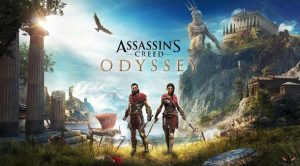
Optional tombs remain the strongest reason to explore. Most set combat aside and ask the player to understand water, wind, fire, counterweights, suspended platforms, or linked machinery. Their puzzles rarely demand extraordinary leaps of logic, but they allow the satisfying transition from staring at an unfamiliar room to seeing how its pieces fit together. The skill reward is useful; understanding the mechanism is the real achievement. For a much broader approach to historical settings, Assassin’s Creed Odyssey offers a different pleasure, although its open-world scale rarely produces the same concentrated puzzle-solving.
Combat That Survives a Broken Plan
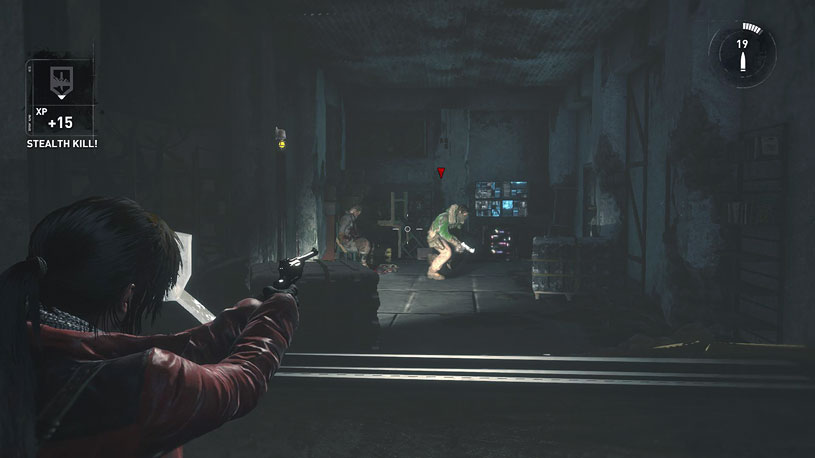
Combat succeeds because preparation helps without making improvisation impossible. Bushes, elevated branches, cover, silent arrows, and throwable objects let Lara study a patrol before committing. Survival Instincts identify useful objects and indicate which enemies can see one another. Choosing an isolated target, looking for an explosive opportunity, and deciding where to retreat makes a guarded camp feel briefly like a tactical problem rather than another compulsory shootout.
There is a limit to that freedom. Lara automatically crouches near danger and moves into suitable cover, rather than offering a dedicated button to control stealth posture whenever the player wishes. The system keeps movement fluid and helps communicate that enemies are nearby, but it can also make sneaking feel prescribed. Metal Gear Solid V: The Phantom Pain allows much greater control over how an infiltration unfolds; Rise prefers to guide the action toward a readable cinematic encounter.
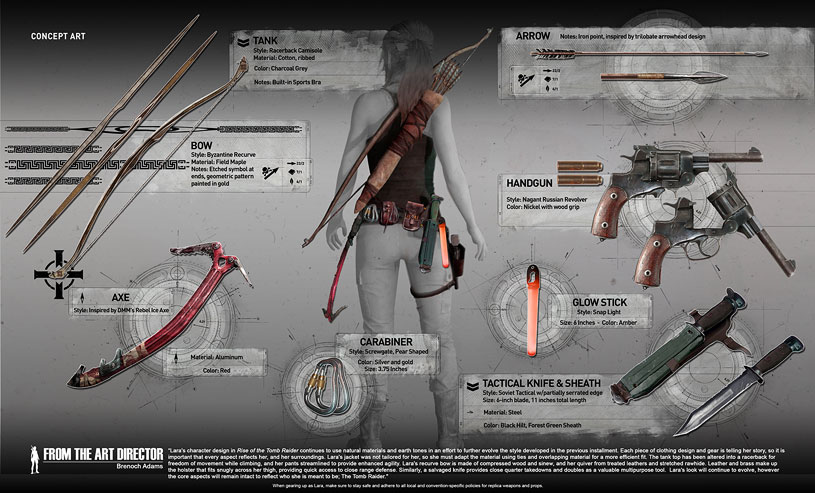
The bow is still the most expressive weapon. Silent shots reward patience, while fire, poison, explosive, and rope arrows introduce different responses to clustered enemies and environmental hazards. Pistols, rifles, shotguns, and improvised explosives take over when stealth collapses. Crafting more ammunition or healing supplies without leaving the encounter is a clever compromise: the resources collected during exploration remain relevant precisely when a tidy plan stops working.
Not every encounter communicates its demands equally well. An armored flamethrower soldier, for example, asks Lara to get behind him and target the tanks on his back while flames consume cover and interfere with visibility. In a confined fighting space, working out that solution can feel more awkward than challenging. Such moments reveal the distance between the game’s dramatic combat presentation and the precision a tougher enemy sometimes requires. Enemy awareness is otherwise fairly predictable, and later chapters rely increasingly on direct fighting. Far Cry 4 builds a more expansive loop around scouting, hunting, and enemy outposts; Rise uses those ideas to support a more directed journey.
Progression Makes Lara More Capable
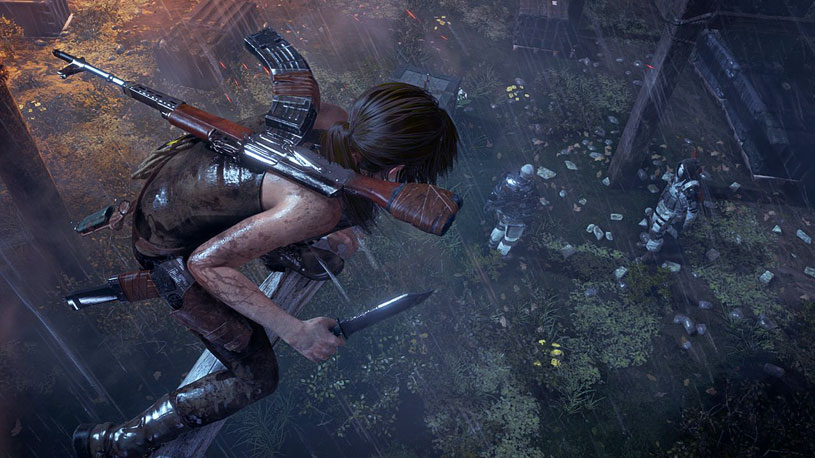
The Brawler, Hunter, and Survivor skill trees develop Lara without burying the player in complicated builds. Early choices improve resource collection, aiming, awareness, and basic survival. Later upgrades expand takedowns, ammunition options, crafting speed, and combat resilience. A normal playthrough gives enough points to shape a preferred approach without making the first few selections feel irreversible. Progression works because Lara gradually gains tools for situations that previously demanded more caution.
The bow upgrades reveal a particularly interesting trade-off. A powerful Compound Bow, or its Death’s Breath variant, can deliver heavier shots, but the faster Ancient Horn Bow and Guiding Light variant are more responsive when targets keep moving. Quick draw speed can matter more than damage on paper, especially when preparing multi-target shots before enemies separate. A slower, harder-hitting bow still makes sense for deliberate ambushes. The choice becomes about how the weapon fits the player’s timing, not simply which statistic is highest.
Other weapon upgrades improve rifle stability, shotgun damage, reload speed, or ammunition capacity. Crafting connects those improvements to wood, cloth, herbs, hides, mushrooms, ore, and salvage gathered throughout the journey. Supplies initially demand attention; later, greater carrying capacity and collection skills make preparation less intrusive. The system sometimes reduces a beautiful landscape to resource prompts, but it also makes exploration useful even when the next optional tomb is some distance away.
Challenge tomb rewards complete that relationship. Solving an ancient mechanism can improve Lara’s navigation, healing, awareness, or resource use in the modern conflict outside. It would be easy for these spaces to feel like optional rooms detached from the campaign. Instead, the knowledge gained inside them follows Lara back into the rest of the game, which gives discovery a lasting purpose.
A Personal Mystery Inside a Familiar Conspiracy
Lara’s search for the Divine Source connects the legend of immortality with the work that ruined her father’s reputation. Trinity wants the same artifact, while the people connected to Kitezh have reasons to protect its history. The organization supplies an immediate threat, but the more convincing motivation is Lara’s need to discover whether her father was right. Her determination is admirable, though the story also allows it to become an obsession that puts other people at risk.
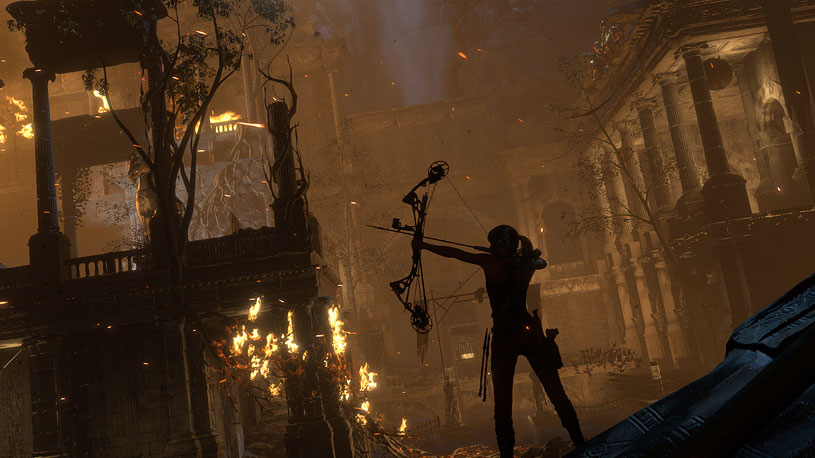
Jonah brings some warmth to a journey that might otherwise be consumed by Lara’s singular purpose. The villains, by comparison, rarely become as interesting as the world they are trying to control. Documents, murals, relics, and the remains of older settlements often communicate more about faith, exile, and survival than the central conspiracy does. The environments reward attention because they suggest ordinary lives continuing long before Lara arrived, rather than existing solely as obstacles in her adventure.
The pacing moves from archaeology in Syria to wilderness survival and open conflict in Siberia, eventually producing set pieces that are almost too destructive for the more human story underneath. Lara can endure an extraordinary amount of punishment, and the growing body count makes her vulnerability harder to believe. Quiet campfire reflections and solitary tombs help restore that scale. Players drawn to adventures that connect puzzles, atmosphere, and action through a central mystery may also appreciate PRAGMATA, though its science-fiction premise and hacking-based combat take a very different route.
DLC and Replay Value
The additional modes explore parts of Lara’s character and the game’s mechanics that the main campaign cannot always accommodate. Baba Yaga offers an unsettling side story built around hallucinations and a distinctive location. Blood Ties removes combat for a quieter investigation of Croft Manor, where objects, documents, and light puzzles give Lara’s family history space to develop. Lara’s Nightmare turns that same setting into an undead challenge, while Cold Darkness Awakened emphasizes infected enemies and repeatable combat objectives.
Endurance changes the meaning of resource gathering more radically. Warmth and hunger become immediate survival concerns while Lara searches for artifacts and decides when to extract. Longer runs demand forward planning as food becomes harder to obtain and the cold grows more dangerous, especially at night. Remaining near a fire or carrying a lantern can be preferable to continuing a fight, although holding a lantern limits combat options. Co-op Endurance makes these decisions a shared responsibility on supported editions; the main story remains single-player.
Higher difficulties offer another kind of pressure. Extreme Survivor restricts saving to base camps, so a failed fight or missed jump can erase progress through more than one encounter. It raises the stakes without fundamentally redesigning the enemies, but repetition after a long unsaved stretch can become frustrating rather than exciting. Expeditions, score attacks, card modifiers, and challenge tombs provide alternatives for players who would rather revisit individual scenarios than risk substantial progress.
Post-story exploration is unusually accommodating. Most hubs remain accessible, missed discoveries can be completed, and later equipment opens previously blocked routes. Remaining Trinity patrols can also interrupt collectible cleanup, sometimes with conversations that acknowledge what Lara has accomplished. Such small reactions help the world feel as though the main conflict happened there. There is no branching narrative to uncover on a second run; replayability instead comes from different combat approaches, higher difficulties, side content, and the varied bonus modes.
Where the Adventure Shows Its Age
The same design choices that make Rise approachable can make it feel too controlled. Climbable surfaces are clearly marked, Survival Instincts can remove much of the uncertainty, and some supposed exploration amounts to following a route already laid out for Lara. Completing every cache and collectible can become checklist work. It is telling that the most memorable tombs often succeed by briefly stepping away from this guidance and trusting the player to examine a room.
Trinity’s familiar conspiracy is less distinctive than the history of Kitezh, and dialogue sometimes explains ideas the ruins have already conveyed. Toward the end, large firefights push the campaign away from the archaeological adventure it handles best. Facial animation, hair movement, and repeated interactions also reveal the game’s generation despite its impressive landscapes. These weaknesses do not erase its strengths, but they expose the compromises beneath an experience that otherwise feels remarkably cohesive.
Final Verdict
Rise of the Tomb Raider remains the modern trilogy’s most convincing meeting point between cinematic action and archaeological discovery. Its larger hubs have a purpose, challenge tombs reward observation, and progression makes returning to old places feel worthwhile. Combat is flexible enough to recover from mistakes, even if automatic stealth behavior and a few cramped encounters sometimes narrow that freedom. The stronger sense of Lara choosing her own expedition gives these systems a satisfying direction.
Players who want a pure puzzle adventure may find too much shooting, while those seeking unrestricted stealth have deeper alternatives. The conspiracy is less memorable than Siberia itself, and the finale occasionally mistakes intensity for momentum. Still, the campaign understands when to slow down and let a ruined room, an unfamiliar path, or a small discovery hold the player’s attention. That balance, supported by worthwhile optional modes, makes Lara’s second reboot-era expedition one of her most complete adventures.
Rise of the Tomb Raider Pros & Cons
- Pro: Strong balance of cinematic action, exploration, stealth, and environmental puzzles
- Pro: Semi-open hubs and optional tombs reward curiosity without becoming an oversized open world
- Pro: Bow combat, crafting, upgrades, and traversal tools create satisfying progression
- Pro: 20 Year Celebration adds worthwhile story, survival, manor, and challenge content
- Con: Trinity and the main conspiracy are less memorable than the locations and optional discoveries
- Con: Marked climbing surfaces and Survival Instincts can make exploration feel overly guided
- Con: Late-game combat and collectible cleanup may wear out players who mainly want tombs and puzzles
Rise of the Tomb Raider PC System Requirements
Official store requirements: The Steam Windows specifications below list 25 GB of storage. The Microsoft Store edition may reserve 35 GB; allow additional installation space and consult your exact storefront listing. Steam lists Windows 7 as a historical game minimum, but the Steam client itself requires Windows 10 or later.
MINIMUM:
OS: Windows 7 64-bit (historical game specification; newer Windows required for the Steam client)
CPU: Intel Core i3-2100 or AMD equivalent
RAM: 6 GB
GPU: NVIDIA GeForce GTX 650 2 GB or AMD Radeon HD 7770 2 GB
DirectX: Version 11
Storage: 25 GB available space
RECOMMENDED:
OS: Windows 10 64-bit
CPU: Intel Core i7-3770K
RAM: 8 GB
GPU: NVIDIA GeForce GTX 980 Ti for 1440p or GTX 970 for 1080p
DirectX: Version 11
Storage: 25 GB available space
Additional PC Performance and Setup Notes
On modern Windows systems, start with updated graphics drivers and the store’s default settings. If frame pacing or stability is poor, compare DirectX 11 and DirectX 12 in the same area, then reduce expensive settings such as PureHair, shadow quality, anti-aliasing, and ambient occlusion. Higher texture settings need sufficient graphics memory.
For crashes, first verify the game files using your official storefront, temporarily disable overlays or incompatible mods, and check whether an unstable overclock is involved. Steam Deck owners should follow Valve’s Playable notes rather than assuming that the game is Verified. Blood Ties VR requires a compatible SteamVR setup; it is a separate presentation of that chapter, not a different full-game PC requirement tier.
Rise of the Tomb Raider Video Review
Rise of the Tomb Raider Frequently Asked Questions
What is Rise of the Tomb Raider about?
Lara searches Syria and Siberia for the Divine Source, a mysterious artifact tied to immortality and her father’s controversial research. The organization Trinity seeks the same discovery, while the legend of Kitezh adds another side to the conflict.
Do I need to play Tomb Raider (2013) before Rise?
No. Rise has a self-contained central mystery, though Tomb Raider (2013) helps explain Lara and Jonah’s history. For the complete modern trilogy, play Tomb Raider (2013), then Rise, then Shadow of the Tomb Raider.
Is Rise of the Tomb Raider an open-world game?
Not fully. Story missions are connected by semi-open hubs where Lara can hunt, explore crypts, complete side missions and challenge tombs, and revisit locations when new tools unlock previously blocked routes.
How long does it take to finish?
A main-story run commonly takes around 12–18 hours. Optional tombs, side content, collectibles, the DLC modes, and 100% completion can add many more hours; the exact time depends heavily on exploration and difficulty.
What does the 20 Year Celebration edition add?
It combines the campaign with the Season Pass and major DLC, including Baba Yaga, Blood Ties, Lara’s Nightmare, Cold Darkness Awakened, Endurance content, extra outfits and weapons, Expedition cards, and Extreme Survivor difficulty. It is the simplest way to obtain the broadest package.
Does Rise of the Tomb Raider have campaign co-op?
No. The main story is single-player. Supported PC editions offer a separate two-player online Co-Op Endurance survival mode, but GOG’s DRM-free edition omits that mode. There is no two-player cooperative story campaign.
Is Rise of the Tomb Raider included in Game Pass?
No Game Pass inclusion was confirmed for this audit. Xbox confirmed the game’s departure from the catalog, so check the live Xbox listing rather than assuming a membership includes it.
What can I do in Blood Ties, and does it support VR?
Blood Ties is a quieter, combat-free investigation of Croft Manor with environmental puzzles and family documents. Its PC Steam release supports SteamVR, but the full Rise of the Tomb Raider campaign does not become a VR adventure.
Does Rise of the Tomb Raider work on Steam Deck?
Valve rates the Steam edition Playable, not Verified. Controller input and text readability are supported, but text entry may require manually opening the on-screen keyboard, and a compatibility notice may appear.
Can I play on Windows 10 or Windows 11?
Yes. The Steam client requires Windows 10 or later, even though the game’s published minimum still lists Windows 7. GOG’s Preservation Program release is validated for Windows 11; use your storefront’s current compatibility notes when troubleshooting.
Should I choose DirectX 11 or DirectX 12?
Test both on your own hardware. DirectX 12 may improve throughput on some systems; DirectX 11 can provide more consistent stability or frame pacing on others. Prefer whichever runs a demanding scene most smoothly without crashes.
How do I reduce stuttering or improve frame rate?
Lower PureHair, shadows, anti-aliasing, and ambient occlusion first; reduce textures when graphics memory is limited. Also check drivers, overlays, game-file integrity, and the difference between DirectX modes before making numerous changes at once.
Are optional challenge tombs worth completing?
Yes. They contain the strongest environmental puzzles and award useful skills. Most can be revisited later, so do not worry about completing every tomb on your first visit to a hub.
What weapons and skills should beginners prioritize?
The bow is a flexible early investment for quiet combat, hunting, and later ammunition types. Resource gathering, arrow recovery, healing, and survival-oriented upgrades help across different play styles; choose weapon upgrades that match how often you actually use each gun.
Can I explore after finishing the story?
Yes. You can revisit hubs, finish tombs and missions, and collect missed items. The main plot has a fixed ending, so replay value comes from completion, different difficulties, Expedition challenges, and DLC rather than narrative branches.
Does Rise of the Tomb Raider support mods?
Unofficial PC mods exist, including visual changes, outfits, and other adjustments, though the scene is smaller than those for Skyrim or Fallout 4. Read version-specific requirements and back up saved games before modifying files.
Should I use keyboard and mouse or a controller?
Mouse aiming offers precision during ranged combat, while a controller offers analog movement for climbing and traversal. The PC game supports both, so the better choice depends on whether shooting or relaxed movement feels more important.
Is Rise of the Tomb Raider available on Nintendo Switch 2?
Yes. Nintendo offers the 20 Year Celebration edition for Switch 2 as a separate console release. Its store features, specifications, and support information should not be confused with the Windows PC editions covered here.
What if I am stuck in an optional tomb or cannot enter an area?
Use Survival Instincts, inspect your map, and look for rope arrows, climbable ice, white ledges, weighted mechanisms, water routes, or breakable barriers. Some passages intentionally require equipment earned later in the main story.
Still have questions? Check the Tomb Raider community on Reddit, Steam Community discussions, or Crystal Dynamics Support for current community and technical help.
Sources & References
Key purchase, edition, platform, performance, release, and subscription details were checked against these official sources and the PC review aggregator:
- Steam: Rise of the Tomb Raider — 20 Year Celebration contents, user reception, PC requirements, Steam Deck, and Blood Ties VR.
- GOG: 20 Year Celebration — DRM-free offline installer, Preservation Program, Windows 11 validation, and Co-Op Endurance exclusion.
- Epic Games Store: 20 Year Celebration — included DLC, online co-op, Epic features, and OpenCritic reception.
- Microsoft/Xbox Store: Rise of the Tomb Raider — standalone Windows PC base edition, separately sold DLC, Microsoft features, and PC specifications.
- Xbox Wire: Game Pass catalog changes — confirmed Game Pass departure.
- Xbox Wire: Windows PC release — official January 28, 2016 Windows PC release date.
- Nintendo: 20 Year Celebration for Switch 2 — separate console platform and edition.
- Metacritic: Rise of the Tomb Raider (PC) — version-labeled PC critic score.
Similar Games Like Rise of the Tomb Raider
- Tomb Raider (2013)
- Shadow of the Tomb Raider
- Tomb Raider I-III Remastered
- Tomb Raider IV-VI Remastered
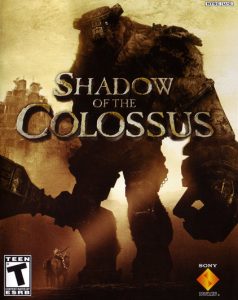
- Shadow of the Colossus
- Assassin’s Creed Odyssey


Found something worth playing through DecideGame?
DecideGame.com is an independent gaming project run by Editor Zero. If this guide helped you discover a game, solve a problem, or find useful information, you can support DecideGame.com and help keep new and updated game guides coming.
DecideGame — PC Game Guides, Reviews & Setup Help